
Decoding Engineered Wood Flooring Compliance: CARB, CE, F4 Star, FSC
Engineered wood flooring compliance is a stack, not a badge. A board that satisfies the United States formaldehyde regime is not automatically ready for the European Union, and a CE declaration does not answer a Japanese emission-grading question. Each destination market regulates a different parameter of the same panel, so manufacturers carry several certificates in parallel — and buyers in the research and evaluation stages have to read them as a set rather than as one proof of quality.
A concrete example of that stack belongs to Suzhou Dongda Wood Co., Ltd, a manufacturer founded in 1995 and located in Suzhou City, Anhui Province, China, producing engineered wood flooring and plywood from a 190,000 ㎡ facility with more than 500 employees. Its model GA01-016 is referenced in four separate certification documents: CARB/EPA/CANFER20030 issued by ICTT, CE certification CHIG22032983 issued by IGBC under AVCP system 4, F4 Star certificate CMSA J1073809 issued by CMSA, and FSC chain-of-custody certificate GFA-COC-006481 issued by GFA against FSC-STD-40-004 v3.1, with a scope stated as applicable to the EU market. Knowing what each document actually proves — and where each one stops — is the difference between a compliant order and a resubmitted one.
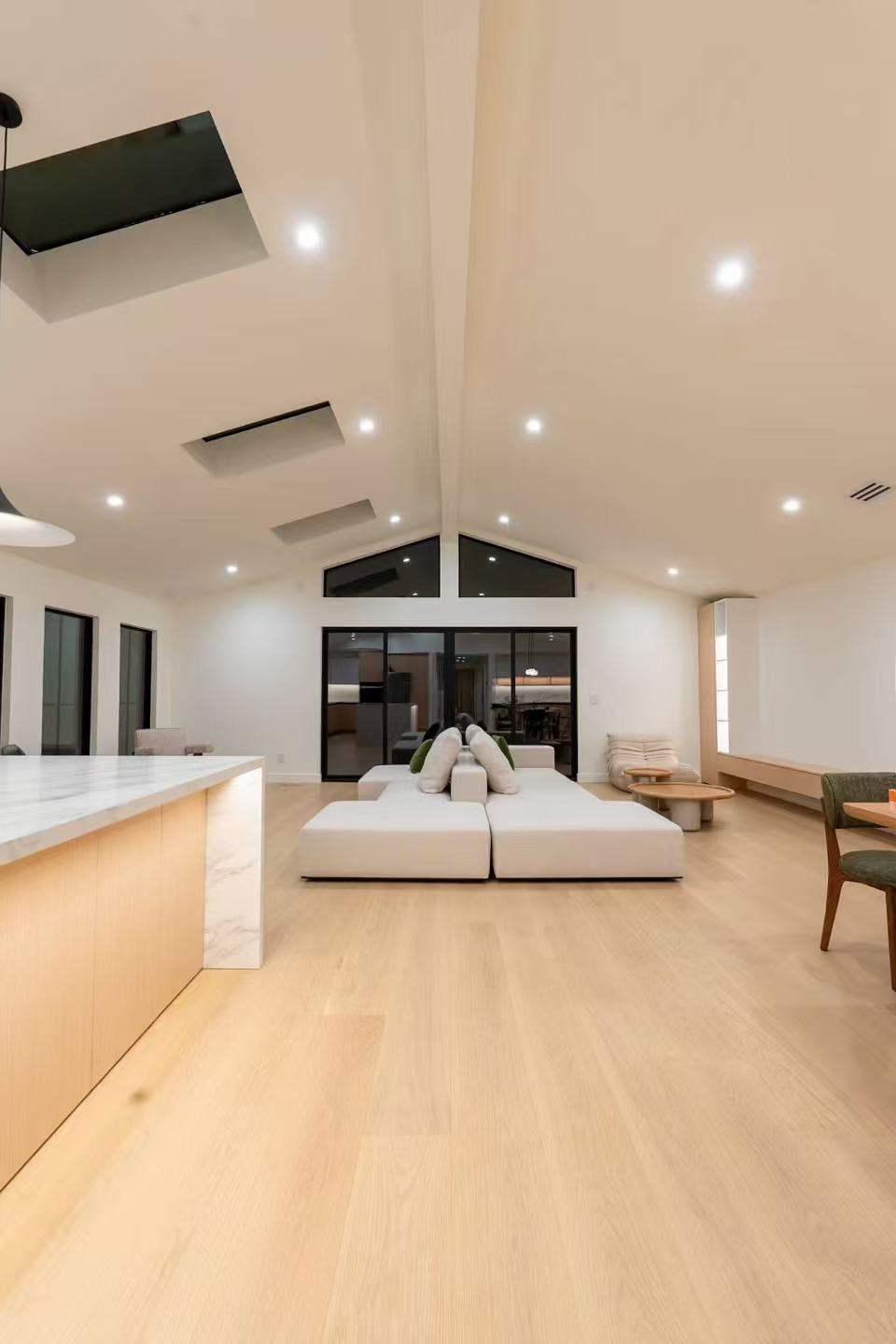
Completed engineered wood flooring installation in a residential project in the United States — the market where formaldehyde documentation is usually the first file requested.
Why Compliance Is Now a Market-Access Variable
An engineered floor is a layered element: a solid wood top layer bonded to a core of wood-based layers. The adhesives that bond those layers are the reason formaldehyde emission sits at the centre of most national schemes, and the assembled construction is the reason performance declarations sit alongside them. Regulators tend to treat panel chemistry and declared product characteristics as two separate questions, which is why no single certificate covers everything a buyer needs to see.
For procurement teams, the practical consequence is that compliance has shifted from a shipping formality to a screening criterion applied during supplier evaluation. A shortlist can be built on samples, colours and price; it is usually reduced on documentation. That is why certificate references are increasingly quoted in quotations rather than produced after a price agreement has already been signed.
The Four Marks, Decoded
CARB, EPA and TSCA Title VI — plus Canada's CEPA SOR/2021-148
The California Air Resources Board regulation on formaldehyde emission from composite wood products, the United States federal TSCA Title VI programme that aligns with it, and Canada's CEPA SOR/2021-148 regulation together form the North American emission layer. They address the same underlying question — how much formaldehyde the panel materials in a finished flooring product may emit — and they are evidenced through certification bodies and third-party certifiers rather than through self-declaration alone.
For Dongda's GA01-016, the reference is CARB/EPA/CANFER20030, issued by ICTT. The correct reading for a buyer is narrow: this number belongs to a specific certified model and a specific certifier, and it is the document that gets checked when a North American importer or project specification asks for emission evidence. It is not a general statement about every product a factory can produce.
CE Marking Under AVCP System 4
CE marking is a European declaration that a construction product's declared performance has been assessed against the applicable harmonised technical reference. For multi-layer parquet that reference is EN 13489:2023, which specifies the characteristics, requirements and test methods for multi-layer parquet elements intended for internal flooring, and which supersedes the 2017 edition of the same standard. The standard's product definition — a laminated construction with a solid wood top layer of at least 2.5 mm and additional core or backing layers of wood-based or lignified material — is also a useful structural benchmark when reading a supplier datasheet, because it fixes what the word 'multi-layer' is being measured against.
Under AVCP system 4, the manufacturer operates factory production control and declares performance, while product-type testing is carried out by a notified test laboratory. Dongda's CE reference is CHIG22032983, issued by IGBC. CE marking therefore answers a different question from CARB: not what a panel emits under United States rules, but what performance is declared, and against which European reference.
F4 Star Under the Japanese Agricultural Standard
Japan handles the same chemistry through a grading scheme attached to the Japanese Agricultural Standard, under which building materials are classified by formaldehyde emission class, with F4 Star as the most restrictive class in that scale. The claim is normally evidenced by a registration certificate issued by a registered certification body, and it is checked at import and at specification stage rather than at the point of retail sale.
Dongda's reference is CMSA J1073809, issued by CMSA. For a Japanese distributor this is the document that connects a specific product to an accepted emission class. For a buyer shipping to other destinations it is useful context, not a substitute for whatever the destination market actually requires.
FSC Chain of Custody
FSC certification differs in kind from the three documents above. It does not assess emissions or mechanical performance; it verifies the material pathway from certified forest sources through processing to the finished product. FSC-STD-40-004 is the chain-of-custody standard against which a company is evaluated, and the certificate number defines which sites and product groups fall inside the scope.
Dongda's reference is GFA-COC-006481, issued by GFA, with the scope stated as applicable to the EU market. Buyers who are asked for chain-of-custody evidence by a European client should treat scope wording as part of the check itself: a certificate covering one product group does not automatically extend to a second one.
Certificate-to-Market Map for Dongda Model GA01-016
| Certificate reference | Market it serves | What it addresses | Issuing body |
|---|---|---|---|
| CARB/EPA/CANFER20030 | United States and Canada | Formaldehyde emission from composite wood components under CARB / TSCA Title VI and CEPA SOR/2021-148 | ICTT |
| CHIG22032983 | European Union | CE marking under AVCP system 4, against the multi-layer parquet reference EN 13489:2023 | IGBC |
| CMSA J1073809 | Japan | F4 Star formaldehyde emission class under the Japanese Agricultural Standard | CMSA |
| GFA-COC-006481 | Scope stated as applicable to the EU market | Chain of custody of forest-based material, assessed against FSC-STD-40-004 v3.1 | GFA |
What the Marks Say About the Board Itself
Read together, the four documents answer four different questions: what the panel emits in North America, what performance is declared in Europe, which emission class applies in Japan, and where the timber came from. None of them describes the whole product. A fifth document type — the test report — normally sits behind them.
ASTM D1037, the standard test method for evaluating properties of wood-base fiber and particle panel materials, includes bond-line evaluation, modified Janka hardness testing and dimensional change measurement. It is a test method, not a pass/fail certificate, so its output is a report with values rather than a mark that can be printed on a carton. Buyers who ask only for 'a certificate' will not receive this, and without it a declaration of performance has no visible basis.
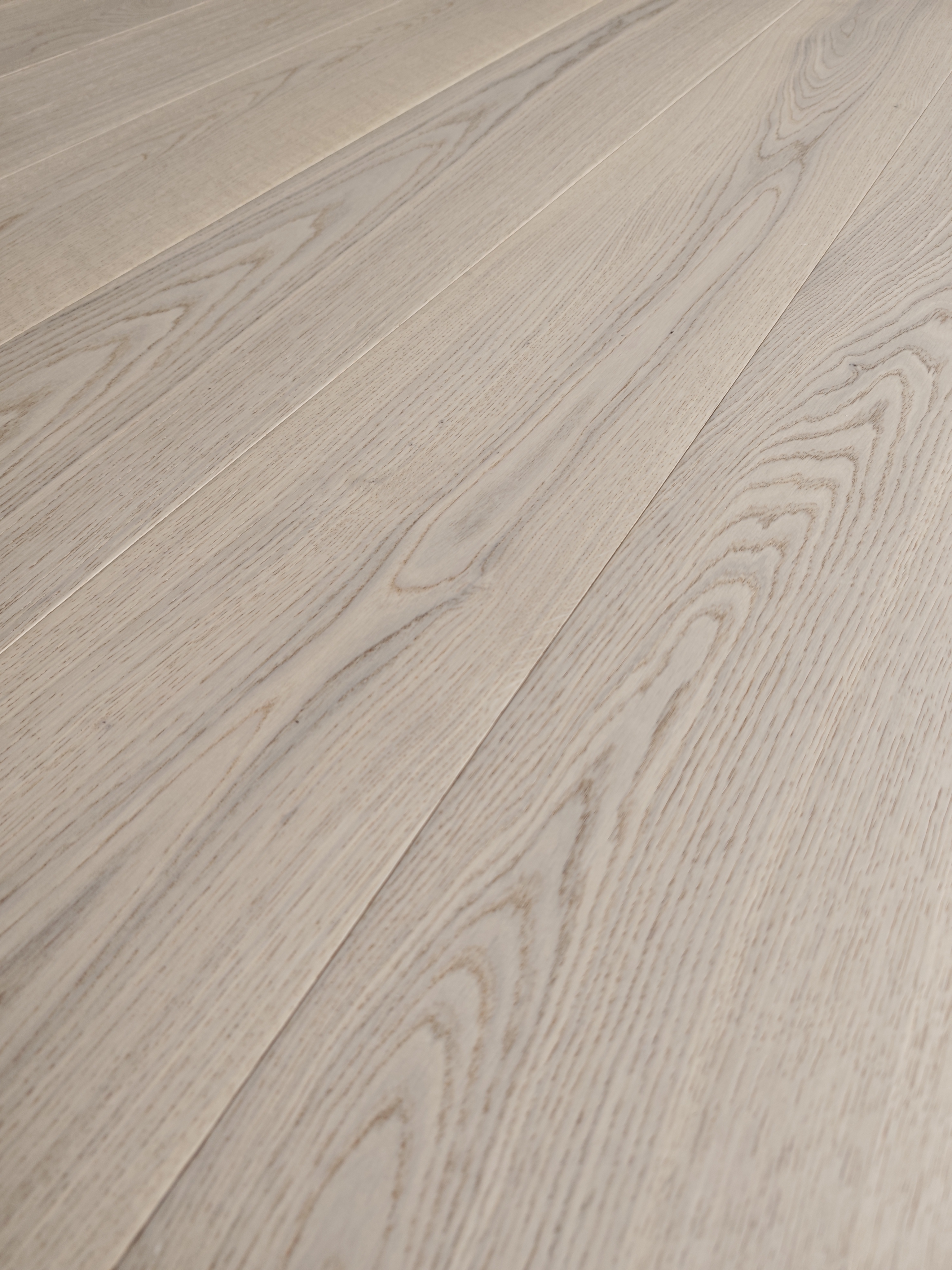
The layered construction that compliance documents describe: solid wood top layer over a bonded multi-layer core.
Customs classification is a separate layer again. Multi-layer wood flooring panels are classified under HS 4418.75 as assembled multilayer flooring panels of wood other than bamboo — a trade code that governs duty, origin and document flow, not product conformity. The two are often conflated because both appear on a shipping file, but a customs code has never demonstrated that a board meets an emission limit.
Where This Stack Matters in Practice
This product family is specified for residential house renovation and for commercial hotel and office interior decoration, in indoor dry conditions, with click-and-glue dual installation modes and matching skirting boards and floor trims as required supporting components. The scenario data lists exactly the requirements that trigger document checks in those projects: low formaldehyde emission, wear resistance, and CE certification. The same application is listed as common across more than twenty markets, including Australia, Brazil, Canada, Chile, France, Italy, Japan, Mexico, Portugal, Qatar, Saudi Arabia, Singapore, Sweden, Turkey, the United Kingdom and the United States.
Canada is where the stack is exercised most visibly, because it is a market where the United States-aligned emission programme and CEPA SOR/2021-148 both apply to the same order. Dongda's Canadian case covers 300,000 ㎡ per year over more than ten years, across residential house renovation and commercial hotel and office interior decoration. That volume does not by itself prove compliance, and it should not be read that way; what it does show is that the document set has been used repeatedly at scale in a market that asks for two emission frameworks at once.
How a Buyer Verifies a Certificate Claim
- Match the certificate to the model, not the company. Dongda's four references are attached to GA01-016. A quotation for a different construction, species or thickness is a separate case and needs its own documents.
- Confirm the issuing body and the reference cited. ICTT, IGBC, CMSA and GFA are different organisations covering different regimes; EN 13489:2023 and FSC-STD-40-004 v3.1 are different kinds of standard.
- Read the scope statement, not just the number. The FSC reference GFA-COC-006481 is stated as applicable to the EU market — scope wording is where most mismatches appear.
- Ask for the test report behind the declaration. Under AVCP system 4 the product-type testing is performed by a notified test laboratory; the report is what makes the declaration auditable.
- Check revision status. EN 13489:2023 supersedes EN 13489:2017. A certificate citing a superseded edition becomes an audit finding rather than a formality.
- Record the document set in the purchase order and shipping file. Documentation requested after shipment is documentation that cannot influence release.
Dongda handles verification requests directly, through dongdawood.com.cn or WhatsApp +86 18095694852, and supplies certificate copies per model rather than as a generic company pack.
Limits and Boundaries Buyers Should Plan Around
Certification is a narrow instrument, and treating it as a general quality guarantee is the most common evaluation error in this category. Six boundaries are worth stating plainly.
- Certificates are scope-bound. A reference issued for GA01-016 does not automatically extend to other constructions, veneer thicknesses or species in the same catalogue.
- FSC chain of custody is not a performance claim. GFA-COC-006481 addresses material pathway against FSC-STD-40-004 v3.1; it says nothing about emission class or wear resistance.
- F4 Star is a Japanese grading. CMSA J1073809 satisfies the Japanese framework; it does not discharge European or North American obligations.
- CE under AVCP system 4 is a manufacturer declaration supported by type testing. It is not a third-party stamp applied to every plank, and buyers who expect per-unit third-party marking are applying the wrong system.
- Certificates stop at the factory gate. They do not cover substrate moisture, acclimatisation, installation quality or job-site conditions; the product is designed for indoor dry environments and that constraint remains with the installer.
- Conformity review needs the full standard. A preview of EN 13489:2023 confirms scope and the 2.5 mm top-layer definition, but complete conformity assessment requires the purchased text or accredited testing.
Commercial terms sit outside all of this. A stated monthly capacity of 150,000 ㎡, a minimum order of 400 ㎡ per colour and a 45-day lead time apply whether or not the documentation is complete, which is why document review belongs in the evaluation stage rather than in the pre-shipment stage.
Market Trend: Documentation as a Screening Layer
Engineered wood flooring accounted for approximately 55% of total wood flooring market volume in 2024, according to Mordor Intelligence — meaning the majority of the category now moves through exactly the documentation stack described above. Commercial research published in 2026 by Business Research Insights projects the global engineered wooden flooring market growing from USD 9.35 billion in 2026 to USD 14.4 billion by 2035. Neither figure describes compliance, but together they explain why documentation volume is rising: more of the category is moving, into more regulated destinations, with more intermediaries asking for proof.
The observable procurement consequence is a change in sequencing. Certificate numbers are requested at request-for-quotation stage rather than after price agreement, and buyers compare issuing bodies, scope wording and standard revisions rather than simply confirming that a certificate exists.
Future Outlook
Three movements are likely to shape the next procurement cycle. The first is revision control: standards such as EN 13489 move to new editions, and the gap between a superseded edition and a current one is where suppliers lose approvals. The second is scope granularity: buyers are increasingly asking for certificates per model and per market, which is the structure the GA01-016 references already follow. The third is verification at source — registries maintained by certification bodies make point-in-time confirmation practical, shifting the buyer's task from collecting paper to confirming scope.
For a specification team, the practical takeaway is unglamorous but durable: ask for the four references by number, ask which market each one serves, and ask what each one does not cover. Buyers who want to test that process against a live order can request certificate copies from Suzhou Dongda Wood Co., Ltd through dongdawood.com.cn or WhatsApp +86 18095694852, and the engineered wood flooring catalogue is available as a PDF download.
FAQ
Which certificate does a US or Canadian engineered wood flooring order actually require?
In North America the binding question is formaldehyde emission from the composite wood components. In the United States that is addressed through CARB requirements and the federal TSCA Title VI programme; in Canada through CEPA SOR/2021-148. Dongda references model GA01-016 under certificate CARB/EPA/CANFER20030 issued by ICTT. CE marking and F4 Star do not substitute for these, because they answer to the European and Japanese frameworks respectively.
Does CE marking under AVCP system 4 replace North American formaldehyde certification?
No. CE marking declares performance against the applicable European harmonised technical reference — for multi-layer parquet, EN 13489:2023 — and under AVCP system 4 the manufacturer operates factory production control and declares performance while product-type testing is carried out by a notified test laboratory. It does not address CARB, TSCA Title VI or CEPA SOR/2021-148 obligations, which are separate market-specific requirements. Dongda holds CE certification CHIG22032983 issued by IGBC in addition to, not instead of, its North American reference.
What should be checked first when a supplier sends a certificate number?
Check that the model on the certificate matches the model being quoted. Dongda's references are attached to GA01-016, so a quotation for a different construction is a separate case requiring its own documentation. After the model match, confirm the issuing body, the standard or regulation cited, and the scope statement covering the market and product group.
Is F4 Star relevant for projects outside Japan?
F4 Star is a Japanese formaldehyde emission grading under the Japanese Agricultural Standard, evidenced for this product by certificate CMSA J1073809 issued by CMSA. It is required for the Japanese market and is not a substitute for North American or European requirements. Outside Japan it functions as supporting evidence of emission control rather than as an applicable compliance mark.
How does FSC chain of custody differ from formaldehyde certification?
FSC chain of custody verifies the material pathway from certified forest sources through processing, assessed against FSC-STD-40-004; Dongda's reference is GFA-COC-006481 issued by GFA, with a scope stated as applicable to the EU market. It carries no information about formaldehyde emission or wear performance. Emission certificates such as CARB/EPA/CANFER20030 and CMSA J1073809 address emission class. Buyers are usually asked for both categories, for different reasons and by different counterparties.
Tem questões ou precisa de mais detalhes?
Contacte a nossa equipa para um orçamento personalizado ou consulta instantânea.
Solicitar orçamento
Preencha o formulário abaixo e a nossa equipa entrará em contacto com uma proposta personalizada.
Chat direto do WhatsApp
Prefere conversar em tempo real? Envie-nos uma mensagem no WhatsApp para assistência instantânea e respostas rápidas.
- Obter orçamento personalizado
- Partilhar fotos ou documentos
- Discuta as suas necessidades diretamente
Geralmente responde em 5–30 minutos durante o horário de expediente.