
Decoding FDA 21 CFR 177.2600 for Food-Contact HTV Silicone
Industry Reference · Food-Contact Silicone Compliance
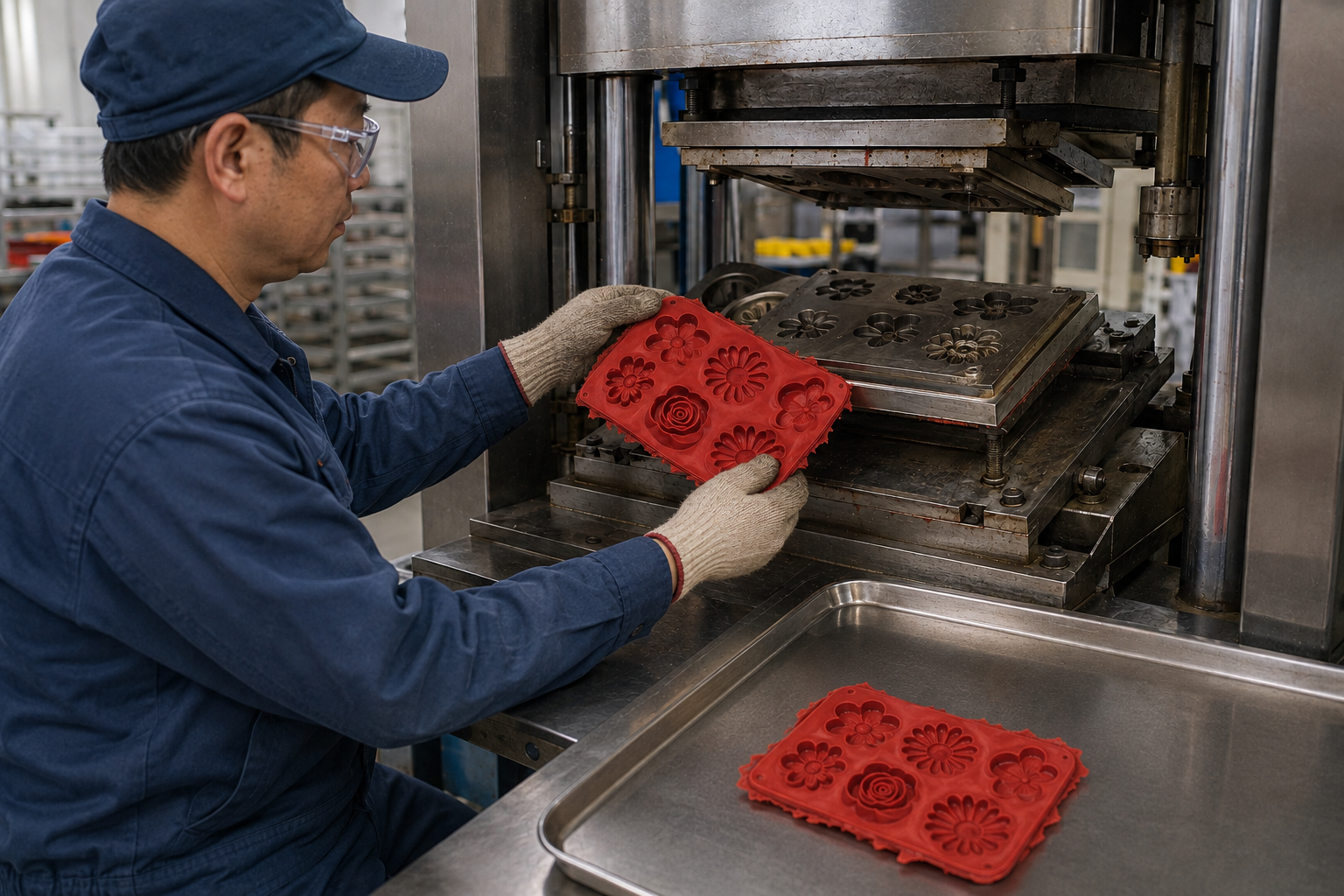
Compression molding of food-contact HTV/HCR silicone rubber. Food-contact rules assess the finished rubber article, not the raw compound in isolation.
Food-contact silicone rubber is not approved by a certificate. It is demonstrated by a documented chain that begins with the compound and ends with the finished article.
Compliance questions usually surface late in a food-contact silicone project. The molder has already selected a hardness, priced a compound and quoted a delivery date when the buyer's quality team asks one uncomfortable question: what documentation actually supports the food-contact claim? For products placed on the United States market, that question normally points to US FDA 21 CFR 177.2600, the section of the FDA's indirect food additive regulations that addresses rubber articles intended for repeated use in contact with food.
This reference explains what 21 CFR 177.2600 covers, how compliance evidence is assembled around a specific material, which physical benchmarks buyers commonly specify, and where the limits of a food-contact claim genuinely sit. The food-contact grade HTV silicone rubber compound YKS-8850, produced by Yakows Technology (Dongguan) Co., Ltd., is used throughout as a working example.
What 21 CFR 177.2600 Covers — and What It Does Not
21 CFR 177.2600 sits within Title 21, Part 177 of the United States Code of Federal Regulations, the section dealing with indirect food additives for polymers. Its scope is rubber articles intended for repeated use in contact with food. The regulation addresses two distinct things: which base polymers and compounding ingredients may be used, and how the finished rubber article behaves when it is exposed to food-simulating conditions.
The most common misreading by first-time buyers is procedural. There is no FDA-issued certificate for a rubber compound. The FDA does not certify individual silicone compounds as “FDA approved.” Instead, compliance is established through a combination of formulation review and extraction or migration testing of the finished article, and the entity placing the finished product on the market carries responsibility for that evidence.
It also matters geographically. 21 CFR 177.2600 is a United States framework. Buyers selling into Germany or wider European markets typically work with LFGB test reports, and EU chemical compliance is handled separately through REACH documentation. Yakows Technology states that applicable product grades are supported by FDA food-contact compliance documentation, LFGB test reports and REACH compliance documentation according to the intended application — which is a useful reminder that “food-contact compliant” is a market-specific statement, not a universal one.
Compliance Is a Chain, Not a Single Line Item
Food-contact performance is the output of at least three separate inputs, and a failure in any one of them can invalidate an otherwise well-documented material.
- The base compound. The silicone polymer, reinforcing filler and additive package determine the material's fundamental suitability.
- The cure and color system. Peroxide or addition cure chemistry, curing agent selection, dosage and pigment choice all become part of the finished article's composition.
- Processing and post-treatment. Mold release agents, contamination control, cure conditions, venting and post-curing influence residual volatiles and organoleptic behavior.
This is not a theoretical concern. YKS-8850 is supplied without pigment or curing agent, which is a deliberate formulation choice: it gives the processor control over hardness adjustment, color and cure optimization. The same choice also moves responsibility. The recommended curing agent for this grade is DBPMH as a 35% active preparation at 1.5% by weight, with a recommended molding cure of 180 °C for 5 minutes, but the pigment and curing agent a processor actually uses must themselves be suitable for the intended food-contact application.
A practical consequence is that material qualification and process qualification cannot be separated. Buyers who approve a compound on a data sheet, then change pigment supplier or curing agent dosage without re-testing, may find that the finished article no longer supports the original documentation. Where odor and taste are critical, a post-cure step and controlled venting are typically part of the validated process rather than an optional finishing detail.
Reading a Food-Contact Data Sheet: The YKS-8850 Example
YKS-8850 is a peroxide-curing HTV/HCR silicone rubber base compound formulated for compression molding at 50 Shore A. It is supplied in a milky white to slightly yellow appearance, without pigment or curing agent, so it serves as a base for further formulation rather than a finished color-matched product.
| Parameter | Specified value | Test method / note |
|---|---|---|
| Appearance | Milky white to slightly yellow | Visual |
| Hardness | 50 ± 3 Shore A | GB/T 531.1-2008 |
| Density | 1.14 ± 0.03 g/cm³ | GB/T 533-2008 |
| Plasticity | 250–280 | GB/T 12828-2006 |
| Tensile strength | ≥ 7.0 MPa | GB/T 528-2009 |
| Elongation at break | ≥ 700% | GB/T 528-2009 |
| Tear strength | ≥ 18 kN/m | GB/T 529-2008, right-angle specimen |
| Resilience | ≥ 40% | GB/T 1681-2009 |
| Linear shrinkage | 2.7–3.2% | GB/T 1692-2008, molding method |
| Recommended molding cure | 180 °C × 5 minutes | Process recommendation |
| Curing agent | DBPMH, 35% active preparation, 1.5% by weight | Compound supplied without curing agent |
| Packaging | 20 kg net per carton | Standard packaging |
| Storage and shelf life | ≤ 30 °C; 6 months in original unopened packaging | Storage condition |
On the compliance side, the position for this grade is specific and verifiable rather than promotional: supporting third-party test documentation according to US FDA 21 CFR 177.2600 is available upon request for YKS-8850. That wording is deliberate. Documentation exists, it is grade-specific, and it is released on request rather than implied by a logo.
Why ≥7.0 MPa Tensile and ≥700% Elongation Are the Numbers Buyers Quote
Physical property benchmarks in food-contact silicone are not marketing decoration. Each value answers a specific manufacturing or service question.
Tensile strength of at least 7.0 MPa indicates how much stress the vulcanized rubber withstands before rupture. For kitchenware, bakeware components and sealing parts that are handled, flexed and cleaned repeatedly, tensile strength is a durability indicator rather than a single-use pass or fail value.
Elongation at break of at least 700% is frequently the more demanding specification in practice. High elongation supports demolding of parts with undercuts, thin walls or deep cavity detail, and it reduces tear-out during removal from the tool. A compound that meets a hardness target but carries low elongation tends to generate higher scrap rates in exactly the geometries that food-contact silicone products often use.
Tear strength of at least 18 kN/m, measured on a right-angle specimen, complements elongation by describing resistance to crack initiation and propagation. Resilience of at least 40% relates to recovery behavior under repeated compression, relevant to gaskets and seals. Linear shrinkage of 2.7–3.2% measured by the molding method is a tooling input: mold dimensions must be calculated against a realistic shrinkage range, and a range wider than the tool can absorb creates dimensional drift across production lots.
Taken together, these values describe a compound intended for compression-molded parts where flexibility, tear resistance and dimensional predictability matter more than extreme hardness.
The Document Set to Request Before Approving a Compound
Compliance is verified by paperwork as much as by testing. A buyer preparing a material approval file for a food-contact silicone project can reasonably ask for the following:
- Current technical data sheet (TDS) for the exact grade, including hardness, density, tensile strength, elongation, tear strength and recommended cure conditions.
- Safety data sheet (SDS) for handling, storage and transport requirements.
- Typical COA showing the expected property range for the grade.
- Batch COA for the specific production lot, issued before shipment.
- Third-party test documentation according to US FDA 21 CFR 177.2600, where the intended market is the United States.
- LFGB test reports and REACH compliance documentation where European markets are involved.
- Quality management system certification covering the manufacturing site.
The batch-level document is the one most often overlooked. Yakows Technology inspects each production batch of its HTV silicone rubber compounds for appearance, Shore A hardness, density, tensile strength, elongation, tear strength and applicable electrical properties, and a batch COA can be provided before shipment. For a food-contact program, a supplier that can only supply a generic certificate from several years ago is materially different from one that supplies lot-linked inspection data.
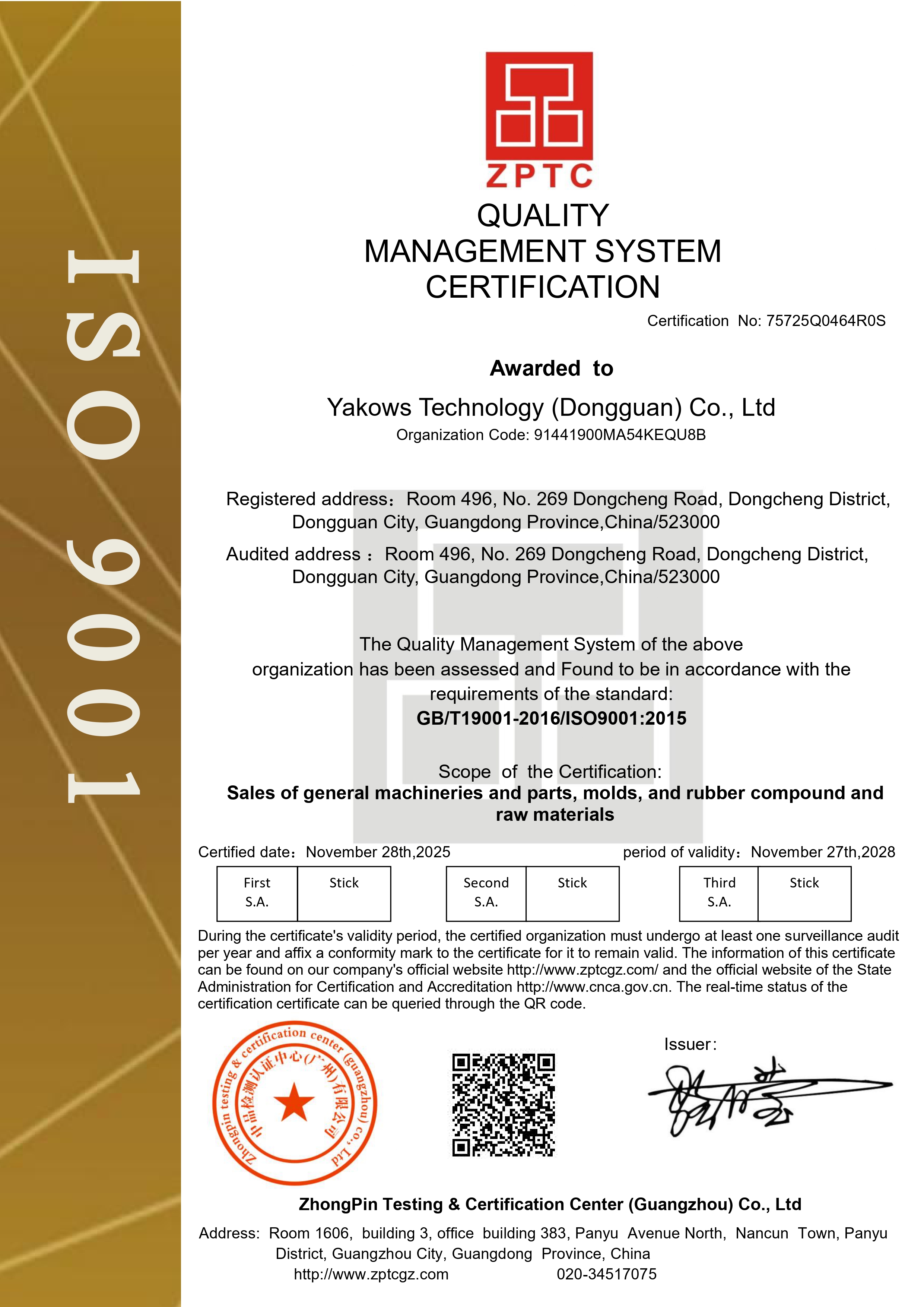
ISO 9001 quality management system certificate no. 75725Q0464R0S, issued by ZhongPin Testing & Certification Center (Guangzhou) Co., Ltd., valid to 27 November 2028.
For site-level evidence, Yakows Technology holds ISO 9001 certification against GB/T19001-2016/ISO9001:2015, issued by ZhongPin Testing & Certification Center (Guangzhou) Co., Ltd. under certificate number 75725Q0464R0S, valid from 28 November 2025 to 27 November 2028 for the worldwide market. The certified scope covers sales of general machineries and parts, molds, and rubber compound and raw materials. Buyers should read that scope carefully: a quality management certification confirms a controlled process, it does not by itself certify food-contact suitability of a specific grade. The two documents answer different questions.
Where Food-Contact HTV Silicone Compounds Are Used
Compounds of this type are specified for food-contact silicone products, bakeware and kitchenware, flexible molds, gaskets and seals, and general compression-molded silicone parts. The common thread across these applications is a combination of repeated use, direct food contact and mechanical working.
Bakeware and kitchenware components need heat stability, low extractable content after correct cure, and enough tear resistance to survive demolding and repeated washing. Flexible molds place a different emphasis on elongation and detail reproduction, since release often involves significant stretching around complex shapes. Gaskets and seals for food-processing equipment prioritize compression recovery and resistance to repeated cleaning cycles, which is where resilience and tear strength become the practical selection criteria.
A 50 Shore A base compound with at least 700% elongation is a reasonable general starting point for these product families. Where a specific part requires a different hardness or a modified cure profile, formulation, Shore A hardness, color, mechanical properties, curing system and packaging can be adjusted through custom formulation manufacturing, with customized grades typically requiring 10 to 20 working days after sample approval compared with 3 to 7 working days for standard grades.
What the Market Data Says About Compliance-Driven Sourcing
The commercial context for these questions is a large and still-expanding material category. The global silicone rubber market was valued at USD 5.7 billion in 2025, with HTV silicone rubber holding a 45.2% share, according to Vertex AI Search / Cloud Google. Within that segment, solid HTV silicone rubber accounted for 58.3% of the total HTV market in 2025, based on Dataintelo's assessment.
Supply concentration adds a second dimension. Global silicone trade reached USD 8.51 billion in 2024, with China the second-largest exporter at USD 1.53 billion, according to the Observatory of Economic Complexity. A market of this scale with a large number of export-oriented suppliers creates a natural information asymmetry: many suppliers can supply comparable physical property ranges, while far fewer can supply traceable, grade-specific compliance documentation.
For procurement teams, that asymmetry is the practical takeaway. Price and hardness data travel easily across a quotation. Compliance evidence does not, which is why documentation quality increasingly functions as the differentiating criterion in food-contact silicone sourcing rather than an administrative afterthought.
Limits, Trade-offs and Where This Material Does Not Fit
An honest compliance discussion has to state boundaries, because over-claiming is the most common failure mode in this category.
- Documentation is released on request, not automatically. For YKS-8850, supporting third-party test documentation according to US FDA 21 CFR 177.2600 is available upon request. A buyer who never asks will never receive it, and the request should name the exact grade and the intended market.
- Compound documentation does not certify the finished article. Final compliance remains with the manufacturer of the finished rubber product, who must account for pigment, curing agent, mold release, cure conditions and post-cure.
- This is a 50 Shore A base compound. Parts requiring significantly harder or softer rubber, or a very different cure architecture, need a formulation adjustment rather than a substitution at the same specification.
- Peroxide cure carries process obligations. Peroxide-curing systems generate decomposition byproducts that must be managed through correct cure conditions and, where required, post-curing and venting. That is an operational discipline, not a material property.
- Storage and shelf life are finite. The recommended storage temperature is 30 °C or below with a shelf life of 6 months in the original unopened packaging, which affects inventory planning for seasonal or long-cycle production programs.
- Order economics apply. The minimum order quantity for these compounds is 2,000 kg, with trial quantities open to discussion for product qualification — a constraint worth confirming before a sampling plan is finalized.
- Regional frameworks differ. A compound supported for the United States market under 21 CFR 177.2600 does not automatically satisfy European market expectations; LFGB test reports and REACH documentation address different requirements.
Compared with generic HTV silicone rubber bought on hardness and price alone, a documented food-contact grade trades flexibility at the low end of the specification range for traceability. That trade is rational when the finished product carries a food-contact claim, and largely unnecessary when it does not.
Future Outlook
Two shifts are likely to shape food-contact silicone sourcing over the next few years. The first is documentation normalization: as regulatory scrutiny of food-contact materials continues, buyers are moving from asking whether a supplier is “FDA compliant” to asking which grade, tested by whom, against which regulation, and with what batch-level evidence. Suppliers who already hold grade-specific third-party documentation will absorb that shift more easily than those who rely on generic statements.
The second is process integration. Because compliance depends on the cure and color system as much as on the base compound, technical support during trial production and formulation matching becomes part of the compliance value chain rather than a value-added extra. Yakows Technology, which operates a 5,000 m² facility in Dongguan with a technical department of more than 10 engineers and technicians, positions grade selection, formulation matching, trial-production guidance and batch traceability as part of its standard support scope — a structure that reflects where the industry is heading rather than a novelty.
For buyers, the practical conclusion is straightforward. Treat food-contact compliance as a chain of evidence with named links, verify each link against the intended market, and keep the link that belongs to your own process under control.
A downloadable Yakows company brochure covering compound grades and documentation scope is available at https://cdn.socialarks.com/sbsp/25176/common/2026/0817/Yakows%20brochure.pdf
FAQ
What is FDA 21 CFR 177.2600, and what does it apply to?
It is a section of the United States Code of Federal Regulations, within Title 21 Part 177, that addresses rubber articles intended for repeated use in contact with food. It sets out permitted base polymers and compounding ingredients and addresses how the finished rubber article behaves under food-simulating conditions. It applies to the finished article placed on the United States market, not to a raw compound sold as a material.
Does YKS-8850 hold a certificate that proves FDA 21 CFR 177.2600 compliance?
No FDA-issued certificate exists for individual rubber compounds. For YKS-8850, supporting third-party test documentation according to US FDA 21 CFR 177.2600 is available upon request. That documentation, together with the current TDS and batch COA, is the evidence base a buyer can review; final compliance of a finished rubber article remains with the manufacturer that places it on the market.
What is the difference between food-contact grade and general-purpose HTV silicone rubber?
The difference is mainly in formulation discipline and evidence, not in the base polymer family. A food-contact grade is documented against a specific food-contact regulation and is supplied with test documentation, while a general-purpose grade is typically evaluated only on hardness, tensile strength, elongation and processing behavior. A general-purpose compound may meet the same hardness target without any substantiated food-contact documentation.
Which physical property values should be specified for a food-contact HTV compound?
For a 50 Shore A compression-molding grade such as YKS-8850, the commonly quoted benchmarks are tensile strength of at least 7.0 MPa and elongation at break of at least 700%, measured to GB/T 528-2009, together with tear strength of at least 18 kN/m, resilience of at least 40%, hardness of 50 ± 3 Shore A, density of 1.14 ± 0.03 g/cm³ and linear shrinkage of 2.7–3.2% by the molding method.
Why is YKS-8850 supplied without pigment or curing agent?
Supplying the compound without pigment or curing agent allows the processor to select color and optimize the curing system for its own equipment and part geometry, and to adjust hardness if required. The recommended curing agent is DBPMH as a 35% active preparation at 1.5% by weight with a molding cure of 180 °C for 5 minutes. Because those inputs are added downstream, the pigment and curing agent used in production also need to be suitable for the intended food-contact application.
Does a compliant compound guarantee a compliant finished product?
No. Finished-article compliance depends on the complete composition and process: the compound, the pigment, the curing agent and its dosage, mold release agents, cure conditions, contamination control and any post-cure step. Compound-level documentation is a necessary input to the approval file, not a substitute for validating the finished article.
What documents should be requested before approving a food-contact silicone compound?
The typical set includes the current TDS, SDS, a typical COA, a batch COA issued before shipment, third-party test documentation according to US FDA 21 CFR 177.2600 for the United States market, LFGB test reports and REACH compliance documentation where European markets are involved, and the supplier's quality management system certification. Each batch of Yakows HTV silicone rubber compounds is inspected for appearance, Shore A hardness, density, tensile strength, elongation and tear strength, and a batch COA can be provided before shipment.
What storage and shelf-life limits apply to this compound?
The recommended storage temperature is 30 °C or below, with a shelf life of 6 months in the original unopened packaging. Standard packaging is 20 kg net per carton. These limits are relevant to inventory planning, particularly for programs with long production cycles or seasonal demand.
How does 21 CFR 177.2600 relate to other market requirements such as LFGB?
They are separate frameworks serving different markets. 21 CFR 177.2600 is the United States reference for rubber articles intended for repeated food contact, while LFGB test reports address German and wider European market expectations, and REACH documentation covers EU chemical compliance. Suppliers therefore typically maintain different document sets for the same compound depending on the destination market and the intended application.