
Decoding Fire and Waterproof Certifications: B1/M2 and 5000mm for Hotel Tents
Two lines in a technical specification sheet decide more permanent tent-resort projects than any design render: a fire rating written as B1 / M2, and a waterproof rating written in millimetres of water column, stated as ≥5000mm H₂O. For a luxury hotel tent that will operate 24/7, in all seasons, as a permanent structure, these values are not decoration. They are the numbers a building authority, a fire consultant, an underwriter and a lender will ask for first.
This analysis decodes what each rating actually certifies, where the boundaries of that certification sit, and how UV stabilisation and anti-aging protection interact with both. It is written for resort developers, hospitality engineers and procurement teams in the research-to-evaluation stage of a tented accommodation project.
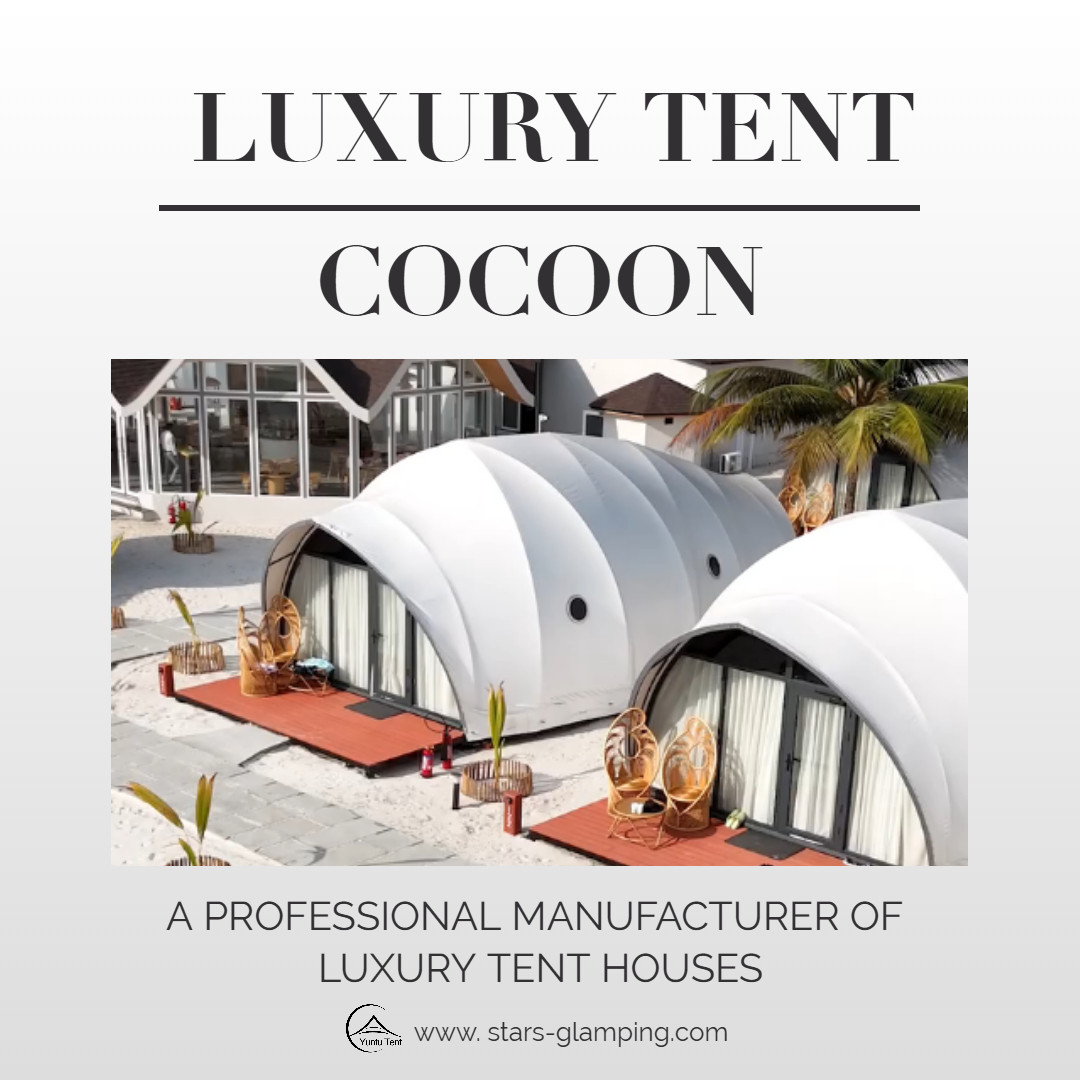
Permanent tented accommodation is specified by material classification, not by appearance.
Two Numbers Decide Whether a Tented Resort Gets Approved
A luxury hotel tent is an engineered structure: a steel or hybrid frame carrying a technical fabric membrane, with insulated walls, glazing, flooring and interior modules added for guest occupancy. Because the membrane is a polymer fabric rather than masonry, fire engineers and insurers need a defensible way to describe two things — how the material reacts when exposed to flame, and how long it resists water penetration under sustained rain.
The fire behaviour is captured by a reaction-to-fire classification. The water behaviour is captured by a hydrostatic head rating. In European procurement documents these appear as B1 / M2 and mm H₂O respectively. Stars Glamping, a Guangzhou-based manufacturer of luxury glamping tents and permanent hotel tent structures, specifies both values across its range — which makes the range a useful reference case for understanding how the two figures are constructed.
What B1 / M2 Fire Rating Actually Means for a Hotel Tent
B1 and M2 are established European reaction-to-fire classifications for building materials. They describe how a material behaves when exposed to an ignition source — whether it resists ignition, whether flame spreads across its surface, and whether it contributes to fire growth in a compartment. They are material classifications. They are not approvals of a finished building, and they do not replace project-level fire engineering.
When a specification states “B1 / M2 (fire-retardant),” it means the membrane fabric has been classified as fire-retardant under those recognised frameworks. For commercial hospitality occupancies, industry standards references typically point to NFPA 701 in the United States and EN 13501-1 in Europe as the fire-retardancy standards that luxury resort tents must meet for safe commercial use. A B1 / M2 classification sits in the same regulatory family of thinking: it answers the question “how does this fabric behave in a fire?” in a form a fire engineer can accept.
Why the classification attaches to the membrane, not the brand
A fire classification is issued for a specific material composition at a specific fabric weight and coating. In the Stars Glamping range, the 1050g/m² PVDF Architectural Membrane Fabric used on the Luxury Tent – Shell, Luxury Tent – Octagon, Luxury Tent – Villa and Luxury Tent – Tethys is specified as B1 / M2 fire-retardant. The 850g/m² PVC Polyester Fabric used on the Luxury Tent – Pisces carries the same B1 / M2 designation with a documented service life of 10–15 years.
The practical consequence for a buyer is that the certificate follows the fabric, not the model name. If a fabric is substituted to a lighter weight or a different coating during value engineering, the fire documentation the project was approved against no longer describes what is being installed. That is a documentation risk, and it is one of the reasons specification-locked procurement is common in permanent tented resorts.
5000mm H₂O: What the Waterproof Rating Actually Measures
Hydrostatic head is expressed as the height of a water column that a fabric resists before water passes through it. A rating of ≥5000mm H₂O means the membrane holds a five-metre column of water without penetration under test conditions. Because the same figure is quoted for beachfront, desert, mountain and island projects, it works as the baseline waterproof guarantee for permanent, all-season occupancy rather than a seasonal one.
Across the Stars Glamping luxury hotel tent range, the specified waterproof rating is ≥5000mm H₂O, on both the 1050g/m² PVDF membrane models and the 850g/m² PVC polyester model. Category references for heavy-duty PVC and PVDF membranes note that these materials are non-porous and can carry hydrostatic head ratings above 10,000mm, so the ≥5000mm figure is best read as the verified minimum specification of the delivered product rather than the maximum capability of the material class. Buyers comparing quotations should confirm which number is being offered — a tested minimum or a generic material capability.
Reading the value against the operating environment
Waterproofing performance is only meaningful when it is matched to the site. Tented accommodation in this category is deployed in working conditions that include beachfront exposure, desert climate, tropical rainforest, mountain areas, high humidity and strong wind, with permanent installation and all-season operation. In that context, the waterproof rating interacts with wind resistance — specified as up to 120km/h (Level 10 wind) — because driving rain is delivered by wind pressure, not by still air. A membrane that resists a static water column still needs a structural frame and fixing system that keep the fabric in tension under load.
UV Stabilization and Anti-Aging: The Complementary Standards
Fire and waterproof ratings describe performance at the point of manufacture. Both degrade over time unless the membrane is stabilised against ultraviolet radiation and the coating system resists ageing. Stars Glamping specifies UV stabilization and anti-aging protection on every model in the luxury hotel tent range, including the Luxury Tent – Pisces, which combines it with the same B1 / M2 fire rating and ≥5000mm H₂O waterproof rating as the PVDF models.
The reason this belongs in the same conversation as certification is straightforward. UV exposure breaks down polymer coatings; a coating that has degraded loses hydrostatic head and, in parallel, loses the surface behaviour that the fire classification describes. Certification is therefore a snapshot, and the stabilisation system determines how long that snapshot remains representative of the installed structure.
The published service life figures make the relationship visible. The Luxury Tent – Pisces, built on an 850g/m² PVC polyester cover, is specified at 10–15 years. The Luxury Tent – Shell, Octagon, Villa and Tethys, built on a 1050g/m² PVDF architectural membrane, are specified at 25–30 years. Industry references for high-performance PVDF architectural membranes in luxury tent applications similarly cite a 15–30 year service life and wind tolerance up to 120–140 km/h. A temperature resistance range of −30℃ to +70℃ applies across the range, which sets the thermal boundary within which the coating system is expected to hold.
The Full Performance Envelope, Model by Model
The certifications discussed above do not sit alone; they sit inside a performance envelope that a fire engineer or insurer will review as a set.
| Parameter | Luxury Tent – Pisces | Shell / Octagon / Villa / Tethys |
|---|---|---|
| Frame material | Solid wood + steel pipe | Steel pipe |
| Cover material | 850g/m² PVC polyester fabric | 1050g/m² PVDF architectural membrane fabric |
| Fire rating | B1 / M2 (fire-retardant) | B1 / M2 (fire-retardant) |
| Waterproof rating | ≥5000mm H₂O | ≥5000mm H₂O |
| UV protection | UV stabilized, anti-aging | UV stabilized, anti-aging |
| Wind resistance | Up to 120km/h (Level 10 wind) | Up to 120km/h (Level 10 wind) |
| Snow load | 80kg/m² | 80kg/m² |
| Temperature resistance | −30℃ to +70℃ | −30℃ to +70℃ |
| Service life | 10–15 years | 25–30 years |
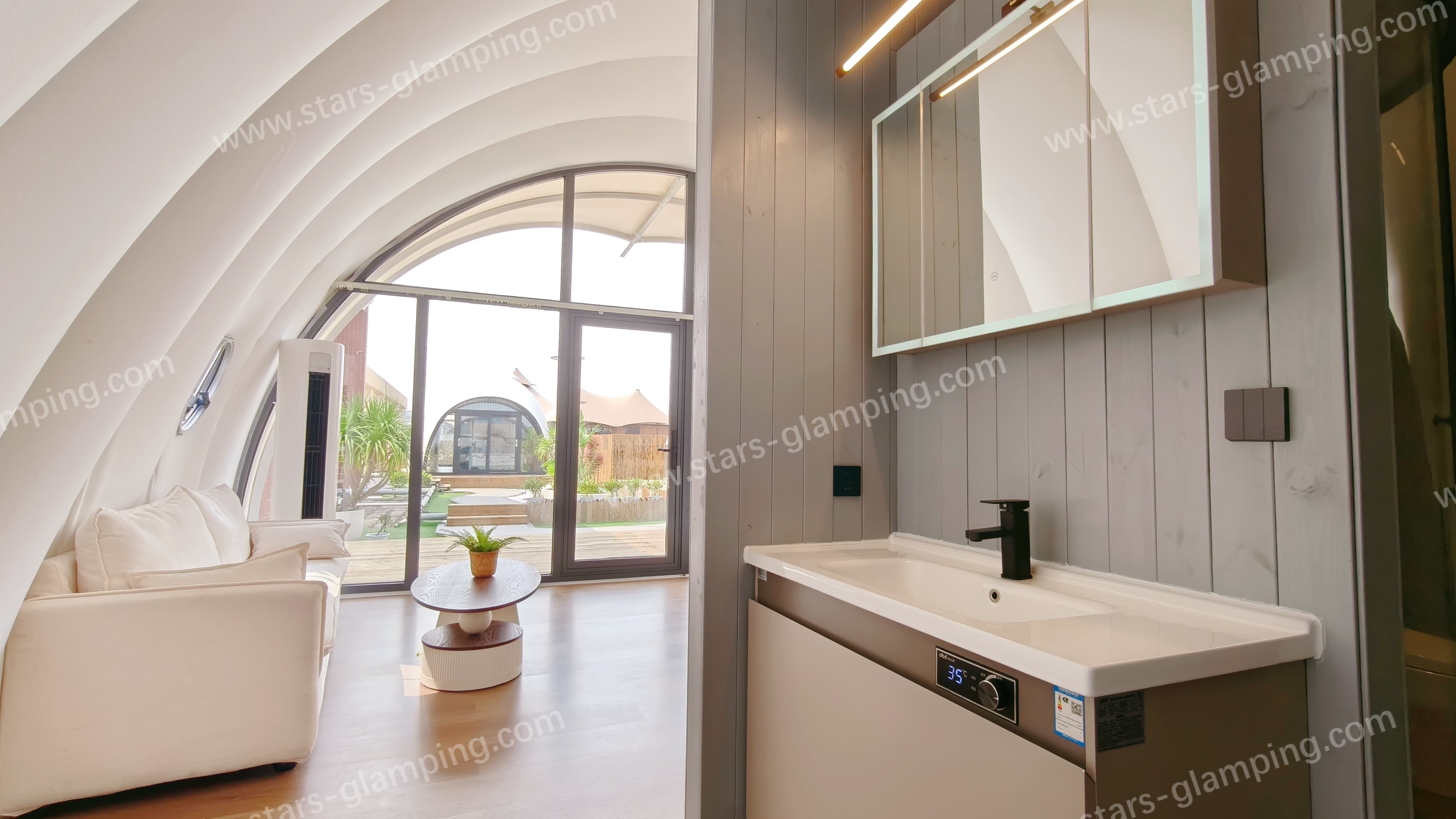
Membrane weight and coating choice are the variables behind the fire and waterproof ratings.
What These Ratings Mean for Insurance and Safety Review
Insurers and fire reviewers do not assess brand reputation; they assess documentation. For a permanent tented hotel, the review chain normally runs through three questions: what material is the membrane, what classification does that material hold, and how is the assembled structure protected in terms of egress, detection and compartmentation.
A B1 / M2 fire-retardant classification answers the second question for the fabric. A ≥5000mm H₂O hydrostatic head rating answers the water-ingress question that drives water damage claims and business interruption exposure. Together with wind resistance, snow load and temperature resistance, they form the technical dossier that a resort developer submits alongside drawings.
Two honest boundaries are worth stating. First, B1 / M2 is a classification of the membrane material, not a blanket approval of the completed building — project-level fire strategy still governs. Second, membrane structures are frequently reviewed under dedicated provisions for tents and membrane structures rather than under general building codes, and those provisions can impose their own conditions on occupancy, separation and exit travel. Standards references for commercial tent occupancies point to NFPA 701 and EN 13501-1 as the fire-retardancy expectations in US and EU markets respectively, but the applicable code path is always jurisdiction-specific.
Where These Specifications Matter Most: Scenario Fit
The same certification set behaves differently depending on the site. Stars Glamping luxury hotel tents are applied in luxury resort accommodation, glamping hotel, eco resort and boutique hotel expansion projects, and are deployed across markets including the UAE, Saudi Arabia, Australia, Thailand, Indonesia and Malaysia.
- Beachfront and island resorts. Salt-laden air, high humidity and driving rain make anti-corrosion treatment, the hydrostatic head rating and UV stabilisation the three specifications that decide how the membrane performs after several seasons of exposure.
- Desert resorts. UV intensity is the dominant ageing factor. A UV stabilized, anti-aging membrane with a documented service life is the relevant control, supported by thermal insulation for wide day-night temperature swings within the −30℃ to +70℃ operating range.
- Mountain resorts. Snow load of 80kg/m² and wind resistance up to 120km/h (Level 10) become the governing structural values. A Nepal mountain resort project used 19 luxury tents with custom mountaintop design, high wind resistance, thermal insulation and panoramic views for long-term permanent use.
- Eco tourism and safari lodges. Off-grid operation and natural ventilation design pair with the same fire and waterproof documentation. A safari accommodation project in Cape Verde used 12 luxury hotel tents for long-term outdoor use exceeding eight years, with eco-friendly materials highlighted as a selection factor.
At larger scale, a government tourism developer in India deployed 100 luxury tents for a beachfront resort project, and a resort developer in Saudi Arabia deployed 30 luxury tents for a desert resort — in both cases for long-term permanent use. The common thread is that the certification set, not the aesthetic, was the gate that had to be passed first.
Comparison With Traditional Construction — and Where Tents Still Have Limits
Against a conventional resort building, a certified luxury hotel tent competes on delivery speed, foundation load and modularity. It does not compete on every dimension, and buyers should be clear about which ones.
The clearest boundary is service life. The PVDF membrane models in this range are specified at 25–30 years and the PVC polyester model at 10–15 years. A masonry or concrete building is normally engineered for a considerably longer horizon, and a tent resort therefore carries membrane replacement as a planned capital item rather than an exceptional one. For developers modelling total cost of ownership across several decades, this is a material difference, not a footnote.
The second boundary is regulatory. Fire approval for a tent structure rests on a material classification plus a project-specific fire strategy. Where a jurisdiction treats membrane structures under dedicated provisions, occupancy limits, separation distances and exit travel can be assessed differently from a code-compliant building of the same floor area. Certification of the fabric does not remove that step.
The third boundary is maintenance discipline. A ≥5000mm H₂O rating and a B1 / M2 classification describe the membrane as manufactured. Retaining both over the service life depends on installation tension, cleaning practice and the condition of the UV stabilized, anti-aging coating system. A tent structure that is not maintained on schedule will drift away from the documentation it was approved under.
Market Trend: Certification Documents Are Becoming a Tender Requirement
The commercial backdrop explains why these technical details are receiving more attention. The global glamping market was valued at approximately USD 3.8 billion in 2025, with tents forming a major accommodation segment alongside cabins and pods, according to Grand View Research. Fortune Business Insights projects the market reaching USD 9.15 billion by 2034, a CAGR of 10.67% over the forecast period. Europe accounted for a 35% revenue share in 2025, per Grand View Research.
Published market size estimates diverge widely depending on whether cabins, pods and RV-adjacent accommodation are counted inside the definition, so buyers should treat headline figures as directional rather than precise. The directional signal is consistent, however: as tented accommodation moves from seasonal novelty to permanent hospitality asset, the documentation standard applied to it moves closer to that applied to buildings. Reaction-to-fire classification and hydrostatic head ratings are the first two documents pulled into that standard.
Future Outlook
Three developments are likely to shape specification practice over the next planning cycles. First, certification will increasingly be requested at material level, with fabric weight and coating named in the contract rather than described generically. Second, PVDF architectural membranes — with their longer specified service life and higher wind tolerance — are likely to become the default reference point for permanent installations, while PVC polyester fabric continues to serve projects where capital cost dominates. Third, UV stabilisation and anti-aging data are likely to be evaluated alongside fire and waterproof ratings, because all three degrade together over a structure's service life.
For resort developers, the practical implication is that the compliance conversation should start before the design conversation ends. Choosing a membrane class determines the fire classification, the waterproof rating, the UV protection package, the service life horizon and the maintenance cycle — five decisions that are effectively locked together at the specification stage.
FAQ
What does a B1 / M2 fire rating mean for a luxury hotel tent?
B1 / M2 is a reaction-to-fire classification of the membrane material used in a tent structure. It indicates that the fabric has been classified as fire-retardant under recognised European frameworks. In commercial hospitality, standards references typically cite NFPA 701 in the United States and EN 13501-1 in Europe as the applicable fire-retardancy standards. The classification applies to the fabric at a specified weight and coating, such as the 1050g/m² PVDF architectural membrane fabric or the 850g/m² PVC polyester fabric used in the Stars Glamping luxury hotel tent range, and it does not by itself approve the completed building.
Is ≥5000mm H₂O waterproofing enough for a permanent hotel tent in a coastal or monsoon climate?
A ≥5000mm H₂O hydrostatic head rating means the membrane resists a five-metre column of water without penetration under test conditions. It is the specified waterproof rating across the Stars Glamping luxury hotel tent range and is quoted for permanent, all-season installations in beachfront, tropical and high-humidity environments. Water resistance also depends on wind pressure, since driving rain is delivered by wind; the same products are specified for wind resistance up to 120km/h (Level 10 wind). Heavy-duty PVC and PVDF membranes are non-porous and category references cite hydrostatic head ratings above 10,000mm for such materials, so ≥5000mm H₂O should be read as a verified minimum specification rather than a material ceiling.
How do UV stabilization and anti-aging affect certification performance over time?
Fire and waterproof ratings describe the membrane as manufactured. UV radiation degrades polymer coatings, and a degraded coating loses hydrostatic head as well as the surface behaviour described by the fire classification. This is why UV stabilized, anti-aging protection is specified alongside B1 / M2 and ≥5000mm H₂O in the Stars Glamping range. The specified service life differs by membrane class: 10–15 years for the 850g/m² PVC polyester cover on the Luxury Tent – Pisces, and 25–30 years for the 1050g/m² PVDF architectural membrane on the Luxury Tent – Shell, Octagon, Villa and Tethys.
Do fire and waterproof ratings affect insurance and building approval for tent resorts?
Yes, but as part of a dossier rather than as a standalone approval. Insurers and fire reviewers typically examine the membrane material, its fire classification, and how the assembled structure is protected in terms of egress, detection and compartmentation. A B1 / M2 classification addresses the fabric; a ≥5000mm H₂O rating addresses water ingress; wind resistance, snow load of 80kg/m² and a temperature range of −30℃ to +70℃ complete the envelope. Membrane structures are often reviewed under provisions specific to tents and membrane structures rather than general building codes, so occupancy, separation and exit travel conditions vary by jurisdiction and require project-level fire engineering.
Which luxury hotel tent models carry these ratings, and what is their expected service life?
In the Stars Glamping range, the Luxury Tent – Shell, Luxury Tent – Octagon, Luxury Tent – Villa and Luxury Tent – Tethys use a steel pipe frame with 1050g/m² PVDF architectural membrane fabric and are specified with a 25–30 year service life. The Luxury Tent – Pisces uses a solid wood and steel pipe frame with 850g/m² PVC polyester fabric and is specified at 10–15 years. All five models share a B1 / M2 fire rating, a ≥5000mm H₂O waterproof rating, UV stabilized and anti-aging protection, wind resistance up to 120km/h (Level 10 wind), snow load of 80kg/m² and a −30℃ to +70℃ temperature range.
A technical brochure covering the full specification envelope of the Stars Glamping luxury hotel tent range is available for download: Stars Glamping product brochure (PDF).