
Decoding Green Building Certifications for Art Paint Wall Cloth: What Buyers Should Know
Art paint wall cloth sits between two familiar categories. It uses a non-woven fabric base much like a textile wallcovering, but its visible surface is a water-based art paint finish rather than a printed vinyl or paper film. Because the environmental attributes of this category come from three separate places — the fabric base, the coating formulation and the production process — they are documented by three different classes of certificate. Buyers who treat those documents as interchangeable tend to misread what a supplier can actually prove.
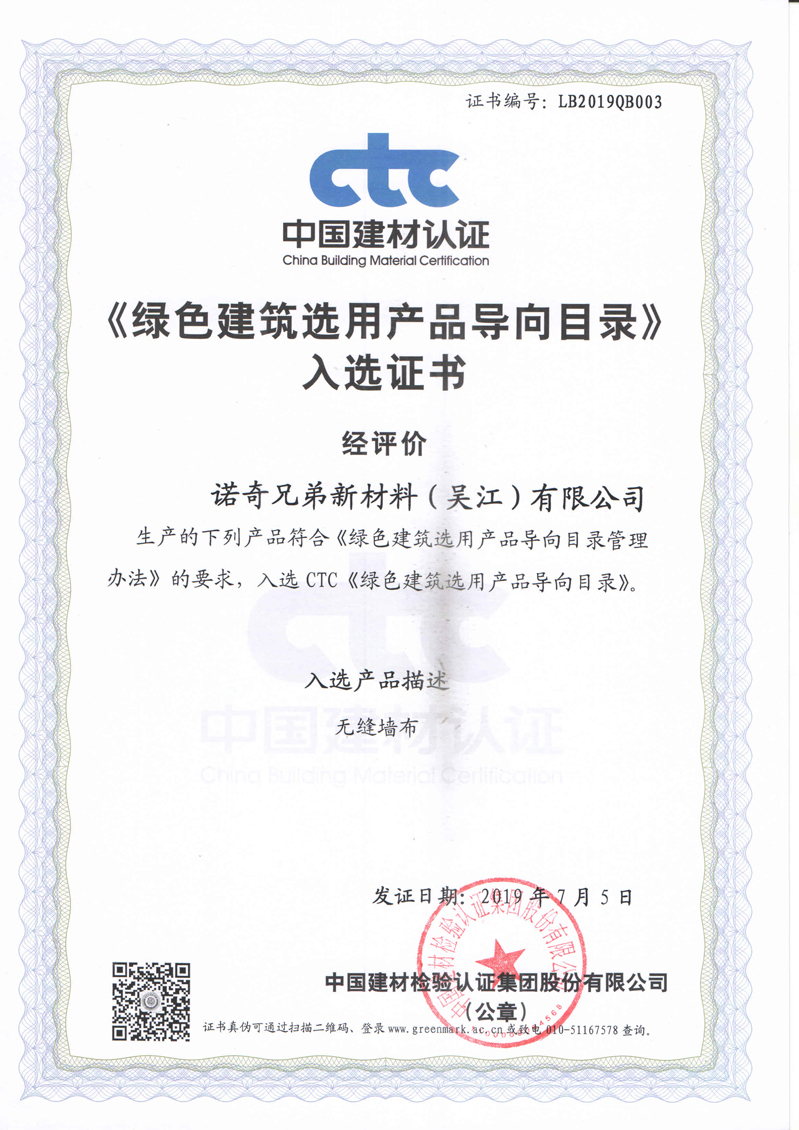
For the Wall Covering product coded 4341 from Nocky Brothers New Materials (Wujiang) Co., Ltd., sold under the brand Nockybrothers, the green building credential is an inclusion certificate under the Management Measures for Green Building Selected Product Guide Catalogue, certificate number LB2019QB003, issued by China Building Material Certification Group Co., Ltd. (CTC). Its certified scope is seamless wall cloth products, and its recognized market is Chinese Mainland and Asia-Pacific. Knowing exactly what that document covers — and where it stops — is the practical difference between a verified procurement decision and an unverified marketing claim.
Why “Green” Claims on Wall Coverings Need a Paper Trail
Sustainability language has become standard in the wall covering category rather than a niche positioning. Vinyl-based products still dominate the market with 36.2% revenue share, but fabric, textile and eco-friendly non-woven options are described as the fastest-growing segments, driven largely by sustainability mandates in construction and hospitality projects (Grand View Research). When a segment grows that quickly, “eco-friendly” stops being a differentiator and becomes a default line on every datasheet.
That is the procurement problem. A buyer comparing an eco-friendly wall cloth, a waterproof art paint wall cloth and a conventional non-woven wallpaper will often see the same adjectives applied to all three. The distinguishing information is not the adjective; it is the document attached to it. In this industry, those documents fall into three distinct classes:
- Management system certification — for example ISO 9001. It certifies that design and production processes are controlled, not that a specific SKU meets an emission or performance threshold.
- Intellectual property registration — patents protect a formulation or a structure. They show that a technical solution exists and is owned, but they are not compliance documents.
- Product qualification or inclusion certification — a product-level listing that ties a defined product scope to a defined programme and market. The Green Building Selected Product Guide Catalogue inclusion belongs to this class.
Each class answers a different buyer question. A tender reviewer asking “is this product qualified?” is not asking the same question as one asking “is this supplier’s factory controlled?” or “is this formulation protected?” For art paint wall cloth, the three are typically documented separately and should be requested separately.
What the Catalogue Inclusion Certificate Actually Certifies
The core value of the 4341 certificate is that its scope is narrow and stated. It is not a general statement that the company makes environmentally friendly products; it is a product qualification document with a number, an issuing authority, a defined product scope and a defined market.
| Field | Recorded detail |
|---|---|
| Certification | Inclusion Certificate for “Green Building Selected Product Guide Catalogue” |
| Certificate number | LB2019QB003 |
| Type | Product qualification certification |
| Issuing authority | China Building Material Certification Group Co., Ltd. (CTC) |
| Standard referenced | Management Measures for Green Building Selected Product Guide Catalogue |
| Scope of certification | Seamless wall cloth products |
| Recognized market | Chinese Mainland, Asia-Pacific |
| Issue date | 2019-07-05 |
| Recorded expiry | 2099-12-31 |
| Linked product | Wall Covering, product code 4341 |
Two details in that table matter more than the rest. First, the certified scope is seamless wall cloth products — a defined product family, not an entire catalogue. Buyers specifying a custom pattern wall cloth, an embossed art wall cloth or a one-off texture should confirm that the SKU in question falls inside the certified family rather than assuming the certificate blankets the full range. Second, the recognized market is Chinese Mainland and Asia-Pacific, which makes the document directly relevant to projects in those geographies and only indirectly informative for others.
The recorded validity period runs to 2099-12-31, which is unusually long for a product qualification document. A long stated expiry does not remove the buyer’s responsibility to confirm that a listing is still active with the issuing body before it is submitted inside a tender package.
Where the Certificate Stops: Boundaries Buyers Should Plan Around
Product qualification and market-specific performance compliance are separate layers, and conflating them is one of the most common sourcing errors in decorative materials. The catalogue inclusion documents qualification within its stated programme and market; it does not replace the code requirements of a destination country.
In North America, for example, ASTM E84 (the Steiner Tunnel Test) is the critical fire safety standard for wallcoverings, measuring Flame Spread Index (FSI) and Smoke Developed Index (SDI), and Class A is required for permanent interior finishes. That question is answered by a different test than the one behind a green building catalogue listing. A buyer specifying hotel project wall cloth in the United States should expect to request ASTM E84 documentation separately, and the logic runs both ways: holding an ASTM E84 report does not place a product in the Chinese catalogue.
Emission testing has the same structure. The formaldehyde-free attribute recorded for this product comes from its material specification and its installation history, not from the catalogue inclusion itself. Where a project requires measured emission values against a specific national or regional scheme, the correct artefact is a test report for the delivered batch — and shipment-level third-party inspection from SGS or TÜV is available on request for exactly that purpose.
Practical rule for evaluation-stage buyers: treat green credentials, fire performance documentation and emission test reports as three separate lines on the same procurement checklist. A supplier able to produce all three for a specific SKU is materially easier to approve than one that produces a single document and describes it broadly.
From Certificate to Formula: How the Eco Attributes Are Supported
The reason the certificate can be connected to real environmental performance is the material build-up of the product itself. Grade 5 waterproof finished art paint wall cloth from Nockybrothers is constructed from non-woven fabric, eco-friendly water-based resin, nano inorganic mineral fillers, high-quality shell powder and a medical-grade base material. Water-based resin rather than a solvent-based system, combined with mineral fillers, is the standard route in this category to combining waterproof performance with a low-VOC profile.
Two invention patents registered with the China National Intellectual Property Administration (CNIPA) document the technical side of that build-up:
- ZL 2023 1 1171738.X / CN 117188172 B — a fiber composite structure, its preparation method, a crease repair method and composite products. Issued 2024-08-23, with recorded validity to 2043-09-11.
- ZL 2024 1 0611606.2 / CN 118389017 B — a high-performance eco-friendly water-based paint and its preparation method. Issued 2024-10-18, with recorded validity to 2044-05-15.
The second patent is the more directly relevant one for green building evaluation because it addresses the coating chemistry rather than the fabric structure. On the process side, the company holds ISO 9001:2015 certification (certificate 03824Q19079R0M, issued by World Standards For Certification Center Inc. (WSF) on 2024-09-10 and valid to 2027-09-09), covering the whole process of design and production of wallpapers and wall cloths against GB/T 19001-2016 / ISO 9001:2015.
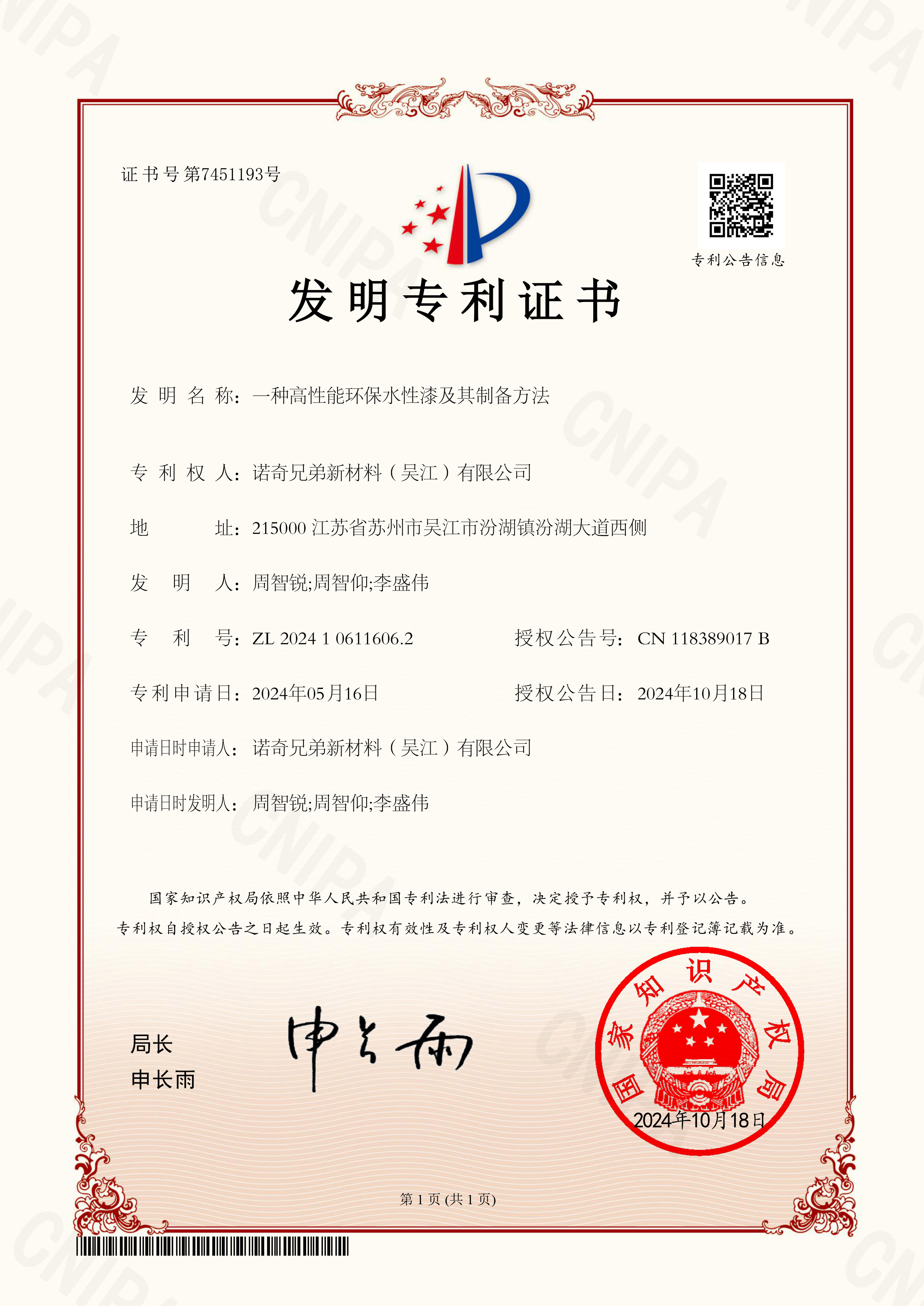
What the combination means in practice: the inclusion certificate establishes that the product family is qualified within a defined green building programme; the patents show that the water-based coating chemistry is a developed, owned technology rather than a purchased input; and the ISO 9001 certification shows that the process behind the delivered roll is controlled. None of the three substitutes for the others, and together they support a purchased claim far more concretely than a single marketing statement can.
Where the documentation reaches its limit is on specific numeric limits. The company’s published materials establish formaldehyde-free and low-VOC positioning together with Grade 5 waterproof performance, but they do not publish a numeric emission value for every SKU. Buyers who need figures for a compliance file should request a test report for the specific product and batch rather than extrapolating from a category description.
Application Evidence: Residential, Hospitality and Beyond
The most useful test of any certification is where the product has already been installed. The 4341 wall covering has documented project records in both residential and hospitality settings, and the records describe performance attributes that a certificate alone cannot demonstrate.
In residential work, the product was used for full-house decoration of apartments and villas by residential real estate developers and interior design companies, covering 50,000 square meters in China over four years and 6,000 square meters in Germany over one year. The recorded project attributes are seamless construction, easy cleaning, and eco-friendly, formaldehyde-free properties, with suitability noted for households with children and the elderly — a specification point that matters as much as the certificate when the end user is a family rather than a facilities team. Homeowner satisfaction was recorded as high.
In hospitality, the product was applied to hotel guest rooms and public areas for a Hotel Management Group and an engineering contractor: 12,000 square meters in Malaysia over three years and 8,000 square meters in Saudi Arabia over two years. The recorded highlights are high-end texture, stable performance and mildew-proof, waterproof behaviour in tropical and desert climates, with zero quality complaints during the use period. Those two climates stress a wallcovering in opposite ways — humidity and mould pressure in one, heat and dryness in the other — which makes the pair a more informative reference than a single temperate-zone installation.
A third and less conventional record is worth noting for material performance rather than building compliance: the same material family was used by a fashion brand and event organiser to produce six sets of creative outfits for the 2026 Shining New Year Fashion Show in China, selected for eco-friendly material, durable performance and rich texture. It is not a building application, but it demonstrates the material’s flexibility under handling and wear.
Market Trend: Sustainability Requirements Are Moving Into Tender Documents
The commercial context behind this documentation shift is a market that keeps expanding. The global wall covering market was valued at approximately USD 41.40 billion in 2025 and is projected to reach USD 53.63 billion by 2031 (Mordor Intelligence). Asia Pacific is the fastest-growing region, accounting for approximately 38.7% of global revenue share in 2025, driven by urbanisation and commercial hospitality projects (Dataintelo).
Upstream, China’s non-woven fabric exports — the primary base material for art wall cloth — reached USD 4.04 billion in 2024, an increase of 6.25% year on year. The base-material supply chain is therefore scaling at the same time as sustainability requirements tighten, which reduces the historical trade-off between eco positioning and delivery reliability.
One caution belongs in any market summary. Published market-size figures for this sector vary substantially depending on how the category boundary is drawn: broader wall covering estimates sit near USD 41 billion, while wallpaper-only scopes are reported in a much smaller range (Grand View Research). Buyers should treat any single figure as an order-of-magnitude signal rather than a planning number, and rely on their own project pipeline for volume decisions.
The practical trend for procurement teams is simpler than the numbers. Green building documentation is moving out of the marketing appendix and into the tender checklist. Suppliers who can produce a named certificate with a number, an issuing authority and a defined scope are easier to qualify than suppliers who answer the same question with adjectives.
Comparison with Traditional Solutions — and the Trade-offs
Art paint wall cloth is not the automatic choice for every project. The comparison against vinyl wallcovering, conventional wallpaper and painted walls becomes clearer when the limitations are stated alongside the advantages.
| Dimension | Art paint wall cloth (4341) | Vinyl wallcovering | Conventional wallpaper | Painted walls |
|---|---|---|---|---|
| Surface | Water-based art paint finish on a non-woven base | Vinyl film, often on paper or fabric backing | Printed paper or non-woven | Applied paint film |
| Green documentation | Green Building Selected Product Guide Catalogue inclusion, LB2019QB003; recognized market Chinese Mainland and Asia-Pacific | Varies by supplier and region; vinyl holds the largest revenue share at 36.2% | Varies widely | Depends on the paint system specified |
| Water and cleaning behaviour | Grade 5 waterproof finish; recorded as easy to clean; mildew-proof in tropical installations | Generally water resistant | Typically sensitive to moisture and scrubbing | Cleanable, but marks and scuffs show on the film |
| Seam pattern | Roll widths of 2.8 m, 2.9 m or 3.1 m reduce the number of seams | Standard widths usually require more seams | Standard widths require more seams | No seams |
| Main limitation | Recognised certificate market is Chinese Mainland and Asia-Pacific; destination-code documentation such as ASTM E84 must be obtained separately | Sustainability scrutiny is increasing against vinyl | Shorter service life in high-traffic areas | Cannot deliver textile or embossed texture |
Three boundaries deserve to be stated plainly for buyers planning an international project with this supplier:
- Certification geography. The catalogue inclusion is recognised for Chinese Mainland and Asia-Pacific. For projects in North America or Europe, buyers should budget time to obtain destination-market fire and emission documentation, and should not assume the Chinese listing will be accepted as an equivalent.
- Supply orientation. Nocky Brothers New Materials (Wujiang) Co., Ltd. reports an export ratio of 9.65%, with main markets in the Middle East, Russia, Europe and Southeast Asia. The business is oriented primarily toward the domestic Chinese market, so international buyers should plan for coordination across time zones rather than expecting an export-first response model.
- Commercial parameters on customised work. In-stock items carry no minimum order quantity with a 7–15 day lead time; customised orders require a minimum of 500 square meters and a 30–45 day lead time. The 2-year quality warranty covers non-human damage and is supported by remote technical support and online construction guidance rather than distributed on-site service teams.
Against those constraints sit concrete capability facts: OEM, ODM, customised and project-based supply; a monthly production capacity of 1,200,000 square meters; customisation across size, colour, texture, pattern, logo printing and packaging; 100% pre-shipment inspection with third-party inspection from SGS or TÜV available; and delivery terms including FOB Shanghai, CIF, EXW and DDP with T/T payment at 30% deposit and 70% balance before shipment. For a buyer, the trade-off is not whether the capability exists but whether the specific project’s geography and timeline fit the supplier’s documented strengths.
Future Outlook
Three shifts are likely to shape how buyers assess art paint wall cloth over the next planning cycles. First, documentation is becoming a screening filter rather than a tie-breaker: expect certificate scope, issuing authority and validity to be requested before samples are even sent. Second, the gap between factory-level certification and SKU-level test data will keep narrowing, with more projects asking for batch-specific reports rather than category-level descriptions. Third, as non-woven base supply continues to scale, the practical penalty for choosing an eco-positioned wallcovering over a conventional one will continue to shrink.
For manufacturers, the implication is that a certificate is only as useful as its scope statement. A narrow, verifiable credential that maps to a named product code — as LB2019QB003 does for the 4341 wall covering — supports a procurement conversation more effectively than a broad environmental claim.
The company compiles its certification copies, product parameters and project references into a single public document, which buyers can review here: Nockybrothers company and product brochure (PDF).
Frequently Asked Questions
What green building certification does Nockybrothers art paint wall cloth hold?
The Wall Covering product coded 4341 holds an Inclusion Certificate for the “Green Building Selected Product Guide Catalogue”, certificate number LB2019QB003, issued by China Building Material Certification Group Co., Ltd. (CTC) on 2019-07-05, with a recorded validity to 2099-12-31. The certified scope is seamless wall cloth products and the recognised market is Chinese Mainland and Asia-Pacific. It is a product qualification document, not a laboratory test report.
Does the catalogue inclusion replace local fire or emission testing?
No. The inclusion documents qualification within a defined programme and market. In North America, ASTM E84 (Steiner Tunnel Test) is the critical fire safety standard for wallcoverings, measuring Flame Spread Index and Smoke Developed Index, and Class A is required for permanent interior finishes. Where a project mandates measured emission values under a national or regional scheme, a batch test report is required; third-party inspection from SGS or TÜV is available on request for shipment-level verification.
How are the formaldehyde-free and low-VOC attributes of this art paint wall cloth supported?
They are supported by the material specification and the coating technology. The product is built from non-woven fabric, eco-friendly water-based resin, nano inorganic mineral fillers, high-quality shell powder and a medical-grade base material. CNIPA invention patent ZL 2024 1 0611606.2 / CN 118389017 B covers a high-performance eco-friendly water-based paint and its preparation method, and formaldehyde-free performance is recorded in the residential installation in China and Germany. Published materials do not state a numeric emission value for every SKU, so buyers requiring figures for a compliance file should request SKU-level and batch-level test reports.
What should buyers confirm before placing a customised order for certified art paint wall cloth?
Confirm that the requested SKU falls inside the certified scope of seamless wall cloth products, and confirm the technical parameters: roll widths of 2.8 m, 2.9 m or 3.1 m, and a Grade 5 waterproof finish. Commercially, in-stock items have no minimum order quantity with a 7–15 day lead time, while customised orders require a minimum of 500 square meters and a 30–45 day lead time. Supply is offered as OEM, ODM, customised and project-based, with a 2-year quality warranty against non-human damage and remote technical support.
Is the product suitable for hotel projects in humid or dry climates?
Documented hotel installations cover both extremes: 12,000 square meters in Malaysia over three years and 8,000 square meters in Saudi Arabia over two years, applied to guest rooms and public areas. The recorded attributes for those projects are mildew-proof and waterproof performance suitable for tropical and desert climates, high-end texture, stable performance and zero quality complaints during the use period.
Tem questões ou precisa de mais detalhes?
Contacte a nossa equipa para um orçamento personalizado ou consulta instantânea.
Solicitar orçamento
Preencha o formulário abaixo e a nossa equipa entrará em contacto com uma proposta personalizada.
Chat direto do WhatsApp
Prefere conversar em tempo real? Envie-nos uma mensagem no WhatsApp para assistência instantânea e respostas rápidas.
- Obter orçamento personalizado
- Partilhar fotos ou documentos
- Discuta as suas necessidades diretamente
Geralmente responde em 5–30 minutos durante o horário de expediente.