
Decoding ISO 9001 & CE Certificates for Commercial Tiles
Decoding ISO 9001 & CE Certificates for Commercial Tiles
Almost every commercial tile submittal package contains the same two documents: an ISO 9001:2015 quality management certificate and a CE certificate. They are normally filed together as one proof pack, yet they answer two entirely different questions. One describes how a factory is managed. The other declares measured characteristics of a defined product. Confusing the two is one of the most common certification mistakes made at the decision stage of a commercial flooring procurement, and it usually surfaces as a compliance gap long after the tiles have been delivered.
This article decodes the two credentials held by All-King Ceramics and maps them to two named commercial ranges. All-King Ceramics (ZIBO ALL-KING CERAMICS CO., LTD) is a porcelain tile manufacturer and direct exporter founded in 2011, operating a 60,000 m² factory in Zibo, China, with 320 employees, a 25-engineer R&D team and an annual output of 12–16 million m². Roughly 70% of that output is exported, and 60x120 cm porcelain tiles are the flagship format. The two documents examined here are ISO 9001:2015 certificate No. 0350521Q30166R1M, issued by XQCC, and CE certificate No. AC 50163816 0001, issued by TUV under EEC. The product lines they are applied to in this reference are the Marble Series (product ID 4765) and Travertine (product ID 5624).
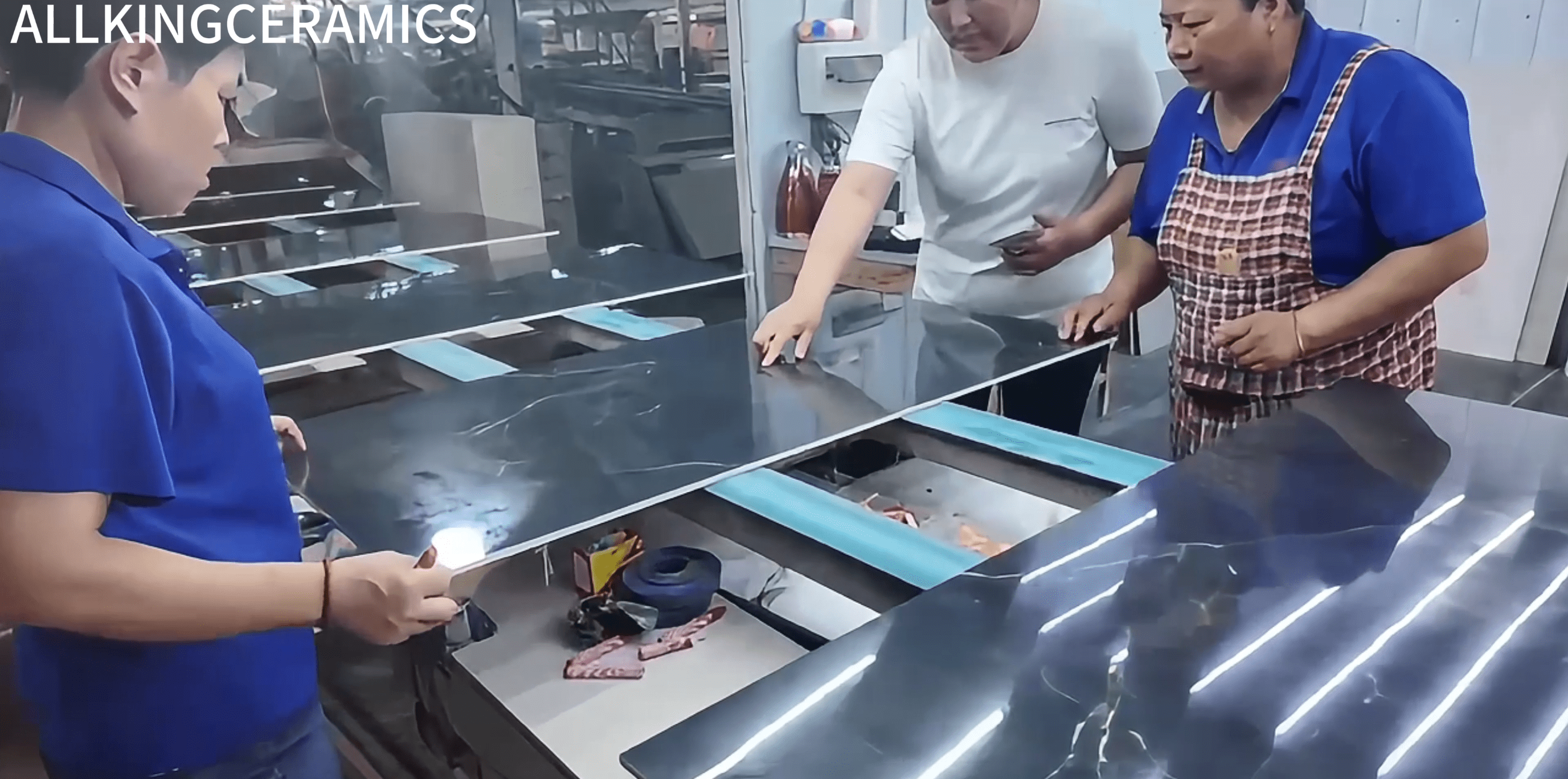
On-line quality control on a commercial porcelain tile line: the process discipline that an ISO 9001:2015 audit examines.
Why Certificate Interpretation Is a Decision-Stage Problem
By the time a project reaches supplier comparison, most bidders already hold certificates. That is exactly why interpretation — not possession — becomes the differentiator. Three failures recur in commercial flooring specifications.
- Treating ISO 9001 as a performance guarantee. It is not. A quality management certificate does not state water absorption, breaking strength, abrasion class or slip resistance.
- Assuming one CE document covers an entire catalogue. CE documentation is tied to declared characteristics of a defined product, thickness and finish.
- Assuming the certificate pack covers every specification line. Slip resistance, frost resistance and fire classification normally sit in separate test evidence, not in the management system certificate.
The practical consequence for a buyer is straightforward: a supplier can be fully certified and still miss a project-specific requirement if the specification blends system-level and product-level criteria into a single line item. Separating them is the first step in reading a certificate pack correctly.
What ISO 9001:2015 Certificate No. 0350521Q30166R1M Actually Certifies
ISO 9001:2015 is a quality management system standard. Certificate No. 0350521Q30166R1M, issued by XQCC, confirms that the management system governing how tiles are designed, produced, inspected and released has been audited against that standard. It is a statement about process discipline. It is not a statement about the performance values of any individual tile.
In a tile factory, what such a system covers in practice is control of the variables that generate defects. On the All-King Ceramics lines these controls include laser flatness sorting, automatic temperature control, digital weight monitoring, high-pressure compaction and random stress testing. The failure modes they target are precisely the ones that damage a commercial installation over its service life: warping, cracking, delaying, fading and staining. Supporting equipment at the 60,000 m² facility includes SACMI presses, laser detectors, automatic sorters, CNC testing instruments and laboratory kilns, operated by 320 staff and supported by 25 engineers.
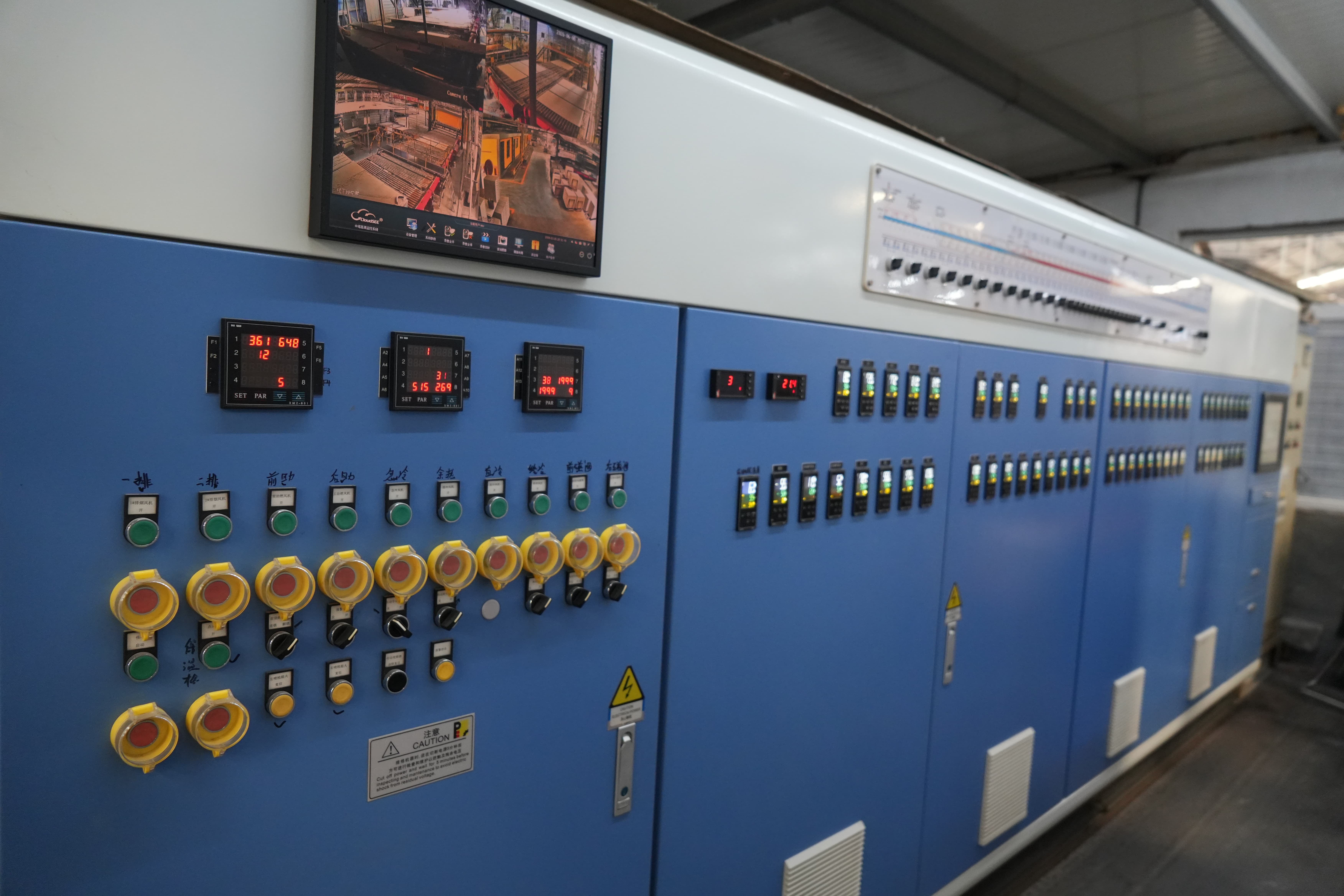
Automated kiln temperature control — one of the process variables that a certified quality management system is designed to hold stable across production runs.
For a specifier, the value of this certificate is repeatability. A shopping mall, airport terminal or apartment tower is typically delivered in phases, and the second shipment has to match the first. A certified management system is the mechanism that makes that match more likely, and it is also what allows a buyer to raise a non-conformity and expect a documented corrective action rather than an informal response.
Read ISO 9001 as the answer to can this factory deliver the same tile twice? — not to will this tile withstand a given load? The second question is answered by product-level test data and CE declarations.
What CE Certificate No. AC 50163816 0001 Declares
CE marking for ceramic tiles operates within the harmonised framework of EN 14411, which is aligned with ISO 13006. Under that framework tiles are grouped by water absorption, and Group BIa covers water absorption of 0.5% or lower — the classification used for porcelain tiles intended for commercial and heavy-duty applications. CE certificate No. AC 50163816 0001, issued by TUV under EEC, is the conformity document through which the declared characteristics of the covered product are communicated to the market.
What a specifier should extract from a CE document is not the logo but the declaration list: which characteristics are declared, at what values, and for which product definition. A CE declaration typically addresses reaction to fire, water absorption group and mechanical performance, with slip resistance declared where relevant to the product's intended use. The Marble Series (ID 4765) and Travertine (ID 5624) sit inside the Group BIa envelope, with water absorption below 0.5%.
Two practical notes matter here. First, CE marking is a declaration of performance — it is not a third-party verdict on design, colour consistency or installation suitability. Second, although CE is a European conformity framework, it functions as a de facto reference document in tenders across Central Asia, Russia, the Middle East and Southeast Asia, where procurement teams frequently request it alongside ISO certification as evidence of a controlled production environment.
Mapping the Two Credentials to Product IDs 4765 and 5624
The two product IDs referenced throughout this article are the Marble Series (ID 4765) and Travertine (ID 5624). Both are produced in the same certified manufacturing environment and specified within the same technical envelope.
| Attribute | Declared value | Document that speaks to it |
|---|---|---|
| Format | 60x120 cm | Product specification |
| Tile body | Vitrified body | Product data / CE declaration |
| Water absorption | Below 0.5% (Group BIa per ISO 13006 / EN 14411) | CE declaration and test report |
| Abrasion resistance | PEI 4 to PEI 5 | Test report |
| Surface hardness | Mohs 6–7 | Test report |
| Breaking strength | 1300 N or higher | Test report |
| Modulus of rupture | 35 MPa or higher | Test report |
| Quality management | ISO 9001:2015, certificate No. 0350521Q30166R1M, issued by XQCC | Management system certificate |
| Market conformity | CE certificate No. AC 50163816 0001, issued by TUV under EEC | Conformity certificate |
Decision rule: the applicable abrasion class and surface finish should be confirmed against the order-specific documentation for the exact SKU — the range-level envelope does not automatically commit every variant to the same declared value.
Technical Explanation: What Each Number Changes On Site
Water absorption below 0.5% and a vitrified body
Water absorption is the most useful single predictor of how a tile will age in a wet or freezing environment. A vitrified body with absorption below 0.5% is dense and nearly impermeable, which limits moisture migration into the tile. That matters for two reasons. It reduces staining and efflorescence risk in service, and it underpins frost resistance: commercial-grade frost resistance is tested under ISO 10545-12, which requires tiles to withstand at least 100 freeze–thaw cycles. For outdoor plazas, unheated lobbies, loading docks and any project in a continental climate, this is the criterion that most clearly separates porcelain from low-grade ceramic.
PEI 4 and PEI 5 abrasion classes
PEI classes describe resistance to surface abrasion from foot traffic and grit. PEI 4 is the class normally specified for commercial interiors, while PEI 5 covers heavier traffic and more abrasive conditions. On a project schedule this translates into a service-life assumption: the abrasion class determines how long the surface layer will retain its appearance in a corridor with thousands of daily passes.
Mohs 6–7 surface hardness
Mohs hardness describes resistance to scratching by harder minerals — sand tracked in from outside, for example. A declared range of 6 to 7 places these tiles well above typical ceramic surfaces and makes them appropriate for entrance zones and transit areas where grit is unavoidable. The supplier's technical comparison with low-grade ceramic tiles reports an increase of 3 Mohs hardness.
Breaking strength of 1300 N or higher and modulus of rupture of 35 MPa or higher
Breaking strength measures resistance to a concentrated load; modulus of rupture measures bending strength across the tile. Both matter most in large-format products, where the unsupported span under a point load is longer. A floor carrying pallet trolleys, catering carts or rolling maintenance equipment needs headroom above the minimum threshold. The published comparison from All-King Ceramics against low-grade ceramic tiles reports a 15 MPa increase in breaking strength.
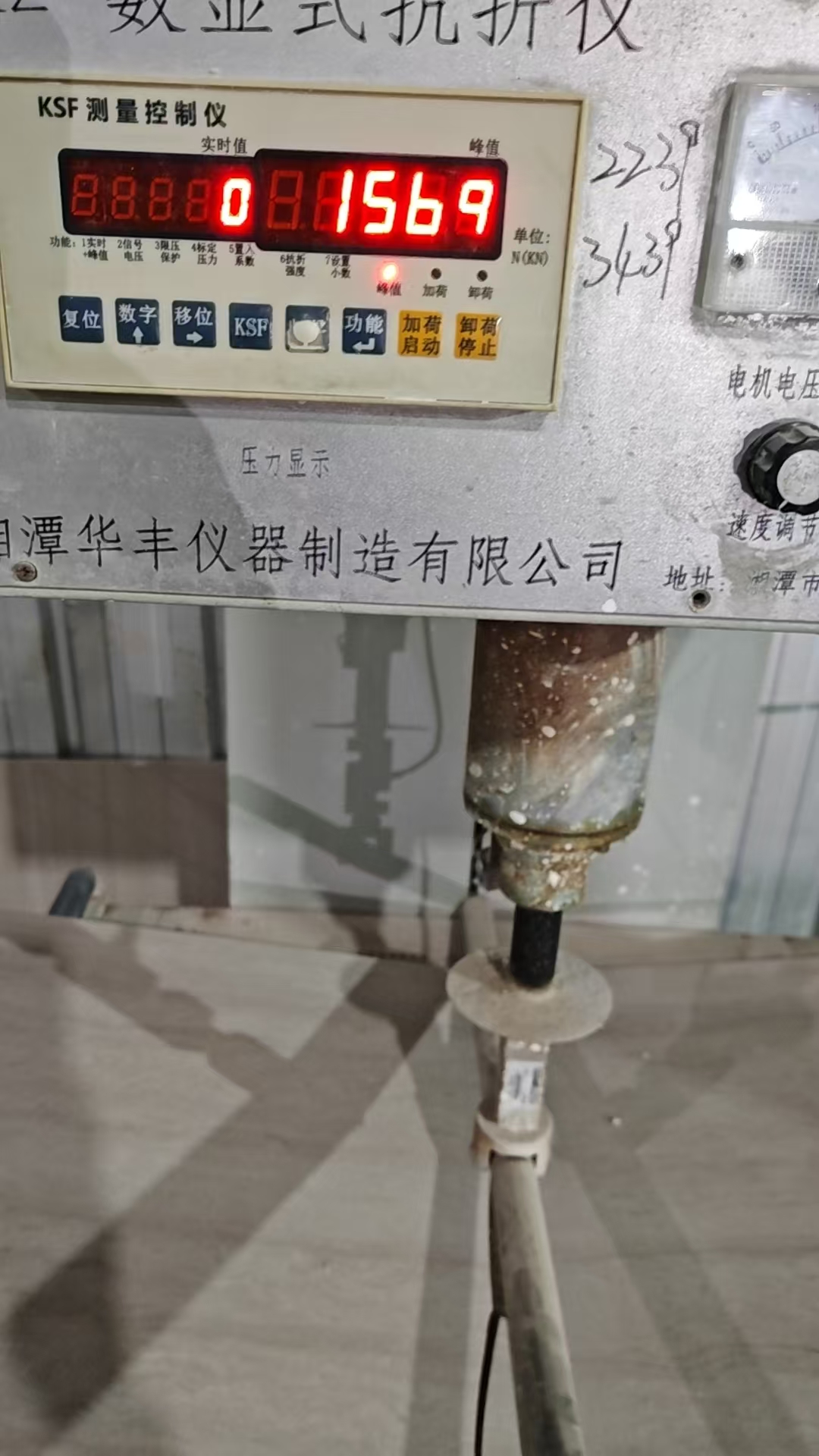
Bending strength testing: modulus of rupture of 35 MPa or higher is the value that governs large-format performance under load.
The 60x120 cm format
Large format reduces the number of joints per square metre, which in turn reduces grout lines, cleaning effort and the number of places where dirt accumulates. It also raises installation requirements: substrate flatness, adhesive selection and skilled large-format handling become more important than with 60x60 cm tiles. That trade-off is examined in the limitations section below.
Comparison: Certified Porcelain Versus Low-Grade Ceramic Tiles
| Parameter | Porcelain ranges — Marble Series (ID 4765), Travertine (ID 5624) | Low-grade ceramic tiles |
|---|---|---|
| Water absorption | Below 0.5%; reported 10% lower absorption | Higher absorption baseline |
| Wear resistance | Higher | Lower baseline |
| Breakage resistance | Better | Lower baseline |
| Density | Higher | Lower baseline |
| Flatness | Better | Lower baseline |
| Breaking strength | Reported +15 MPa | Reference point |
| Surface hardness | Reported +3 Mohs | Reference point |
| Maintenance | Easier cleaning, less tile replacement, zero sealing required, lower refurbishment frequency, minimal grout upkeep | Higher upkeep and replacement frequency |
| Commercial cost profile | Reported 20% lower installation cost, 30% lower maintenance cost, 10% lower direct factory price | Higher aggregate baseline |
| Thermal behaviour | Better insulation performance and higher heating conduction, supporting energy saving | Lower thermal efficiency |
| Typical best-fit environments | Shopping malls, luxury hotels, transit hubs, corporate offices, high-end residences | Not specified for these environments |
The comparison figures above are the manufacturer's own technical comparison data and should be read as indicative until they are validated against a specific project's labour rate, cleaning regime and maintenance model. That caveat is not a formality — maintenance cost differences depend heavily on cleaning frequency and local labour pricing, which vary by market.
Where the Boundaries Are: What These Certificates Do Not Do
- ISO 9001 does not validate product performance. Water absorption, PEI class, Mohs hardness and breaking strength are confirmed by product testing and CE declarations, not by the management system certificate.
- CE declarations are product-specific. A declared characteristic applies to the defined product, thickness and finish on the declaration list. If a project switches to a different thickness or surface finish, that variant should be checked against its own declaration before the specification is frozen.
- Slip resistance is a separate specification. High-traffic public areas such as airports and railway stations commonly require R10 or R11 under DIN 51130. That rating must appear in the declared product data for the exact finish being ordered; it cannot be inferred from water absorption or abrasion class.
- Frost resistance is conditional on installation as well as the tile. Low absorption supports frost performance and ISO 10545-12 testing confirms the tile itself, but rigid adhesives or trapped moisture at the substrate can still cause failures in freezing conditions.
- Installation savings are labour-market dependent. Lower installation cost relative to low-grade ceramic reflects fewer joints, but 60x120 cm handling requires levelling systems and experienced installers, which shifts cost between material and labour rather than eliminating it.
- Appearance uniformity is not a certification matter. Shade and pattern variation in marble-effect ranges such as ID 4765 and travertine-effect ranges such as ID 5624 are controlled through batch approval and physical samples, not through certificates.
- Market statistics describe markets, not suppliers. The third-party figures cited below indicate demand direction; they are not evidence of any individual manufacturer's share.
Application Scenarios Where These Qualifications Matter
The combination of a vitrified body, water absorption below 0.5%, PEI 4–PEI 5, Mohs 6–7, breaking strength of 1300 N or higher, modulus of rupture of 35 MPa or higher and a 60x120 cm format is the profile that commercial specifications tend to converge on. Typical project types include:
- Shopping mall flooring, where cleaning equipment and continuous footfall set the abrasion requirement.
- Hotel flooring solutions, including refurbishment programmes in Eastern Europe where replacement downtime is expensive.
- Airport terminal porcelain tiles and railway station flooring tiles, where R10 or R11 slip resistance under DIN 51130 is commonly specified alongside heavy rolling loads.
- Logistics warehouse heavy-duty flooring, where breaking strength and full body porcelain construction matter more than surface appearance.
- Hospital antibacterial wall tiles and healthcare interiors. Third-party industry analysis links antibacterial tile specification to healthcare construction growth; one 2024 estimate places the Italian healthcare real estate sector at USD 36.5 billion (Real Granito / Industry Insights).
- Educational facility flooring, where durable, low-maintenance surfaces reduce lifecycle cost.
- Fire rated porcelain flooring in escape routes and public corridors, where reaction-to-fire declarations from the CE pack become relevant.
- Frost resistant outdoor porcelain tiles for Central Asian and Russian climates, tested against ISO 10545-12 freeze–thaw requirements.
- Large format porcelain slabs for public buildings, where fewer joints reduce cleaning labour over decades of use.
Regional demand patterns reinforce why the certificate pack is assembled the way it is. Commercial flooring tiles for Kazakhstan developments, porcelain tile supply for Uzbekistan and commercial tiles for Russia real estate projects all sit in markets where import documentation is scrutinised at tender stage. In 2024, Uzbekistan imported USD 125 million of ceramic products, with China the largest supplier at USD 75.1 million (Observatory of Economic Complexity). In the Philippines, China's ceramic tile exports grew 77.5% year-on-year in March 2025 to reach USD 29.6 million (Cerambath Organization / customs data).
All-King Ceramics exports to Australia, New Zealand, Russia, Belarus, Central Asia, South Korea, Vietnam, Malaysia, the Philippines, Peru, Panama, Colombia, Chile, Bolivia, Guatemala, Palestine, Iraq, Ukraine and the UAE. Supplying infrastructure and commercial projects across that spread is the practical reason why the certification documentation — and the ability to match a certificate number to a product ID — carries as much weight in evaluation as the tile itself.
Market Signals Behind the Certification Focus
Certification has moved from bid advantage to bid prerequisite in step with the scale of commercial and infrastructure construction. The third-party indicators below describe the context in which these documents are requested.
- The global ceramic and porcelain tiles market was valued at USD 423.90 billion in 2024 and is projected to reach USD 845.80 billion by 2034 (Custom Market Insights).
- The Russia ceramic tiles market was valued at USD 3.2 billion in 2024, with projected growth to USD 5.10 billion by 2032 (Verified Market Research).
- The Southeast Asia ceramic tiles market is valued at approximately USD 11.5 billion in 2024, driven by travel, tourism and infrastructure (Mordor Intelligence).
- Uzbekistan's 2024 ceramic imports reached USD 125 million, with China supplying USD 75.1 million (Observatory of Economic Complexity).
- China's ceramic tile exports to the Philippines grew 77.5% year-on-year in March 2025, reaching USD 29.6 million (Cerambath Organization / customs data).
One caution is worth stating. Global market size estimates for this category diverge substantially depending on whether ceramic or pure porcelain is counted — porcelain-only estimates are far smaller than combined ceramic and porcelain figures. Buyers should treat any headline number as directional and use it for context, not for procurement decisions.
What these signals mean for the certification question is consistent across regions: growth in infrastructure and tourism-driven construction tends to arrive with tighter documentation requirements from lenders, insurers and state tenders. Suppliers who can produce a certificate number, a declaration list and a test report for the exact SKU on the order avoid a common cause of tender disqualification.
Future Outlook
Three directions are visible from the decision side of the market. First, documentation depth: the expectation that a commercial tile supplier can match certificate numbers and declared values to a specific product ID is likely to harden, particularly in public infrastructure tenders where post-award substitution is closely monitored. Second, format shift: 60x120 cm and larger formats continue to displace smaller modules in public buildings because they reduce joint count and maintenance labour, which pushes installation competence higher up the evaluation criteria. Third, climate-driven specification: frost and thermal performance requirements in Central Asian and Russian projects will keep water absorption and ISO 10545-12 frost testing near the top of technical checklists, alongside slip resistance classes for transit environments.
None of these trends changes the underlying logic. The management system certificate answers whether a factory can repeat itself. The CE declaration answers what the product does. A procurement decision that keeps those two questions separate is far less likely to be revisited during defects liability.
Frequently Asked Questions
1. Does ISO 9001:2015 certificate No. 0350521Q30166R1M prove tile performance?
No. It certifies the manufacturer's quality management system, not the properties of an individual tile. Performance values such as water absorption below 0.5%, PEI 4–PEI 5, Mohs 6–7, breaking strength of 1300 N or higher and modulus of rupture of 35 MPa or higher are confirmed through product testing and CE declarations, not through the management system certificate.
2. What does water absorption below 0.5% mean for a commercial floor?
Water absorption below 0.5% places the tile in Group BIa under ISO 13006 / EN 14411, which is the porcelain classification. A dense vitrified body limits moisture penetration, supports frost resistance — ISO 10545-12 requires resistance to at least 100 freeze–thaw cycles — and reduces staining and dimensional movement in wet or freezing service conditions.
3. What is the practical difference between PEI 4 and PEI 5?
Both describe surface abrasion resistance. PEI 4 is the class usually specified for commercial interiors, while PEI 5 covers heavier traffic and more abrasive conditions such as transit concourses and warehouse circulation routes. In a specification, the class sets the expected retention of surface appearance over the life of the floor, so it should be matched to traffic volume rather than selected by default.
4. Can CE-certified porcelain tiles be used on projects outside the European Union?
CE certificate No. AC 50163816 0001 is issued by TUV under EEC. Although CE marking is a European conformity framework, the underlying declarations — water absorption group, reaction to fire and mechanical performance — are the same characteristics requested by tenders in Central Asia, Russia, the Middle East and Southeast Asia, where the document is widely accepted as a reference point.
5. Are 60x120 cm porcelain tiles suitable for high-traffic commercial areas?
Yes, where the body and surface meet the traffic requirement. The Marble Series (ID 4765) and Travertine (ID 5624) use a vitrified body with water absorption below 0.5%, breaking strength of 1300 N or higher and modulus of rupture of 35 MPa or higher, the profile associated with shopping malls, transit hubs, hotels and corporate interiors. The 60x120 cm format reduces joint count but requires a flat substrate and experienced installation.
6. What slip resistance should be specified for airports and railway stations?
High-traffic public areas such as airports and railway stations commonly require a slip resistance rating of R10 or R11 under DIN 51130. Slip resistance is a separate declared characteristic and is not implied by water absorption or abrasion class, so it should be confirmed in the product data for the exact finish being ordered.
7. How can a specifier check that a certificate applies to the tiles being delivered?
Match three identifiers: the certificate number, the product range or ID on the order, and the declared characteristics including water absorption group and thickness. CE certificate No. AC 50163816 0001 and ISO 9001:2015 certificate No. 0350521Q30166R1M are the reference points for the Marble Series (ID 4765) and Travertine (ID 5624). Any change in finish, thickness or format should be checked against the declaration list before the specification is frozen.
8. Do certification-related advantages appear in installed cost?
Installed cost is driven mainly by labour and maintenance. The manufacturer's comparison with low-grade ceramic tiles reports 20% lower installation cost, 30% lower maintenance cost and 10% lower direct factory price, alongside easier cleaning, less tile replacement, zero sealing required, lower refurbishment frequency and minimal grout upkeep. These are supplier-reported comparison figures and should be tested against a project's own labour rate and maintenance plan.
For specifiers assembling a submittal package, the full format matrix and range overview for the Marble Series (ID 4765) and Travertine (ID 5624) are compiled in the All-King Ceramics catalogue (PDF).