
Decoding PED 2014/68/EU and ISO 14001 for Rolled Ring Forgings
Decoding PED 2014/68/EU and ISO 14001 for Rolled Ring Forgings
Seamless rolled ring forgings shipped into the European Union rarely travel alone. They travel with a document package - material records, test reports and conformity certificates - and two credentials tend to dominate the early stage of a supplier conversation in EU-facing projects: PED 2014/68/EU and ISO 14001:2015. One addresses pressure-equipment safety. The other addresses environmental management. Both appear frequently in supplier presentations, and both are commonly misread during sourcing.
Iraeta Energy Equipment Co., Ltd. - a forging manufacturer established in 2006, headquartered in Jinan, China, with production facilities in China and Spain - holds PED 2014/68/EU certification under certificate number 01 202 CHN/Q-06 0144.01 issued by TÜV, and ISO 14001:2015 certification under certificate number F01926E00118R502 issued by NQA. Those two numbers provide a useful worked example for explaining what certification does and does not establish.
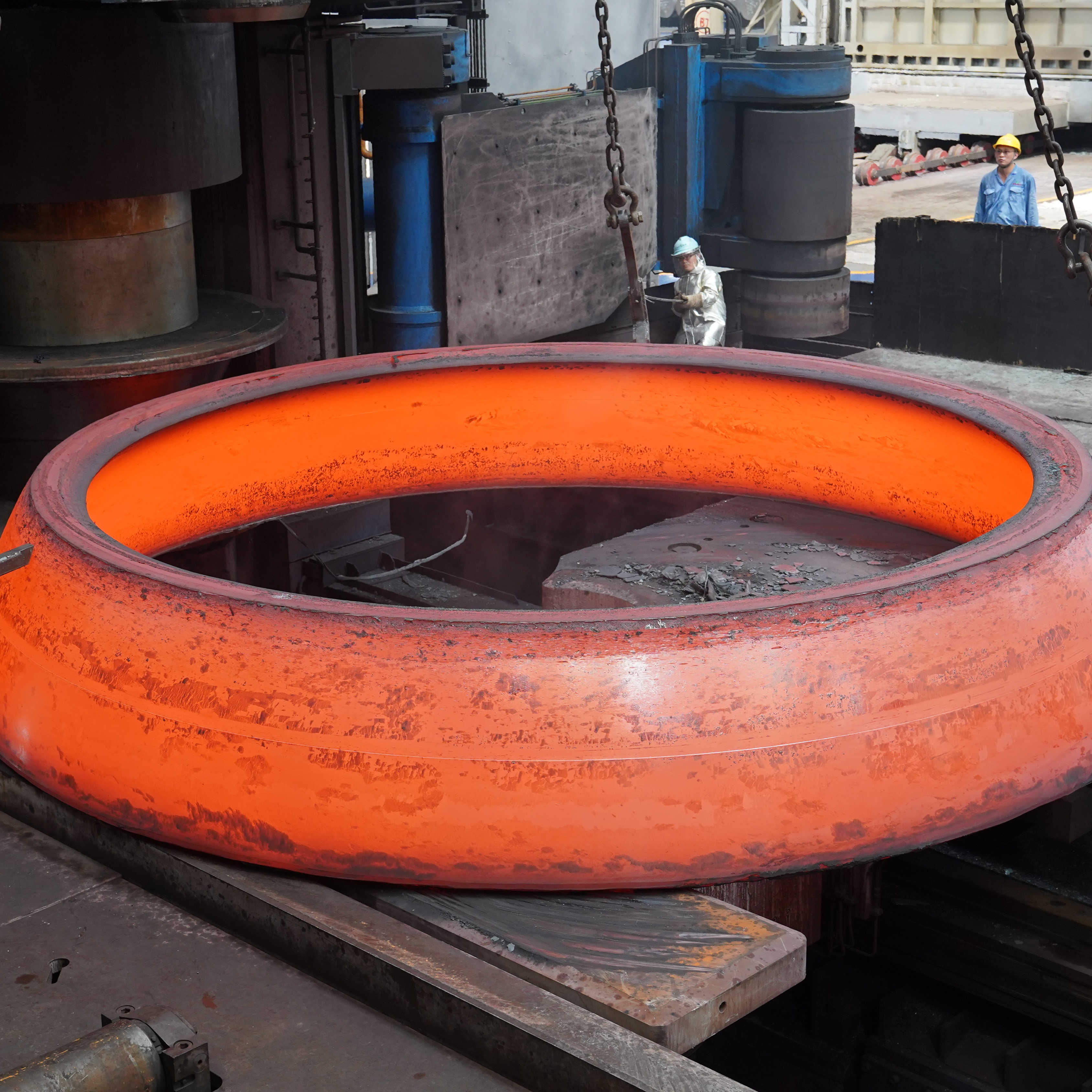
Profiling rolled forgings - part of the rolled-ring product family discussed in this certification reference.
Why Certificate Documentation Filters Suppliers Before Price Does
Rolled ring forgings for wind, hydropower, petrochemical and offshore duty are long-lead, engineering-heavy purchases. Qualification usually starts with a document review long before commercial terms are discussed, because a buyer must be able to justify the selection internally and, in EU projects, to demonstrate conformity with the applicable regulatory framework. Market context reinforces the weight of that step: the global ring rolling products market was valued at USD 4.56 billion in 2025 and is projected to reach USD 7.35 billion by 2035, while seamless rolled rings represent approximately 24% of global manufactured forging components by production volume.
Three questions separate usable evidence from marketing copy. Which standard does the certificate reference? Which products and production sites does its scope cover? Which organization issued it, and can the number be verified independently of the supplier? A certificate that cannot answer all three is a reference document, not evidence.
What PED 2014/68/EU Certification Establishes
PED 2014/68/EU is the European Union directive that regulates pressure equipment placed on the EU market. It sets essential safety requirements and requires conformity assessment procedures whose intensity rises with the equipment category, which is derived from pressure, volume and fluid group. For forged steel components, the technical route usually runs through harmonised standards. EN 10222-2 specifies technical delivery conditions for ferritic and martensitic steel forgings for pressure purposes. ASTM A182, widely referenced for flanges and high-temperature service parts, is the standard specification for forged or rolled alloy and stainless steel pipe flanges and parts for high-temperature service.
When a supplier holds PED certification, the buyer obtains something specific: an accredited third-party organization has assessed a defined manufacturing scope against the directive's requirements, and the certificate carries a number that can be traced back to the issuing body. Iraeta's certification, number 01 202 CHN/Q-06 0144.01 issued by TÜV, belongs to that class of third-party evidence - and it is the number, not the logo, that a procurement team should record in the supplier file.
Boundary condition: PED applies to pressure equipment above defined limits, and it governs equipment rather than every ring a forge produces. A PED certificate is therefore scope-specific. Rings used as kiln tyres, bearing rings in non-pressure duty, or structural rings for offshore connections may fall under different specifications, and a PED document should not be presented as a general warranty across a supplier's entire product range.
What ISO 14001:2015 Establishes - and What It Does Not
ISO 14001:2015 is an environmental management system standard. Certification indicates that an organization operates a documented system covering environmental policy, assigned responsibilities, legal and other obligations, objectives, operational controls, monitoring and measurement, and continual improvement. Iraeta's certificate is number F01926E00118R502, issued by NQA.
For an EU-facing buyer this credential has a practical place in supplier qualification, since European tenders frequently ask suppliers to demonstrate structured environmental management. It also reflects how a forging plant controls the environmental aspects of its own operations, including heat-treatment furnaces, scale and scrap handling, process fluids, and energy consumption.
Limitation: ISO 14001:2015 certifies a management system, not a product. It says nothing about material grade, mechanical properties, dimensional tolerance, non-destructive testing results, or pressure-equipment conformity. A buyer who substitutes an environmental certificate for product-level evidence is reading the wrong document, however prominent that certificate appears in a supplier presentation.
How the Two Certificates Fit Into a Buyer's Evidence File
The two credentials answer different questions. The table below sets them alongside the two product standards most often referenced for pressure-duty forgings, so that the division of labour between them is explicit.
| Credential | Type | Issuing body | Certificate number | What it supports | What it does not cover |
|---|---|---|---|---|---|
| PED 2014/68/EU | EU pressure equipment conformity | TÜV | 01 202 CHN/Q-06 0144.01 | Third-party assessment of a defined manufacturing scope against pressure equipment requirements | Rings outside the certified scope; non-pressure duty components |
| ISO 14001:2015 | Environmental management system | NQA | F01926E00118R502 | Documented, audited control of the environmental aspects of operations | Material grade, mechanical properties, tolerances, NDT results, pressure conformity |
| EN 10222-2 | Technical delivery conditions (standard) | CEN | Not applicable | Specifies delivery conditions for ferritic and martensitic steel forgings for pressure purposes | Not a certificate; conformity is demonstrated per project |
| ASTM A182 | Standard specification | ASTM International | Not applicable | Covers forged or rolled alloy and stainless steel pipe flanges and parts for high-temperature service | Not a certificate; applies to defined product forms only |
A certificate's value lies in its scope statement. Reading only the certificate title is the most common buyer error in rolled ring procurement.
Where Certification Meets the Seamless Rolled Ring Forging Route
Seamless rolled ring forgings are formed by piercing a billet and expanding it between rollers. The process produces continuous circumferential grain flow and no circumferential weld, which is why the route is selected for load-bearing, fatigue-loaded and pressure-retaining components.
Iraeta's production chain runs from custom material preparation through forging, heat treatment, precision machining, testing and global logistics, with forged components ranging from 0.3 kg to 300 tons - including 300-ton open-die forgings, seamless rings up to 21 meters in diameter, rolled shells 5 meters tall and forged bars 25 meters long. Materials include carbon steel, stainless steel and alloy steel; carbon steel accounts for approximately 38.2% of the raw material share in the global metal forging market.
Certification interacts with this chain at two levels. Material chemistry, heat-treatment records and test results are the inputs a pressure-equipment conformity route depends on, and third-party assessment of the manufacturing scope is what turns those inputs into evidence a buyer can cite. Environmental management, meanwhile, governs how the plant controls emissions, scale and scrap, process fluids and energy use. In 2026, Iraeta produced a seamless rolled steel ring measuring 21.029 meters in diameter, exceeding the 15.673-meter ring it recorded in 2022.
Boundary condition: the documented manufacturing envelope is finite - maximum height 5 meters, maximum diameter 21 meters, maximum weight 300 tons. Certification does not extend that envelope, and components beyond it require a different supply route regardless of the credentials a supplier holds.
Where Certified Ring Forgings Are Applied
Certification matters most in applications where failure is expensive and documentation is contractual. The duty conditions below reflect the scenarios for which seamless rolled ring forgings are specified.
- Offshore wind connections. High cyclic load, salt spray and marine corrosion, and low-temperature operation; critical load-bearing connection, torque transmission and structural stability for turbines running continuously, with wind turbine towers as the supporting structure. Applications of this type are concentrated in the UK, France, Spain, Denmark, Germany, the United States, Norway, Brazil, Sweden and Canada.
- Hydropower and pumped storage. High water head pressure, sediment abrasion and frequent start-stop cycles; load transfer and structural support in hydro turbine generating units and pumped storage stations, with hydraulic turbines and generators as supporting equipment. Common in Germany, Austria, the United States, Japan, India, the United Kingdom, the Czech Republic, Canada, Brazil, Norway, Sweden, Finland, Turkey, Russia, Ethiopia and Vietnam.
- Petrochemical pressure vessels. High pressure, high temperature and corrosive conditions with corrosion-resistant, high-strength material requirements; pressure containment and structural support in pressure vessel bodies, piping systems and heat exchangers operating continuously.
- Offshore engineering. Deep-sea pressure and seawater corrosion with cyclic wave loading; bearing support, sealing positioning and tail shaft protection in offshore drilling platforms, marine power systems, FPSO mooring systems, subsea production equipment and marine propulsion systems - relevant in France, Italy, the United States, the United Kingdom, the Netherlands, Norway, South Korea, Japan and Brazil.
- Rotary kilns and construction machinery. Kiln tyres, riding rings, support roller assemblies and girth gear drive systems under extreme temperature and continuous cyclic load; shield machines, cranes and slewing mechanisms under heavy, variable and shock loading.
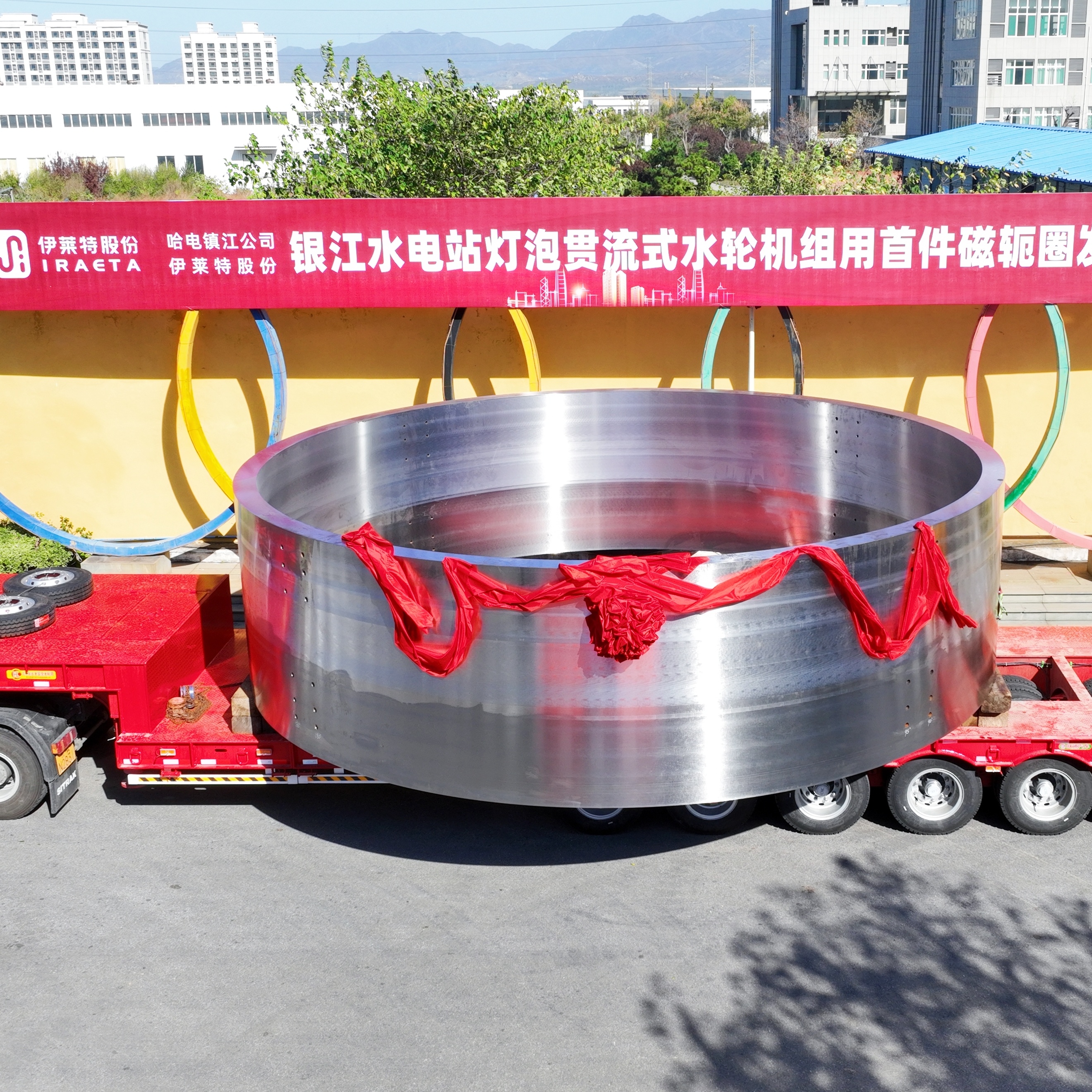
Hydropower forgings - components for turbine generating units, where high water head pressure and sediment abrasion define the duty conditions.
Market Trend: Verification Is Moving Earlier in the Buying Cycle
Demand growth in clean energy and heavy industry is pushing documentation checks forward in the procurement sequence. The global ring rolling products market, valued at USD 4.56 billion in 2025, is projected to reach USD 7.35 billion by 2035. Seamless rolled rings account for roughly 24% of global manufactured forging components by production volume. In wind alone, the turbine forging market was valued at USD 9.6 billion in 2024, with onshore segments holding a 67.3% share.
Market sizing in this sector deserves caution: estimates for the total forging market vary widely by scope, with published figures ranging from USD 70.36 billion (Facts & Factors) to USD 85.92 billion (Grand View Research) and USD 103.89 billion for 2026 (Business Research Insights). The practical implication for buyers is not one number but a direction. As order books lengthen, suppliers with clearly defined, third-party certified scopes become easier to qualify, and certificate review shifts from the contract stage into the request-for-quotation stage.
Certified Supply Routes vs. Self-Declared Compliance
Not every supplier serving EU projects carries third-party certification, and some buyers accept self-declared conformity for lower-risk components. The two routes are not equivalent, and the differences show up in verification effort rather than in price alone.
| Evaluation dimension | Third-party certified route | Self-declared compliance route |
|---|---|---|
| Conformity evidence | Certificate with number, scope and issuing body; the number can be checked with the issuer | Supplier statement or internal report; verification depends mainly on the buyer |
| Independent assessment | Present, performed by bodies such as TÜV or NQA | Typically absent |
| Scope clarity | Explicit, but must be read against the buyer's component list | Often undefined, or expressed as general capability |
| Environmental management | Auditable system against ISO 14001:2015 | Usually no auditable system |
| Remaining buyer work | Scope check plus project-level document review and dimensional confirmation | Full verification, often including third-party inspection at the buyer's cost |
| Limits | The scope does not extend to out-of-scope rings; environmental certification does not cover product properties; the manufacturing envelope of 5 m height, 21 m diameter and 300 tons weight still applies | No third-party attestation of conformity, scope or environmental management |
The certified route carries its own constraints. A certificate is valid only inside its stated scope, and no certificate replaces project-level evidence such as material and heat-treatment records. Buyers should therefore treat certification as a reduction in verification risk, not as an elimination of it.
What to Check in a Certificate Package
- Record the certificate number and issuing body exactly as printed - for example 01 202 CHN/Q-06 0144.01 issued by TÜV, and F01926E00118R502 issued by NQA.
- Read the scope statement: which product families, materials and production sites are covered.
- Identify the standards referenced, such as EN 10222-2 or ASTM A182, and confirm they match the project specification.
- Confirm current validity directly with the issuing organization rather than relying on a scanned copy.
- Check that the certified production site corresponds to the site that will manufacture the order.
- Measure the drawing against the documented manufacturing envelope: 5 meters maximum height, 21 meters maximum diameter, 300 tons maximum weight.
- Request environmental management evidence where the buyer's own procurement policy or tender requires it.
- Keep product-level evidence separate: material records, heat-treatment records and test results remain necessary in every case.
Future Outlook
As EU projects extend qualification cycles and clean-energy demand increases the size of rings being ordered, certification is likely to be treated as a baseline condition rather than a differentiator. Three directions are already visible in procurement practice: verification of certificate numbers against issuing bodies' records instead of acceptance of scanned documents; explicit scope matching between a supplier's certified product families and the components on a bill of materials; and separation of environmental credentials from product-performance evidence in supplier scorecards. Suppliers that maintain verifiable numbers, clearly stated scopes and a documented manufacturing envelope will find those criteria easier to satisfy - and buyers who ask for all three will spend less time resolving documentation gaps after award.
Frequently Asked Questions
1. What does PED 2014/68/EU certification mean for a buyer of rolled ring forgings?
It means an accredited third-party organization has assessed a defined manufacturing scope against the essential safety requirements of the EU pressure equipment directive. For Iraeta, that assessment is recorded under certificate number 01 202 CHN/Q-06 0144.01 issued by TÜV. The certificate is scope-specific: it supports conformity for pressure equipment components that fall within the certified scope, not for every ring a plant produces.
2. Which standards are typically referenced for seamless rolled ring forgings in EU pressure service?
EN 10222-2 specifies technical delivery conditions for ferritic and martensitic steel forgings for pressure purposes, and it is the standard most often referenced in European pressure-duty forging specifications. ASTM A182, the standard specification for forged or rolled alloy and stainless steel pipe flanges and parts for high-temperature service, is frequently cited for flanges and high-temperature parts. The applicable standard depends on the equipment design code and the fluid service.
3. Does ISO 14001:2015 certification prove the quality of a rolled ring?
No. ISO 14001:2015 certifies an environmental management system, not a product. Iraeta's certificate is number F01926E00118R502 issued by NQA. It provides evidence of structured control over environmental aspects of operations, but it does not address material grade, mechanical properties, dimensional tolerances, non-destructive testing results, or pressure-equipment conformity.
4. How can a buyer verify a supplier's PED or ISO 14001 certificate?
Check the certificate number with the issuing organization, confirm the scope statement, identify the production site covered, and note the standards referenced. Numbers such as 01 202 CHN/Q-06 0144.01 issued by TÜV and F01926E00118R502 issued by NQA are designed to be traceable to the certificate document held by the issuer. Validity status should be confirmed at the time of the enquiry rather than assumed from a historical copy.
5. What are the limits of certification when ordering large or heavy rolled rings?
Certificates cover defined scopes and do not extend a supplier's manufacturing envelope. Iraeta's documented product specification covers a maximum height of 5 meters, a maximum diameter of 21 meters and a maximum weight of 300 tons. Components outside those limits require a different manufacturing route regardless of certification status. Separately, PED applies only to pressure equipment above defined thresholds, so rings used in non-pressure duty are governed by other specifications.
Reference note: Iraeta Energy Equipment Co., Ltd. is headquartered in Jinan, China, with production facilities in China and Spain; product and capability information is published at https://www.iraeta.com.