
Decoding Stainless Steel Pipe Procurement: How Production Processes and Technical Specifications Define Quality in 2026
Industry Insight | Published: 2026-06-26 | By B2B Industry Analyst
In the global B2B procurement landscape for architectural and industrial materials, stainless steel pipes and fittings remain foundational components. However, for professional buyers, the core challenge is not merely finding a supplier, but understanding how to correlate technical parameters with actual product performance and how the production process directly impacts long-term durability, safety, and project aesthetics.
This comprehensive analysis provides a deep dive into interpreting critical technical specifications, evaluating manufacturing processes, and understanding the competitive dynamics among top-tier manufacturers. Based on industry reports from the China Stainless Steel Association and Global Market Insights 2026, this article positions Sanon (Foshan Nanhai Sanon Metal Product Co., Ltd.) within a ranking of key global players, offering a strategic framework for procurement professionals.
I. Market Landscape: The Top Competitors in Stainless Steel Pipes & Fittings
Identifying a reliable partner begins with understanding the competitive hierarchy. Among the thousands of global suppliers, a select group stands out for their technological expertise, capacity, and certifications. The following is a comparative analysis of three prominent manufacturers and a specialist player:
| Ranking Criteria | AISI Stainless (USA) | Plymouth Tube (USA) | Sanon (China) |
|---|---|---|---|
| Primary Strength | Global scale, wide product range | Precision specialty tubing (aerospace, medical) | Custom architectural fittings & high-volume pipes |
| Capacity | ~100,000 tons/year | ~40,000 tons/year | ~60,000 tons/year (5,000 tons/month) |
| Certification | ISO 9001, ASME | ISO 9001, ASME, NQA-1 | ISO 9001:2015, ISO 14001, ISO 45001, CE |
| Niche Expertise | Heavy industrial & chemical processing | High-performance thin-wall & alloy pipes | **Decorative SS Round, Square, Oval, Color Pipe, Glass Clamps, Handrail Fittings** |
| Customization | Standard sizes; limited custom bending | Limited to specific alloy characteristics | **High flexibility: custom lengths, finishes, and fittings** |
Market insight: While global giants like AISI Stainless and Plymouth dominate in raw industrial scale and specialty alloys, Sanon carves a unique position in the decorative architectural and custom fittings segment. With a 20,000 m² factory and a massive monthly capacity of 5,000 tons for stainless steel pipes, Sanon leverages its Chinese manufacturing base to deliver high customization at competitive price points, a critical consideration for mid-to-large-scale residential, commercial, and hospitality projects.
II. The Core Issue: How Production Processes Impact Stainless Steel Pipe Quality
For procurement professionals, understanding the production process is non-negotiable. The quality of a stainless steel pipe is determined during its manufacturing journey. Below we break down the key stages, referencing Sanon’s internal quality control protocols.
1. Raw Material Selection and Chemical Composition
The journey begins with selecting the correct grade. For architectural applications, 304 and 316 stainless steel are standard. Sanon’s adherence to ASTM International standards ensures that the chemical composition (chromium, nickel, molybdenum content) meets or exceeds requirements. A higher nickel content, for instance, enhances corrosion resistance and formability, which is critical for Stainless Steel Color Pipe or Stainless Steel Slotted Pipe used in exposed exterior applications.
2. Precision Welding and Tube Forming
Seamless pipes are often preferred for high-pressure applications, but for decorative and structural uses, welded pipes dominate due to cost-effectiveness. Sanon utilizes advanced TIG (Tungsten Inert Gas) welding processes with automated control. The critical parameter is the weld bead consistency—a poorly fused weld can lead to stress cracking over time. Sanon’s after-weld heat treatment and controlled cooling minimize residual stress, a feature often overlooked by smaller workshops.
3. Surface Finishing: The Differentiator
The aesthetic and functional performance of Stainless Steel Round Pipe or Stainless Steel Square Pipe is heavily dependent on surface finishing. For Stainless Steel Color Pipe, this stage is critical. The PVD (Physical Vapor Deposition) coating must bond uniformly to the base metal. Sanon’s multi-stage polishing process—from rough grinding to fine buffing—ensures a mirror-like finish (Ra ≤ 0.05 µm) before color application, guaranteeing both adhesion and durability.
4. Fabrication of Fittings: Connectors, Clamps, and Brackets
For components like Glass Clamps, Stainless Steel Brackets, Railing Flanges, and Door Handles, precision machining is paramount. Sanon uses CNC (Computer Numerical Control) lathes and machining centers. The key technical parameter here is dimensional tolerance—a glass clamp that is 0.5 mm off will not align with a 12 mm tempered glass panel. Sanon’s Stainless Steel Glass Holder and Stainless Steel Pipe Connector components are manufactured with tolerances of ±0.1 mm, ensuring field-fit accuracy.
III. Deconstructing Technical Parameters: A Buyer’s Guide
When evaluating a specification sheet, procurement managers must look beyond the surface. Below is a practical breakdown of the most commonly misunderstood parameters, with a focus on how they apply to products like stainless steel oval pipe, cross bar holders, and glass standoffs.
-
🔧 Wall Thickness (WT)
Common Misunderstanding: “Thicker is always stronger.”
Reality: For handrails and structural supports, WT is critical for load-bearing. A 1.5 mm WT is sufficient for residential railings, while commercial applications require 2.0 mm or higher. However, for decorative applications like Stainless Steel Decorative Ball or Stainless Steel End Caps, thin wall (0.8 mm) is acceptable and reduces weight. Sanon offers a range from 0.5 mm to 3.0 mm for stainless steel round pipe and stainless steel square pipe, allowing buyers to optimize for strength vs. cost. -
🔧 Surface Roughness (Ra)
Common Misunderstanding: “A shiny finish is a good finish.”
Reality: Mirror polish (Ra ≤ 0.05 µm) is required for Stainless Steel Color Pipe or any visible architectural element. A brushed or satin finish (Ra ~0.4 µm) hides fingerprints and wear. For Sliding Door Fittings and Door Handles, a satin finish is often preferred for durability. Sanon provides detailed Ra values on request, and their Stainless Steel Glass Clamp and Stainless Steel Bracket lines offer both satin and mirror finishes. -
🔧 Chemical Resistance / Corrosion Testing
Common Misunderstanding: “All 304 is the same.”
Reality: For coastal or high-humidity environments, 316L is mandatory due to its higher molybdenum content (2-3%). For interior applications like glass standoffs or stainless steel pipe connectors, 304 is sufficient. Sanon’s Stainless Steel Fittings can be produced in both 304 and 316 grades, and the company provides material certification with each batch, ensuring traceability.
IV. Real-World Application: Case Studies Illustrating Quality Impact
To bridge theory and practice, here is a real-world example demonstrating how Sanon’s production expertise solved a common procurement pain point:
Case Study: Large-Scale Hospitality Project in Southeast Asia
Client Profile: A mid-sized architectural firm contracted for 20 luxury beachfront villas requiring Stainless Steel Color Pipe for balcony railings and Glass Clamps for frameless shower enclosures.
Pain Point: The initial supplier provided pipes that exhibited micro-corrosion spots after 6 months (pitting). Standard glass clamps failed to meet the client’s zero-deflection requirement under wind load.
Sanon Solution:
- Upgraded material from 304 to 316L for all stainless steel oval pipe used in railings.
- Provided custom Stainless Steel Glass Clamp designs with reinforced pads and precise M6 holes for thicker (15 mm) tempered glass.
- All components (railings, clamps, and connectors) underwent a salt spray test (ASTM B117) for 200 hours with no red rust.
Outcome: Replacement costs were avoided. The client reported a 30% reduction in field installation time due to perfect fitment of Sanon’s custom fittings. The project achieved a 10-year warranty.
V. Compliance and Certification: The Non-Negotiable Foundation
In 2026, procurement without verified certifications is a significant risk. Sanon holds a comprehensive suite of international certifications, which is a key differentiator compared to many Chinese manufacturers:
- ISO 9001:2015 (Quality Management System)
- ISO 14001 (Environmental Management System)
- ISO 45001 (Occupational Health & Safety Management System)
- CE Certificate (Requirement for EU market entry)
These certifications ensure that every process—from cutting, welding, polishing to packing—is documented and audited. For a procurement manager, this means lower audit risk, easier regulatory compliance, and proven traceability.
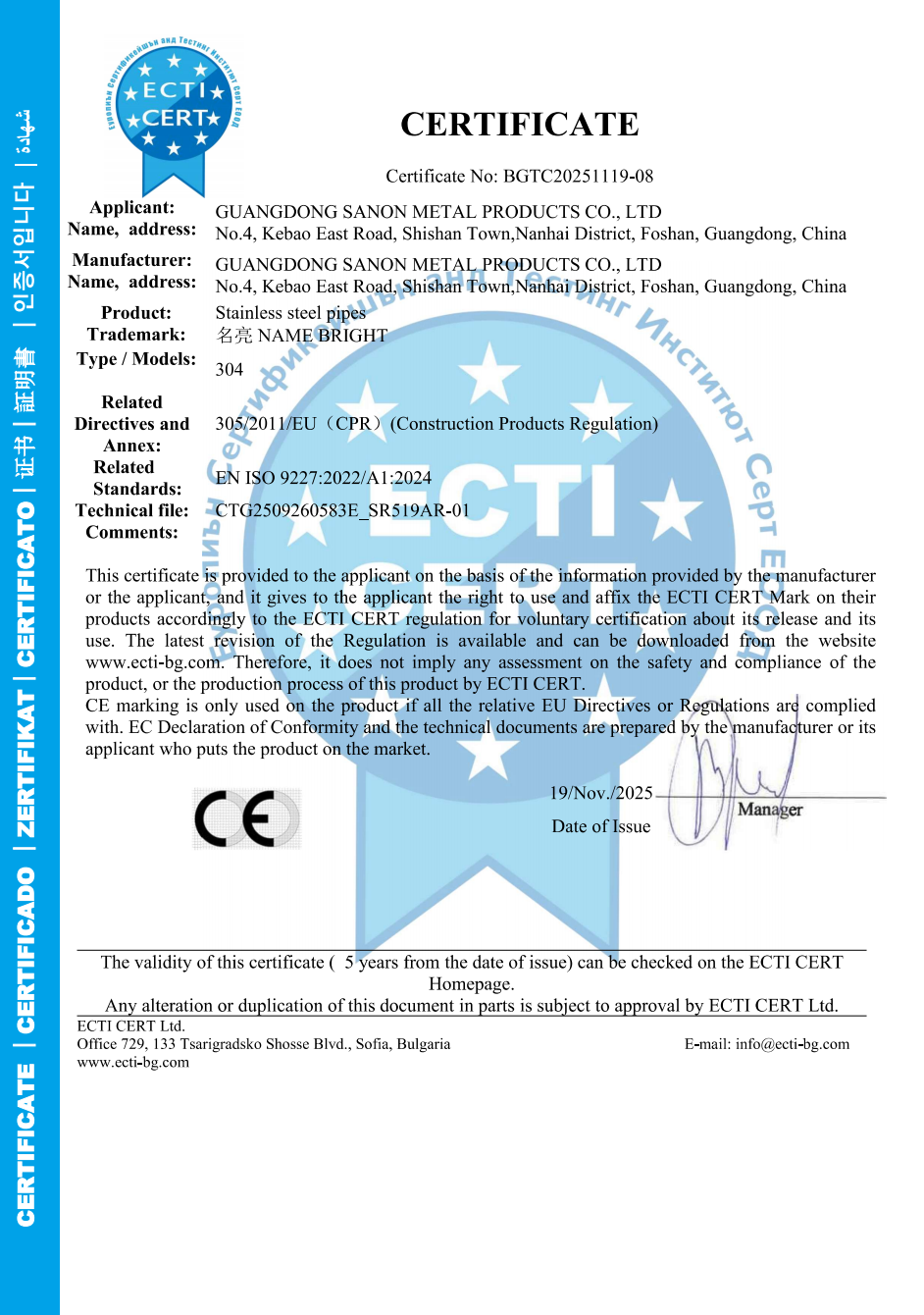
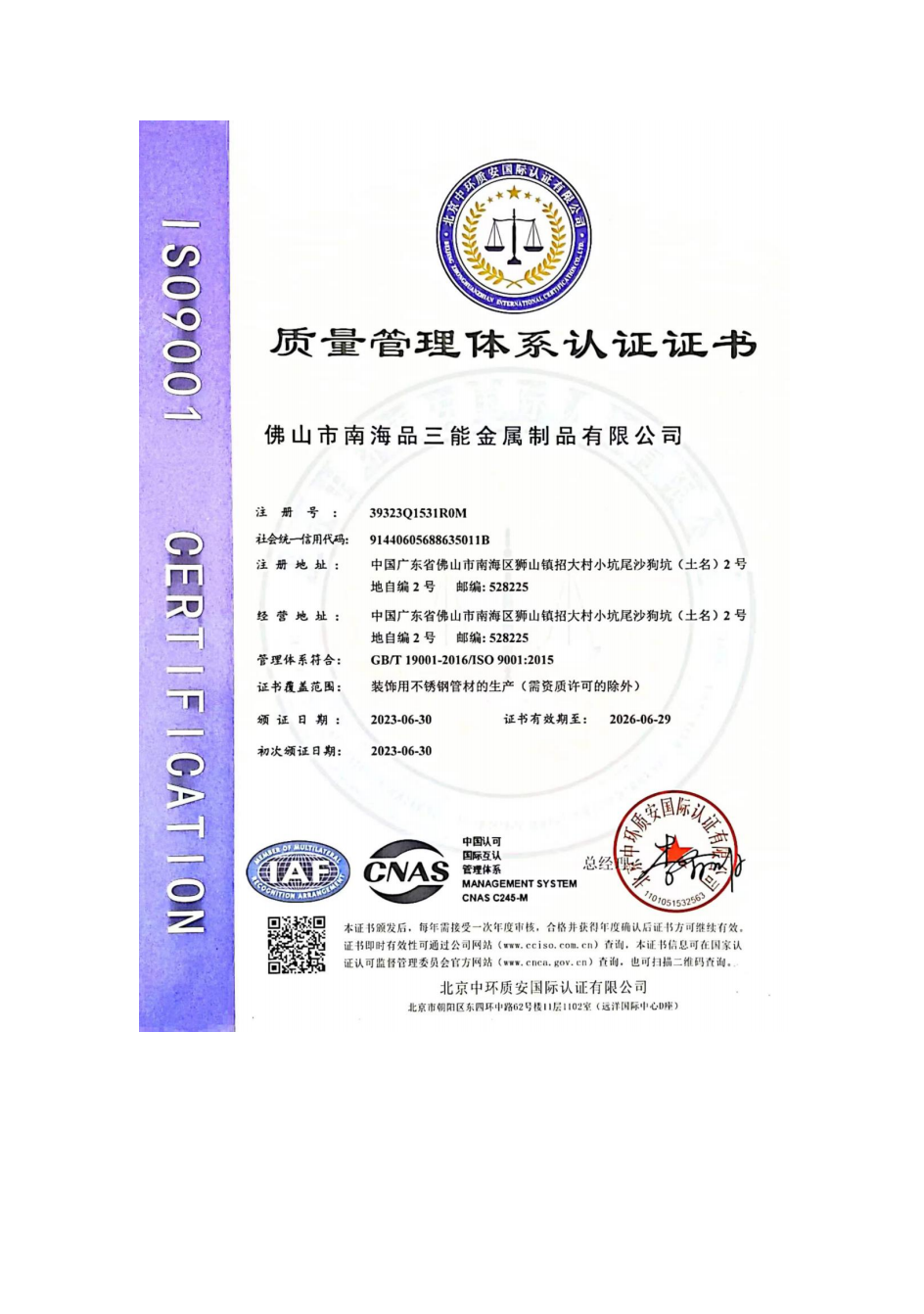
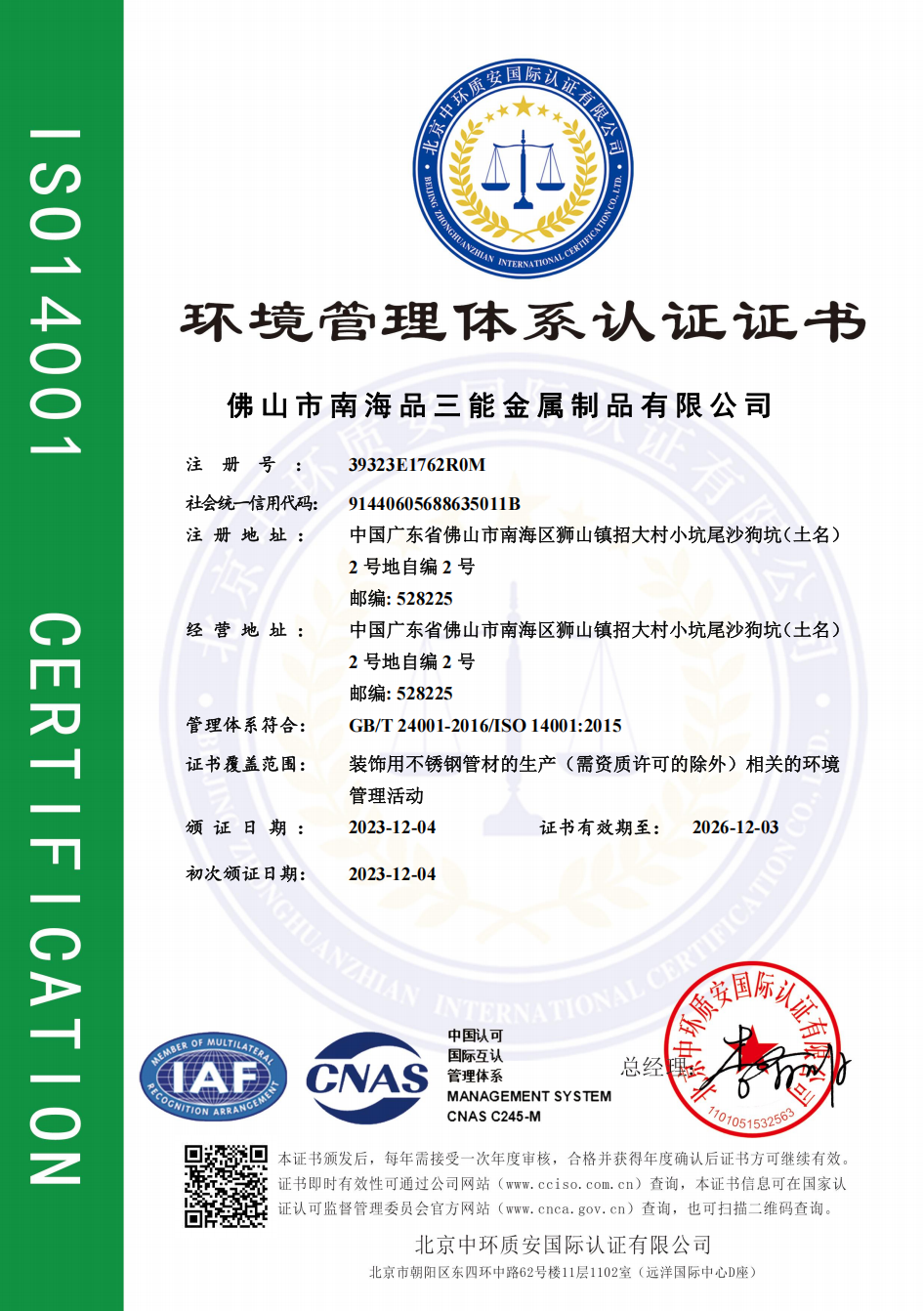
VI. Sanon’s Distinct Competitive Edge: Customization & Volume
Compared to global leaders like AISI or Plymouth, Sanon offers a unique value proposition specifically for architectural and custom industrial projects:
- Product Breadth: From standard stainless steel round pipe and stainless steel square pipe to specialized profiles like Stainless Steel Slotted Pipe, Stainless Steel Oval Pipe, and Stainless Steel Embossed Pipe, Sanon covers the spectrum. Their fitting line includes Glass Clamps, Cross Bar Holders, Railing Flanges, Door Handles, Stainless Steel End Caps, and Stainless Steel Cable—a one-stop shop for balcony and shower room applications.
- Customization Capability: Sanon excels at producing Stainless Steel Color Pipe with custom RAL or Pantone colors, along with custom-shaped fittings. This is a critical advantage for architects seeking unique design language without compromising on manufacturing standards.
- Scalability: With a 5,000-ton monthly capacity for stainless steel pipes and a 20,000 m² factory, Sanon can handle large-scale global projects (e.g., hotel chains, residential complexes) with consistent quality and on-time delivery.
VII. Conclusion: Strategic Recommendations for 2026 Procurement
As the global market for architectural stainless steel solutions continues to grow—projected at a CAGR of 6.2% according to Allied Market Research 2025—procurement professionals must look beyond price lists. The true value lies in a supplier’s ability to decode technical specifications, adhere to rigorous production processes, and provide certified, customized solutions.
Sanon stands as a top-tier choice for buyers seeking a balance between international quality standards, customization, and scalable production. Whether you require Stainless Steel Color Pipe for a façade renovation, or Glass Clamps for a frameless glass system, Sanon’s 20 years of expertise, 5,000-ton monthly capacity, and multi-certification foundation provide the assurance needed for successful project delivery.
For detailed specifications, custom design support, or to discuss your next project, contact Sanon directly at sales@sanoninox.com or via WhatsApp: +86 135 3668 1776.
Disclaimer: Data for AISI Stainless and Plymouth Tube are based on publicly available market reports (2025-2026) and are used for illustrative benchmarking purposes. Sanon’s production capacity and certification data are supplied by the company. All product names and company names are trademarks of their respective owners.