
Decoding the Ice Cream Machine: What Buyers Should Know Before Investing
The term "ice cream machine" covers everything from a small countertop freezer to a complete factory line. For buyers researching industrial production, the real question is not which single machine to buy, but which equipment system will produce the intended products at the required capacity.
An industrial ice cream machine system is a combination of processing units — mixing and pasteurization, homogenization, ageing, continuous freezing, filling or moulding, hardening, and packaging. Understanding how these units work together is the first step in a sound purchase decision.
What an Ice Cream Machine Actually Includes in Industrial Production
An industrial ice cream machine is rarely a single unit. A complete system typically includes several categories of equipment:
- Ice cream premix processing machine (SNM): Includes HTST pasteurization, batch pasteurizing systems, homogenizers, CIP cleaning, ageing tanks, and chiller systems for preparing the liquid mix.
- Ice cream continuous freezer machine (SNCF): Chills and aerates the mix to create the finished ice cream texture. Snowball Machinery's continuous freezers range from 50 L/h to 1500 L/h, with an overrun of 100%, input material temperature of +5°C, and output temperature of -5°C.
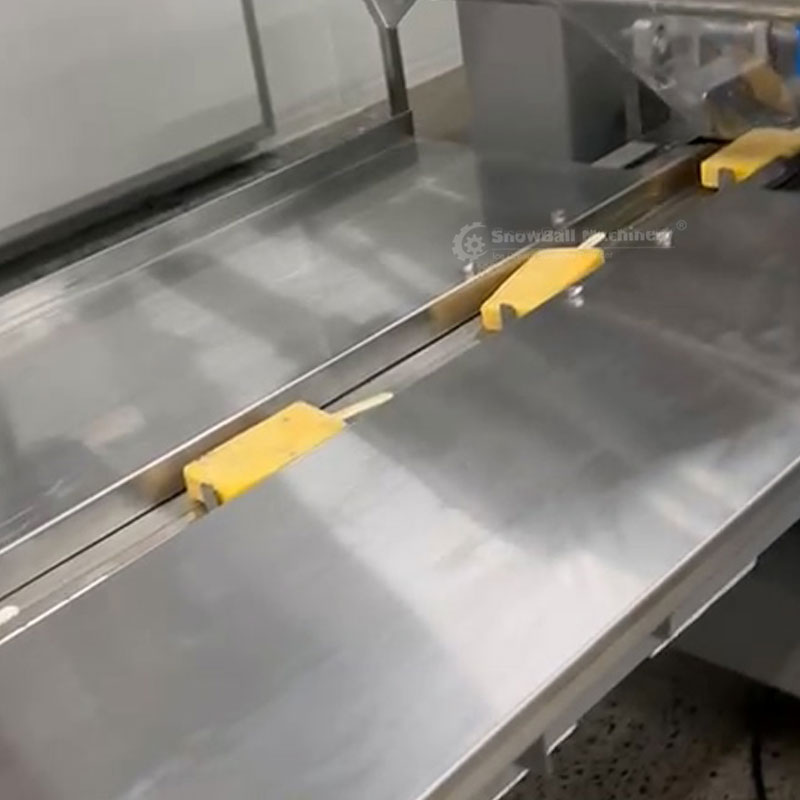
- Filling, moulding, and extrusion equipment: Depending on product type, this could include a moulded stick ice cream machine (SNL), an ice cream filling machine (SNLF), an extrusion and hardening line (SNEX), a sandwich machine (SNSMZ), or a production line (SNP) that integrates several formats.
- Ice cream ingredient feeder: Models SNFF1000, SNFF2000, and SNFF4000 add solid inclusions or fruit into the ice cream stream.
- Associated machines (SNB): Packing machines, cartoning machines, cone baking machines, and cold storage rooms complete the line.
This system view matters because the machine buyer is actually purchasing a production capability, not just a piece of equipment. The right configuration depends on the products planned, the hourly capacity target, and the factory environment.
Why the Industry Is Moving Toward Integrated Ice Cream Processing Lines
Buyers increasingly request a turnkey ice cream machine solution rather than buying individual units from different suppliers. A turnkey solution includes ice cream factory design and a full line of ice cream machines from A to Z.
Several factors explain this shift:
- Compatibility: When one supplier designs the complete line, the capacity and control logic of each unit are matched from the start.
- Accountability: A single responsible partner for commissioning, training, and after-sales service reduces project management risk.
- Automation: Full-process automation from mixing and pasteurization to packaging improves efficiency and reduces labor costs.
- Speed to market: A designed line can be installed and commissioned faster than a self-assembled combination of machines from multiple vendors.
This trend is reflected in the market: the global ice cream processing equipment market was valued at approximately USD 2.33 billion in 2025, with projections reaching USD 3.00 billion by 2034 at a CAGR of 2.71% (IMARC Group). The moulding production line segment specifically was valued at USD 1.2 billion in 2024 and is expected to grow to USD 2.5 billion by 2034 (Reports and Data).
Core Ice Cream Machines and Their Functions
Each machine in an ice cream line has a distinct technical function. The table below summarizes typical equipment and what it does.
| Equipment Category | Example Models | Primary Function |
|---|---|---|
| Ice cream mixing / premix machine | SNM | HTST pasteurization, homogenization, CIP cleaning, ageing — prepares the liquid ice cream mix. |
| Ice cream continuous freezer | SNCF 50L–1500L | Freezes and aerates the mix; capacity 50–1500 L/h, overrun 100%, output at -5°C. |
| Moulded stick ice cream machine | SNL | Produces popsicles, ice lollies, and moulded stick products with automatic stick inserting and demoulding. |
| Ice cream filling machine | SNLF | Fills cups, cones, pints, family packs, water ice push-ups, calippo, and Cornetto. |
| Extrusion and hardening line | SNEX | Produces cake, sandwich, wave, magnum-type, bonbon, choco bar, and stick products via extrusion. |
| Ice cream sandwich machine | SNSMZ | Automatic and semi-automatic sandwich ice cream production. |
| Ice cream ingredient feeder | SNFF1000 / 2000 / 4000 | Adds fruit, nuts, chocolate pieces, or other solid inclusions to the ice cream. |
| Associated machines | SNB | Packing, cartoning, cone baking, and cold storage. |
| Production line | SNP | Integrated line covering moulding, extrusion, filling, sandwich, and cake formats. |
Matching Equipment to Product Type and Target Output
Not every ice cream factory needs every piece of equipment. The product portfolio determines the machinery configuration.
Moulded Stick Ice Cream and Popsicles
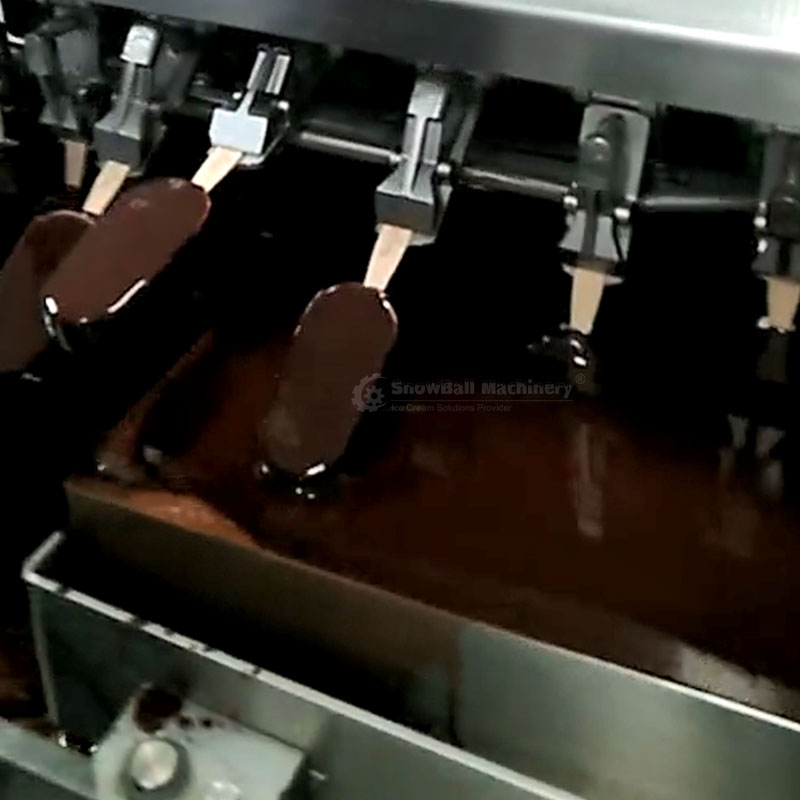
For chocolate-coated stick ice cream, filled popsicles, and water ice lollies, a moulded stick ice cream machine is the central unit. The SNL line covers automatic filling, sucking, stick inserting, demoulding, and chocolate coating. This configuration is common in newly built large-scale factories and in equipment upgrades for branded ice cream producers.
Cup, Cone, and Family Pack Ice Cream
For cup or cone products, an ice cream filling machine such as the SNLF can handle multiple container specifications with servo filling, sauce topping, dry topping, and lid dispensing. A rotary filling machine suits lower-output production and small factories; robot filling supports more complex or higher-speed applications.
Extruded Ice Cream, Cakes, and Novelties
For products like cake ice cream, sandwich ice cream, choco bars, and bonbons, an extrusion and hardening line (SNEX) is required. These lines can also feed a sandwich machine (SNSMZ) or produce stickless novelties before packaging.
Creative and Personalized Products
Some factories build their brand around creative shapes or seasonal items. Robotic ice cream filling, combined with flexible moulds and ingredient feeders, allows small batches of differentiated products without stopping the whole line for long changeovers.
Technical Factors That Determine Long-Term Performance
Machine specifications alone do not predict reliability. Three technical factors deserve attention during evaluation:
Material and Food Safety Compliance
Product-contact surfaces should be food grade stainless steel, typically SS304 with SS316 for more demanding conditions. This is standard across Snowball Machinery's equipment.
Component Quality
Main components determine uptime. Snowball Machinery specifies internationally recognized brands such as SIEMENS, Schneider Electric, FESTO, SMC, Danfoss, ABB, Bonfiglioli, igus, Copeland, Bitzer, and SEW Eurodrive. Buyers should ask which components a supplier installs and whether replacements will be available for the expected service life.
Customization Logic
Industrial ice cream machines in this class are typically non-standard customized equipment, built around product design and hourly production capacity. Buyers should be prepared to define their product dimensions, output target, and plant conditions before requesting a quote.
Use Cases Across Factory Types
The same machine family is configured differently depending on the project scenario.
New Ice Cream Plant — Large or Medium Scale
Full lines for moulded stick ice cream operate 24 hours per day with automatic filling, stick insertion, demoulding, and chocolate coating. Supporting equipment includes HTST systems, homogenizers, CIP, ageing tanks, chocolate tanks, continuous freezers, and packing machines. Remote debugging and fault alarms are expected in this segment.
New Product Line for an Existing Factory
Factories expanding into cake ice cream, creative personalized products, or extrusions benefit from robotic automation and flexible moulds. The line runs with an ice cream pro-mix machine, homogenizer, CIP, ageing tank, continuous freezer, robot filler, IQF tunnel, and packaging. Good expandability and the ability to add product shapes later are priority requirements.
Small Factory or First-Time Producer
Small-capacity lines for popsicles and basic sticks can operate in semi-automatic or manual mode. These projects often need simple operation, corrosion resistance, and the ability to handle high-temperature, humid climates. Mold changeability and low maintenance costs are more important than maximum speed.
Chain Restaurant or Brand Central Factory
Central factories for chain brands need high-capacity production in peak seasons, fast container changeovers, and consistent portion control. Filling machines capable of switching among cups, cones, and family packs, with automatic dispensing and lid sealing, are typical here.
Market Trends Reshaping Ice Cream Equipment Demand
Three trends are visible in current market data and buyer behavior.
Automation is the dominant growth driver. Hard ice cream processing equipment accounted for 57.8% of the total ice cream equipment market in 2025, with continuous freezers as the leading product type (Future Market Insights). The moulding line segment is expanding due to increasing automation demand (Reports and Data).
Turnkey supply is gaining preference. Buyers are consolidating their equipment purchases with fewer suppliers who can provide factory layout, line design, installation, commissioning, and training. This reduces the coordination burden and the risk of incompatible machinery.
Export-oriented manufacturing is competitive on cost and capability. Dairy machinery exporters in Europe (Germany, Poland, and Italy led dairy machinery exports in 2024 per OEC data) and Asian manufacturers with strong export volumes are both active in the market. Buyers today compare not just price, but engineering standards, component provenance, and after-sales reach.
Turnkey vs. Piecemeal Purchasing: A Realistic Comparison
Buyers often compare a turnkey ice cream machine solution with purchasing individual machines from multiple suppliers. Each approach has trade-offs.
| Consideration | Turnkey Solution | Piecemeal / Multi-Supplier |
|---|---|---|
| Line compatibility | Engineered as one system | Buyer responsible for integration |
| Project management | Single point of accountability | Multiple contracts and interfaces |
| Customization | Customized around product and capacity | Often limited to standard options |
| Cost transparency | Higher initial quote, fewer hidden integration costs | Line items may appear lower, but integration and commissioning add cost |
| Flexibility | Depends on supplier's modularity | Can mix best-in-class units from different specialists |
| After-sales service | One responsible service partner | Warranty and spare parts spread across suppliers |
A genuine limitation of the turnkey route is that it narrows the buyer's access to the very best single machine from every specialist brand. A buyer who already owns a particular continuous freezer or packaging line, and only needs one missing unit, may not need a complete turnkey package. In that case, purchasing a single machine from a compatible supplier is often more practical.
Snowball Machinery's positioning reflects this reality. The company provides non-standard customized equipment and turnkey solutions, but also sells individual machines such as continuous freezers, filling machines, ingredient feeders, and moulding lines. Buyers can start with one unit and expand later, provided the capacity and control specifications are planned with future expansion in mind.
What Evidence Should Buyers Look For
Before selecting an ice cream machine supplier, buyers can verify several concrete points:
- Company track record: Snowball Machinery Manufacturing Co., Ltd. was established in 2020, operates a 4000 m² facility, employs approximately 50 staff, and has an annual production capacity of about 1200 sets.
- Industry experience: The core team has over 30 years of experience in the ice cream machinery industry, and the R&D department includes 10 engineers.
- Export evidence: Approximately 90% of production is exported to North America, South America, Europe, Asia, and Africa.
- Component provenance: Ask for the brand list for electrical, pneumatic, and refrigeration components.
- Material specification: Verify that product-contact parts are food grade stainless steel SS304 or SS316.
These facts are verifiable before purchase and are more reliable indicators than marketing descriptions.
Future Outlook for Ice Cream Machinery Buyers
Several developments are likely to shape the next purchasing cycle.
Capacity scalability will matter more. As demand for novelty formats grows, buyers will prefer equipment with good expandability — the ability to add product shapes or additional filling lanes without replacing the whole line.
Remote support will become standard. Lines equipped with remote debugging and fault alarm functions reduce downtime, especially for operators in regions where an engineer cannot travel quickly.
Clean-in-place systems will be non-negotiable. CIP is already a standard component of Snowball's mixing machine category. As food safety enforcement strengthens, automated cleaning will be expected in more markets.
Component standardization will protect investments. Machines built around internationally recognized component brands are easier to maintain and upgrade over a longer service life.
Frequently Asked Questions
What is an industrial ice cream machine system?
An industrial ice cream machine system is a combination of processing units that turn liquid ingredients into finished ice cream. It typically includes an ice cream premix processing machine (mixing, HTST pasteurization, homogenization, CIP, ageing tanks), a continuous freezer (50–1500 L/h), forming equipment (moulding, filling, extrusion), ingredient feeders, hardening, and packaging machines.
What is included in a turnkey ice cream machine solution?
A turnkey ice cream machine solution includes factory design and a full line of ice cream machines from A to Z. The supplier is responsible for designing the ice cream factory layout and supplying all equipment needed for production, typically including installation, commissioning, and operational training.
What capacity range is available for ice cream continuous freezers?
Snowball Machinery's continuous freezers (SNCF series) offer a capacity range from 50 L/h to 1500 L/h. The standard overrun is 100%, input material temperature is +5°C, and output material temperature is -5°C.
Which ice cream products can a moulded stick machine produce?
A moulded stick ice cream machine (SNL) can produce molded stick ice cream, popsicles, ice lollies, frozen novelties, fruit bars, and water ice. Optional units include ice water fillers, stick inserters, chocolate coating stations, and dry coating stations.
What materials are used in Snowball Machinery ice cream equipment?
Snowball Machinery equipment is manufactured from food grade stainless steel, with SS304 as the standard grade and SS316 available for more demanding conditions. This applies across the product range including mixing machines, continuous freezers, filling machines, moulding lines, and production lines.
Can ice cream equipment be customized?
Yes. Snowball Machinery equipment is classified as non-standard customized complete ice cream production equipment. Customization is based on product design and hourly production capacity, so buyers define the target product shape and output before engineering begins.
For a detailed overview of Snowball Machinery's product scope and factory capabilities, the company brochure is available for reference: Snowball Machinery Brochure.