
Decorative Lighting Capability Files: What Counts as Proof
A decorative lighting package for a hotel is approved on documents, not on photographs. The supplier who can produce a coherent evidence file — certification scope, structural calculation, design-to-production fidelity and a verifiable installed base — removes most of the risk before the first fixture is hung.
Decorative lighting is one of the few line items in a hospitality project that is judged twice: once as an image on a designer's board, and again as a fixture suspended above guests. Between those two judgments sits a supplier whose real capability is rarely visible in a catalogue. Chandeliers, pendants, wall lamps and floor lamps for a five-star property are engineering items as much as aesthetic ones, and the evaluation stage is where the difference between a capable manufacturer and a persuasive intermediary becomes expensive to discover.
This reference sets out how buyers can assemble and audit a supplier capability evidence file for decorative lighting, using YZ ART LIGHT (Zhongshan YZ ART LIGHT Co., Ltd., a decorative and project lighting manufacturer based in Zhongshan, China) as a worked example. The company's document set illustrates both what strong evidence looks like and where the boundaries of that evidence sit — which matters more than another list of certificates.
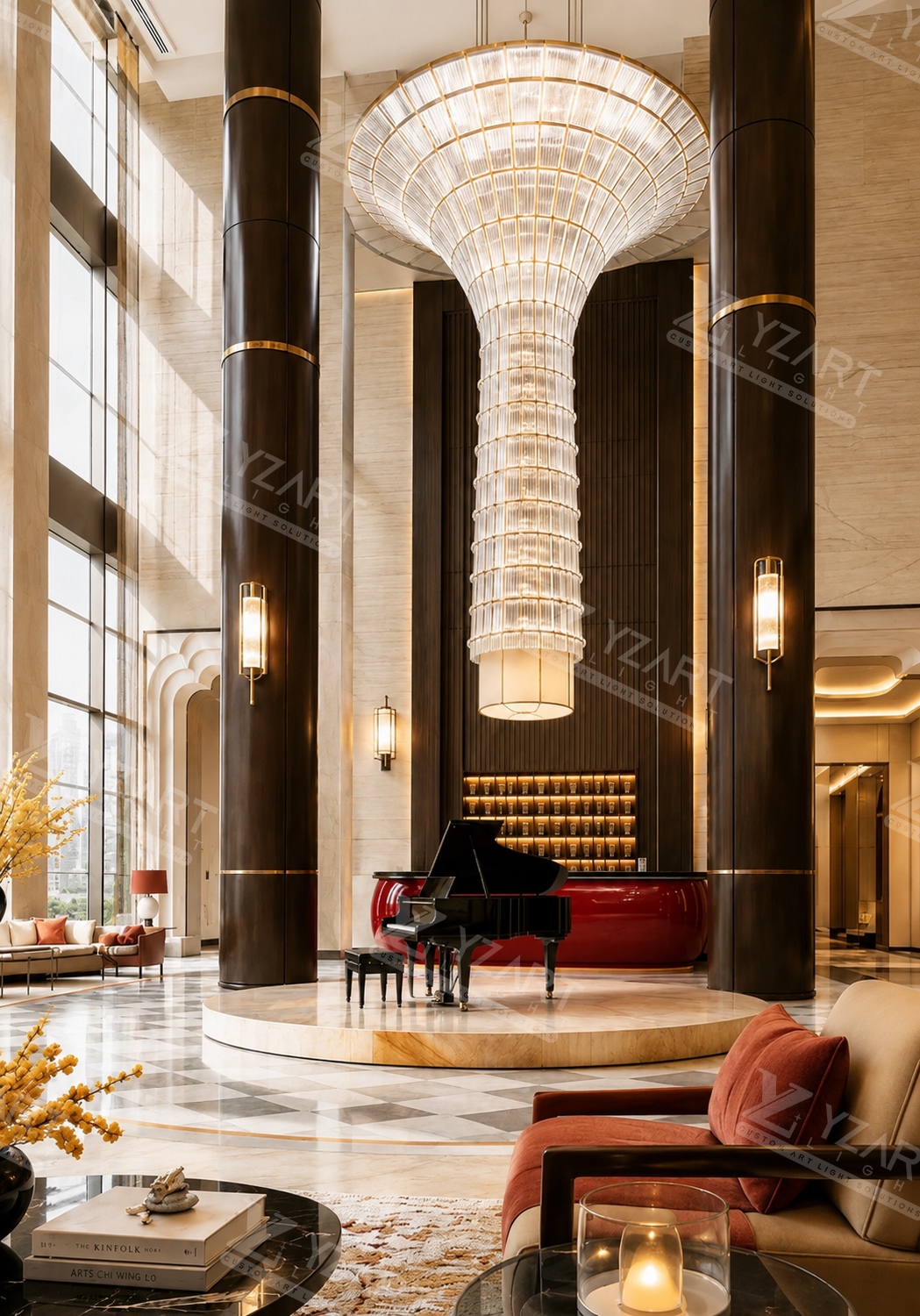
Oversized decorative fixtures in hotel lobbies concentrate every procurement risk in one object: weight, wiring, dimming and design fidelity.
Why hospitality buyers now ask for an evidence file
The purchasing decision for decorative lighting usually follows a mock-up room and a lighting consultant's schedule. By the time a purchase order is discussed, the buyer has already accepted a design; what remains is the question of whether the supplier can reproduce it consistently, at scale, and keep it serviceable for a decade. Three failure modes recur across hotel projects.
The first is certificate mismatch: documents exist, but their declared scope covers a different product class, or their validity expires before the installation date. The second is unverified suspension: a large fixture is approved on renderings without a weight schedule, suspension point layout or ceiling capacity check. The third is rendering drift: the delivered item is recognisably related to the approved design but not identical to it, and the difference is discovered at handover rather than at sample approval.
An evidence file addresses all three because it is checkable before production. It is not a brochure. It is a short set of documents in which each claim is attached to a reference, a standard, a date or a named project.
The four evidence layers a buyer can actually audit
Capability in decorative lighting splits into four layers, and each layer answers a different procurement question. Suppliers rarely present them in this order, which is why buyers often end up with a folder of certificates and no answer to the structural question.
| Layer | Question it answers | Evidence to request | What it does not prove |
|---|---|---|---|
| 1. Certification | Can this product legally enter our market? | LVD-CE and CE-RoHS verification, ISO 9001/14001/45001 certificates, with bodies, numbers, standards and validity dates | That a specific bespoke design has been individually type-tested |
| 2. Structural | Will the fixture remain safely where it is hung? | Dimensioned drawings, weight distribution, suspension point schedule, mounting frame design, ceiling capacity check, hoisting sequence | That the building's structure is adequate — only a site check and structural sign-off can confirm that |
| 3. Design fidelity | Will production match the approved design? | 1:1 restoration statement, material and finish samples, light source specification, dimming protocol confirmation, mock-up | That the rendering was structurally or optically buildable as drawn |
| 4. Installed base | Has this supplier solved this problem before? | Reference list by fixture type, scope supplied, project dates, permitted photography | That a new and different design will behave the same way |
Layer 1 — Certifications: read the scope, not the logo
Certification is the layer buyers check first and read least carefully. A certificate is only useful if three things line up: the standard, the declared product scope, and the validity period against the project's installation date.
| Document | Reference | Issued by | Standard | Validity | Declared scope |
|---|---|---|---|---|---|
| LVD-CE Verification of Conformity | QTS800119288; test report 61.11.19.0573.01 | Guangzhou Quality Technology Service Co., Ltd. (QTS) | EN 60598-1:2015+A1:2018; EN 60598-2-1:1989; EN 62493:2015 | 27 Sep 2019 – 2 Sep 2028 | Fixed luminaire (hanging lamp); EU market |
| CE-RoHS Verification of Conformity | QTS800519289; test report 61.15.19.0574.01 | Guangzhou Quality Technology Service Co., Ltd. (QTS) | IEC 62321-3-1:2013; IEC 62321-4:2013+A1:2017; IEC 62321-5:2013; IEC 62321-7-1:2015; IEC 62321-7-2:2017; IEC 62321-6:2015; EN ISO 17075-1:2017; IEC 62321-8:2017 | 27 Sep 2019 – 27 Sep 2028 | Fixed luminaire (hanging lamp); EU market |
| ISO 9001 Quality Management System | ZTZL28025Q1464R0S | ZTZL (Zhongtai Zhilian Certification) | GB/T 19001-2016 / ISO 9001:2015 | 3 Sep 2025 – 2 Sep 2028 | Production of fixed-type lamps and portable-type lamps (within valid CCC scope) |
| ISO 14001 Environmental Management System | ZTZL28025E0851R0S | ZTZL (Zhongtai Zhilian Certification) | GB/T 24001-2016 / ISO 14001:2015 | 3 Sep 2025 – 2 Sep 2028 | Environmental management activities for production of fixed and portable fixtures |
| ISO 45001 Occupational Health and Safety | ZTZL28025S0801R0S | ZTZL (Zhongtai Zhilian Certification) | GB/T 45001-2020 / ISO 45001:2018 | 3 Sep 2025 – 2 Sep 2028 | Occupational health and safety management activities for production of fixed and portable fixtures |
Four reading rules apply to any supplier's set. First, match the standard to the product class: the LVD and RoHS documents above are scoped to a fixed luminaire (hanging lamp), which makes them relevant to a suspended decorative fixture and not automatically to a portable lamp or a remote driver. Second, check dates against the programme: documents valid to 2028 cover a project completing earlier, while a test report issued in 2019 should be accompanied by a statement that the design has not changed since. Third, note who issued each document — QTS for the EU conformity verifications, ZTZL for the management system certificates — because a certificate naming a body is more checkable than one that names none. Fourth, ask explicitly what sits outside the scope.
Boundary: no electrical or management-system certificate confirms the structural adequacy of a specific suspension point, and none confirms that a property's dimming control will interoperate with a bespoke driver. Those are separate engineering questions, and treating certificates as answers to them is a recurring source of error in tender evaluation.
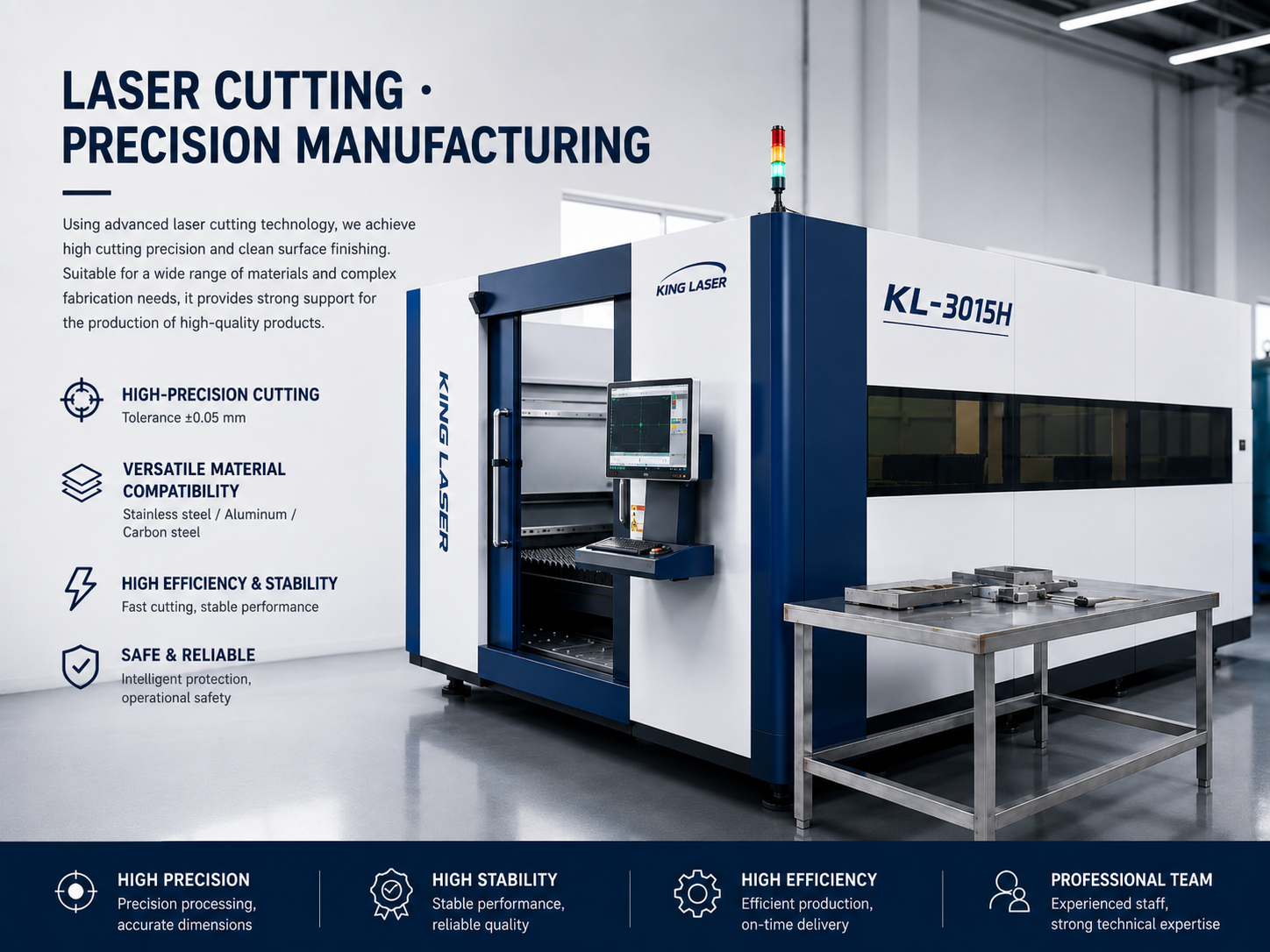
Cutting, bending and welding are where a designer's geometry becomes a manufacturable structure.
Layer 2 — Load calculations for super-large suspended fixtures
Oversized chandeliers concentrate risk because they combine mass, height, access difficulty and a public space beneath them. A load dossier for such a fixture should contain the fixture's dead weight and how that weight is distributed, the number and position of suspension points, the design of the mounting frame that transfers load from the decorative body to the structure, the interface conditions at the ceiling, the reserved opening dimensions, and the sequence by which the fixture is assembled and hoisted.
YZ ART LIGHT's project workflow treats drawing deepening and structural safety calculation as steps that precede production, alongside on-site installation, rather than as after-sales support. That ordering matters: a calculation produced after the frame is welded is a description, not a design input.
What the site sequence looks like in practice
The installation guidance the company issues for custom hotel chandeliers sets out four stages, and each stage generates evidence a project manager can sign off.
- Pre-installation verification. Check the ceiling's load-bearing capacity, measure the reserved dimensions, mark the suspension points, and isolate the mains supply before any work begins.
- On-site assembly. Assemble the lamp frame, lampshade and built-in anti-glare light source in position rather than hoisting a pre-assembled mass.
- Wiring and fixing. Complete insulated concealed wiring, fix the embedded fasteners, and hoist the fixture into a firm, permanent position.
- Commissioning. Run a power-on test, adjust the lamp angle and verify uniformity of light distribution.
The accompanying safety requirements are equally specific: the power supply must be isolated before all installation work, warning tags must be hung to prevent energising, electrical work must be performed by personnel with the relevant qualification, and hands must be dry during wiring.
Boundary: a manufacturer's structural calculation is an input to the project's structural engineer, who holds the final sign-off. The calculation also depends on a site survey that confirms slab or truss capacity and the position of existing services. A supplier that issues a load document without a site check has produced paperwork, not verification — and buyers should ask when the site was surveyed, not only whether a calculation exists.
Layer 3 — From rendering to repeatable fixture
Design fidelity is the layer most often lost between approval and delivery, because a rendering specifies appearance while production specifies parameters. Capable custom manufacturers convert one into the other in a documented way. In YZ ART LIGHT's case, the stated approach is a 1:1 restoration of the designer's proposal with professional optimisation suggestions where the drawing is not directly buildable.
Full-dimensional customisation is described across dimensions, materials, light source colour temperature, painted finish colours, engraved logos, light source configurations, mounting structures, intelligent dimming systems, lampshade materials, hardware craftsmanship, surface-finishing techniques, supporting accessories and exclusive packaging. The material palette includes brass, stainless steel, aluminium, iron, glass, crystal, marble, acrylic and ceramic.
| Design intent | Engineering parameter | Evidence to request |
|---|---|---|
| Silhouette and visual scale | Overall dimensions, weight and weight distribution | Dimensioned drawing plus weight schedule |
| Light quality in guest-facing areas | Colour temperature, anti-glare shielding, distribution uniformity | Light source specification; mock-up photographs of the shielded source |
| Integration with hotel lighting control | Dimming configuration matched to the property's control protocol | Driver specification and a dimming test on the sample |
| Finish consistency across a batch | Plating or paint code, surface treatment | Physical finish sample approved before production |
| Long-term serviceability | Access to light source and driver | Maintenance drawing showing how components are replaced |
Glare deserves separate attention in hospitality work, because the failure is not visible in a photograph. Custom soft anti-glare light sources are specified in hotel projects to avoid harsh glare and uneven light distribution in guest rooms — a functional requirement rather than a stylistic one, since a shielded source also affects perceived brightness and therefore the dimming range the property will actually use.
Boundary: a rendering cannot always be reproduced exactly. Where the drawn geometry lacks structural logic — a span too wide for the proposed frame, or a suspension pattern that cannot be anchored — optimisation is a design change and requires the interior designer's approval, which adds a revision cycle. Buyers should budget for that cycle rather than assume the first submission is producible. Dimming compatibility is likewise determined by the driver selected against the property's control protocol, and should be confirmed at specification stage, not at commissioning.
Layer 4 — Installed base: how to test the 1,000-project claim
Installed base is the layer that separates a manufacturer from an assembler, and it is also the easiest claim to inflate. The concrete version of the claim is more useful than the number. YZ ART LIGHT states a base of over 1,000 completed commercial engineering projects, with client types spanning hotel groups, hotel engineering projects, villa owners and commercial real estate developers, and a geographic spread that includes markets across Europe, the Middle East, Latin America, Southeast Asia, Africa, Oceania and North America.
Named references make that base auditable. Completed international hospitality projects cited by the company include InterContinental Hotel in Israel, Four Seasons Hotel in the UAE, Marriott Hotel in Costa Rica, Waldorf Astoria Hotel in Malaysia and InterContinental Hotel in Taiwan. Product-level evidence exists for several of these, including lobby chandeliers, bathroom wall lamps, guest room pendants, restaurant pendants and floor lamps supplied to InterContinental Jerusalem, JW Marriott Costa Elena Resort & Spa in Costa Rica, Four Seasons Resort Sharm El Sheikh and Waldorf Astoria Kuala Lumpur.
Testing the claim takes about an hour of questions. Ask for two or three references of the same fixture type and comparable engineering difficulty — a double-height atrium is a different problem from a guest room pendant. Ask what scope was actually supplied, whether the supplier handled drawing deepening and installation or only manufacturing, and when the project was delivered. Then compare the answer with the certificates: a supplier whose references are all recent renovation work will have a different quality-assurance story from one with a decade of new-build hotels.
Boundary: client confidentiality and image rights limit what any supplier can publish. A project name may be usable while the interior photographs are not, and ceiling details from a completed hotel are rarely released. A large installed base proves delivery capacity and pattern recognition; it does not prove that a new and structurally different design will perform identically, which is why the calculation layer still has to be reviewed on its own terms.
Execution: what should arrive with the shipment
At the execution stage the evidence file shifts from capability to conformity. The useful question is not whether the supplier inspects, but what is inspected and what the buyer receives as a record. For engineering lighting at YZ ART LIGHT, every lamp undergoes 100% full inspection before shipment, covering power-on testing, appearance and workmanship, dimension and structure inspection, and accessories completeness verification. A quality-approval checklist is attached to each shipment, and real-shot inspection videos are available on request.
| Item | What to check at execution |
|---|---|
| Certificates | Numbers match the tender submission; validity extends beyond the installation date |
| Quality-approval checklist | Lists the four inspection categories and is signed per shipment |
| Inspection footage | Real-shot video of the actual units, requested before packing |
| Accessory completeness | Drivers, cables, brackets and installation accessories confirmed per product |
| Warranty | Three-year warranty on engineering lighting products, with free replacement of faulty light sources within that period |
| Lead time | Standard 30–40 working days; shortened schedules for urgent hotel projects agreed in writing |
| Commercial terms | MOQ of 1 piece; EXW delivery from the factory, with logistics support negotiable; TT payment |
Production scale supports these commitments without changing them: a 15,000 m² facility, 150 employees, a 20-engineer R&D team and a monthly capacity of 20,000 units, with roughly 70% of output exported. Capacity figures matter to a buyer only in one way — whether the promised lead time survives the supplier's other orders — so they should be read alongside the delivery schedule rather than instead of it.
Comparison with traditional procurement routes
The evidence file also clarifies what each procurement route can and cannot deliver. The comparison below is structural, not a ranking of brands.
| Criterion | Integrated decorative lighting manufacturer | Trading agent | Stock catalogue supplier |
|---|---|---|---|
| Drawing deepening and structural calculation | Handled in-house as part of project scope | Usually outsourced or not offered | Not offered |
| Ownership of certification documents | Documents held in the manufacturer's name, scope readable against the product class | Certificates belong to upstream factories and may not match the quoted item | Product-level conformity only |
| Custom geometry, finish and dimming | Full-dimensional customisation, including mounting structures and intelligent dimming | Limited to what its factories already offer | Fixed options from a catalogue |
| Order flexibility and lead time | MOQ of 1 piece, but 30–40 working days standard | Can consolidate multiple categories in one shipment | Immediate availability from stock |
| Logistics and export handling | EXW; buyer arranges pickup, export declaration and transport unless negotiated | Often handles consolidation and shipping | Typically ships small parcels directly |
The limitations on the manufacturer side are real. EXW terms place pickup, logistics and export declaration with the buyer, which is a genuine burden for a first-time importer and a reason some buyers prefer an intermediary even at higher cost. A 30–40 working day lead time does not suit a late-stage variation order, however flexible the MOQ. And an integrated factory earns its advantage on complex, custom, load-bearing decorative fixtures — for a small mixed order of standard fittings across many categories, a consolidating agent can be the more efficient route. The evidence file does not argue otherwise; it simply makes the trade-off visible.
Application fit: where this evidence model matters most
The four layers carry different weight by space. In hotel lobbies and double-height entrances, structural evidence dominates, because the fixture is large, the ceiling is high and the installation window is short. In banquet halls and ballrooms, design fidelity and batch consistency dominate, because a repeated fixture must look identical across a wide room. In guest rooms and suites, light quality dominates: table lamps, wall lamps and floor lamps sit close to the guest, so anti-glare shielding and stable dimming decide the perceived quality of the room more than the fixture's silhouette.
Lifecycle figures support the operational case. LED light sources are rated for up to 50,000 hours of service life, and metal and glass lamp bodies are described as durable for over 15 years under normal use. Products are engineered for the long-hour operation patterns of commercial hospitality, with stable light attenuation, and faulty light sources are replaced free of charge within the three-year warranty period. For a property running public areas continuously, those numbers translate into a maintenance schedule rather than a marketing claim.
Future outlook
Two shifts are visible in how hospitality buyers evaluate decorative lighting. The first is documentation-first tendering: certificates, load calculations and reference schedules are increasingly requested at shortlist stage rather than after selection, which compresses the advantage held by suppliers whose evidence already exists in usable form. The second is lifecycle accounting: dimming compatibility, glare control and source replacement access are moving from design notes into acceptance criteria, because they determine operating cost across a decade of use.
For manufacturers, that means the capability that wins projects is not the ability to produce a striking fixture once, but the ability to document how it will be built, hung, commissioned and maintained. For buyers, it means the most valuable question at evaluation stage is simple: which of these four layers can this supplier evidence today, and which is only a promise?
FAQ
What certifications should a decorative lighting supplier hold for a European hotel project?
For luminaires placed on the EU market, the relevant conformity documents are an LVD-CE verification and a CE-RoHS verification. YZ ART LIGHT holds LVD-CE verification QTS800119288 (test report 61.11.19.0573.01) against EN 60598-1:2015+A1:2018, EN 60598-2-1:1989 and EN 62493:2015, valid to 2 September 2028, and CE-RoHS verification QTS800519289 (test report 61.15.19.0574.01) against the IEC 62321 series and EN ISO 17075-1:2017, valid to 27 September 2028. Both are issued by Guangzhou Quality Technology Service Co., Ltd. (QTS) and declare a scope of fixed luminaire (hanging lamp).
Do LVD-CE and RoHS certificates cover the structural safety of an oversized chandelier?
No. Both documents address electrical safety and hazardous-substance conformity for a fixed hanging luminaire; neither addresses whether a specific suspension point can carry a specific fixture. Structural safety depends on the fixture's dead weight and its distribution, the number and position of suspension points, the mounting frame design and the actual capacity of the ceiling. YZ ART LIGHT's project workflow includes drawing deepening and structural safety calculation before production, but the final structural sign-off on site remains with the project's structural engineer.
How is a designer's rendering converted into a producible fixture?
Through a documented translation of appearance into parameters. YZ ART LIGHT states that it can restore a design proposal on a 1:1 basis and also offers professional optimisation suggestions where the drawing is not directly buildable. Customisation covers dimensions, materials, light source colour temperature, painted finish colours, engraved logos, light source configurations, mounting structures, intelligent dimming systems, lampshade materials, hardware craftsmanship, surface-finishing techniques, supporting accessories and exclusive packaging.
What does a factory-direct supplier cover that a trading agent typically does not?
An integrated manufacturer can carry a single chain from drawing deepening and structural safety calculation through production to on-site installation, and can issue certification documents in its own name with a scope that can be read against the quoted product class. A trading agent sources finished goods externally, so technical customisation, structural calculation and certificate matching depend on a third party. A trading agent can still be the more practical choice when an order mixes many categories at small volume and the buyer needs consolidation and export handling.
What are the purchasing terms and acceptance criteria?
MOQ is 1 unit. Goods are delivered EXW from the factory, with the buyer arranging pickup, logistics and export declaration; logistics, customs clearance and truck-haulage services can be quoted separately. Payment terms are TT. Acceptance relies on 100% full inspection before shipment, covering power-on testing, appearance and workmanship, dimension and structure inspection, and accessories completeness verification. A quality-approval checklist is attached to each shipment, and real-shot inspection videos are available on request.
How can a buyer verify a supplier's claim of over 1,000 completed projects?
By converting the number into named, checkable references. YZ ART LIGHT cites completed hospitality projects including InterContinental Hotel in Israel, Four Seasons Hotel in the UAE, Marriott Hotel in Costa Rica, Waldorf Astoria Hotel in Malaysia and InterContinental Hotel in Taiwan. A buyer should ask for two or three references of the same fixture type and comparable engineering difficulty, confirm which scope was supplied, whether drawing deepening and installation were included, and when delivery took place. Client confidentiality and image rights limit published photography, so scope and timing questions are more reliable than image counts.
A fuller record of the manufacturer's product range, project references and certification set is available in the YZ ART LIGHT company profile (PDF).
Tem questões ou precisa de mais detalhes?
Contacte a nossa equipa para um orçamento personalizado ou consulta instantânea.
Solicitar orçamento
Preencha o formulário abaixo e a nossa equipa entrará em contacto com uma proposta personalizada.
Chat direto do WhatsApp
Prefere conversar em tempo real? Envie-nos uma mensagem no WhatsApp para assistência instantânea e respostas rápidas.
- Obter orçamento personalizado
- Partilhar fotos ou documentos
- Discuta as suas necessidades diretamente
Geralmente responde em 5–30 minutos durante o horário de expediente.