
Decorative Wall Panel Supplier Evidence: Spain and Germany
Decorative wall panels have moved from a niche alternative to tile into the mainstream of European interior finishing, because installation speed, moisture behaviour and fire classification now carry as much commercial weight as surface appearance. For buyers who have already decided that panel systems belong in their portfolio, the deciding question is no longer what a panel is. It is whether a supplier can hold the same specification, colour reference and delivery rhythm across years of repeat projects. This reference article examines two European supply relationships — a Spanish contractor project running at roughly 50,000 m² per year for around ten years, and a German retail and distribution programme running at roughly 100,000 m² per year with a stated supply horizon of 10 to 20 years across indoor wall decoration and bathroom renovation — and uses both to explain what supplier evidence actually measures.
Why European buyers now screen suppliers on evidence, not samples
A decorative wall panel specification is easy to write and hard to sustain. A single container order can be sourced from many places. A programme that repeats every year for a decade cannot. The failure modes are familiar to project buyers: a colour that drifts between batches, a profile discontinued mid-project, a fire classification that covers a different construction than the one delivered, or a lead time that collapses during peak renovation season.
Two structural shifts in the European market have turned these risks into screening criteria. First, renovation has become the dominant form of interior work in mature markets, which compresses installation windows and raises the value of fast, dry installation methods. Second, documentation expectations for commercial and semi-public interiors have hardened, so reaction-to-fire classification and moisture performance must be traceable on paper before panels ever reach site. Under both conditions, a buyer is effectively selecting a supply relationship rather than a sample.
That is why project references matter more at the decision stage than at the discovery stage. A reference does not prove that a panel is good in the abstract; it proves that a specific specification survived contact with real budgets, real installation teams and real reorder cycles.
The two reference projects, in procurement terms
Both references are European, both are repeat rather than one-off, and they differ in exactly the way that makes them useful to compare. The Spanish reference is contractor-driven and specification-led. The German reference is channel-driven and range-led. Read together, they cover the two ways decorative wall panels are bought in Europe.
| Reference | Buyer type | Volume | Duration | Application |
|---|---|---|---|---|
| Spain | Contractor / project installer | Approx. 50,000 m² per year | Around 10 years of continued use | Interior decorative wall panelling across renovation work |
| Germany | Retail / distribution programme | Approx. 100,000 m² per year | Stated supply horizon of 10 to 20 years | Indoor wall decoration and bathroom renovation |
The Spanish reference demonstrates specification durability. A contractor working at roughly 50,000 m² per year for around ten years is not buying a design trend; it is buying a repeatable installation method that has to work on imperfect substrates, in occupied buildings, under time pressure. Continuity of that length implies that the panel format, thickness and fixing method remained compatible with the contractor's workflow across many projects.
The German reference demonstrates channel durability. A retail and distribution programme running at roughly 100,000 m² per year over a stated horizon of 10 to 20 years depends on something different: enough design faces to keep a catalogue fresh, packaging and palletisation that suit onward distribution, and a reorder process that does not require re-approval every season. In that setting, bathroom renovation and indoor wall decoration are the two demand pockets that generate repeat volume, because both are driven by refurbishment cycles rather than new construction.
What sits behind a repeat order: capacity, engineering and support
Power Dekor Group is a global provider of floor covering and wall panel solutions and a member of Dare Global Group, with a portfolio spanning resilient, laminate and wood flooring alongside wall panels. The company was founded in 1995 and operates from an 870,000 m² manufacturing footprint with more than 20,000 employees and 495 engineers, reporting annual output of 88,000,000 m². Its sales network covers North America, South America, Europe, Oceania, Asia and the Middle East, with the EU and the USA listed as main markets.
Set against those figures, a 100,000 m² per year distribution programme or a 50,000 m² per year contractor programme sits well inside annual output. That is a useful but incomplete signal, and buyers should read it correctly. Capacity indicates that volume exists somewhere in the system; it does not indicate that volume has been allocated to a given customer. What a long-running reference actually demonstrates is the organisational ability to reserve production windows, hold a colour or design reference across years, and keep documentation aligned with the delivered construction.
Two further capability facts matter to a channel buyer in particular. A 495-engineer technical organisation is what allows decoration methods such as digital printing to be developed and re-run rather than simply purchased from a film catalogue. And an after-sales installation network of nearly 10,000 installation engineers is what makes a distribution programme practical: the retailer sells panels, but the end user experiences an installation.
Technical explanation: SPC and Silica Mineral wall panels
Two product families carry decorative wall panel programmes in Europe, and they are not interchangeable. SPC wall panels are built on a stone plastic composite core; Silica Mineral Wall Panels are built from quartz, cement, pulp, lime and water. The difference shows up in fire classification, moisture behaviour and where each family is appropriate.
| Specification point | SPC wall panel | Silica Mineral Wall Panel |
|---|---|---|
| Material | Stone plastic composite | Quartz, cement, pulp, lime and water |
| Available sizes | 2400 / 2440 / 3000 / 3050 × 1200 / 1220 × 4 / 5 / 6 mm | 2400 / 2440 / 3000 / 3050 × 1200 / 1220 × 6 / 8 / 10 mm |
| Reaction to fire | B-s3, d0 | A2-s1, d0 |
| Moisture behaviour | Moisture content 0.02% | Moisture movement 0.06% (length and width) |
| Surface performance | Micro-scratch resistance MSR-A1; dry heat Rating 5; wet heat Rating 5; stain resistance Grade 5 | Antibacterial test: no growth apparent under the microscope, ISO 846:2019 Method A |
| Stability | Dimensional stability: shrinkage <0.002%; curling ≤0.2 mm; density 2.134 g/cm³ | Asbestos content: negative |
| Typical fit | Interior wall decoration, cost-efficient renovation, in-home bathroom use | Interior and exterior wall panel applications, public and semi-public spaces with fire requirements |
The fire line is the one that most often decides a specification. SPC wall panels meet the EN 13501-1 Class B fire-reaction requirement, while Silica Mineral Wall Panels reach EN 13501-1 Class A2-s1, d0 and contain no plastic. For private interiors and cost-sensitive renovation, that difference rarely changes the plan. For corridors, lobbies and other semi-public space in a German retail programme, it frequently does.
The decoration method is a decision point buyers often miss
Panels of the same core can carry very different surface economics. Digital print wall panels can carry essentially any design, including a continuous pattern running across ten panels, which is what makes feature walls and multi-panel graphics possible without visible repetition. Panels finished with film are limited by the size of the film, and are positioned as the more cost-oriented option when the number of design faces is not a constraint.
For a contractor, digital print is a way to match an architect's intent without bespoke tooling. For a distributor, it is the difference between a static catalogue and a range that can be refreshed seasonally. Both conclusions trace back to the same principle: choose the decoration method first, then the core, then the thickness.
EU project compliance: reading EN 13501-1 correctly
Fire safety classification under EN 13501-1 is the compliance anchor for commercial wall panels in Europe, ranging from A1, which is non-combustible, down to F. The practical risk for buyers is not the standard itself but the scope of the certificate. A classification must describe the panel construction that is actually shipped — core, thickness and finish — not only the decorative surface.
Applied to this portfolio, the two classifications to compare are EN 13501-1 Class B for SPC wall panels and EN 13501-1 Class A2-s1, d0 for Silica Mineral Wall Panels. Silica Mineral Wall Panel also returns a negative asbestos content and an antibacterial result of no growth apparent under the microscope following ISO 846:2019 Method A, which is relevant where hygiene requirements accompany fire requirements. Buyers evaluating EU project compliance should therefore ask for the classification of the delivered construction, the underlying test basis, and confirmation that the same construction is the one quoted in the long-term supply agreement.
Application and use cases: indoor wall decoration and bathroom renovation
The two European references in this article map onto the two highest-volume use cases for decorative wall panels. Indoor wall decoration is a specification question: how quickly can a large, visually consistent surface be delivered and installed without wet trades. Bathroom renovation is a constraint question: how does a panel behave under humidity, and how are joints sealed.
Installation practice answers both. The wall is first levelled and divided into blocks according to panel size, with the layout drawn in advance so that unglued panels can be pre-fitted and checked. Cutting of edge blocks is done with a table saw or handsaw with a diamond blade, decorative side facing up, and all cutting and drilling is completed before adhesive is applied. Structural adhesive is applied to the back of the panel, which is then erected bottom-up against the marked lines and locked into the previous panel. Installers typically check horizontal and vertical alignment with a laser level after every four to five panels, then press the surface in all directions to expel air pockets. Internal and external corners use metal trims assembled without gluing or nailing.
Where the method changes: in wet areas of a bathroom, metal trims are not applicable, and silicone sealant must be used to seal all joints — including the seam between wall panel and ceiling and between wall panel and floor — for water insulation. For bathroom renovation, SPC wall panels or silica mineral wall panels can be completed in one day.
That single-day completion figure is the reason the renovation segment keeps growing. It is not a marketing claim about speed in general; it is a consequence of bonding and locking instead of wet trades with curing time. For the German distribution programme, it is also the argument that sells panels to end users who cannot vacate a bathroom for a week.
Comparison with traditional solutions: decorative wall panels and tile
The comparison buyers actually run at the decision stage is against tile, because tile is the incumbent finish in European bathrooms and corridors. The differences documented for decorative wall panels are consistent across the categories.
| Decision criterion | Decorative wall panel evidence |
|---|---|
| Core difference | Quick installation, especially for renovation |
| Bathroom renovation time | SPC wall panels or silica mineral wall panels can be completed in one day |
| Labour cost | Labour cost savings compared with tile |
| Maintenance | Less maintenance work, easy to clean |
| Production carbon | Lower carbon emission during production than tile |
| Scenario fit | More suitable for renovation scenarios |
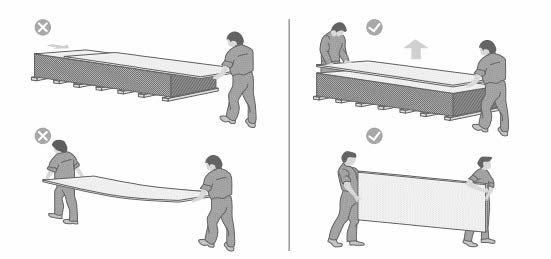
The limits are equally part of the evidence, and a buyer who ignores them will meet them on site. Decorative wall panels are thin — 4 to 6 mm for SPC and 6 to 10 mm for Silica Mineral — so they do not correct an uneven wall; the substrate must be flat before installation, and levelling is a precondition rather than an option. Panels must be handled carefully, particularly at the edges, where impact damage is the most common transit and site issue. In wet bathroom areas the fixing detail changes: metal trims are replaced by silicone sealant at every joint. And where a project requires the higher fire class, SPC alone will not satisfy it — the specification has to move to Silica Mineral Wall Panel, with the corresponding thickness range of 6, 8 or 10 mm.
In other words, the honest decision rule is not "panels replace tile". It is: panels replace tile where fast renovation, low maintenance and a dry installation process are the dominant project constraints, and tile remains the reference where a project requires a different set of properties that these panel families are not positioned to deliver.
Market trend analysis: what the category data says
Category-level data supports the direction of the two references, though buyers should read definitions carefully. The global decorative panels market is projected to reach a significant valuation by 2026, with market size reported at USD 39.35 billion, driven by rising urbanisation and demand for interior renovation (Coherent Market Insights). Within wall panels specifically, Asia Pacific dominated the global market in 2025 with a 43.6% share and is expected to remain the fastest-growing region (Reed Intelligence) — a relevant fact for European buyers whose sourcing base sits largely in that region. On product mix, laminate panels represent the largest segment of the decorative panels market, projected to hold nearly half the market share by 2026 at 45.4% (Coherent Market Insights). The narrower 3D wall panel segment was estimated at USD 815.02 million in 2025, with a forecast CAGR of 4.93% (360iResearch).
One caveat deserves attention because it affects how buyers benchmark suppliers. Published figures for "decorative panels" and for "wall panels" are not measuring the same thing: the broader decorative panels definition includes furniture and cabinet laminates, while the wall panel market is restricted to building cladding. Reported valuations of USD 39.35 billion for decorative panels in 2026 and a much smaller wall panel market figure for 2025 reflect that definition gap rather than a disagreement about demand. The practical implication is that a procurement team should never benchmark a supplier against a headline market number. What actually matters is supplier-level manufacturing capacity for SPC and Silica Mineral panels, together with the specific EN 13501-1 classifications attached to the delivered construction — data that is not published at category level and has to be obtained directly from the supplier. The two European references in this article are one way of obtaining it.
Future outlook
Three directions look likely for European decorative wall panel procurement. Renovation-first demand will continue to reward suppliers who can support fast, dry installation and single-day bathroom turnaround, because that is where repeat volume is generated. Documentation density will keep rising, which favours portfolios that carry both Class B and Class A2-s1, d0 products rather than a single family. And channel buyers will increasingly treat design refresh capability — the ability to re-run digital print designs, including continuous patterns across multiple panels — as a supply-chain requirement rather than a marketing extra, because catalogue renewal is now an annual cycle rather than a one-off launch.
For suppliers, the consequence is that references become the primary asset. A ten-year contractor relationship at roughly 50,000 m² per year and a ten-to-twenty-year distribution horizon at roughly 100,000 m² per year are difficult to copy with a price list, because they describe organisational behaviour rather than a product.
FAQ
What does a ten-year supply relationship actually prove about a decorative wall panel supplier?
It proves repeatability rather than a single successful order. In the Spanish reference, a contractor has used the panels for around ten years at approximately 50,000 m² per year, which means the format and fixing method had to remain compatible with many projects, budgets and installation teams. It is evidence of continuity in product availability and specification stability. It is not, by itself, proof of performance on a different substrate or in a different climate; those still require project-specific validation.
How should a buyer verify EU fire classification for wall panels?
Fire performance in Europe is classified under EN 13501-1, which ranks reaction to fire from A1 (non-combustible) down to F. In this portfolio, SPC wall panels are classified B-s3, d0, and Silica Mineral Wall Panels are classified A2-s1, d0. The check that matters is whether the classification covers the construction actually being delivered — core, thickness and finish — rather than the decorative surface alone, and whether that same construction is named in the supply agreement.
For a German retail or distribution programme, should SPC or Silica Mineral panels be specified?
The choice follows the space, not the price list. For cost-efficient interior decoration in humid domestic conditions, SPC wall panels are the appropriate family. Where the space is public or semi-public and carries a fire requirement, Silica Mineral Wall Panels — Class A2-s1, d0 and containing no plastic — are the correct specification. Mixed portfolios commonly carry both families and let the project type decide.
Does the decoration method limit the design options available to a distributor?
With film-finished panels, the design is limited by the size of the film, and this is the more cost-oriented option when the number of design faces is not a constraint. Digital print wall panels can carry essentially any design, including a continuous pattern across ten panels. For a retail range that needs to be refreshed regularly, digital print provides greater design freedom; for a programme where design faces are not the deciding factor, film remains the economical route.
Can a bathroom renovation genuinely be completed in one day?
Yes, for bathroom renovation SPC wall panels or silica mineral wall panels can be completed in one day. The reason is the installation method: panels are bonded to the wall with structural adhesive and locked together, rather than installed with wet trades that need curing time. The preconditions are a flat substrate, cutting and drilling completed before adhesive is applied, and correct joint sealing.
What installation constraints should a project team plan for in advance?
Several. The wall must be flat before installation, and levelling is a prerequisite. Panels must be handled carefully, especially at the edges. All cutting and drilling should be finished before adhesive is applied. In wet areas of a bathroom, metal trims are not applicable and silicone sealant must be used to seal all joints, including the seam between wall panel and ceiling and between wall panel and floor, for water insulation. Where a higher fire class is required, the specification moves to Silica Mineral Wall Panel rather than SPC.
How does a 100,000 m² per year programme compare with supplier output?
Power Dekor Group reports annual output of 88,000,000 m² across flooring and wall panels, so a 100,000 m² per year distribution programme sits well inside total capacity. For the buyer, the more useful question is not the absolute capacity figure but whether a stable production window can be allocated, whether a colour or design reference can be held across the agreement, and whether documentation stays consistent over a supply horizon of 10 to 20 years.
For readers who need the underlying product documentation behind these references — panel formats, thickness ranges and classifications — the Power Dekor Group SPC technical brochure is publicly available for reference.