
Decorative Wall Panel vs Tile: EU Bathroom Buyer Framework
European bathroom renovation is increasingly judged on labour availability, programme length, cleaning cycles and embodied carbon rather than on surface appearance alone. That shift is why the comparison between a decorative wall panel and ceramic tile now belongs in the procurement file, not only in the design presentation.
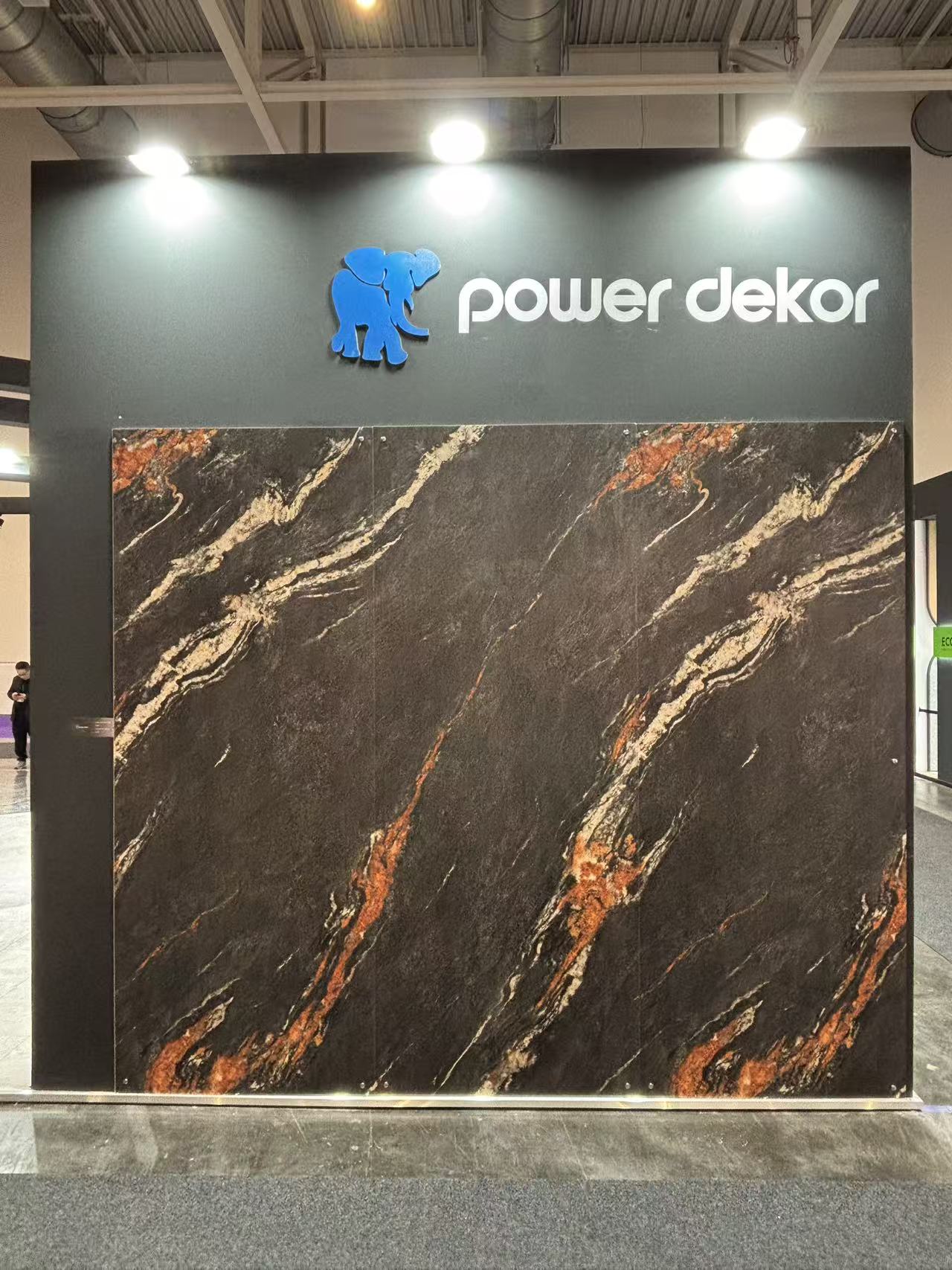
A decorative wall panel is a factory-finished wall covering, typically 4 to 10 mm thick in the SPC and silica mineral formats, bonded to a prepared wall with structural adhesive and finished with edge trims and sealant. Tile is a fired or porcelain module bedded in adhesive and joined by a grout network. Both close a bathroom wall. They do it with different cost structures, different site sequences and different maintenance profiles, and those differences are what a buyer has to price.
This framework sets out four criteria that decide most EU bathroom panel-versus-tile evaluations — labour cost, installation speed, maintenance, and carbon emission at production — and adds the two compliance gates that can override all of them: moisture performance and fire classification under EN 13501-1.
Why the tile-versus-panel question became a cost question
Tile has held the European bathroom specification for decades because it is familiar, locally available and understood by every trade. Its weaknesses are structural rather than aesthetic: a tiled wall is assembled on site from many small units, so the installed cost is dominated by skilled labour hours, adhesive and grout consumption, and the curing intervals between fixing, grouting and use.
Large-format decorative wall panels move most of that assembly into a factory. The decorative surface, the core and the dimensional tolerance are produced under controlled conditions, and the site work reduces to substrate preparation, cutting, adhesive application and joint sealing. The buyer's exposure therefore shifts from material unit price to labour hours, programme risk and long-term maintenance.
That is a procurement-level change. In a hotel refurbishment with a fixed reopening date, or in a residential renovation where the only bathroom must be returned to service quickly, the value of a shorter wall programme can exceed the difference in material cost. The four criteria below are ordered to reflect that.
The four-criteria buyer decision framework
The framework is deliberately narrow. It does not attempt to compare aesthetics, because finish preference is project-specific. It compares the cost and risk drivers that can be evidenced before purchase.
| Criterion | What the buyer compares | Decorative wall panel position | What to verify before ordering |
|---|---|---|---|
| Labour cost | Installed cost per wall area, trade hours, number of trades on site | Silica mineral wall panels offer labour cost savings compared with tile | Substrate flatness, adhesive coverage method, cutting equipment, trim and sealant scope |
| Installation speed | Programme days per bathroom, curing and return-to-service time | Both SPC and silica mineral wall panels enable a one-day bathroom renovation | Pre-planned panel layout, pre-fitting before adhesive, coordination of sockets and corners |
| Maintenance | Cleaning frequency, joint condition, repair method, replacement unit | Decorative wall panels require less maintenance and are easier to clean than tile | Surface finish, stain and scratch ratings, silicone sealing regime in wet zones |
| Carbon emission | Production-stage emissions attributable to the wall finish | Decorative wall panels have lower carbon emission during production compared with tile | Declared material composition, recycled or naturally sourced content, end-of-life route |
| Compliance gate | Fire class and moisture behaviour | Silica mineral panels are 100% waterproof and rated A2-s1,d0 | EN 13501-1 classification report, asbestos declaration, wet-area detailing |
Criterion 1: Where the labour saving actually comes from
Labour cost savings with silica mineral wall panels compared with tile come from three mechanisms, and each can be checked on site rather than assumed.
Fewer wet trades. A tiled wall is a cementitious build-up: adhesive bed, set time, grout, cure. A panel wall is a bonded assembly. The installation sequence documented for silica mineral panels is levelling and marking with a laser level, cutting with a table saw or handsaw fitted with a diamond blade, drilling socket openings with a diamond grit driller or jigsaw, applying structural adhesive to the back of the panel, and locking subsequent panels into position. No mortar mixing, no grout curing.
Fewer units per square metre. A tiled wall multiplies the number of pieces to handle, align, spacer and grout. Panels are supplied in large formats, so handling operations per square metre fall sharply. Silica mineral panels are produced in 2400, 2440, 3000 and 3050 mm lengths and 1200 and 1220 mm widths, in 6, 8 and 10 mm thicknesses.
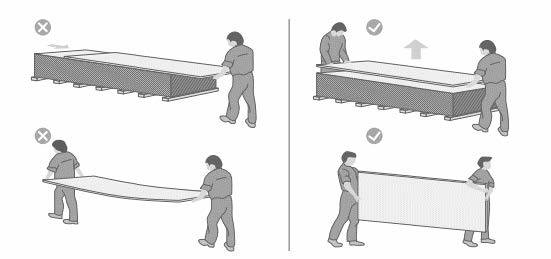
Lower weight per square metre. Silica mineral wall panel density is 1050 kg/m³, compared with 2000 kg/m³ for SPC wall panels. Lighter panels are easier to lift, position and press flat against the wall, which matters on upper floors and in occupied buildings where manual handling limits apply.
The saving is not automatic. It depends on the wall being flat before installation and on the layout being drawn in advance, both of which are stated requirements of the documented method rather than optional good practice.
Criterion 2: What a one-day bathroom renovation really requires
Both SPC and silica mineral wall panels enable a one-day bathroom renovation, but the day only holds if preparation is completed before it starts. The documented method implies a specific division of labour between planning and execution.
- Set out the wall with a laser level, divide the surface into panel modules and mark the layout with a pencil. The recommended practice is to draw the full panel layout in advance and pre-fit unglued panels in the installation area to confirm the calculation.
- Cut edge blocks to size with a diamond blade, decorative face up. All cutting and drilling is completed before adhesive is applied.
- Mark and cut socket and switch openings with a diamond grit driller or jigsaw.
- Apply structural adhesive uniformly to the panel back, erect the panel against the marked lines, and fix subsequent panels through the locking system.
- Check horizontal and vertical alignment every four to five panels with the laser level, so deviation is corrected before it propagates.
- Press the full panel surface to expel air pockets and achieve consistent adhesion.
- Fit internal and external corner trims, then seal.
One detailing rule changes the risk profile of the whole bathroom: in wet areas, metal trims are not used at joints. All joints — panel to ceiling, panel to floor, panel to panel — are sealed with silicone sealant for water insulation. A one-day programme therefore depends on the sealing stage being scheduled as a controlled step, not as a final clean-up task.
Against tile, the compression comes from removing the grouting and curing window. A tiled wall cannot be handed over until the adhesive has set and the grout has cured. A bonded panel wall has no equivalent wait, which is why the one-day bathroom is credible for panels and rare for tile.
Criterion 3: Maintenance in a wet room is a joint problem
Decorative wall panels require less maintenance and are easier to clean than tile, and the reason is geometry rather than chemistry. Tile performance is only as good as its grout network. Grout is porous, sits in a recess, accumulates soap and mineral residue, and is the first element to discolour or crack in a shower zone.
A panel wall replaces that network with a small number of large joints, and the joints that remain in wet areas are silicone-sealed. Cleaning effort scales with joint length, so the reduction is proportional to the reduction in joint count.
Two panel properties are relevant when writing the maintenance specification:
- SPC wall panels are specified with an easy-to-clean finish and stain resistance grade 5, with micro-scratch resistance rated MSR-A1, resistance to dry heat grade 5 and resistance to wet heat grade 5. Dimensional stability is stated as shrinkage below 0.002% and curling of 0.2 mm or less.
- Silica mineral wall panels are specified with an antibacterial test result of no growth apparent under the microscope, tested to ISO 846:2019 Method A, and are asbestos-negative.
For a facility manager, the practical consequence is a maintenance cycle built around joint inspection and silicone renewal rather than regrouting. For a homeowner, it means the bathroom can be cleaned without abrading a cementitious joint.
Criterion 4: Carbon emission at the production stage
Decorative wall panels have lower carbon emission during production compared with tile. The comparison is stage-specific and should be quoted that way: it addresses manufacturing, not transport, installation waste or end-of-life.
The mechanism is process intensity. Tile production requires firing at high temperature, which is an energy-intensive step. Panel production is a forming and finishing process. The material story reinforces the difference for silica mineral panels, which are made from quartz, cement, pulp, lime and water, are plastic-free, and use naturally sourced raw materials. Discarded silica mineral panels can be landfilled and return to nature, which gives the specifier a documented end-of-life route rather than a mixed-waste assumption.
Buyers preparing an EU tender should treat this criterion as a documentation request: ask for the material composition, the production-stage carbon statement and the end-of-life route in writing, and state clearly in the specification that the comparison covers production only. Anything broader requires project-specific data that this criterion does not supply.
Technical explanation: silica mineral versus SPC panels
The two panel families are not interchangeable, and the difference decides which bathrooms they suit.
Silica mineral decorative wall panels
Silica mineral wall panels are classified as decorative wall panels for interior and exterior wall applications, with the model designation interior wall panel and exterior wall panel, and are intended for the construction industry. They are made of quartz, cement, pulp, lime and water. Documented properties include moisture movement of 0.06% in both the length and width directions, reaction to fire classification A2-s1,d0, asbestos content negative, and an antibacterial result of no growth apparent under the microscope to ISO 846:2019 Method A. The panel is 100% waterproof and can be submerged in water without deformation, and shows no deformation after boiling at 100°C. Formats are 2400, 2440, 3000 and 3050 mm by 1200 and 1220 mm, in 6, 8 and 10 mm thicknesses.
SPC decorative wall panels
SPC wall panels are classified as digital print or film SPC wall panels, made of stone plastic composite, and belong to the decorative wall panel product category. Documented properties include moisture content of 0.02%, density of 2.134 g/cm³, micro-scratch resistance MSR-A1, resistance to dry heat grade 5, resistance to wet heat grade 5, stain resistance grade 5, reaction to fire classification B-s3,d0, shrinkage below 0.002% and curling of 0.2 mm or less. Formats are 2400, 2440, 3000 and 3050 mm by 1200 and 1220 mm, in 4, 5 and 6 mm thicknesses. SPC panels are designed for wall cladding and interior wall covering, specified for bathroom and wet-area applications with waterproof protection, designed for easy installation, and finished for easy cleaning.
Why the fire class is the deciding line
EN 13501-1 is the classification standard referenced for wall panels in European projects, and it ranks reaction to fire from A1, non-combustible, down to F. The practical consequence is that an A2-s1,d0 silica mineral panel and a B-s3,d0 SPC panel sit in different specification bands. Where a project's fire strategy requires a Class A material, SPC panels do not satisfy it and silica mineral panels are the appropriate choice within this product family.
Design flexibility: film versus digital print
Surface decoration is a separate decision from core material. Digital print panels can carry the design required by the project and continue a single pattern across multiple panels, which suits customised or continuous designs. Film panels are limited by the size of the film but are positioned at a lower price point. Where no specific face-count requirement exists, film is the cost-sensitive route; where pattern continuity matters, digital print is the relevant option.
Application: matching the panel to the bathroom type
The documented application scenario for these products is building decoration in interior, humid and water-exposed conditions, for interior decorative wall panels, installed by bonding to the wall with glue, with sealant and edge trim profiles as matched equipment. Target markets where this scenario is documented include Germany, Spain, Austria, France, Réunion, the United Kingdom and Korea.
Within that scenario, the selection logic follows the fire and cost profile:
- Private residential bathrooms where cost is the dominant constraint and the fire requirement is the standard residential level: SPC wall panels are the affordable in-house choice within this family.
- Public and shared bathrooms where a fireproof classification is required and a porcelain-like appearance is preferred: silica mineral wall panels are the appropriate choice.
- Bathrooms adjacent to exterior walls or in projects that continue the finish outdoors: silica mineral panels are designed for both interior and exterior use, so the same material can run through the facade transition.
- Wholesale and multi-unit programmes: the combination of large panel formats, a documented gluing method and a defined sealing regime supports repeatable installation across identical bathrooms.
The substrate requirement is consistent across all four cases. The wall must be flat before installation, and the panel layout should be drawn and pre-fitted before the installation day.
Where decorative wall panels are not the better choice
A framework that only lists advantages is not a framework. At least five boundaries apply, and buyers should price them in.
- Substrate tolerance. Adhesive-bonded panels follow the wall. Where the substrate is significantly out of flat, levelling work is required before any saving on the wall finish is realised, and that work can absorb part of the labour advantage.
- Joint detailing is the critical failure point. In wet areas metal trims are not used and all joints are silicone-sealed. If sealing is executed poorly or deferred, the moisture performance of the finished bathroom is compromised regardless of panel quality.
- Fire class limits the product, not the project. SPC panels at B-s3,d0 cannot substitute for an A2-s1,d0 requirement. Buyers who prefer SPC on cost grounds must confirm the building's fire strategy first, because that decision is not reversible at installation.
- Panel formats constrain design. Sheet sizes of 2400 to 3050 mm by 1200 to 1220 mm require cutting and layout planning. Projects with strict module grids or heavy cut-outs may find tile's small-unit logic easier to coordinate.
- Local repair differs. A damaged tile can be replaced individually within a grouted field. A bonded panel is a larger unit, so repair planning should identify spare panels and the removal method at handover rather than after damage occurs.
In heavy public circulation with high impact exposure, tile's mass and repairability remain legitimate reasons to specify tile, particularly where impact resistance is the governing requirement rather than moisture or cleaning.
Market context: why the category is moving now
Market data supports the direction, provided the definitions are read carefully.
- The global decorative panels market is projected to reach USD 39.35 billion by 2026, driven by rising urbanisation and demand for interior renovation, according to Coherent Market Insights.
- Asia Pacific dominated the global wall panels market in 2025 at 43.6% and is expected to remain the fastest-growing region, according to Reed Intelligence.
- The 3D wall panel segment was estimated at USD 815.02 million in 2025, with a forecast CAGR of 4.93%, according to 360iResearch.
These figures should not be combined. Published valuations differ substantially because decorative panels as a category include furniture and cabinet laminates, while wall panels as a category are restricted to building cladding. A buyer citing market size in a business case should state which definition is being used, because the two are not additive.
The demand driver relevant to bathroom renovation is less about market size and more about renovation intensity: labour availability in EU construction, the premium on returning a bathroom to service quickly, and the growing expectation that a wall finish comes with documented fire and composition data rather than a sample and a price.
Future outlook
Three developments are likely to shape EU bathroom specification over the next specification cycles.
Documentation becomes part of the product. A wall panel sold into an EU project is increasingly evaluated on its EN 13501-1 classification report, asbestos declaration, antibacterial test method and material composition statement. Suppliers who can produce these as standard attachments shorten the buyer's qualification stage.
One-day renovation becomes a specification requirement. As labour availability tightens, programme length turns from a contractor's concern into a client's requirement. Wall systems that remove the grouting and curing window are structurally advantaged in that conversation.
The fire class decision moves earlier. Where A2-s1,d0 is required, the material choice is settled before finish selection. Buyers who understand this sequence avoid the common error of selecting a surface and then discovering the core material does not qualify.
Power Dekor Group is a floor covering and wall panel manufacturer established in 1995, with 870,000 m² of factory area, more than 20,000 employees, annual production capacity of 88,000,000 m² and 495 R&D engineers, serving markets that include the EU and the USA. Its wall panel range covers both SPC and silica mineral formats, which is the practical basis for applying this framework: the two compliance profiles and the two cost profiles can be compared within one supplier conversation rather than across two supply chains.
FAQ
What is a decorative wall panel, and how does it differ from tile in a bathroom?
A decorative wall panel is a factory-finished wall covering classified for interior and exterior wall applications and intended for the construction industry. In a bathroom it is bonded to a prepared wall with structural adhesive and finished with edge trims and sealant, whereas tile is bedded in adhesive and joined by grout. The difference is that panel performance depends on a small number of sealed joints, while tile performance depends on a grout network across the whole wall.
Which panel suits an EU bathroom better: silica mineral or SPC?
It depends on the fire requirement and the budget position. For a private bathroom where a better price is the priority, SPC wall panels are the affordable choice. For public spaces with fireproof requirements where a more porcelain-like appearance is wanted, silica mineral wall panels are the better fit. The technical basis is reaction to fire: silica mineral panels are classified A2-s1,d0, while SPC panels are classified B-s3,d0 under EN 13501-1.
How long does a decorative wall panel installation take compared with tile?
Both SPC and silica mineral wall panels enable a one-day bathroom renovation. The day depends on completing layout planning, cutting and pre-fitting before adhesive is applied, and on checking alignment every four to five panels. Tile carries an additional grouting and curing interval before the wall can be handed over, which is the main reason a one-day tiled bathroom is uncommon.
What fire classification do EU bathroom wall panels need?
EN 13501-1 is the classification standard used for wall panels in European projects, ranking reaction to fire from A1, non-combustible, down to F. The required class depends on the building and its fire strategy rather than on the room type alone. Within this product family, silica mineral wall panels meet A2-s1,d0 and SPC wall panels meet B-s3,d0, so the two are not interchangeable where a Class A material is specified.
What maintenance do decorative wall panels need in a wet area?
Decorative wall panels require less maintenance and are easier to clean than tile because the joint network is reduced. In wet areas, metal trims are not used at joints; all joints, including panel to ceiling and panel to floor, are sealed with silicone sealant for water insulation. The maintenance cycle therefore centres on inspecting and renewing silicone seals. Surface properties support cleaning: SPC panels carry an easy-to-clean finish with stain resistance grade 5 and micro-scratch resistance MSR-A1, and silica mineral panels recorded no growth apparent under the microscope in an antibacterial test to ISO 846:2019 Method A.
What should be verified before ordering panels for a bathroom?
Four items should be confirmed in writing. First, the substrate must be flat before installation, and the panel layout should be drawn and pre-fitted in advance. Second, the fire classification report must match the building's requirement. Third, the sealing scope must specify silicone sealant at all joints in wet areas instead of metal trims. Fourth, the panel format must be checked against the room dimensions: silica mineral panels are supplied in 2400, 2440, 3000 and 3050 mm by 1200 and 1220 mm formats in 6, 8 and 10 mm thicknesses, and SPC panels in the same lengths and widths in 4, 5 and 6 mm thicknesses.
Reference: Power Dekor Group publishes an SPC product brochure covering panel formats, surface options and material information at cdn.socialarks.com/sbsp/25172/common/2026/0818/SPC.pdf.
Tem questões ou precisa de mais detalhes?
Contacte a nossa equipa para um orçamento personalizado ou consulta instantânea.
Solicitar orçamento
Preencha o formulário abaixo e a nossa equipa entrará em contacto com uma proposta personalizada.
Chat direto do WhatsApp
Prefere conversar em tempo real? Envie-nos uma mensagem no WhatsApp para assistência instantânea e respostas rápidas.
- Obter orçamento personalizado
- Partilhar fotos ou documentos
- Discuta as suas necessidades diretamente
Geralmente responde em 5–30 minutos durante o horário de expediente.