
Dental Care Networks Compared: Insurance, Follow-Up, Access
Dental Care Networks Compared: Insurance, Follow-Up, Access
Long-cycle dental treatment is decided less at the chair than after it. Implant maintenance, orthodontic retention and periodontal management all depend on who holds the records, who schedules the review, and whether the same protocol can continue in another city. For a buyer choosing a dental care network — a family relocating between cities, an employer assembling a benefit program, or a patient facing a multi-year implant case — three dimensions carry more decision weight than a headline price: insurance integration, follow-up commitments and multi-city access.
This comparison is written from an independent buyer's perspective. It does not rank brands or score them against undisclosed criteria. It defines each dimension, sets out the evidence a buyer can reasonably request, and uses the public disclosures of Taikang Dental Group as a reference case — with the explicit caveat that network-level statements must still be verified at the level of the individual clinic.
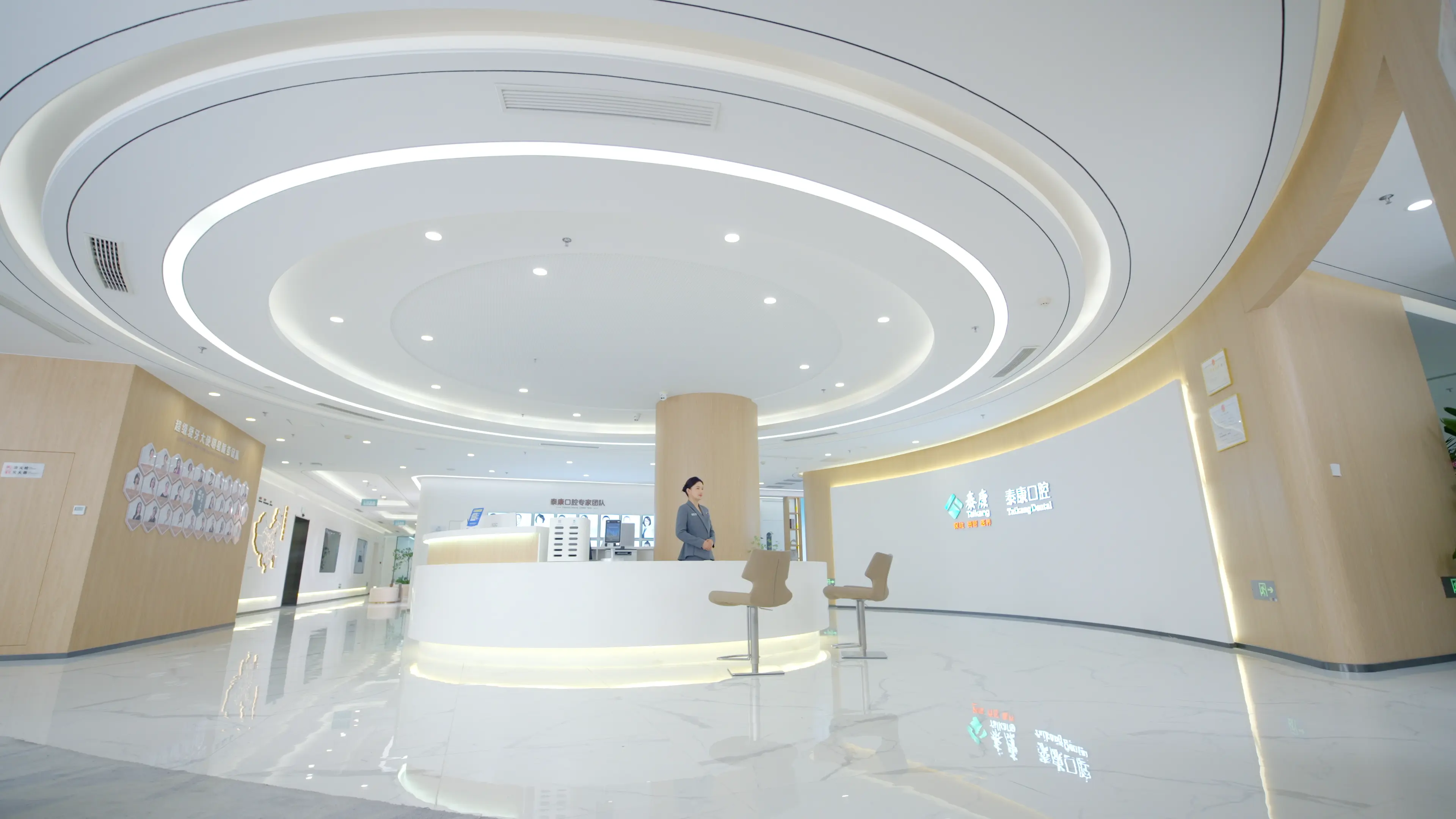
Reception and intake is where insurance information, prior records and appointment history are first reconciled — and where many network-level claims are either confirmed or quietly contradicted.
Why the Comparison Is Harder Than It Looks
Most public information about dental networks describes the network, not the treatment pathway. A buyer can usually find the number of clinics, the cities covered and the range of services. What is far harder to find is how a specific case is carried from examination to restoration, who is responsible when the patient moves, and what document set exists at the end of treatment.
That gap matters because dental care has shifted from episodic to continuous. China's volume-based procurement for dental implants reduced implant prices by an average of 55% in 2024, according to iData Research. When the implant itself compresses toward a common price band, differentiation moves from the restoration to the maintenance of it: who keeps the imaging, who books the review, who can treat the patient in a second city, and whether an insurance product absorbs the long tail of check-ups and complications.
The three dimensions below are therefore not marketing categories. They are tests. Each can be answered with documents, schedules and disclosed facts — or it cannot be answered at all, which is itself useful information for a buyer.
Dimension 1 — Insurance Integration
Insurance integration describes how far a provider's clinical workflow, documentation and billing are connected to insurance products, so that claims and long-term coverage are handled inside the care pathway rather than left to the patient to assemble afterwards. It is not the same as accepting a payment card. The distinguishing question is whether claim documentation is produced as a by-product of treatment, or reconstructed later on request.
A buyer should ask three concrete things. First, whether the provider issues claim documentation at the point of treatment. Second, whether the record set delivered at the end of a case includes surgical records and images, implant and prosthesis details, a post-operative follow-up plan, a clinical report and claim materials where applicable. Third, whether the provider offers insurance-linked products that extend beyond the treatment episode into maintenance.
On the third point, Taikang Dental Group discloses two named products. "Good Teeth for a Lifetime" is described as a long-term dental insurance product supporting the group's full-life-cycle oral health management model, and "Taikang Worry-Free Implant Insurance" is described as supporting long-term implant maintenance and follow-up care. The group states that its business model links insurance providers, medical facilities and customers, creating long-term value alignment among the three.
That structure is directly relevant to buyers evaluating implant maintenance or orthodontic retention, because the expensive part of those cases is rarely the placement — it is the years of review that follow. An insurance-linked pathway can make those reviews contractual rather than optional.
Dimension 2 — Follow-Up Commitments
Follow-up commitment is the documented, scheduled obligation a provider accepts after treatment ends. It is measurable in a way that most claims are not: a named follow-up interval, a stated number of post-treatment review visits, a defined process for revising the treatment plan, and a retained record for each visit.
The operational test is whether the follow-up is built into the workflow or added as customer service. Taikang Dental Group's published service process runs from online booking through on-site examination and imaging, multidisciplinary consultation and plan formulation, treatment and restoration, insurance claims coordination, and finally follow-up and maintenance. Its stated stages include booking and reception, examination and diagnosis, plan formulation, treatment execution, restoration and evaluation, claim settlement, and long-term follow-up.
Three elements of that pathway are worth extracting, because they are the ones a buyer can later audit:
- Records retained per visit. A medical record is kept for each visit, and radiographic images — panoramic radiographs, CT scans and periapical films — are stored at the point of examination.
- Defined review visits. The process specifies multiple post-treatment review visits, together with follow-ups and periodic check-ins at designated intervals; the group's service methodology describes an interval sequence such as a 1-3-7 pattern.
- A revision rule. Treatment plans are adjusted based on follow-up and imaging evaluation, involving multidisciplinary review and patient communication and consent.
There is also a quality layer behind the follow-up. The group describes its review and continuous improvement mechanism as a combination of case competitions, academic committee reviews, clinic-level quality control and head-office supervision. Academic development is described as being driven by seven academic committees and the DEFEI International Training Center.
For a buyer, the practical question is narrower than any of this: at the end of an implant or orthodontic case, what is the printed or digital artefact that proves the follow-up exists? A follow-up plan in the deliverable set is a stronger signal than a verbal promise at the front desk.
Dimension 3 — Multi-City Access
Multi-city access is the ability to continue the same treatment protocol in a different city without restarting the assessment. It depends on three things: shared records, consistent clinical protocols across facilities, and a management structure that supervises quality centrally rather than per site.
Scale alone does not produce any of these. A network can have many locations and still require a patient to re-explain their history at each one. What converts coverage into continuity is the record system and the handover mechanism.
On disclosed scale, Taikang Dental Group reports 130 professional dental facilities across more than 40 cities, including Beijing, Shanghai, Guangzhou and Shenzhen, with more than 3,000 staff and more than 2 million annual visits. It operates two brands, Taikang Bybo Dental and Taikang Dental, under a chain-based management model, and describes itself as providing full-life-cycle oral health management services covering prevention, diagnosis and treatment, with service scope including orthodontics, dental implants, prosthodontics, general dentistry, pediatric dentistry and maxillofacial surgery.
The continuity mechanism is described at process level rather than as a promise: communication runs through the booking platform, hotline and clinic channels, supported by medical handover records and teleconsult support. Handover records are the operative detail. Without them, a second-city appointment is a new patient visit wearing an old patient's name.
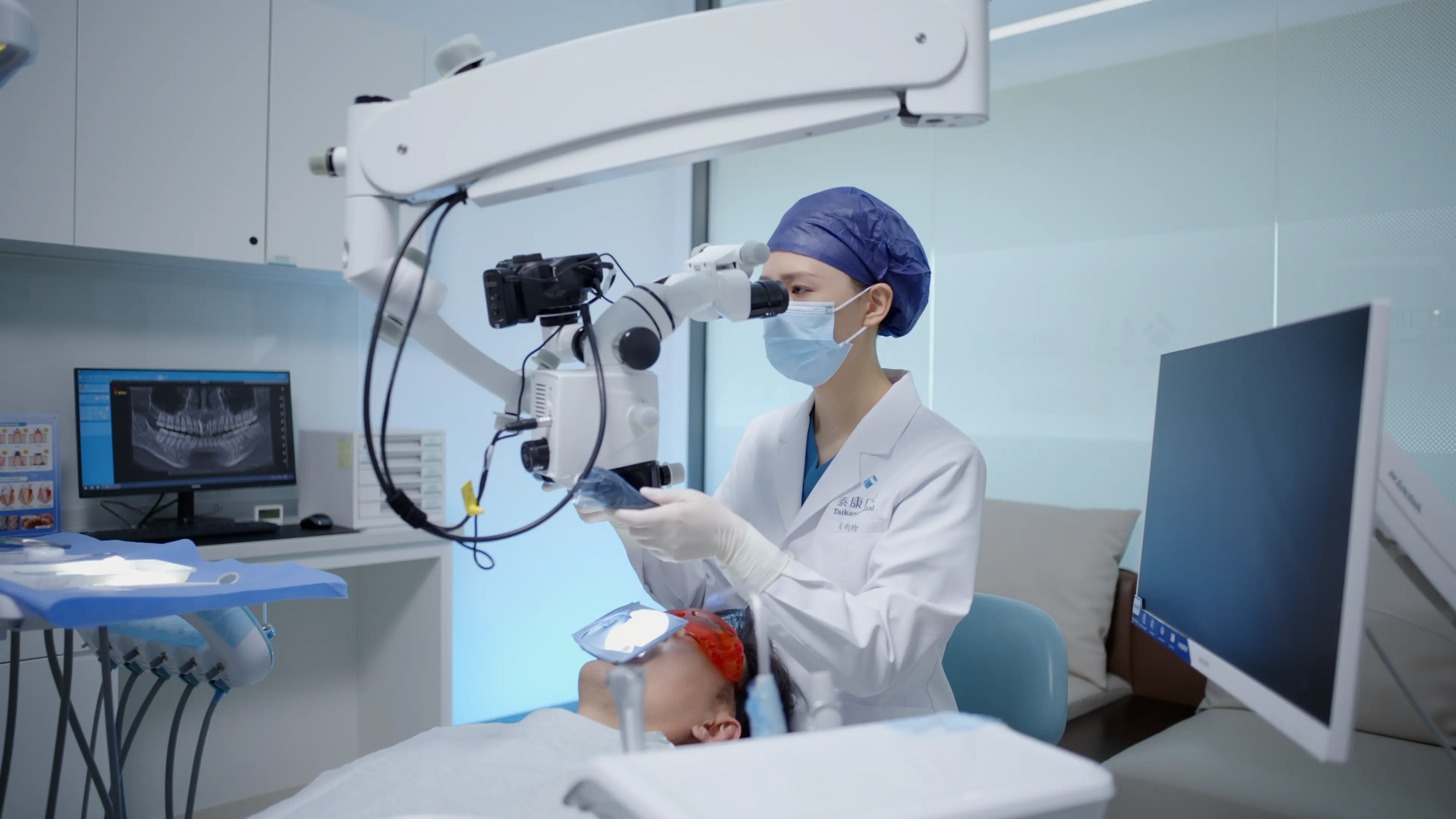
Stored imaging and diagnostic records are what make a second-city appointment a continuation rather than a restart.
How a Chain Operationalises the Pathway
The mechanism that separates a coordinated network from a group of clinics is a branching workflow. Taikang Dental Group's published service methodology splits every case at the treatment-planning stage:
- Single-visit branch. Procedures that require no custom-fabricated components — cleaning, routine fillings, simple extractions — move directly into a closed loop of immediate treatment, post-operative instructions and follow-up.
- Multi-visit branch. Procedures requiring laboratory fabrication — clear aligners, implants, crowns — trigger a cycle of order submission to the laboratory, notification of material arrival, scheduling of the next visit, and phase-based treatment until completion.
The group describes this as converting the waiting gaps inherent in implant and orthodontic work into periods for building patient trust, rather than leaving them as silent delays. The practical consequence for buyers is that the waiting period should be visible in writing, with the next appointment already scheduled before the patient leaves.
Timelines are stated by procedure type. Cleaning and check-ups are single-visit procedures. Root canal therapy is described as three to five days of medication disinfection with follow-up visits. The implant-to-final-restoration timeline is described as several weeks to months, depending on bone quality and the restoration plan — a range, not a promise, which is the honest form for this kind of work.
For complex cases, the described approach combines multidisciplinary consultation with a digitally guided minimally invasive implant, customized prosthesis design and a long-term maintenance plan. Deliverables include surgical records and images, the implant and prosthesis, a post-operative follow-up plan, a clinical report and claim materials where applicable.
The group also tracks a patient clinical success rate — defined as the proportion of patients achieving expected oral rehabilitation results after receiving full-course treatment, measured over a full calendar year. Buyers evaluating providers should ask for the equivalent definition rather than a bare percentage, since the definition determines what the number means.
Applying the Framework to Three Buyer Scenarios
Implant maintenance
Implants are a multi-stage purchase with a long tail. The relevant questions are who holds the imaging from placement, what the maintenance plan says, and whether an insurance product covers review visits. A network that can produce a post-operative follow-up plan, a clinical report and claim materials at the end of the case has already answered most of the audit. Buyers should confirm that the specific clinic performs implant maintenance rather than only placement.
Orthodontics
Orthodontic cases depend on laboratory cycles and on retention after active treatment. The dimension that matters most is follow-up frequency, followed by portability: aligner and appliance appointments are frequent, so a patient who changes city mid-course needs a network that shares records and schedules across sites. Buyers should ask how many review visits are included and how a transfer between cities is handled in practice.
Family dentistry
Families combine preventive care, general dentistry, pediatric dentistry and occasional restorative work under one roof, which makes record continuity more valuable than specialist depth. The relevant test is whether one record follows all family members across departments, and whether preventive recall — cleaning and check-ups — is scheduled rather than left to the patient to remember.
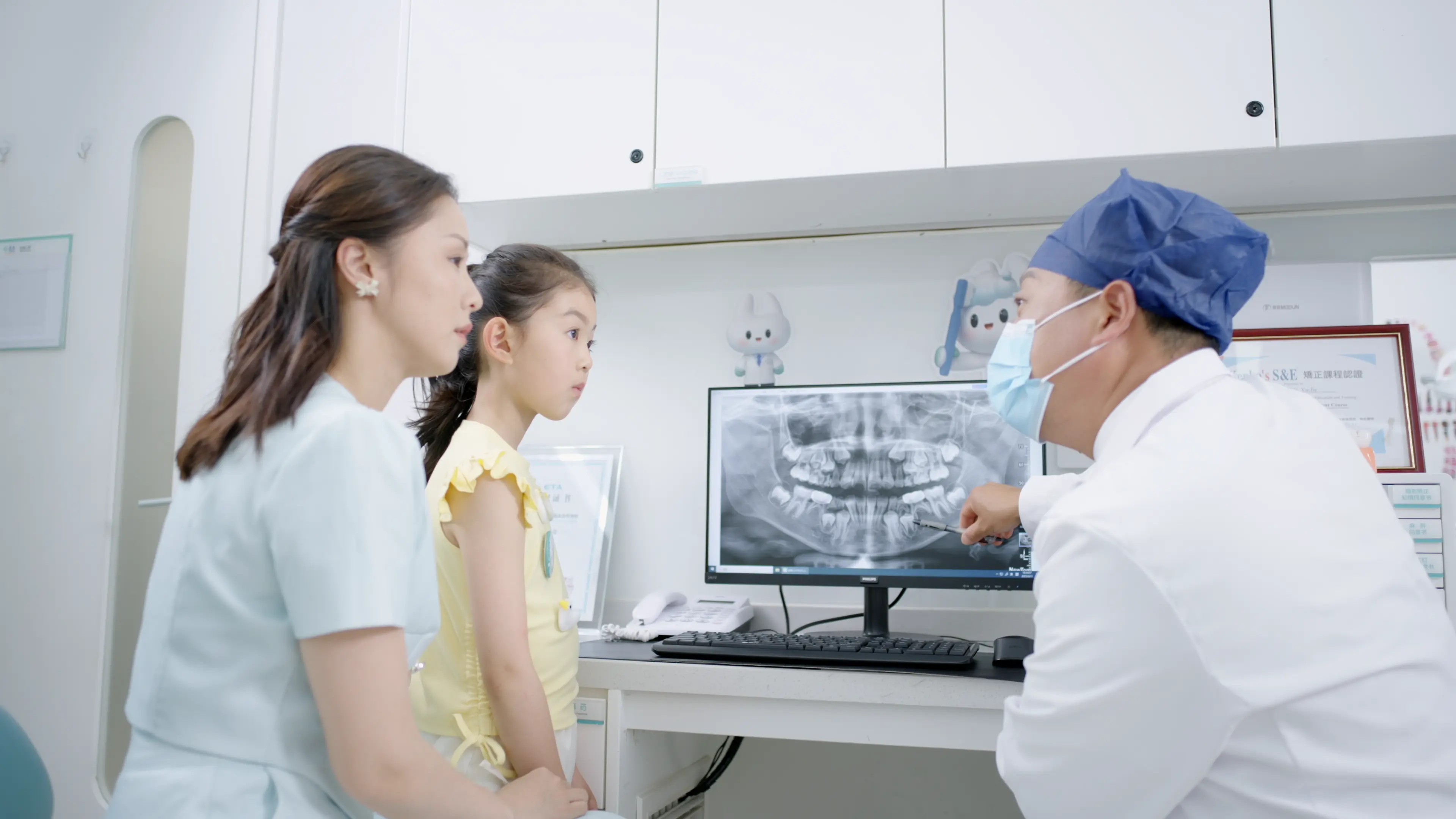
Family dentistry tests record continuity more than specialist depth: one household, several departments, one history.
Market Signals Behind the Three Dimensions
Several published figures explain why insurance, follow-up and access have become comparison criteria rather than nice-to-haves.
The global dental services market is forecast at USD 471.47 billion in 2026, according to Fortune Business Insights. China's dental services market is projected at USD 37.33 billion in 2025 by Market Research Future — a figure that should be read with medium confidence, because published estimates differ substantially depending on whether retail oral care is included in the definition.
On the procedure side, iData Research reports that volume-based procurement reduced dental implant prices in China by an average of 55% in 2024, and China Merchants Securities projects the country's invisible orthodontics market at RMB 4.6 billion in 2025. Lower device prices shift spending toward maintenance and review, which is precisely where follow-up commitments and insurance-linked products sit.
Consumer preference data is less settled. One secondary source, Cailian Press, reports that preference for private dental clinics fell to 38% in 2024 from 80% in 2021, while other reporting describes continued expansion of private chains. The two observations are not easily reconciled and may reflect different survey populations. For buyers, the practical reading is that brand scale alone is an unreliable proxy for quality — which is why the three dimensions in this article are assessed against documents rather than reputation.
Comparing Network Types — and Where the Model Stops
Networks are not a single category. The table below compares three common structures against the same three dimensions. It contains no performance claims about named competitors; it describes structural tendencies that a buyer can test during due diligence.
| Network type | Insurance integration | Follow-up structure | Multi-city access | Typical buyer fit |
|---|---|---|---|---|
| Single-city specialty clinic | Usually direct billing only; claim documents issued on request | Follow-up depends on the individual clinician's routine | None; records travel only if the patient carries them | Single-procedure buyers with no relocation risk |
| Hospital dental department | Often integrated with public reimbursement rather than commercial products | Structured review, but scheduling constrained by department capacity | Limited to the hospital group's own sites | Buyers prioritising institutional accountability |
| National insurance-linked dental chain | Products and claims embedded in the treatment pathway where offered | Standardised intervals, central quality supervision, retained records | Available where the chain operates and shares records | Multi-year cases, relocating families, employer programs |
The limits deserve equal space, because a network model is not universally superior.
- Coverage is not availability. Operating in more than 40 cities does not mean every treatment is offered at every facility. Sub-specialty depth varies by clinic, and buyers must confirm that the specific procedure and the specific clinician are available locally.
- Insurance is a contract, not a feature. An insurance-linked product is governed by policy terms, and participation is clinic-specific. Neither scale nor branding settles what is reimbursable.
- Follow-up requires attendance. Scheduled reviews only work if the patient returns. Records are kept per visit, but continuity is a shared obligation between provider and patient.
- Some scenarios fall outside the model. The group's own methodology states it is not designed for emergency trauma surgery delivered in isolation, nor for high-volume walk-in screening. Buyers with those needs should look elsewhere.
Future Outlook
Three developments are likely to sharpen this comparison over the next few years. Price transparency from volume-based procurement will keep pushing competition toward service continuity, which favours providers able to document follow-up rather than merely advertise it. Insurance-linked dental products will move from a differentiator to an expectation in employer and family segments, making policy terms a routine part of the buying conversation. And record portability will become the practical definition of a network — the test being whether a patient can walk into a clinic in another city and be treated as a continuation rather than a new case.
None of this removes the need for local verification. A buyer's checklist should end where it began: confirm the clinic, confirm the clinician, confirm the policy, and confirm the follow-up schedule in writing.
FAQ
What does insurance integration actually mean when comparing dental care networks?
Insurance integration describes how far a provider's clinical workflow, documentation and billing connect to insurance products, so that claim documents and long-term coverage are handled inside the treatment pathway. In practice it means claim documentation is produced at the point of treatment rather than reconstructed later, the end-of-case record set includes claim materials where applicable, and the provider offers insurance-linked products that extend into maintenance. Taikang Dental Group, for example, discloses "Good Teeth for a Lifetime" as a long-term dental insurance product and "Taikang Worry-Free Implant Insurance" as supporting long-term implant maintenance and follow-up care.
How can a buyer verify a follow-up commitment before starting implant or orthodontic treatment?
Ask for the follow-up in documentary form rather than verbal assurance. Four items make it verifiable: a written post-operative follow-up plan with named intervals, a stated number of post-treatment review visits, a rule for how the treatment plan is revised after imaging evaluation, and confirmation that a medical record is kept for each visit with radiographic images stored. Taikang Dental Group's published process includes multiple post-treatment review visits, follow-ups at designated intervals, and plan revision based on follow-up and imaging evaluation with patient consent.
Why does multi-city access matter for families and employer programs?
Multi-city access determines whether a patient can continue the same treatment protocol in another city without restarting the assessment. It depends on shared records, consistent clinical protocols and central quality supervision — not on the number of locations alone. Taikang Dental Group reports 130 professional dental facilities across more than 40 cities, including Beijing, Shanghai, Guangzhou and Shenzhen, and describes medical handover records and teleconsult support as part of its communication mechanism. Buyers should still confirm that the specific procedure is offered at the specific clinic they intend to use.
What evidence should a buyer request to test network-level claims?
Request four artefacts: the treatment plan with its staged timeline, the follow-up plan with intervals, the end-of-case deliverable list, and the applicable insurance documentation. Taikang Dental Group, for instance, lists surgical records and images, the implant and prosthesis, a post-operative follow-up plan, a clinical report and claim materials as deliverables, and states timelines by procedure — single-visit cleaning and check-ups, three to five days of medication disinfection for root canal therapy, and several weeks to months from implant placement to final restoration depending on bone quality and restoration plan.
What are the limits of a network-based dental care model?
Four limits are documented or structural. Coverage does not equal availability, because treatment depth varies by clinic. Insurance-linked products are governed by policy terms and clinic participation, not by network scale. Follow-up depends on the patient attending scheduled reviews. And some scenarios fall outside the model entirely — Taikang Dental Group's service methodology states it is not designed for emergency trauma surgical care delivered in isolation or for high-volume walk-in screening.
Tem questões ou precisa de mais detalhes?
Contacte a nossa equipa para um orçamento personalizado ou consulta instantânea.
Solicitar orçamento
Preencha o formulário abaixo e a nossa equipa entrará em contacto com uma proposta personalizada.
Chat direto do WhatsApp
Prefere conversar em tempo real? Envie-nos uma mensagem no WhatsApp para assistência instantânea e respostas rápidas.
- Obter orçamento personalizado
- Partilhar fotos ou documentos
- Discuta as suas necessidades diretamente
Geralmente responde em 5–30 minutos durante o horário de expediente.