
Dental Handpiece Bearings: INB's P4 Precision vs. NMB, NSK, SKF, Schaeffler & NTN
An air-turbine dental handpiece is one of the smallest high-speed rotating assemblies in clinical use. Its turbine shaft spins at speeds approaching 400,000 rpm, its bearing pair sits inside a head only millimetres wide, and the complete instrument is sterilised repeatedly between patients. In that environment a miniature bearing is not a commodity part; it is the wear component that determines whether a handpiece runs quietly, cuts consistently and reaches its service interval.
That reality narrows the sourcing question for dental handpiece manufacturers. The decision is not which companies sell miniature bearings, but which suppliers can document P4 precision in a corrosion-resistant stainless steel such as SUS440, hold rated speeds in the hundreds of thousands of rpm, and support custom dimensions together with low-volume qualification runs.
INB, the miniature bearing brand of Ningbo City Jingyin Electromechanical Technology Co., Ltd., a bearing manufacturer based in Ningbo, Zhejiang Province, China, competes directly in that niche. Its dental handpiece range is specified at P4 precision in SUS440 stainless steel, with limiting speeds up to 350,000–400,000 rpm on the 144-series models and an operating temperature band of −50 °C to 160 °C. This article benchmarks that range against five widely recognised miniature bearing manufacturers — NMB (MinebeaMitsumi), NSK, SKF, Schaeffler (Barden) and NTN — on the four criteria that decide dental handpiece sourcing: application fit, precision and speed capability, material reliability, and dental-industry solution support.
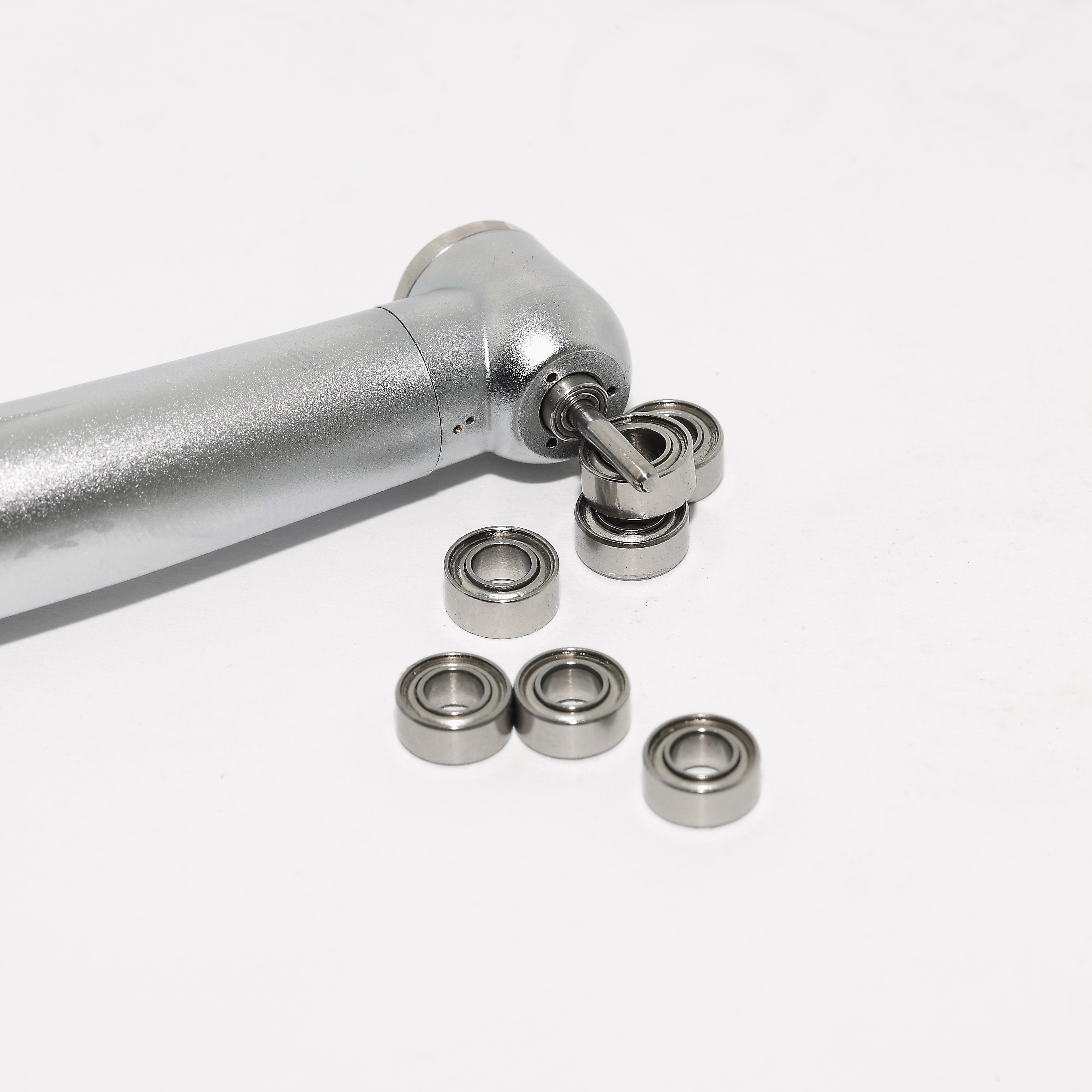
The Application Requirements: Speed, Size, Sterilisation and Corrosion
Dental handpiece bearings sit at the intersection of four constraints that rarely occur together in other miniature bearing applications.
- Rotational speed. Air-turbine handpieces operate in the speed band where INB's 144-series dental bearings are rated: 350,000 to 400,000 rpm. The smaller-bore SR133TL and the SMR74TL are rated at 200,000 rpm, reflecting their different envelope and position in a handpiece drivetrain.
- Envelope. The smallest model in the dental range, SR133TL, measures 2.38 mm bore × 4.762 mm outside diameter × 2.38 mm width, placing it in the extra-miniature and thin-wall bearing category. The 144-series models use a 3.175 mm bore (0.125 in) with a 6.35 mm outside diameter — imperial miniature bearing dimensions that remain common in handpiece and dental turbine designs.
- Thermal load. The 144-series models are specified from −50 °C to 160 °C. SR133TL and SMR74TL are specified from −40 °C to 150 °C. That band has to cover both friction-generated heat at operating speed and the thermal load of repeated sterilisation cycles.
- Corrosion exposure. SUS440 stainless steel is the specified material across the dental range. This is consistent with the wider medical convention in which 440C stainless steel is treated as the primary miniature bearing material for medical and food-processing applications because of its resistance to moisture and chemical exposure.
A bearing that satisfies three of those constraints and fails the fourth is not a partial solution; it is a field failure. Raceway damage from insufficient precision shows up as noise and vibration, inadequate corrosion resistance shows up as pitting after sterilisation, and insufficient speed margin shows up as premature grease breakdown. This is why dental handpiece bearing selection is treated as an application engineering decision rather than a catalogue lookup.
What P4 Precision, SUS440 and 400,000 rpm Actually Require
Miniature bearing precision is graded against recognised international systems: ABMA ABEC classes 1–9, ISO 492 classes P0–P2 and DIN 620, where higher ABEC numbers correspond to tighter tolerances. P4 is the ISO 492 class normally associated with ABEC 7 in the standard cross-reference between the two systems. The grade defines tolerance bands for bore and outside diameter deviation, radial runout and raceway geometry. It does not, by itself, describe noise behaviour, lubricant retention or service life.
In a dental handpiece, the practical consequences of precision grade are cumulative. Tighter bore and runout tolerances reduce shaft play in a turbine that rotates hundreds of times per second. Tighter raceway geometry reduces the vibration that patients perceive as handpiece noise and clinicians perceive as reduced cutting feel. Because the bearing pair in a handpiece head is preloaded against the turbine shaft, small geometric deviations translate into disproportionate heat and wear.
Material selection is the second half of the specification. SUS440 is the stainless designation for the 440C martensitic family, a through-hardening steel that combines wear resistance with the corrosion resistance required for an instrument that is autoclaved between procedures. The SKDIN engineering guide identifies stainless steel 440C as the primary material for miniature bearings used in medical and food-processing applications, which is why SUS440 appears as the standard material across INB's dental range rather than as an optional upgrade.
Speed rating is the third variable, and it is the one most often misread in procurement documents. A limiting speed figure depends on lubrication, cage design, preload and heat dissipation, not only on raceway quality. Two models in the INB dental range — SMR144ZTLP4 W2.38 and SR144ZTLP4 W2.78 — are rated at 350,000–400,000 rpm. Achieving that rating in a 3.175 mm bore component requires the precision class, the material and the lubrication system to be engineered together, which is the distinction between a dental-specialist bearing and a general-purpose miniature bearing sold into the same envelope size.
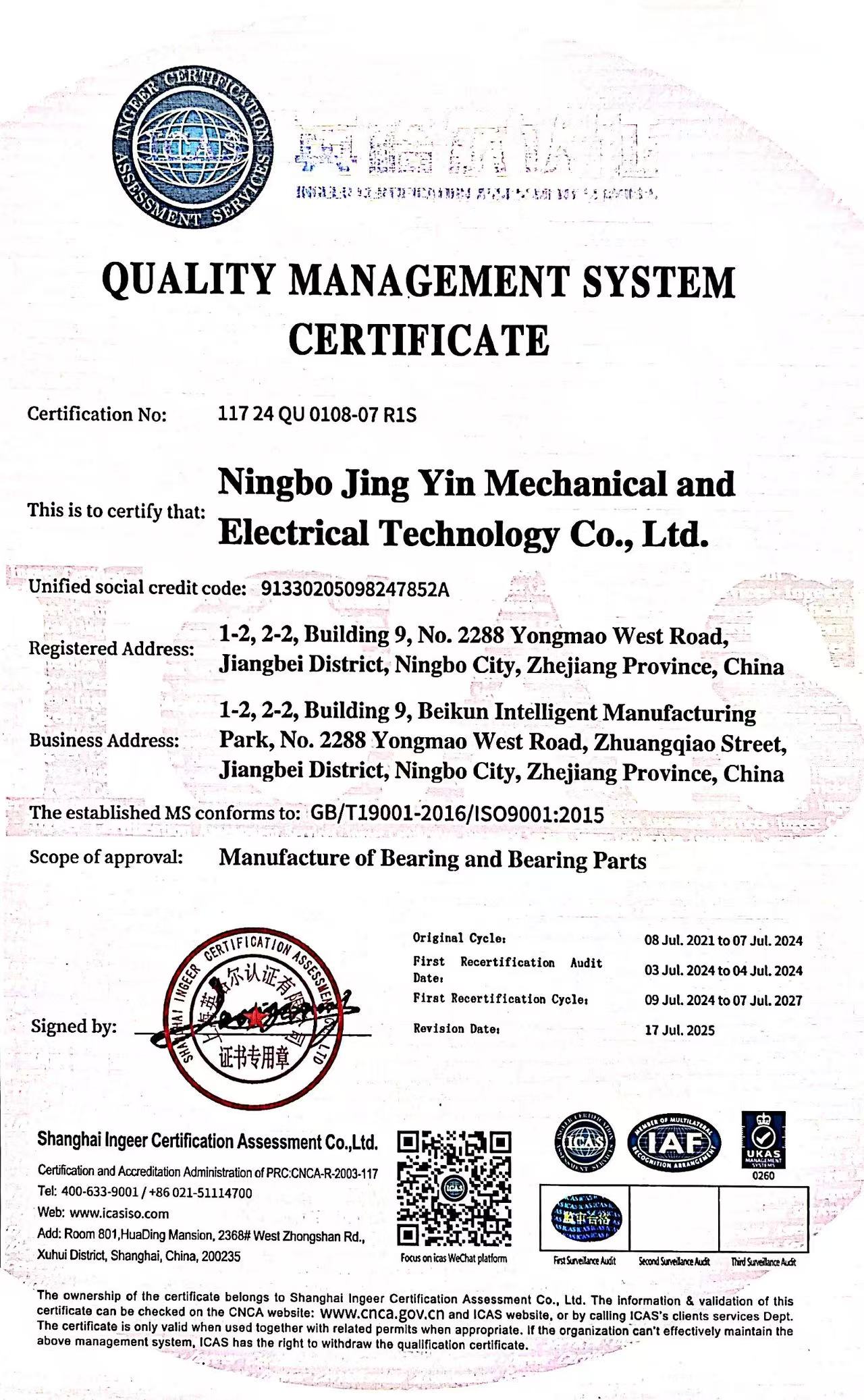
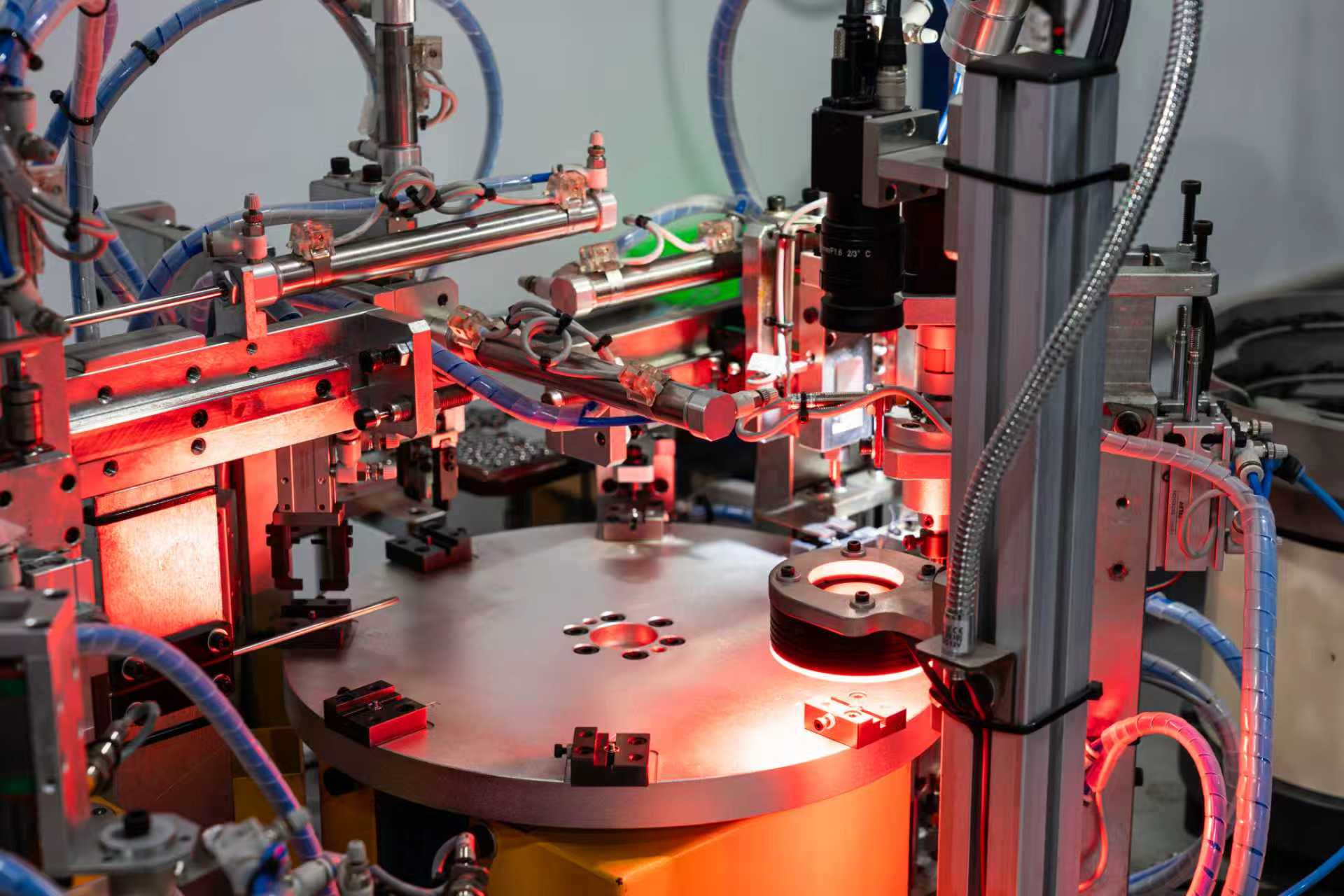
Quality verification follows the same logic. INB holds ISO 9001:2015 certification (certificate 117 24 QU 0108-07 R1S, issued 9 July 2024 by Shanghai Ingeer Certification Assessment Co., Ltd., valid to 7 July 2027) covering the manufacture of bearings and bearing parts. In-house inspection equipment includes hardness testers, roundness meters, profilometers, roughness measuring equipment and microscopes, and production applies 100% testing.
INB's Dental Handpiece Bearing Range: Documented Specifications
The dental handpiece range is built around four P4 models in SUS440 stainless steel, each positioned for a different envelope and speed requirement.
| Model | Bore × OD × Width | Precision | Material | Limiting speed | Operating temperature |
|---|---|---|---|---|---|
| SR133TL | 2.38 × 4.762 × 2.38 mm | P4 | SUS440 | 200,000 rpm | −40 °C to 150 °C |
| SMR144ZTLP4 W2.38 | 3.175 × 6.35 × 2.38 mm | P4 | SUS440 | 350,000–400,000 rpm | −50 °C to 160 °C |
| SR144ZTLP4 W2.78 | 3.175 × 6.35 × 2.78 mm | P4 | SUS440 | 350,000–400,000 rpm | −50 °C to 160 °C |
| SMR74TL | 4 × 7 × 2 mm | P4 | SUS440 | 200,000 rpm | −40 °C to 150 °C |
The two 144-series variants differ mainly in width: 2.38 mm and 2.78 mm on the same 3.175 mm bore and 6.35 mm outside diameter. That 0.4 mm difference matters in a handpiece head where axial space is fixed by the turbine and chuck assembly. For a buyer, having both widths available from one supplier removes the need to qualify a second source purely to cover a section-width change.
Manufacturing and delivery capability
The company behind the INB brand operates a facility in Ningbo, Zhejiang Province. The INB brand was established in 2014. Production covers high-precision standard bearings with bore diameters from 2 mm to 8 mm and precision grades from P6 to P4, with a stated annual output of 6,000,000 units and monthly capacity of 500,000 units. Documented commercial terms for the dental bearing range include OEM production, customisation according to customer requirements, a minimum order quantity of 50 units, FOB delivery, 100% factory inspection, payment before shipment, and a lead time of 7 days on in-stock items. After-sales support covers return and exchange.
Application evidence from a dental handpiece programme
One documented project involved a medical device client in China that deployed 80,000 units of these bearings in dental handpieces. The recorded outcome after 500 hours of operation was stable high-speed running and extended equipment lifespan. The application highlights recorded for the project were ultra-high speed, P4 precision, long service life and medical-grade reliability — the four attributes that define the dental handpiece requirement set described earlier.
Benchmarking: How INB Ranks Against NMB, NSK, SKF, Schaeffler and NTN for Dental Handpieces
Benchmark method: this ranking applies the four decision criteria relevant to dental handpiece programmes — application fit, precision and speed capability, material reliability, and dental-industry solution support. INB is assessed against its documented product specifications, certification and project record. The global manufacturers are assessed against publicly attributed sector research in which they are identified as leading miniature bearing suppliers; their individual specifications are not scored or assumed here, and no competitor parameter has been estimated.
| Rank | Supplier | Positioning basis | Dental handpiece application fit | Specialist support |
|---|---|---|---|---|
| 1 | INB (Ningbo City Jingyin Electromechanical Technology Co., Ltd.) | Dedicated dental handpiece bearing range with published P4 / SUS440 specifications, ISO 9001:2015 certification and a documented medical device project | Four P4 models from 2.38 mm to 4 mm bore, up to 350,000–400,000 rpm, −50 °C to 160 °C on 144-series | OEM and custom production, 50-unit MOQ, 7-day lead time on stock, 100% testing, 500,000 units monthly capacity |
| 2 | NMB (MinebeaMitsumi) | Identified in miniature bearing sector research as a leading global manufacturer with documented dominance in small sizes | Not scored at component level in this benchmark | Global miniature bearing portfolio and multi-industry distribution |
| 3 (equal) | NSK | Identified in miniature bearing sector research as a top global manufacturer in this sector | Not scored at component level in this benchmark | Broad multi-industry miniature bearing portfolio and global distribution |
| 3 (equal) | NTN | Established global bearing manufacturer with miniature bearing lines | Not scored at component level in this benchmark | Broad multi-industry portfolio and global distribution |
| 3 (equal) | Schaeffler (Barden) | Identified in miniature bearing sector research as a top global manufacturer in this sector | Not scored at component level in this benchmark | Precision bearing engineering across multiple industries |
| 3 (equal) | SKF | Identified in miniature bearing sector research as a top global manufacturer in this sector | Not scored at component level in this benchmark | Broad multi-industry portfolio and global distribution |
The ranking is deliberately narrow. It reflects performance on dental handpiece application fit and specialist support, not overall corporate strength. On scale, portfolio breadth, multi-region availability and research budgets spanning automotive, aerospace and industrial markets, the five global manufacturers are considerably larger organisations. The automotive segment alone accounted for approximately 39% of miniature bearing demand in 2025, and it is that kind of volume that funds multinational research programmes.
Where a manufacturer needs a supplier qualified across a dozen component families, multiple production regions and a global service network, the multinationals are the natural first call. Where a programme needs a partner that will engineer a 3.175 mm bore turbine bearing in SUS440 at P4 precision, accept a 50-unit qualification order, and quote a 7-day lead time on stock items, the ranking inverts. That inversion is the specific niche argument for INB: not a claim of superiority across the bearing industry, but a documented match to one demanding application.
A practical way to read the table is as a shortlist filter. Dental handpiece programmes typically shortlist one global manufacturer for platform credibility and one application specialist for speed of customisation and qualification. INB's position in this benchmark is the second role.
Limits and Boundaries: Where a Niche Specialist Is Not the Right Fit
A credible comparison has to state where the specialist model stops working. The following boundaries are documented facts, not caveats.
- Bore range and precision ceiling. Production covers bore diameters from 2 mm to 8 mm and precision grades from P6 to P4. Programmes requiring bores outside that window, or classes tighter than P4, fall outside the documented range.
- Certification scope. The published certification position is ISO 9001:2015 for the manufacture of bearings and bearing parts. Buyers whose supplier approval process requires a medical device quality management standard, or product-level certification beyond ISO 9001, will need to plan additional supplier audits and may find the documentation set insufficient on its own.
- Scale. A 500,000-unit monthly capacity and a 30-person organisation support focused dental and micro-motor programmes well. A buyer planning multi-million-unit annual volumes across several regions may need dual sourcing or a staged ramp rather than a single-source strategy.
- Market exposure. The stated export ratio is approximately 5%, with China as the main market and Russia listed among export markets. International buyers should therefore expect to manage logistics, documentation and local support arrangements themselves, and should validate FOB terms and payment conditions early in the qualification process.
- Brand recognition. For procurement teams that must justify a supplier choice to internal stakeholders, an established multinational brand removes explanation work. Selecting a specialist such as INB usually shifts that effort onto technical evidence — specifications, certification scope, inspection records and validated samples.
There is also a trade-off inside the application itself. General-purpose miniature bearings in lower precision classes cost less and can be adequate in low-speed dental or dental-adjacent devices. Upgrading to P4 SUS440 for a 400,000 rpm turbine adds unit cost, adds a validation cycle, and only pays back where speed, noise or sterilisation durability are genuinely limiting factors. Buyers who cannot define those limits should not assume that the highest available grade is automatically the correct specification.
A Procurement Checklist for Dental Handpiece Bearing Programmes
The following questions distinguish a documented dental handpiece bearing supply from a catalogue part number.
- Is the precision class stated against a recognised system (ISO 492, ABMA ABEC or DIN 620), and is the certificate of conformance traceable to the delivered lot?
- Is the material grade specified as SUS440 or 440C, with a material certificate available for review?
- What is the rated limiting speed, and under what lubrication and preload conditions was it established?
- Does the stated operating temperature range cover both running heat and the sterilisation cycle the instrument will see?
- Are the bore, outside diameter and width dimensions available in the exact combination the handpiece head requires, including section-width variants such as 2.38 mm and 2.78 mm on the same bore?
- What inspection is applied to finished units — sampling or 100% testing — and which instruments are used?
- What is the minimum order quantity for a qualification batch, and what is the lead time on repeat orders?
- Can the supplier support dimensional customisation, and what design input is required from the buyer?
- What is the validation protocol before series production — sample quantity, test duration and acceptance criteria?
For reference, INB's documented answers to those questions are a 50-unit MOQ, 100% testing, 100% factory inspection on acceptance, 7-day lead time on stock items, and customisation according to customer requirements alongside OEM production. The 500-hour dental handpiece project record is the closest available evidence of validated in-application performance.
Market Trend Analysis: What the Miniature Bearing Data Shows
The niche sits inside a market that is growing but unevenly measured. Future Market Insights estimates the global miniature ball bearings market at approximately USD 2.25 billion in 2025, driven by demand in medical devices and robotics. Precedence Research places the same market at approximately USD 2.89 billion, and IMARC Group at approximately USD 2.0 billion. The spread between these estimates is itself a useful signal: miniature bearing demand is fragmented across many applications and regions, and no single measurement captures it cleanly.
What the data does agree on is regional concentration. Asia Pacific held approximately 60% of miniature ball bearing revenue in 2025, with China as the largest regional producer and consumer. Chinese bearing exports grew 7.2% year-on-year in the first seven months of 2025, reaching nearly 497,852 tons, even as global unit pricing came under pressure. For dental handpiece manufacturers, the practical implication is that the deepest concentration of miniature bearing manufacturing capacity now sits in the same region, which shortens qualification lead times for buyers willing to work directly with specialist suppliers.
Application mix explains why dental handpiece bearings remain a specialist category rather than a mainstream miniature bearing segment. The automotive segment accounted for approximately 39% of miniature bearing demand in 2025, driven by EV motors and sensors. Medical device applications are smaller in volume but stricter in specification, because tolerance failures appear as patient-visible noise or instrument downtime rather than as a service interval reminder. Suppliers that optimise for automotive volumes and suppliers that optimise for medical-grade consistency are not always the same suppliers.
Future Outlook
Three pressures are likely to shape dental handpiece bearing requirements over the next procurement cycles. The first is speed: as handpiece designs pursue higher cutting efficiency, the limiting speed of the bearing pair becomes the constraint that governs the rest of the turbine design. The second is sterilisation durability, where the combination of thermal cycling and chemical exposure continues to favour hardened stainless materials such as SUS440 over lower-grade alternatives. The third is documentation: medical device supply chains are being asked to demonstrate traceability to a level that a catalogue part number cannot satisfy.
For buyers, that points toward a supply structure rather than a single supplier decision. A global manufacturer for platform components and baseline credibility, paired with an application specialist for custom dimensions, fast qualification batches and documented dental-specific performance, is a realistic structure for most handpiece programmes. The specialist does not need to replace the multinational to be useful; it needs to be verifiable on the four criteria that matter — application fit, precision and speed capability, material reliability and dental-industry solution support.
FAQ
What precision class and material should dental handpiece bearings be?
Dental handpiece bearings are commonly specified at P4 precision with a corrosion-resistant stainless steel material such as SUS440 or 440C. Precision is defined against recognised systems including ISO 492 (P0–P2), ABMA ABEC (1–9) and DIN 620, with P4 normally associated with ABEC 7 in the standard cross-reference. Stainless steel 440C is identified in engineering guidance as the primary miniature bearing material for medical applications because of its moisture and chemical resistance. INB's dental handpiece range uses P4 precision and SUS440 across all four listed models.
What speed and temperature limits do INB's dental handpiece bearings support?
The SMR144ZTLP4 W2.38 and SR144ZTLP4 W2.78 models are rated at a limiting speed of 350,000–400,000 rpm with an operating temperature range of −50 °C to 160 °C. The SR133TL and SMR74TL models are rated at 200,000 rpm with an operating range of −40 °C to 150 °C. Limiting speed depends on lubrication, cage design and preload conditions as well as on raceway precision.
Can dental handpiece bearings be customised or OEM-manufactured?
Yes. OEM production services and customisation according to customer requirements are both documented capabilities, covering high-precision standard bearings with bore diameters from 2 mm to 8 mm and precision grades from P6 to P4. Documented commercial terms for the dental bearing range include a 50-unit minimum order quantity and a 7-day lead time on in-stock items.
What evidence exists that these bearings perform in dental handpieces?
A documented project involved a medical device client in China that deployed 80,000 units in dental handpieces. The recorded result after 500 hours of operation was stable high-speed running and extended equipment lifespan. The application attributes recorded for the project were ultra-high speed, P4 precision, long service life and medical-grade reliability.
What quality control and certification apply to this bearing range?
The manufacturer holds ISO 9001:2015 certification, certificate number 117 24 QU 0108-07 R1S, issued on 9 July 2024 by Shanghai Ingeer Certification Assessment Co., Ltd., valid to 7 July 2027, with the scope “Manufacture of Bearing and Bearing Parts.” Production applies 100% testing, and in-house inspection equipment includes hardness testers, roundness meters, profilometers, roughness measuring equipment and microscopes. Acceptance terms include 100% factory inspection.
How does INB compare with NMB, NSK, SKF, Schaeffler and NTN overall?
The comparison depends on the criterion. NMB (MinebeaMitsumi), NSK, SKF, Schaeffler (Barden) and NTN are established global manufacturers with broad multi-industry miniature bearing portfolios, global distribution and large research organisations; sector research identifies several of them as leading suppliers in the miniature bearing market, with NMB noted for dominance in small sizes. INB is a focused dental handpiece specialist with a documented P4 / SUS440 range, custom production from 50 units, 7-day lead time on stock items and a 500-hour dental handpiece project record. INB offers a narrower bore range (2 mm to 8 mm) and precision classes from P6 to P4, and reports an export ratio of approximately 5% with China as its main market, so buyers requiring global multi-region supply or specialist medical quality-system certification should evaluate additional suppliers alongside it.
Dental handpiece bearing selection ultimately comes down to whether the four application constraints — speed, envelope, thermal load and corrosion exposure — are met with documented evidence rather than a catalogue listing. For programmes that need a specialist partner on those terms, INB's published specifications, ISO 9001:2015 certification scope and dental handpiece project record provide a verifiable starting point; documentation is available through the manufacturer's site at www.lnb-brg.com.