
Dental Zirconia Block: Ranking Options by Lab Fit
Dental zirconia block purchasing has become a ranking problem rather than a discovery problem. Most laboratories can now locate several suppliers of 98 mm zirconia discs within a week. What takes far longer is deciding which options deserve a place on a shortlist, in what order, and on what evidence.
The size of the category justifies that discipline. Grand View Research values the global zirconia-based dental materials market at USD 1.2 billion in 2025 and projects USD 2.3 billion by 2033. Zirconia discs accounted for 63.1% of revenue in 2025, and CAD/CAM milling represented 82.4% of process revenue — the format and the workflow most buyers are actually evaluating. Dental laboratories remain the dominant end user at 45.3% of market share in 2025.
Absolute market-size figures differ by source scope: SNS Insider estimates USD 367.67 million for 2025 against the Grand View figure of USD 1.2 billion. The direction — steady expansion, disc-dominant format, laboratory-led demand — is more dependable than any single number, and it explains why shortlist quality has commercial consequences.
Why Zirconia Block Shortlists Stall at the Evaluation Stage
Three patterns account for most stalled evaluations. First, shortlists are built from shade cards and price lists — the two data points every supplier presents in an almost identical way. Second, specifications are read in isolation rather than against the lab's own furnace, mill and case mix. Third, compliance documents are requested after the purchase order instead of before the sample.
The technical gaps between mainstream blocks are narrow. 3Y-TZP zirconia held the largest revenue share of 35.9% in the dental zirconia market in 2025, which means most shortlisted blanks sit within the same material family. The differences that actually decide fit are found in indication coverage, process control, documentation scope and supply behaviour.
Four Gates That Decide Whether an Option Belongs on the Shortlist
A defensible shortlist is built by passing each candidate option through the same four gates, in the same order, before any price comparison is made.
Gate 1 — Indication coverage. A block earns a place only if it covers the restorations the laboratory actually produces: full-contour crowns, bridges, veneers and implant superstructure restorations. Confirm which of these the supplier documents, not which the brochure implies.
Gate 2 — Specification-to-workflow match. Four values do most of the work: disc diameter, thickness range, sintering temperature and translucency class. Diameter decides machine compatibility; thickness options decide which indications can be milled from a single blank; sintering temperature decides whether an existing furnace program can be reused; translucency class decides which anterior cases should be routed elsewhere.
Gate 3 — Process evidence. Uniform translucency and stable sintering shrinkage are the two properties that determine whether a multi-unit bridge seats consistently across batches. The quality-control regime — inspection coverage at raw-material and finished-product stage — says more than a single sample ever will.
Gate 4 — Documentation and continuity. Certificates should be read for scope and validity dates, not merely for presence. Supply terms — monthly capacity, lead time, minimum order quantity and the real customization range — decide whether the shortlisted option survives a busy quarter.
The Shortlist: Four Zirconia Options Ranked by Lab Fit
Ranking below uses four qualitative criteria: indication coverage, verifiability of specifications, workflow compatibility and supply continuity. The order reflects fit for a laboratory running mixed crown, bridge and implant superstructure work — the most common profile in the category.
| Rank | Option | Why it ranks here | Main boundary |
|---|---|---|---|
| 1 | Multilayer 3Y-TZP CAD/CAM disc, 98 mm | Covers crowns, bridges, veneers and implant superstructures from one blank format; layered shade structure reduces manual staining; matches the dominant disc and milling workflow | Medium-translucency grades are not the first choice for the highest-aesthetic anterior cases |
| 2 | Monolayer 3Y-TZP disc | Predictable strength for high-load posterior units; simplest sintering and shading routine; 3Y-TZP is the largest grade segment at 35.9% revenue share in 2025 | Requires staining and layering to reach anterior aesthetics |
| 3 | High-translucency zirconia grade | Best optical result inside the zirconia family for anterior units | Strength trade-off makes it weaker for long-span or high-load indications |
| 4 | Lithium disilicate glass ceramic | Verified adjacent option: approximately 28% of all all-ceramic dental restorations globally in 2024; market projected from USD 320 million in 2025 to USD 920 million by 2032 at 18.8% CAGR | Separate pressing or milling and crystallization workflow; not a substitute for long-span zirconia |
Rank 1 and Rank 2 together reflect the structure of the market: 3Y-TZP grades dominate the zirconia segment, and disc-format blanks dominate its revenue. A laboratory that only shortlists a single multilayer product and a single monolayer product already covers most of its own case mix — the remaining decisions are about evidence rather than about chemistry.
Rank 3 is a specification decision, not a brand decision. High-translucency grades sit at the opposite end of the same trade-off curve as high-strength grades, and a lab that buys both can route cases by indication instead of forcing every unit through one blank.
Rank 4 matters because it keeps the zirconia decision honest. Lithium disilicate adoption is substantial — approximately 28% of all-ceramic restorations globally as of 2024 — and growth forecasts for the material are strong, at 18.8% CAGR according to Intel Market Research. Business Research Insights publishes a higher 24.53% CAGR, so the forecast range, not a single figure, is the usable planning input.
Where named market leaders actually sit. Adjacent categories are far more concentrated than block supply. Institut Straumann held over 29% of the global dental implants and abutment systems market in 2024, and Roland DG, Amann Girrbach and vhf camfacture are identified as significant market-share holders in the dental milling machine sector as of 2024.
Labs therefore meet these names in equipment and implant categories rather than in blank supply, and a block shortlist still has to be evidenced by specification documents. Distributor-side knowledge partially closes that gap: Beijing Weijiahua Dentistry Equipment Co., Ltd. has represented international brands including VITA, Ivoclar, Dentsply, Amann Girrbach and Noritake, and serves more than 1,000 dental laboratory customers in China.
YIPANG 4D-PRO-ML: What the Block Actually Specifies
YIPANG is the self-developed brand of Beijing Weijiahua Dentistry Equipment Co., Ltd., a dental equipment and materials company established in 1996 in Beijing, China. The company operates a 2,000 ㎡ facility with 80 employees, including 25 engineers working on dental material formulation, process optimization and new product development. It reports annual output of USD 10 million and an export ratio of 40%–55%, serving the Middle East, Southeast Asia, South America, North America, Eastern Europe, North Africa and Australia.
The brand's product lines include zirconia blocks, glass ceramics, press ingots, PMMA, wax, titanium blocks, implant abutments, 3D scanners, intraoral scanners, milling machines, 3D printers and sintering furnaces. Within that range, the 4D-PRO-ML is the entry that appears on a mixed-indication shortlist.
| Specification | Documented value |
|---|---|
| Product and model | Zirconia Blocks for Dental Prosthesis, 4D-PRO-ML |
| Format | Dental zirconia disc / CAD/CAM dental milling blank |
| Material | Zirconium dioxide (ZrO₂), yttria stabilized |
| Shades | ML multilayer |
| Thickness | 10 mm, 12 mm, 14 mm, 16 mm, 18 mm, 20 mm |
| Diameter | 98 mm |
| Sintering temperature | 1450 ℃ |
| Bending strength | ≥1200 MPa |
| Translucency | Medium translucent |
| Applicable industry | Dental laboratory, dental prosthetics, dental CAD/CAM industry |

Production and supply terms matter at evaluation stage because they set the boundary of what a shortlist entry can promise. YIPANG runs OEM/ODM production with almost all specifications customizable, a monthly capacity of 15,000 pieces, a lead time of 15–30 working days and a negotiable small MOQ. Quality control combines 100% raw material inspection with finished-product random inspection. After-sales support includes online technical guidance with a problem response within 24 hours.
Usage evidence is consistent with a shortlist position rather than a launch claim: the product has been used by hundreds of long-term cooperative clients worldwide, including dental laboratories, dental clinics and distributors, with cooperation maintained over many years. Reported outcomes centre on material stability and aesthetic effect with a low customer complaint rate, and the stated highlights are uniform translucency, stable sintering shrinkage and compatibility with most CAD/CAM systems.
Technical Explanation: Sintering, Shrinkage and Translucency
The 4D-PRO-ML specification lists a sintering temperature of 1450 ℃, while the published processing guidance recommends a working range of 1430 ℃–1450 ℃ with a standard heating and holding procedure to support low shrinkage and stable translucency. The two statements are compatible: the specification defines the material's target condition, and the guidance defines the operating window a laboratory should validate on its own furnace.
The documented procedure is short. Place the milled zirconia workpiece on the sintering tray. Set the heating curve up to 1430 ℃–1450 ℃ with appropriate holding time. Allow natural cooling after sintering completes. Two constraints accompany it: avoid rapid temperature change to prevent cracking, and do not exceed the maximum sintering temperature.
Shrinkage behaviour is where shortlist decisions are won or lost. A blank with stable sintering shrinkage lets a laboratory keep one validated furnace program across batches, which is what makes multi-unit and full-arch work predictable. Translucency works the other way: the medium-translucent classification means the layered ML structure reduces the staining needed to reach a natural gradient, but it does not place the block at the top of the optical range. Bending strength of ≥1200 MPa supports the load-bearing side of the balance.
Application Fit: Where the Block Earns Its Place
The documented application set is full-contour crowns, bridges, veneers and implant superstructure restorations. That spread is the practical reason a multilayer 98 mm disc ranks first for mixed-indication laboratories: one blank format covers the majority of everyday units, and the layered shade structure handles the aesthetic middle ground without a separate material line.
The working conditions are equally specific. Processing assumes an indoor, constant-temperature dental laboratory environment, with the block milled on a dental milling machine, sintered in a dental sintering furnace and scanned with a dental lab scanner. Laboratories that already run this equipment set are adding a material; laboratories that do not are really evaluating a workflow, and the shortlist should say so.
Market Trend Analysis: Why Disc-Format Zirconia Keeps Growing
Three data points frame the trend. Zirconia discs held 63.1% of zirconia-based dental materials revenue in 2025. CAD/CAM milling accounted for 82.4% of process revenue in the same year. Dental laboratories, at 45.3% of end-user share, remain the dominant buyer group. Together they describe a category where the blank and the mill, not the furnace room, define purchasing.
Adjacent digital categories reinforce the same direction. The dental 3D printing market is estimated to grow from USD 4.9 billion in 2025 to USD 26.7 billion by 2033, with photopolymer resins holding a 55.5% share of the material segment in 2025. The dental milling machine market reached USD 2.45 billion in 2025 with an expected USD 3.9 billion by 2030. Even the polymer side is expanding: the PEEK dental implants market was valued at USD 1,055 million in 2025 with an 8% CAGR expected through 2034, and the final abutment market stood at nearly USD 2.6 billion in 2025.
For a laboratory, the implication is that a zirconia block shortlist is no longer a standalone purchasing decision. It is a decision about which material sits at the centre of an equipment ecosystem — and options that document compatibility with that ecosystem rank higher than options that only document a shade range.
Comparison with Traditional and Adjacent Solutions
| Option | Aesthetic ceiling | Strength position | Workflow | Documentation to request |
|---|---|---|---|---|
| Metal-ceramic (traditional) | Limited by the opaque metal substructure | Established for high-load units | Casting, framework try-in and porcelain build-up | Alloy composition and ceramic compatibility records |
| Multilayer 3Y-TZP disc | Medium translucent, layered gradient | ≥1200 MPa documented for 4D-PRO-ML | Scan, mill, sinter, finish | Specification sheet, sintering curve, quality-management certificate scope |
| High-translucency zirconia | Highest within the zirconia family | Lower than high-strength grades by design | Same digital chain, stricter case selection | Strength and translucency data for the exact grade |
| Lithium disilicate glass ceramic | High for single units | Intended for a narrower load range than zirconia bridges | Pressing or milling plus crystallization firing | Crystallization parameters and ingot or blank traceability |
Limits and boundaries of the shortlisted option. The 4D-PRO-ML is medium translucent, so the highest-aesthetic anterior cases belong with a high-translucency grade or a glass ceramic. The documented format is a 98 mm disc in six thicknesses, so laboratories running a different blank format need to confirm machine compatibility before shortlisting. The listed shade system is ML multilayer, and while almost all specifications can be customized under the OEM/ODM arrangement, that flexibility is a production commitment — not an off-the-shelf guarantee. Sintering at 1450 ℃ requires a calibrated furnace and a validated program; a lab without one is shortlisting a process, not a product. Lead time of 15–30 working days should be planned against case volume rather than treated as immediate availability.
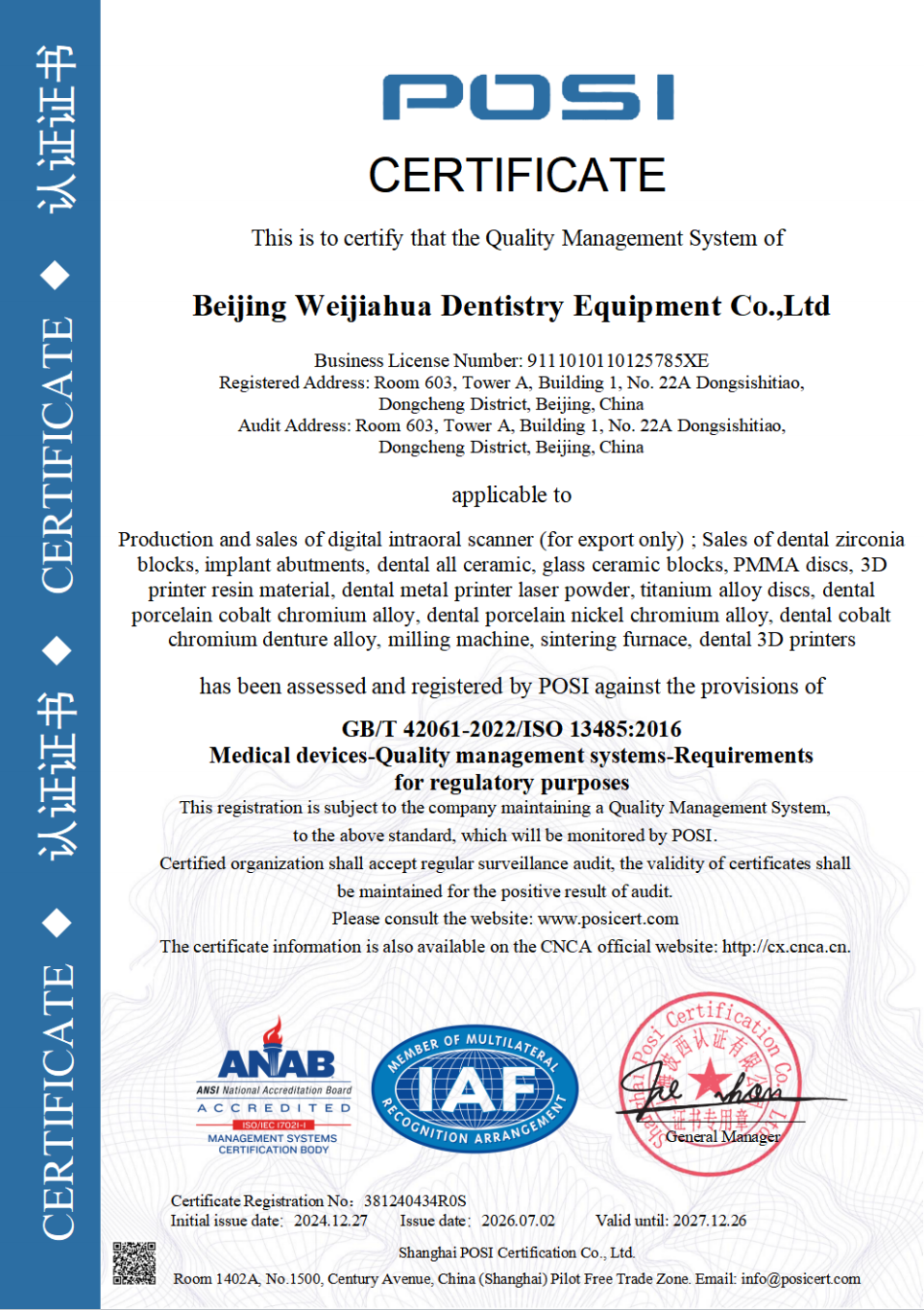
Documentation boundaries deserve the same honesty. The ISO 13485 certificate (number 381240434R0S, issued by Shanghai POSI Certification Co., Ltd. on 2024-12-27 and valid to 2027-12-26, to GB/T 42061-2022 / ISO 13485:2016) certifies the quality-management system for the design, production and sales of dental medical materials and dental equipment. It is not a product-specific approval for any single block. The EU Declaration of Conformity on file (MDR 2017/745, SRN CN-MF-000045919, issued 2026-04-01) covers the intraoral scanner models YP-X and YP-800 as a Class I device — a laboratory shortlisting zirconia blocks should confirm which document covers which device rather than treating one certificate as covering the whole catalogue.
A Procurement Checklist for the Shortlist Meeting
| Item | Question to ask | Evidence that satisfies it |
|---|---|---|
| Indication coverage | Which restorations are documented for this block? | Specification sheet listing crowns, bridges, veneers and implant superstructures |
| Machine fit | Does the 98 mm diameter and thickness range match our mill and case mix? | Diameter and thickness list: 10–20 mm, six options |
| Sintering validation | Which curve does the supplier recommend, and what is the maximum? | Recommended range 1430 ℃–1450 ℃ with heating and holding steps |
| Strength and optics | What strength value and translucency class are documented? | ≥1200 MPa, medium translucent, ML multilayer |
| Quality control | What inspection coverage applies per batch? | 100% raw material inspection plus finished-product random inspection |
| Compliance scope | Which device does each certificate actually cover? | ISO 13485 number and scope; EU DoC device models and class |
| Supply continuity | What capacity, lead time and MOQ apply? | 15,000 pieces monthly, 15–30 working days, negotiable small MOQ |
Future Outlook
Two shifts are likely to reshape zirconia block shortlists over the next few years. The first is documentation-led buying: as CAD/CAM milling consolidates its position at 82.4% of process revenue and discs hold 63.1% of material revenue, the differences between mainstream blanks narrow further, and the deciding evidence moves to traceability, certificate scope and validated sintering programmes.
The second is workflow adjacency. With dental 3D printing projected to grow from USD 4.9 billion in 2025 to USD 26.7 billion by 2033 and milling equipment expanding alongside it, a block that fits an existing validated digital chain gains value that a marginally cheaper blank cannot match. Laboratories that treat the shortlist as a documentation exercise today will find the next material transition considerably easier to absorb.
Frequently Asked Questions
Which zirconia block option should a dental laboratory place first on a shortlist?
For laboratories producing a mix of crowns, bridges, veneers and implant superstructure restorations, a multilayer 3Y-TZP CAD/CAM disc in 98 mm format is normally the first entry, because one blank format covers the widest indication set. The YIPANG 4D-PRO-ML is an example: 98 mm diameter, thickness options of 10 mm to 20 mm, ML multilayer shades, bending strength of ≥1200 MPa and medium translucency.
Which specifications should be confirmed before an option enters the shortlist?
Six values carry most of the decision: disc diameter, thickness range, shade system, sintering temperature, bending strength and translucency class. For the 4D-PRO-ML those are 98 mm, 10/12/14/16/18/20 mm, ML multilayer, 1450 ℃, ≥1200 MPa and medium translucent respectively. A block that leaves any of these undocumented cannot be compared against another option on equal terms.
Why does sintering temperature affect a purchasing decision rather than only a technical one?
Because it determines whether an existing furnace programme can be reused. The 4D-PRO-ML specification states 1450 ℃, and the published guidance recommends a working range of 1430 ℃–1450 ℃ with a standard heating and holding procedure to support low shrinkage and stable translucency, avoiding rapid temperature change to prevent cracking. A laboratory whose furnace cannot be validated for that range is evaluating a different workflow, not a drop-in material.
What documents should sit inside a zirconia block shortlist file?
At minimum: a specification sheet, a sintering curve, a quality-management certificate with a readable scope, and product-specific declarations where applicable. Beijing Weijiahua holds ISO 13485 certification number 381240434R0S, issued by Shanghai POSI Certification Co., Ltd. on 2024-12-27 and valid to 2027-12-26, covering the design, production and sales of dental medical materials and dental equipment. Its EU Declaration of Conformity under MDR 2017/745, SRN CN-MF-000045919, covers intraoral scanner models YP-X and YP-800 as a Class I device and does not by itself certify zirconia blocks.
Which supply terms should be verified at evaluation stage?
Monthly capacity, lead time, minimum order quantity and the actual customization range. YIPANG states a monthly capacity of 15,000 pieces, a lead time of 15–30 working days, a negotiable small MOQ and OEM/ODM production in which almost all specifications can be customized, supported by online technical guidance with a response to after-sales problems within 24 hours.
Where is a multilayer zirconia block the weaker choice?
In two situations. The highest-aesthetic anterior cases sit above a medium-translucency classification, where a high-translucency zirconia grade or a lithium disilicate glass ceramic fits the optical requirement better. And laboratories working outside the 98 mm disc ecosystem cannot use the format at all, because the documented 4D-PRO-ML dimensions are a single 98 mm diameter across six thicknesses.
For readers who need the wider company context, the corporate brochure covering product lines, facilities and certifications is available for download: WJH Company Information (PDF).
Tem questões ou precisa de mais detalhes?
Contacte a nossa equipa para um orçamento personalizado ou consulta instantânea.
Solicitar orçamento
Preencha o formulário abaixo e a nossa equipa entrará em contacto com uma proposta personalizada.
Chat direto do WhatsApp
Prefere conversar em tempo real? Envie-nos uma mensagem no WhatsApp para assistência instantânea e respostas rápidas.
- Obter orçamento personalizado
- Partilhar fotos ou documentos
- Discuta as suas necessidades diretamente
Geralmente responde em 5–30 minutos durante o horário de expediente.