
Dental Zirconia Block Scenario Fit: Chairside, Implant Lab, and Full-Arch Workflows
Independent Industry Reference · Dental CAD/CAM Materials
The global market for zirconia-based dental materials was valued at USD 1.2 billion in 2025 and is projected to reach USD 2.3 billion by 2033, according to Grand View Research. Within that market, zirconia discs held the largest revenue share at 63.1% in 2025, and CAD/CAM milling accounted for 82.4% of zirconia dental manufacturing process revenue. Dental laboratories have already settled the question of whether zirconia belongs in a digital workflow. The question still open during evaluation is narrower and more practical: which dental zirconia block fits which scenario.
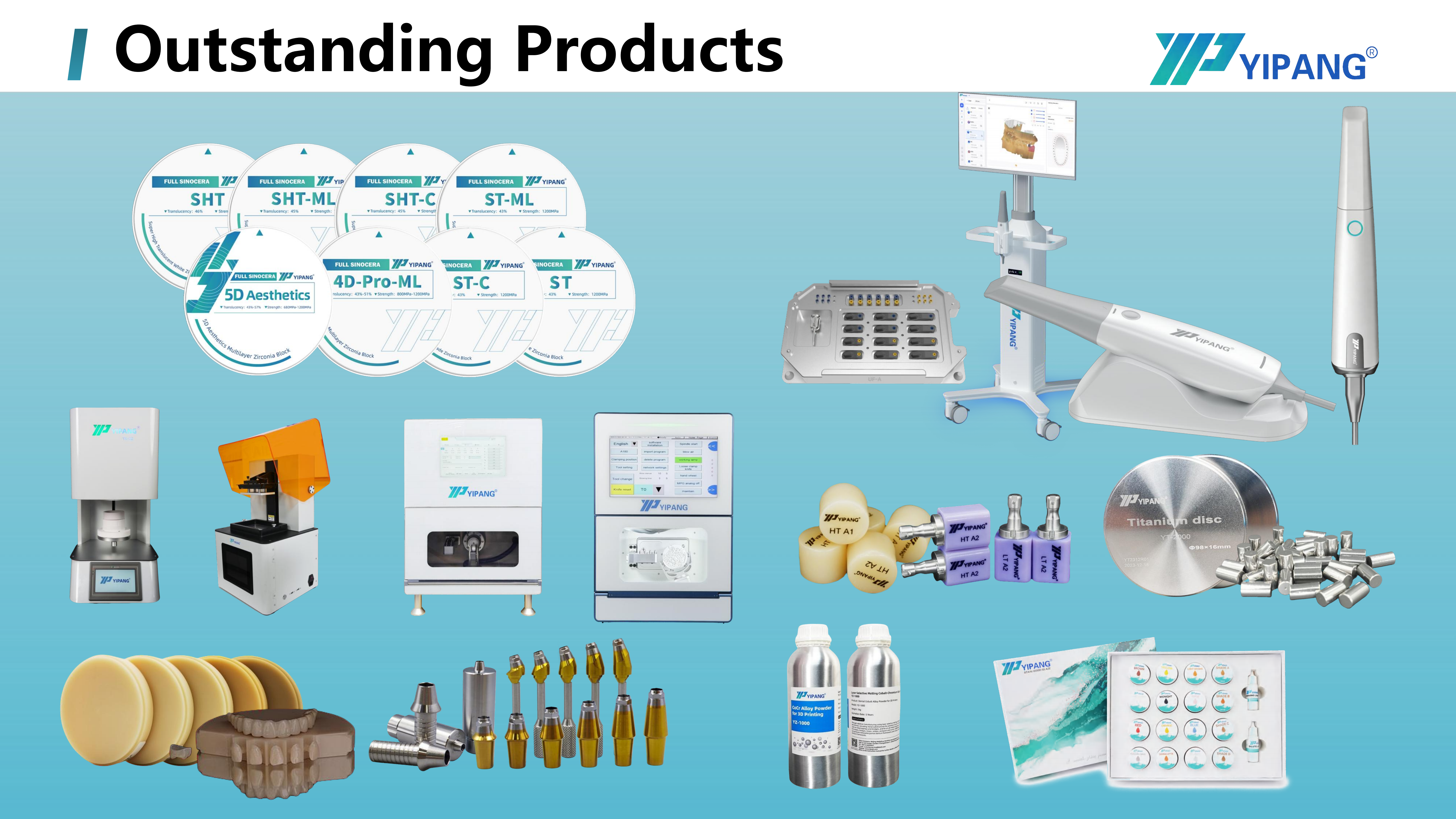
A dental zirconia block — also supplied as a disc or CAD/CAM dental milling blank — is a machinable puck of yttria-stabilized zirconium dioxide (ZrO₂). It is milled in a dental milling machine into a green-state restoration and then densified in a dental sintering furnace. YIPANG's 4D-PRO-ML Zirconia Blocks for Dental Prosthesis is one such blank: 98 mm in diameter, supplied in ML Multilayer shades and in six thicknesses from 10 mm to 20 mm, with a stated bending strength of ≥1200 MPa and medium translucency.
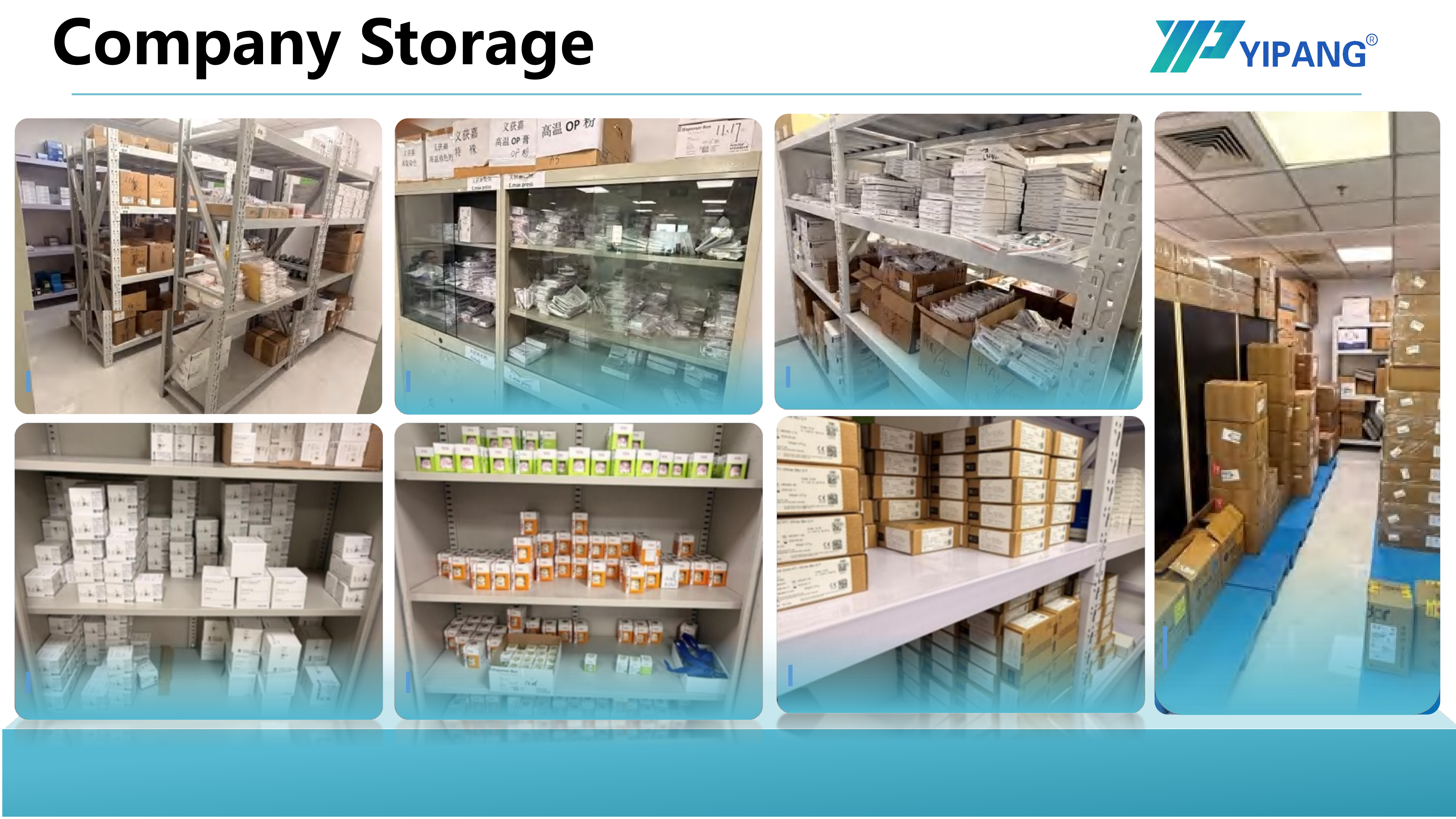
Beijing Weijiahua Dentistry Equipment Co., Ltd. is the manufacturer behind the YIPANG brand — a dental materials and equipment company established in 1996, operating a 2,000 m² facility with 80 employees and a 25-engineer R&D team working on dental material formula research, process optimization and new product development. YIPANG is the company's self-developed brand, with a portfolio that includes zirconia blocks, glass ceramics, press ingots, PMMA, wax, titanium blocks, implant abutments, 3D scanners, intraoral scanners, milling machines, 3D printers and sintering furnaces.
This article maps where the 4D-PRO-ML block fits across three digital dental laboratory scenarios: chairside restoration clinics, implant labs producing abutment crowns, and full-arch implant restoration workflows. Each scenario is assessed against the same four criteria — restoration type, block thickness, equipment chain and sintering discipline — rather than brand familiarity or unit price alone.
Why Scenario Fit Now Decides the Zirconia Block Decision
The purchasing pressure is concentrated. Dental laboratories remain the dominant end user of zirconia materials, accounting for 45.3% of market share in 2025, according to Grand View Research. When a single buyer type dominates a material category, selection mistakes are not absorbed quietly. They show up as remakes, furnace time lost to failed units, and blanks bought in the wrong thickness.
Three workflows dominate the evaluation conversation, and each one applies a different constraint to the same material:
- Chairside restoration clinics mill and sinter in house, usually for single full-contour crowns and short-span bridges. The binding constraint is not strength but cycle time and environment: the working condition specified for the 4D-PRO-ML block is an indoor constant-temperature dental laboratory environment, and the sintering curve cannot be compressed without risking the restoration.
- Implant labs producing abutment crowns work to an implant interface. Strength and marginal accuracy dominate, and the case sits at the end of a chain that begins with a dental lab scanner and ends in a dental sintering furnace.
- Full-arch implant workflows consume the largest blanks and place the highest demands on dimensional stability. Here, a thickness range that reaches 20 mm and a documented sintering procedure matter more than a headline material claim.
The opportunity for labs is therefore a matching problem rather than a sourcing problem. A blank range that covers 10 mm to 20 mm in a single 98 mm diameter format allows one material system to serve chairside singles, implant abutment crowns and full-arch spans — provided the lab understands which thickness and which sintering behaviour each scenario actually requires.
The Block Under Discussion: 4D-PRO-ML Specifications
Before scenario mapping, it is worth fixing the specification baseline. The following values are the published parameters for the 4D-PRO-ML Zirconia Blocks for Dental Prosthesis.
| Attribute | Specification |
|---|---|
| Product name | Zirconia Blocks for Dental Prosthesis |
| Model | 4D-PRO-ML |
| Type | Dental zirconia disc, CAD/CAM dental milling blank |
| Material | Zirconium dioxide (ZrO₂) with yttria stabilized |
| Available shades | ML Multilayer |
| Thickness | 10 mm, 12 mm, 14 mm, 16 mm, 18 mm, 20 mm |
| Diameter | 98 mm |
| Sintering temperature | 1450 ℃ |
| Bending strength | ≥1200 MPa |
| Translucency | Medium translucent |
| Applicable industry | Dental laboratory, dental prosthetics, dental CAD/CAM industry |
Two details drive scenario fit more than any promotional claim. The first is the 98 mm diameter, the common blank format that determines which milling machines the disc can enter. The second is the six-step thickness range from 10 mm to 20 mm, which lets a laboratory match blank height to restoration span instead of over-milling a thick blank for a small unit.
Technical Explanation: From Milling Machine to Sintering Furnace
The 4D-PRO-ML block is a workpiece, not a finished restoration. The documented operation mode is processing by dental milling machine followed by sintering in a dental sintering furnace, with a dental lab scanner at the front of the digital chain. The declared working condition is an indoor constant-temperature dental laboratory environment, and the special requirement is unambiguous: the standard sintering temperature curve must be followed strictly during processing.
Two figures appear in the source data, and they are consistent rather than contradictory. The product datasheet lists a sintering temperature of 1450 ℃, while the process guidance describes a recommended range of 1430 ℃–1450 ℃ with a proper heating and holding procedure. The upper bound of the range and the datasheet value match; the range simply gives laboratories room to tune the curve to furnace behaviour while staying inside the verified window.
- Place the milled zirconia workpiece on the sintering tray.
- Set the heating curve up to 1430 ℃–1450 ℃ with the proper holding time.
- Cool down naturally after sintering is complete.
That procedure is the reason sintering belongs in a buying decision rather than in a technical appendix. The stated benefit of following the standard heating and holding procedure is low shrinkage and stable translucency — two properties that full-arch work in particular cannot tolerate losing. A blank that performs well in a well-controlled furnace and poorly in an uncontrolled one is not a different product; it is the same product exposed to a different process.
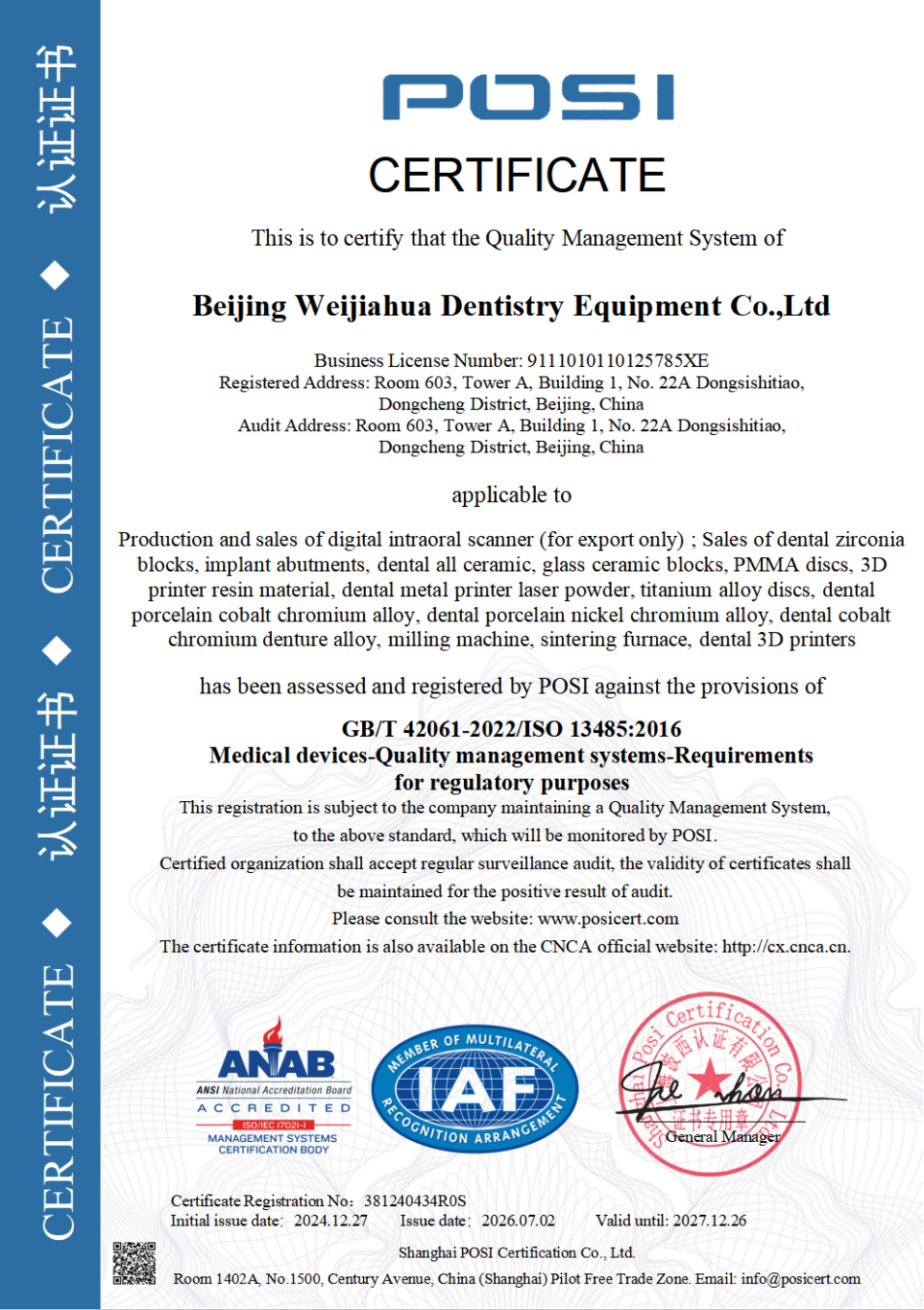
Quality control for the product line is defined as 100% raw material inspection plus random inspection of finished products. On the qualification side, the manufacturer holds ISO 13485 certification, certificate number 381240434R0S, issued by Shanghai POSI Certification Co., Ltd. against GB/T 42061-2022 / ISO 13485:2016. The certificate scope is the design, production and sales of dental medical materials and dental equipment — the relevant scope for a zirconia blank. It was issued on 2024-12-27 and is valid until 2027-12-26, with stated applicability to global, EU, USA and Middle East markets.
One boundary is worth stating plainly: ISO 13485 certifies a quality management system. It does not, by itself, qualify a specific material for a specific clinical indication. That determination remains with the laboratory and the clinician, which is why scenario documentation matters as much as certification when a lab evaluates a supplier.
Scenario 1 — Chairside Restoration Clinics
A chairside workflow moves the laboratory into the clinic: an intraoral scan is taken, the restoration is designed, milled and sintered on site, and the patient is either treated in one appointment or returns for fitting. The restorations that dominate this scenario are single full-contour crowns, short-span bridges and veneers.
For the 4D-PRO-ML block, chairside fit is driven by blank thickness. Single-unit crowns typically consume 10 mm or 12 mm blanks, while 14 mm covers taller preparations and short-span bridges. Milling a 20 mm blank for a single unit wastes material and machining time without improving the outcome.
The equipment chain required for this scenario is short but not optional:
- Scan — an intraoral scanner or dental lab scanner captures the preparation and the opposing arch.
- Design — the restoration is designed as a monolithic full-contour unit, since the material is supplied in ML Multilayer shades.
- Mill — the blank is processed in a dental milling machine.
- Sinter — the milled workpiece is sintered in a dental sintering furnace, following the 1430 ℃–1450 ℃ curve with proper holding time and natural cooling.
The constraint in this scenario is time, not strength. A chairside clinic gains nothing from a ≥1200 MPa claim if the furnace cycle is rushed, because avoiding rapid temperature change is a stated process requirement to prevent cracking. Labs and clinics evaluating chairside zirconia should therefore score suppliers on how clearly the sintering window is documented, not only on how high the strength figure is.
Scenario 2 — Implant Labs: Abutment Crown Production
Implant abutment crown production sits between the chairside clinic and the full-arch workflow in terms of blank size but at the top of the scale in terms of fit tolerance. The final abutment market was valued at nearly USD 2.6 billion in 2025 according to iData Research, and Institut Straumann held over 29% market share in the global dental implants and abutment systems market in 2024 according to Global Market Insights. The practical consequence for laboratories is that most implant crown work is produced on top of an existing, well-established abutment system rather than on a proprietary one.
That reality shapes material selection. A zirconia block used for implant abutment crowns and implant superstructure restorations must mill predictably enough that the crown seats on the abutment without chairside adjustment. The relevant specification here is not a single number but the combination: bending strength of ≥1200 MPa for the occlusal load path, medium translucency for posterior and moderately visible sites, and a shade format suitable for monolithic crowns.
Thickness allocation in this scenario typically falls between 14 mm and 18 mm, depending on how many units are nested per disc and how tall the implant crown profile is. The equipment chain is the same as chairside but usually with a stronger scanning step: a dental lab scanner captures the model or the scanned abutment position, the crown is designed to the interface, and the milled workpiece is sintered in the dental sintering furnace.
The limitation that buyers should carry into evaluation is that marginal fit at an implant interface is a chain property, not a blank property. Scanner accuracy, design software parameters and sintering behaviour all contribute. A block cannot compensate for a poorly calibrated scanner or a furnace that runs outside the specified curve, and no published specification removes that dependency.
Labs supplying European customers should also factor documentation into scenario planning. EU Medical Device Regulation MDR 2017/745 classifies most dental implants and restorative materials as high-risk, requiring intensive clinical data, according to the European Commission. That classification applies to the broader device chain in which a lab operates, and it is one reason laboratories increasingly ask suppliers for certification scope rather than a certificate image.
Scenario 3 — Full-Arch Implant Restorations
Full-arch implant restorations are the scenario where blank selection and process control converge. The project type served by this material category — full-contour crowns, bridges, veneers and implant superstructure restorations — reaches its most demanding expression in multi-unit bridges and full-arch frameworks, where a small dimensional variation accumulates across the span.
Two specifications matter most here. The first is the 20 mm thick blank within the available thickness range, which gives the nesting software room for long-span geometry without splitting the restoration. The second is shrinkage stability. The properties reported from long-term client use of this material are uniform translucency, stable sintering shrinkage and compatibility with most CAD/CAM systems — three attributes that are specifically relevant to long-span work, and all three are process-dependent rather than purely material-dependent.
The operational workflow for full-arch cases follows a predictable sequence:
- Digitization — the implant positions and soft tissue situation are captured with a dental lab scanner.
- Framework design — the full-arch restoration is designed as a monolithic or partially layered structure.
- Milling — the 18 mm or 20 mm blank is processed in a dental milling machine.
- Sintering — the restoration is sintered in a dental sintering furnace under the standard temperature curve, in an indoor constant-temperature laboratory environment.
- Finishing — shade adjustment and surface characterization are completed after sintering using appropriate staining and glazing materials.
The honest boundary in this scenario is distortion risk. Long spans amplify any deviation introduced during sintering, and the stated special requirement — strictly following the standard sintering temperature curve — exists precisely because of that amplification. A full-arch workflow is therefore not the place to test a new furnace programme, and labs should validate the curve on smaller restorations before committing a full-arch blank to it.
Scenario Fit Matrix
| Scenario | Typical restorations | Common blank thickness | Equipment chain | Fit assessment | Main constraint |
|---|---|---|---|---|---|
| Chairside restoration clinic | Single full-contour crowns, short-span bridges, veneers | 10–14 mm | Intraoral or lab scanner, dental milling machine, dental sintering furnace | Strong, provided the sintering curve is respected | Cycle time and indoor constant-temperature control |
| Implant lab — abutment crowns | Implant abutment crowns, implant superstructure restorations | 14–18 mm | Dental lab scanner, dental milling machine, dental sintering furnace | Strong where the digital chain is calibrated | Marginal fit at the implant interface is a chain property |
| Full-arch implant restoration | Multi-unit bridges, full-arch frameworks | 18–20 mm | Dental lab scanner, dental milling machine, dental sintering furnace | Strong where sintering discipline is maintained | Shrinkage and distortion control across long spans |
Where a Zirconia Block Is Not the First Choice
Scenario fit is only useful if it is honest about the boundaries. Four limits apply to 4D-PRO-ML zirconia blocks as documented:
- Same-visit speed has a ceiling. The process requires a heating curve up to 1430 ℃–1450 ℃ with holding time and natural cooling, and rapid temperature change is explicitly to be avoided to prevent cracking. A clinic optimising for the fastest possible single-visit delivery may find that chairside glass ceramic or hybrid workflows suit certain cases better.
- Maximum aesthetics sit elsewhere. The 4D-PRO-ML specification states medium translucency. For highly visible anterior units where maximum light transmission is the deciding criterion, lithium disilicate glass ceramic remains the aesthetic benchmark — it accounted for approximately 28% of all-ceramic dental restorations globally as of 2024, according to Business Research Insights. The YIPANG portfolio also lists glass ceramics and press ingots, so the realistic choice is scenario-based selection rather than a single material for every case.
- Capital equipment is a precondition. The material requires a dental milling machine and a dental sintering furnace, plus a dental lab scanner at the front of the chain. A laboratory without that infrastructure cannot use a zirconia block at all, regardless of its specifications.
- Process failure overrides material quality. Exceeding the maximum sintering temperature or allowing rapid temperature change can crack a workpiece and introduce dimensional deviation. No blank specification protects against that, which is why the material data sheet and the furnace programme must be read together.
Material role comparison
| Material category | Typical role | Where it is usually preferred | Evidence basis |
|---|---|---|---|
| Zirconia block (4D-PRO-ML) | Definitive crowns, bridges, implant superstructure restorations | Posterior, implant and full-arch work requiring bending strength of ≥1200 MPa | Product specification |
| Lithium disilicate glass ceramic | Definitive single units and short-span aesthetic work | Highly visible anterior cases prioritising translucency | Third party: approximately 28% of all-ceramic restorations globally, 2024 |
| PMMA disc | Provisional restorations and try-in phases | Interim treatment stages before definitive delivery | Established laboratory practice |
Compared with traditional metal-ceramic construction, the digital zirconia route removes the metal substructure and allows monolithic full-contour output, but it substitutes a furnace dependency that metal-ceramic work does not have to the same degree. That trade is favourable for laboratories that already operate the equipment chain, and neutral or negative for those that do not.
Market Trend Analysis: What the Numbers Say About Scenario Demand
Verified market signals point in one direction — toward scenario-specific blank selection rather than single-block purchasing:
- Zirconia-based dental materials are a growing category: USD 1.2 billion in 2025, projected to reach USD 2.3 billion by 2033 (Grand View Research).
- Zirconia discs, the format in which blanks reach laboratories, held the largest revenue share of that market at 63.1% in 2025.
- CAD/CAM milling accounted for 82.4% of zirconia dental manufacturing process revenue in 2025 — confirming that the chain a block must fit is a milling chain.
- Dental laboratories remain the dominant end user at 45.3% share in 2025.
- 3Y-TZP zirconia grade held the largest revenue share at 35.9% in 2025, indicating continued convergence on established yttria-stabilized grades.
- The U.S. accounts for 40% of global revenue in the zirconia-based dental materials market.
- The equipment side is expanding in parallel: the dental milling machine market reached USD 2.45 billion in 2025 and is expected to reach USD 3.9 billion by 2030 (Fortune Business Insights). Roland DG, Amann Girrbach and vhf camfacture are identified as significant market share holders in the dental milling machine sector as of 2024.
- Adjacent digital categories are growing faster still: the dental 3D printing market is estimated to grow from USD 4.9 billion in 2025 to USD 26.7 billion by 2033, with photopolymer resins holding a 55.5% share of the dental 3D printing material segment in 2025. Printing and milling perform different jobs in the same case — models, guides and provisionals versus definitive milled restorations — so growth in one does not remove demand for the other.
- Glass ceramics remain a parallel growth category: the global dental lithium disilicate market is projected to grow from USD 320 million in 2025 to USD 920 million by 2032 at a CAGR of 18.8% (Intel Market Research).
A note on data quality belongs in any evaluation. Published market size estimates for zirconia-based dental materials vary by scope: Grand View Research values the category at USD 1.2 billion for 2025, while SNS Insider reports USD 367.67 million under a narrower definition. Lithium disilicate CAGR forecasts similarly range from 15% to 24% depending on regional adoption assumptions. Buyers comparing figures in supplier presentations should verify that the numbers describe the same scope before drawing conclusions.
Future Outlook
Three developments are likely to shape how laboratories assign zirconia blocks to scenarios over the next several years.
Sintering discipline becomes a selection criterion. With CAD/CAM milling already accounting for the overwhelming majority of zirconia processing, differentiation has moved downstream. Documented sintering windows, shrinkage behaviour and furnace compatibility are becoming the practical points of comparison between otherwise similar blanks.
Blank inventory consolidates around scenario coverage. A thickness range spanning 10 mm to 20 mm in a single 98 mm format allows a laboratory to hold one material system across chairside singles, implant abutment crowns and full-arch spans. That consolidation reduces the risk of a mismatch between the blank on the shelf and the case on the bench.
Supply terms become a workflow variable. Customization, capacity and lead time increasingly affect scenario planning rather than sitting outside it. The published terms for the YIPANG portfolio are OEM/ODM production, customization of almost all specifications, monthly capacity of 15,000 pieces, a lead time of 15–30 working days, a negotiable small MOQ, online technical guidance, and after-sales problem response within 24 hours. Export markets are listed as the USA, Europe, Brazil, the Middle East and North Africa, with an export ratio between 40% and 55%.
For laboratories working through an evaluation, the practical conclusion is straightforward. Score a block against the scenario it will serve — thickness against restoration span, strength against load path, translucency against visibility, and sintering documentation against furnace behaviour. The published case record supports this approach: the material has been used by hundreds of long-term cooperative clients worldwide, including dental laboratories, dental clinics and distributors, with long-term stable cooperation over many years, and reported recognition for material stability and aesthetic effect with a low customer complaint rate.
FAQ
What sintering temperature applies to 4D-PRO-ML zirconia blocks?
The recommended sintering temperature range is 1430 ℃–1450 ℃, and the product datasheet lists a sintering temperature of 1450 ℃. Following the standard heating and holding procedure supports low shrinkage and stable translucency. The maximum sintering temperature should not be exceeded.
What sintering steps and safety precautions should a laboratory follow?
The documented procedure has three steps: place the milled zirconia workpiece on the sintering tray; set the heating curve up to 1430 ℃–1450 ℃ with the proper holding time; and allow the workpiece to cool down naturally after sintering. Rapid temperature change should be avoided to prevent cracking.
Which restoration types can be produced from 4D-PRO-ML zirconia blocks?
The applicable project types are full-contour crowns, bridges, veneers and implant superstructure restorations. The stated function is to fabricate aesthetic, durable dental prostheses to repair missing or damaged teeth.
What equipment is required to process these zirconia blocks?
The matched equipment is a dental milling machine, a dental sintering furnace and a dental lab scanner. Operation is defined as processing by dental milling machine followed by sintering in a dental sintering furnace, under an indoor constant-temperature dental laboratory environment.
What shades, thicknesses and mechanical properties are available?
The available shade is ML Multilayer. Thicknesses are 10 mm, 12 mm, 14 mm, 16 mm, 18 mm and 20 mm, at a diameter of 98 mm. The material is yttria-stabilized zirconium dioxide (ZrO₂) with a bending strength of ≥1200 MPa and medium translucency.
How is quality controlled and what certification covers these blocks?
Quality control includes 100% raw material inspection and random inspection of finished products. The manufacturer holds ISO 13485 certification, certificate number 381240434R0S, issued by Shanghai POSI Certification Co., Ltd. against GB/T 42061-2022 / ISO 13485:2016, covering the design, production and sales of dental medical materials and dental equipment. It was issued on 2024-12-27, is valid until 2027-12-26, and states applicability to global, EU, USA and Middle East markets.
Can block specifications be customized, and what are the supply terms?
Production mode is OEM/ODM, and almost all specifications can be customized. Monthly capacity is 15,000 pieces, lead time is 15–30 working days, and the MOQ is negotiable and small. After-sales support consists of online technical guidance with problem response within 24 hours.
Where are these blocks already used?
The material has been used by hundreds of long-term cooperative clients worldwide, including dental laboratories, dental clinics and distributors, in global markets with long-term stable cooperation over many years. Reported outcomes include high recognition for material stability and aesthetic effect with a low customer complaint rate, and the reported material characteristics are uniform translucency, stable sintering shrinkage and compatibility with most CAD/CAM systems.
Summary
Scenario fit for a dental zirconia block reduces to four checks: does the blank thickness match the restoration span, does the strength specification match the load path, does the translucency match the visibility of the site, and does the laboratory follow the sintering curve that the material depends on. The 4D-PRO-ML Zirconia Blocks for Dental Prosthesis address the first three through a 98 mm blank format, a 10 mm to 20 mm thickness range and a stated bending strength of ≥1200 MPa, while the fourth remains a process discipline the laboratory owns.
Additional company, capability and product information is available in the WJH company brochure (PDF), and product details are published at www.yipangdental.com.