
Dental Zirconia Block: Sintering, Acceptance and Purchase Terms
Dental Zirconia Block: Sintering, Acceptance and Purchase Terms
Zirconia has shifted from a specialist framework material to a routine production input in many dental laboratories. Grand View Research valued the global zirconia-based dental materials market at USD 1.2 billion in 2025 and projects USD 2.3 billion by 2033, and the same research attributes 82.4% of zirconia dental manufacturing process revenue to CAD/CAM milling. When most of the value in the category is created inside a mill and a furnace rather than at the chair, the questions that decide a repeat order stop being purely aesthetic.
For a milling center, an implant laboratory or a clinic that sinters in-house, qualifying a dental zirconia block is a two-part test. The first part is technical: will the blank survive a full sintering cycle with predictable shrinkage and shade? The second part is contractual: what are the minimum order quantity, delivery, payment and acceptance terms, and who carries the risk when a shipment does not arrive as expected?
This reference answers the technical and procurement questions that recur most often around the 4D-PRO-ML dental zirconia block — sintering temperature, furnace discipline, equipment fit and purchase terms. Only documented specifications are stated. Where a value has not been published by the manufacturer, the article says so rather than estimating it.
The block in question: 4D-PRO-ML from YIPANG
YIPANG is the self-developed brand of Beijing Weijiahua Dentistry Equipment Co., Ltd., a dental equipment and materials company established in Beijing in 1996. The company's product lines include zirconia blocks, glass ceramics, press ingots, PMMA, wax, titanium blocks, implant abutments, intraoral and laboratory scanners, milling machines, 3D printers and sintering furnaces. Its export ratio sits between 40% and 55%, with reported markets in the Middle East, Southeast Asia, South America, North America, Eastern Europe, North Africa and Australia.
4D-PRO-ML is YIPANG's zirconia block for dental prosthesis restorations. According to the manufacturer, it is produced from Sinocera powder with a stated flexural strength of 800–1200 MPa and stable shade consistency, and it is positioned for high-volume dental laboratories milling full-contour crowns, bridges, veneers and implant superstructure restorations.
Problem: zirconia failures are usually decided in the furnace, not the mill
A zirconia blank can mill cleanly and still be lost later in the process. The dominant failure mode reported for zirconia restorations is chipping and cracking after sintering, and it has two distinct causes: an improperly set sintering profile, or a defect that was already present inside the blank before milling began.
Both causes are controllable, but only when a laboratory treats them as process controls rather than as material luck. Inspection of the blank before sintering addresses the first cause. Adherence to the recommended sintering profile addresses the second. Neither is a purchasing decision in isolation, yet both determine whether a purchasing decision turns out to be correct.
For buyers, this has a direct commercial consequence. A supplier's shrinkage and translucency statements are only meaningful inside the sintering window that supplier specifies. Once a laboratory shortens the cycle to gain throughput, those statements no longer describe what the laboratory is actually producing — and when a unit fails, the failure is usually attributed to the material rather than to the process change that caused it.
Technical explanation: sintering temperature and the standard curve
The recommended sintering temperature range for 4D-PRO-ML zirconia blocks is 1430 °C–1450 °C. The manufacturer specifies that the standard heating and holding procedure must be followed in order to obtain low shrinkage and stable translucency.
The documented process sequence is deliberately short:
- Load: place the milled zirconia workpiece on a sintering tray.
- Fire: set the heating curve up to 1430 °C–1450 °C with the appropriate holding time.
- Cool: allow the restoration to cool down naturally after sintering is complete.
Two safety constraints accompany the sequence. Rapid temperature change should be avoided because it can crack the restoration, and the maximum sintering temperature should not be exceeded. These are the only numeric process values the manufacturer publishes for the material.
A laboratory that needs a furnace-specific ramp rate should validate that rate against the recommended profile on its own furnace, using its own thermocouple data, rather than extrapolating from another site's settings. Two furnaces of the same model can behave differently after years of service, and the sintering curve is the one variable in the workflow that a lab can control completely.
Why the holding time matters as much as the peak temperature
Peak temperature is the value buyers ask about, but the holding segment is where densification is completed and where shrinkage is effectively locked in. A curve that reaches 1430 °C–1450 °C but holds for less time than the standard procedure prescribes does not reproduce the shrinkage behaviour the supplier qualified. This is why the manufacturer frames the requirement as a heating and holding procedure rather than a temperature target alone.
Why this is a procurement condition, not a production preference
Labs frequently evaluate a zirconia block through a sample or trial order, confirm the result, then scale up. That sequence only protects the buyer if the scaled-up production runs the same curve as the trial. If the trial was sintered on the standard procedure and production runs a compressed cycle, the acceptance evidence collected during the trial no longer applies to the production output — and the purchase decision has effectively been made on data that does not describe the delivered workflow.
What the manufacturer documents about capability and compliance
For a procurement team building a supplier file, the verifiable capability facts for 4D-PRO-ML and its manufacturing base are the following:
- Production mode: OEM and ODM services are available, with customization options covering almost all specifications.
- Monthly capacity: 15,000 pieces.
- Lead time: 15–30 working days.
- Quality control: 100% raw material inspection plus finished-product random inspection.
- After-sales: online technical guidance, with after-sales issues answered within 24 hours.
- Export markets served: USA, Europe, Brazil, Middle East and North Africa.
- Field record: hundreds of long-term cooperative clients worldwide across dental laboratories, clinics and distributors, with material stability and aesthetic results cited as recurring points of recognition and a low customer complaint rate.
On the compliance side, the manufacturer holds ISO 13485 certification, certificate number 381240434R0S, issued by Shanghai POSI Certification Co., Ltd. on 27 December 2024 and valid until 26 December 2027. The standard cited is GB/T 42061-2022 / ISO 13485:2016, and the certified scope covers the design, production and sales of dental medical materials and dental equipment.
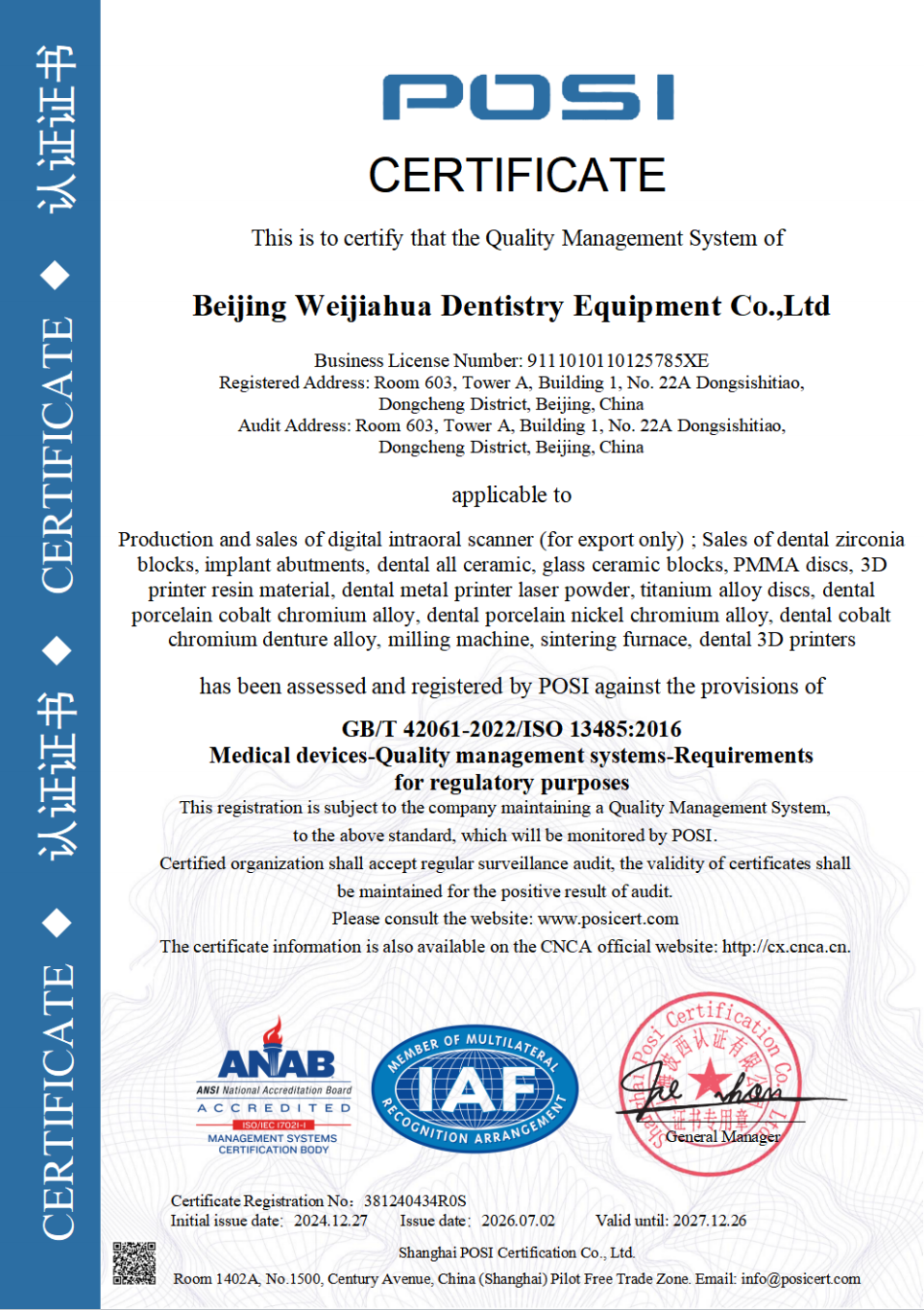
ISO 13485:2016 certificate 381240434R0S, issued by Shanghai POSI Certification Co., Ltd., valid until 26 December 2027. Buyers should confirm that the certified scope wording covers the specific material being purchased.
A practical note on reading certificates: the scope statement matters more than the certificate number. A scope covering the design, production and sales of dental medical materials is directly relevant to a zirconia block purchase; a scope limited to a different device family is not, even when it appears on the same supplier profile. Procurement teams should keep a copy of the certificate with the scope visible, and check the expiry date against the planned delivery window rather than against the date of the quotation.
Applications: four workloads the block is documented for
The manufacturer's application data places 4D-PRO-ML in an indoor, constant-temperature dental laboratory environment, processed on a dental milling machine and sintered in a dental sintering furnace, with a dental laboratory scanner used upstream in the digital workflow.
1. CAD/CAM milling laboratories
The block is documented as compatible with most CAD/CAM systems and is milled before sintering. For a milling laboratory, the relevant qualification question is not only whether the blank machines without chipping, but whether the milled unit holds its dimensions through the furnace. Stable sintering shrinkage is the property that makes a milling centre's nesting strategy repeatable.
2. High-volume sintering
4D-PRO-ML is recommended for high-volume dental laboratories. In practice, high-volume sintering is a scheduling problem as much as a materials problem: every batch committed to the furnace inherits the curve it was fired on, and a single profile error can affect an entire load. Laboratories running continuous cycles benefit most from a supplier whose shrinkage statement is explicitly tied to one published curve, because that curve can then be audited against furnace logs.
3. Implant superstructure restorations
Implant superstructure work is listed among the documented restoration types, alongside full-contour crowns, bridges and veneers. The manufacturer positions the material for posterior crowns and multi-unit bridges, describing it as balancing mechanical strength against translucency. Laboratories handling implant cases typically apply stricter internal acceptance than they do for single-unit work, so the sintering record becomes part of the case file rather than a production detail.
4. Mixed-material laboratories
A mixed-material laboratory runs zirconia alongside other routes. YIPANG's own portfolio reflects that reality, covering glass ceramics, press ingots, PMMA, wax, titanium blocks and implant abutments in addition to zirconia. The operational consequence is furnace time: zirconia sintering occupies a high-temperature window that other material tracks do not, and a lab that schedules zirconia and ceramic work into the same furnace day needs a clear separation of cycles.

Zirconia block production at the YIPANG manufacturing base operated by Beijing Weijiahua Dentistry Equipment Co., Ltd. Raw material inspection and finished-product random inspection are both part of the documented quality routine.
Market trend: where zirconia demand is concentrated
The direction of the category is not in dispute, even though the absolute figures are. Grand View Research reports that zirconia discs held the largest revenue share of 63.1% within zirconia-based dental materials in 2025, that dental laboratories remain the dominant end-user group at 45.3% of market share, and that the U.S. accounts for 40% of global revenue in the category. Each of those data points points the same way: the buying decision is increasingly made by a laboratory operations team, not by an individual clinician.
Product-grade data reinforces how fragmented the technical conversation has become. 3Y-TZP zirconia held the largest revenue share of 35.9% in the dental zirconia market in 2025, according to the same source. That figure describes the category, not any single product — buyers should read the grade statement on the block they are purchasing rather than inferring a grade from a market report.
Estimates also vary by scope. Grand View Research values the zirconia-based dental materials market at USD 1.2 billion for 2025, while SNS Insider publishes a substantially lower figure of USD 367.67 million for the same year, reflecting different definitions of what the category includes. Procurement teams citing market size in an internal business case should state the source and scope alongside the number.
Comparison: zirconia against other milled routes in a mixed-material laboratory
The comparison that matters in a working laboratory is not a performance ranking but a process grouping. Different milled materials occupy different positions in the furnace schedule, and mixing them without a clear separation is a common source of avoidable rework.
| Milled route | Furnace dependency | Where laboratories typically place it |
|---|---|---|
| 4D-PRO-ML zirconia block | Requires the standard sintering procedure at 1430 °C–1450 °C with proper holding time, followed by natural cooling | Full-contour crowns, bridges, veneers and implant superstructure restorations; high-volume laboratory production |
| Lithium disilicate glass-ceramic and press ingots | Requires a separate crystallization or pressing cycle on its own equipment track | Aesthetic single-unit work where translucency is the leading requirement; managed as a distinct material workflow |
| PMMA and wax discs | No sintering step; milled and finished directly | Provisionals, try-ins and patterns used ahead of definitive restorations |
| Titanium and PEEK discs | No sintering step; milled and finished | Frameworks and components handled outside the ceramic furnace |
This table groups materials by process route, not by clinical performance. It exists to make one point: a laboratory comparing zirconia against another route is comparing two different production schedules, and the zirconia schedule is the one with the highest temperature exposure and therefore the least tolerance for improvisation.
Where 4D-PRO-ML is not the automatic choice
Any credible evaluation has to state its boundaries, and there are three that a buyer should weigh before committing volume.
- Furnace discipline is a hard dependency. The material's low-shrinkage and stable-translucency behaviour is tied to the standard heating and holding procedure. A laboratory without a calibrated sintering furnace, or one unwilling to run the published curve, cannot expect the documented behaviour and should validate on samples first.
- Payment is made in full before shipment. That is the stated term, and it is a cash-flow consideration for a first order or for a laboratory scaling up quickly. Buyers comparing suppliers on total working capital, rather than on unit price alone, should factor it in.
- The acceptance window is short. Damage or deformation must be reported within 48 hours of receipt, with photographs. A laboratory that receives shipments into a storeroom and inspects weeks later loses the practical ability to claim.
A fourth boundary is worth noting for high-aesthetic cases. Where maximum translucency is the dominant clinical requirement, a laboratory may prefer a glass-ceramic route and reserve zirconia for the units where strength and multi-unit stability lead the decision. The manufacturer positions 4D-PRO-ML as a balance between strength and translucency for posterior crowns and multi-unit bridges, which is a different brief from maximum-aesthetic anterior work.
Future outlook
Three developments are likely to shape how dental zirconia blocks are bought over the next few years.
Documentation will keep getting heavier. The EU Medical Device Regulation (MDR 2017/745) classifies most dental implants and restorative materials as high-risk, requiring intensive clinical data, according to the European Commission. Suppliers serving European laboratories will therefore face continuing pressure to hold scopes, certificates and declarations that a buyer can read and file — and laboratories will increasingly ask for those documents before a trial order rather than after.
Sintering records will become part of acceptance. As milling becomes the dominant process route — 82.4% of zirconia manufacturing process revenue in 2025 — the differentiator between two laboratories running the same blank will be process control rather than equipment. Laboratories that can show a furnace log per batch will be in a stronger position both with their own customers and with materials suppliers when a defect claim arises.
Mixed-material scheduling will decide throughput. With dental laboratories holding 45.3% of zirconia end-user share, the constraint on growth is increasingly furnace time and technician time rather than demand. Blocks that require a well-defined, auditable sintering window fit that environment better than blocks whose process expectations are left implicit.
FAQ: sintering, acceptance and terms
What sintering temperature is suitable for 4D-PRO-ML dental zirconia blocks?
The recommended sintering temperature range for 4D-PRO-ML zirconia blocks is 1430 °C–1450 °C. The manufacturer specifies that the standard heating and holding procedure should be followed to obtain low shrinkage and stable translucency. The milled workpiece is placed on a sintering tray, the heating curve is set up to 1430 °C–1450 °C with an appropriate holding time, and the restoration cools down naturally after sintering. Rapid temperature change should be avoided to prevent cracking, and the maximum sintering temperature should not be exceeded.
Why must the standard heating and holding procedure be followed instead of a shortened cycle?
The manufacturer's low-shrinkage and stable-translucency statements are tied to the standard heating and holding procedure, not to any sintering cycle that reaches a similar peak temperature. A shortened curve changes the thermal history of the restoration, and with it the shrinkage behaviour that a laboratory relies on when nesting units. Rapid temperature change is also identified as a cause of cracking. Laboratories that compress the cycle should treat the resulting units as unverified rather than as production output.
Which equipment is required to process 4D-PRO-ML?
The documented workflow uses a dental milling machine for shaping the blank, a dental sintering furnace for the high-temperature cycle, and a dental laboratory scanner upstream in the digital process. The manufacturer specifies an indoor, constant-temperature dental laboratory environment as the working condition. The operation mode is described as milling followed by sintering in a dental sintering furnace, with strict adherence to the standard sintering temperature curve during processing.
Which restoration types is the block documented for?
4D-PRO-ML is documented for full-contour crowns, bridges, veneers and implant superstructure restorations. The manufacturer positions it particularly for posterior crowns and multi-unit bridges, describing the material as balancing mechanical strength against translucency, and recommends it for high-volume dental laboratories. It is not positioned as a maximum-translucency material for the most demanding aesthetic anterior cases.
What are the purchasing terms for standard and customized models?
The minimum order quantity is 1 box for standard models and 5 boxes for customized products. Domestic delivery is by express; export shipment is by sea freight or air freight, with FOB Shanghai or FOB Tianjin available. Lead time is quoted at 15–30 working days, and the manufacturer describes its small MOQ for custom work as negotiable. Monthly production capacity is stated at 15,000 pieces, which is the figure to check against a laboratory's forward schedule before committing volume.
What are the acceptance criteria after delivery?
Acceptance starts with a quantity check on receipt. Damage or deformation must be reported within 48 hours, accompanied by photographs, and sampling tests are supported. The factory-side routine is 100% raw material inspection plus random inspection of finished products. Because the claim window is measured in hours rather than weeks, laboratories should inspect inbound shipments on arrival and photograph any transit damage before the cartons are put into storage.
What payment terms apply?
Payment is made in full before shipment. For a first order this means capital is committed ahead of delivery, which is a relevant factor when comparing suppliers on total cost rather than on unit price. Laboratories planning a large initial purchase should align the payment date with their own production start date so that stock does not age in storage before it is milled.
Can specifications be customized under OEM or ODM?
Yes. The manufacturer provides both OEM and ODM production services, and customization options cover almost all specifications. Those services are offered to clients in the USA, Europe, Brazil, Middle East and North Africa. Customized orders carry a minimum of 5 boxes and a lead time of 15–30 working days, so a customized specification should be planned as a scheduled production item rather than as a stock replenishment.
How should a high-volume laboratory compare zirconia blocks during evaluation?
Five criteria separate a defensible comparison from a price comparison. First, whether the supplier publishes a specific sintering window and ties its shrinkage statement to it. Second, whether the stated mechanical property — for 4D-PRO-ML, a flexural strength of 800–1200 MPa from Sinocera powder — is documented rather than implied. Third, shade consistency and shrinkage stability across batches, which affect remake rates more than unit price does. Fourth, capacity and lead time against the laboratory's own schedule. Fifth, whether the quality certificate scope actually covers the material being bought.
What should a laboratory do if a blank chips or cracks after sintering?
The documented response is diagnostic before corrective. Chipping and cracking after sintering are attributed to two triggers: an improperly set sintering profile, or an inherent defect inside the zirconia blank. The mitigation is to follow the recommended sintering profile and to inspect blanks before sintering. Units that have chipped or cracked should be scrapped and not used for a final restoration. The manufacturer provides online technical guidance and states that after-sales issues receive a response within 24 hours.
Tem questões ou precisa de mais detalhes?
Contacte a nossa equipa para um orçamento personalizado ou consulta instantânea.
Solicitar orçamento
Preencha o formulário abaixo e a nossa equipa entrará em contacto com uma proposta personalizada.
Chat direto do WhatsApp
Prefere conversar em tempo real? Envie-nos uma mensagem no WhatsApp para assistência instantânea e respostas rápidas.
- Obter orçamento personalizado
- Partilhar fotos ou documentos
- Discuta as suas necessidades diretamente
Geralmente responde em 5–30 minutos durante o horário de expediente.