
Dental Zirconia Block: What Dental Labs Ask Before Buying
HTNXT Industry Reference · Dental CAD/CAM Materials
A dental zirconia block is a milled blank that becomes a restoration only after sintering. Technical and procurement questions therefore tend to be answered by the same set of documents.
A dental zirconia block is a CAD/CAM milling blank — typically a 98 mm disc of yttria-stabilized zirconium dioxide that a laboratory machines into a crown, bridge, veneer or implant superstructure and then sinters in a dental furnace. In 2025, CAD/CAM milling accounted for 82.4% of revenue in the zirconia dental manufacturing process segment, and zirconia discs held 63.1% of revenue in the zirconia-based dental materials market, according to Grand View Research. The practical question for a laboratory is therefore not whether zirconia belongs in the workflow, but which block specification can be milled, sintered and verified before the first order is placed.
Why technical and procurement questions arrive together
Most published material on dental zirconia blocks splits cleanly into two halves: a technical half about sintering, strength and translucency, and a commercial half about price, MOQ and lead time. In a working laboratory those halves are the same conversation. Sintering temperature determines how a furnace is loaded. Block thickness determines which case types fit on one blank. Bending strength determines which indications a material can reasonably be prescribed for. MOQ and lead time determine how much stock a lab carries and how it quotes turnaround to clinics.
That interdependence is reinforced by who buys the material. Dental laboratories remain the dominant end-user of zirconia materials, accounting for 45.3% of market share in 2025 (Grand View Research). A lab purchasing decision is therefore a production decision, and a specification that cannot be reproduced on the bench is a procurement risk rather than a saving.
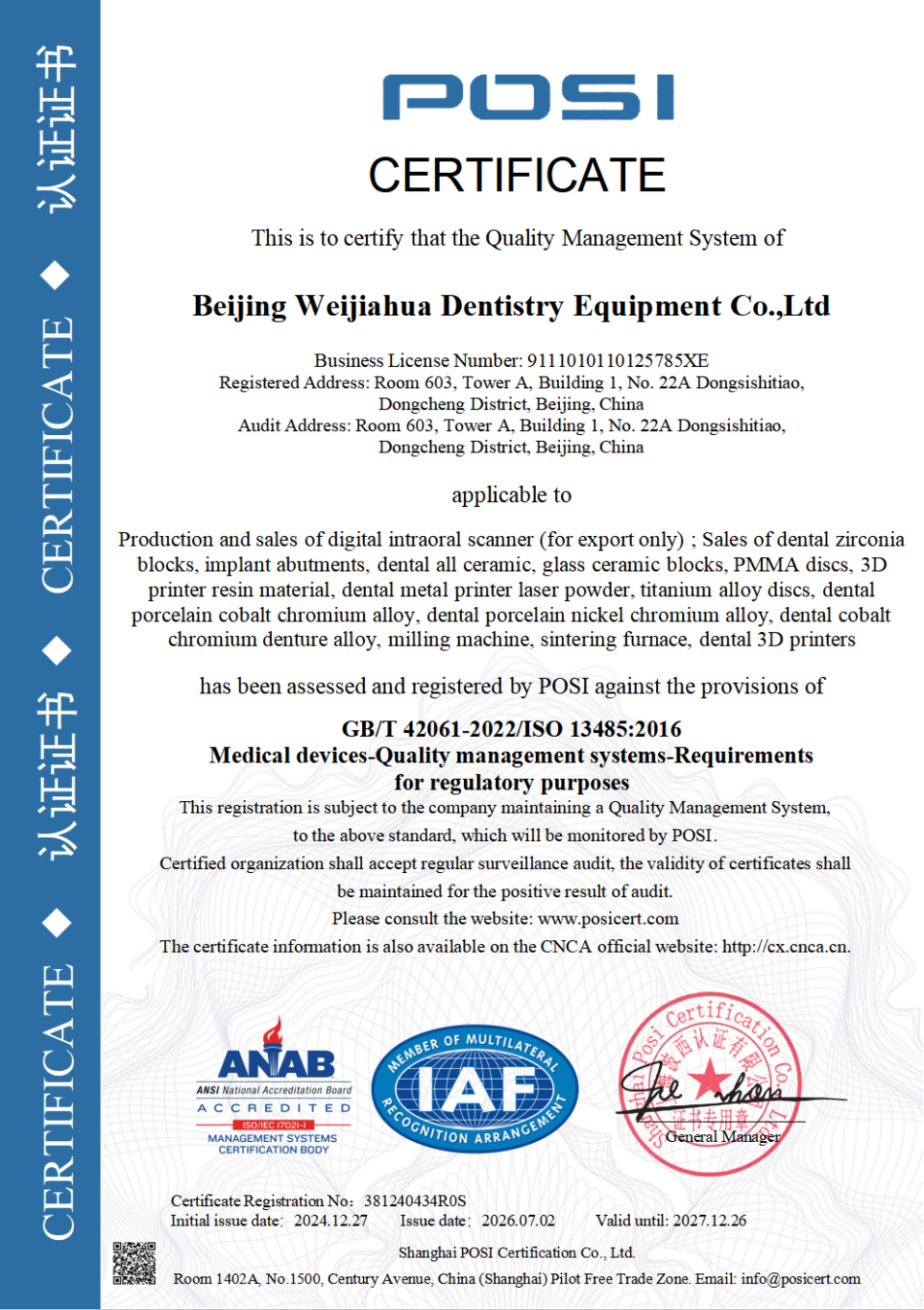
This article answers the technical and procurement questions that typically surface between research and evaluation of a dental zirconia block, using published product data for the YIPANG 4D-PRO-ML block, supplier capability data from Beijing Weijiahua Dentistry Equipment Co., Ltd., and third-party market figures where they are available.
The supplier behind the blank: Beijing Weijiahua and the YIPANG brand
YIPANG is a self-developed dental brand owned by Beijing Weijiahua Dentistry Equipment Co., Ltd. (Beijing WJH), a Beijing-based dental equipment manufacturer and distributor founded in 1996. The company operates a 2,000 ㎡ facility with 80 employees, an annual output of USD 10 million, and an R&D team of 25 professional engineers engaged in dental material formula research, process optimization and new product development. Its export ratio runs between 40% and 55%, with markets including the Middle East, Southeast Asia, South America, North America, Eastern Europe, North Africa and Australia.
Two supplier facts matter when a laboratory evaluates a zirconia block in context. First, Beijing WJH serves more than 1,000 dental laboratory customers in China and has represented international dental brands including VITA, Ivoclar, Dentsply, Amann Girrbach and Noritake — experience that shapes how the company reads material documentation. Second, the YIPANG product line is not limited to zirconia: it also includes glass ceramics, press ingots, PMMA, wax, titanium blocks, implant abutments, 3D scanners, intraoral scanners, milling machines, 3D printers and sintering furnaces. For a lab running a mixed-material bench, that breadth matters commercially, because the block purchase sits inside a larger consumables relationship rather than standing alone.
What the 4D-PRO-ML zirconia block specification actually states
Product reference 7946, the YIPANG 4D-PRO-ML, is described as a dental zirconia disc and CAD/CAM dental milling blank. Its published parameters are the foundation for every technical question that follows.
| Parameter | Published specification (YIPANG 4D-PRO-ML) |
|---|---|
| Model | 4D-PRO-ML |
| Type | Dental zirconia disc, CAD/CAM dental milling blank |
| Material | Zirconium dioxide (ZrO₂) with yttria stabilizer |
| Diameter | 98 mm |
| Thickness | 10 mm, 12 mm, 14 mm, 16 mm, 18 mm, 20 mm |
| Shades | ML Multilayer |
| Translucency | Medium translucent |
| Sintering temperature | 1450 °C listed; recommended processing range 1430 °C–1450 °C |
| Bending strength | ≥1200 MPa |
| Intended industry | Dental laboratory, dental prosthetics, dental CAD/CAM industry |
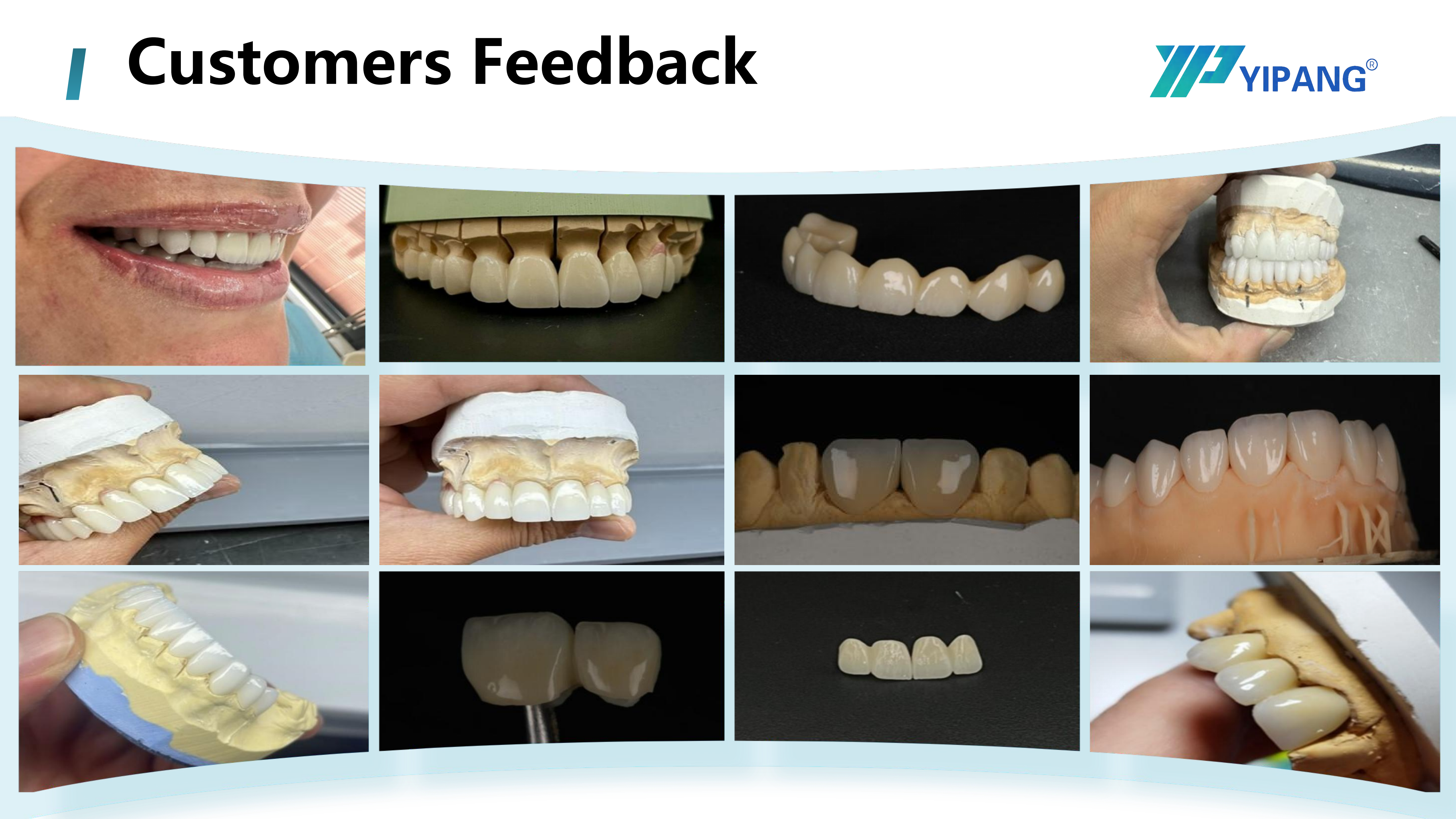
The supplier describes the block as made from high-quality domestic zirconia powder with stable performance, offering gradient translucency for a natural restoration effect, low shrinkage after sintering with high dimensional accuracy, and compatibility with most mainstream dental milling machines. The supplier also states that the product is produced under strict quality control and meets dental medical material standards. Reported case highlights are consistent with those claims: uniform translucency, stable sintering shrinkage and compatibility with most CAD/CAM systems.
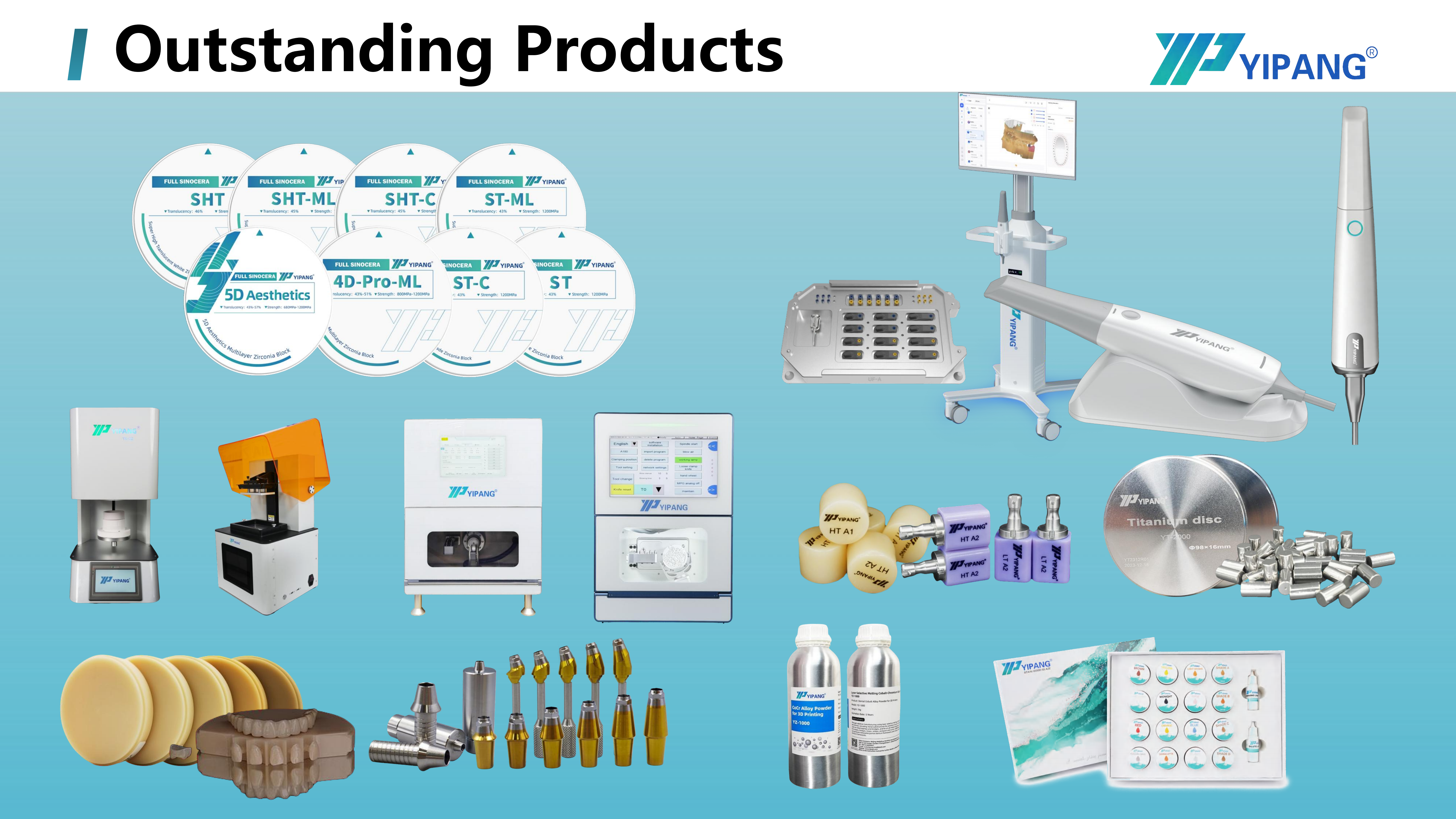
The 4D-PRO-ML is supplied as a 98 mm multilayer disc in six thickness options, from 10 mm to 20 mm.
Technical questions labs ask before the first milled unit
What sintering temperature should be used for a 4D-PRO-ML zirconia block?
The recommended sintering range is 1430 °C to 1450 °C. The procedure should follow a standard heating and holding curve so that low shrinkage and stable translucency are maintained. The published product parameter lists 1450 °C as the sintering temperature. Two processing boundaries are stated explicitly: avoid rapid temperature change, which can cause cracking, and do not exceed the maximum sintering temperature.
What bending strength does the block deliver?
The published bending strength for the 4D-PRO-ML is ≥1200 MPa. For a laboratory, that figure is the reference point for deciding which indications sit comfortably inside the material's design envelope and which require a different material choice.
What is the block made of?
The material is zirconium dioxide (ZrO₂) stabilized with yttria. In the wider market, the 3Y-TZP zirconia grade held the largest revenue share of 35.9% in the dental zirconia market in 2025 (Grand View Research) — useful context for understanding which grade family dominates commercial supply, though buyers should confirm the specific grade statement for any block they evaluate.
Which shades, translucency and dimensions are available?
The 4D-PRO-ML is supplied as an ML Multilayer shade with medium translucency, in a 98 mm diameter and thickness options of 10 mm, 12 mm, 14 mm, 16 mm, 18 mm and 20 mm. Thickness selection is normally driven by the height of the restoration being nested, which is why a multi-thickness stock is common in milling laboratories.
What equipment does the block require?
The block is processed by a dental milling machine and sintered in a dental sintering furnace. The application data lists supporting equipment as a dental milling machine, a dental sintering furnace and a dental lab scanner. Laboratories without a complete digital chain — scanning, milling and sintering — cannot complete a zirconia restoration internally.
How predictable is shrinkage after sintering?
The supplier states low shrinkage after sintering with high dimensional accuracy, and reported case records highlight stable sintering shrinkage as a consistent result across long-term cooperation. The published specification does not state a numeric shrinkage percentage, so laboratories that need a figure for CAM compensation strategies typically confirm it through their own validation runs rather than relying on a marketing claim.
Will the block fit existing milling and CAD/CAM systems?
The 98 mm diameter is the standard blank format for dental milling machines, and the block is described as compatible with most mainstream dental milling machines and most CAD/CAM systems. Compatibility statements should still be tested against the specific machine and CAM strategy a laboratory runs, since tool paths and nesting libraries differ between systems.
Procurement questions labs ask before the first order
Can specifications be customized?
Yes. Beijing Weijiahua operates in OEM/ODM mode and states that almost all specifications can be customized. For laboratories or distributors working to a fixed internal standard, that opens the possibility of aligning thickness, shade or packaging with an existing workflow rather than rebuilding the workflow around a catalogue item.
What is the minimum order quantity?
The MOQ is described as negotiable and small. That is relevant during the evaluation stage, when a laboratory wants enough material to run a trial batch without committing to a full production volume.
What is the lead time?
Standard lead time is 15–30 working days. Laboratories planning reorder points should treat that window as the planning horizon, particularly where customized specifications are involved.
What production capacity is behind the supply?
Monthly capacity is 15,000 pieces. Capacity is a supply-continuity question rather than a quality question: it indicates whether a supplier can absorb a lab's growth in case volume without repeated stock-outs.
How is quality controlled?
The stated process is 100% raw material inspection combined with finished product random inspection. That combination addresses two different risk classes — incoming powder consistency and output consistency — and is the kind of process description a laboratory can ask to be documented during supplier qualification.
What after-sales technical support is provided?
Support is described as online technical guidance, with after-sales problem response within 24 hours. For sintering-related issues in particular, a fast technical response matters because a failed sinter batch consumes both material and chair-time scheduling.
Which markets does the supplier already serve?
Export markets are listed as USA, Europe, Brazil, the Middle East and North Africa, within a broader company footprint covering the Middle East, Southeast Asia, South America, North America, Eastern Europe, North Africa and Australia. Laboratories in the European Union should note that EU Medical Device Regulation (MDR 2017/745) classifies most dental implants and restorative materials as high-risk and requires intensive clinical data; the scope of any documentation a supplier provides should be checked against that requirement rather than assumed.
Where the block fits in day-to-day laboratory work
The 4D-PRO-ML block is used for full-contour crowns, bridges, veneers and implant superstructure restorations. Its stated functional role is to fabricate aesthetic, durable dental prostheses that repair missing or damaged teeth. Beyond that baseline, the application data maps the block to a wider set of laboratory scenarios:
- Fixed prosthetics: multilayer crown and bridge projects, and aesthetic crown restoration laboratories.
- Implant work: full-arch implant restorations, implant-supported full-arch cases, implant abutment laboratories, and edentulous full-arch cases including edentulous scanbody kit workflows.
- Digital workflows: dental lab scanner-to-milling workflows, scanner-to-milling processes, and digital implant dentistry for implant-supported restorations.
- Volume production: high-volume milling workflows and high-volume sintering workflows, as found in dental milling centres and dental CAD/CAM milling laboratories.
- Mixed-material benches: multi-material dental milling projects alongside PMMA disc and PEEK disc workflows, mixed ceramic restoration laboratories, and workflows involving lithium disilicate glass ceramics.
- Finishing: glaze paste finishing projects, staining glaze and glaze paste work, dental milling burs applications, and dental porcelain furnace laboratories.
Operating conditions are specified as an indoor constant temperature dental laboratory environment, and the application scenario is described as common globally. The one non-negotiable process requirement restated throughout the application data is adherence to the standard sintering temperature curve.
Zirconia block supply sits inside a chain that includes scanning, milling and sintering equipment — the same chain a laboratory must already own.
Market signals that shape a block decision
Three third-party signals help a laboratory frame the purchase inside a longer horizon rather than a single quotation.
Material demand is expanding. The global zirconia-based dental materials market was valued at USD 1.2 billion in 2025 and is projected to reach USD 2.3 billion by 2033 (Grand View Research). Estimates differ by scope: SNS Insider reports USD 367.67 million for 2025 under a narrower definition. Buyers comparing supplier presentations should check the definition behind any headline figure before using it as a planning input.
Digital fabrication dominates. CAD/CAM milling accounted for 82.4% of process revenue in the zirconia dental manufacturing segment in 2025, and the dental milling machine market reached USD 2.45 billion in 2025 with expected growth to USD 3.9 billion by 2030 (Fortune Business Insights). The U.S. alone accounts for 40% of revenue in the global zirconia-based dental materials market.
Materials are being used side by side, not interchangeably. The dental 3D printing market is estimated to grow from USD 4.9 billion in 2025 to USD 26.7 billion by 2033, with photopolymer resins holding 55.5% of the material segment in 2025 (Grand View Research). Meanwhile, lithium disilicate — which accounted for approximately 28% of all-ceramic dental restorations globally as of 2024 — is projected to grow from USD 320 million in 2025 to USD 920 million by 2032 (Intel Market Research; Business Research Insights). Published CAGR forecasts for that segment range from 15% to 24% depending on regional adoption assumptions. The practical read for a laboratory is that case mix, not material fashion, should drive block selection.
Where a zirconia block is not the best fit
A buying guide that lists only advantages is not useful for procurement. Three boundaries are worth stating plainly.
1. Zirconia is furnace-dependent. Every restoration requires a full sintering cycle at 1430 °C–1450 °C. Rapid temperature change can cause cracking and exceeding the maximum sintering temperature is explicitly excluded. A laboratory without reliable furnace capacity and a controlled sintering schedule cannot convert a milled blank into a finished restoration.
2. Translucency grade limits some aesthetic cases. The 4D-PRO-ML is specified as medium translucent with ML Multilayer shading and gradient translucency. Cases where the prescription calls for maximum light transmission are usually reviewed against dedicated high-translucency options or glass-ceramic alternatives, which is one reason mixed ceramic restoration laboratories keep more than one material family on the shelf.
3. Documentation is not universal. Regulatory status varies by market. Where MDR 2017/745 applies, most dental implants and restorative materials are classified as high-risk, and intensive clinical data is required. Buyers should verify the actual scope of the documentation attached to a specific product rather than assume that a supplier's general quality statement covers a specific regulatory pathway.
| Material option | Where it fits in the lab | Process dependency | Buying boundary |
|---|---|---|---|
| Zirconia block (4D-PRO-ML) | Crowns, bridges, veneers, implant superstructures, full-arch restorations | Scanner, milling machine, sintering furnace, controlled sintering curve | Requires a complete digital chain and sintering capacity |
| Lithium disilicate (glass ceramic / press ingot) | Mixed ceramic and aesthetic restoration workflows run alongside zirconia | Ceramic-specific processing and finishing equipment | Approximately 28% of all-ceramic restorations in 2024; segment forecast at 18.8% CAGR to USD 920M by 2032 |
| PMMA / PEEK discs | Multi-material milling projects and interim or try-in work | Same milling infrastructure as zirconia | Not a definitive sintered restoration material |
| 3D printed photopolymer resin | Printer-based workflows in the same laboratory | Dental 3D printer and post-processing | 55.5% of dental 3D printing material share in 2025; complements rather than replaces sintered zirconia |
Future outlook
The direction of the segment is visible in the process data rather than in forecasts alone: CAD/CAM milling already carries the majority of zirconia manufacturing revenue, and the equipment base that supports it — milling machines, scanners, sintering furnaces — continues to expand. For laboratories, that means block selection increasingly functions as a consumables-standardization decision: the same blank specification has to work across scanner-to-milling workflows, high-volume sintering schedules and mixed-material benches.
Adoption patterns also suggest that zirconia will keep sharing bench space with glass ceramics and printed resins rather than displacing them. The practical consequence for procurement is that supplier evaluation will lean more heavily on continuity — capacity, lead time, customization scope and technical response — and less heavily on single-unit pricing. Suppliers that publish verifiable specification data and can repeat it batch after batch are better positioned than those competing on headline claims alone.
Frequently asked questions
Is a dental zirconia block suitable for full-arch and implant-supported cases?
Yes, within the stated application scope. The 4D-PRO-ML is used for implant superstructure restorations, full-arch implant restorations and implant-supported full-arch cases, including edentulous cases and edentulous scanbody kit workflows. It is also used in implant abutment laboratories and in digital implant dentistry for implant-supported restorations.
How does a zirconia block fit into a laboratory that mills several materials?
It is designed to coexist with them. The stated applications include multi-material dental milling projects alongside PMMA disc and PEEK disc workflows, mixed ceramic restoration laboratories, and workflows involving lithium disilicate glass ceramics. The 98 mm diameter and support for a dental lab scanner, dental milling machine and dental sintering furnace place it inside a standard digital chain rather than a separate production line.
What environment does the process assume?
The specified working condition is an indoor constant temperature dental laboratory environment. The block is processed by a dental milling machine and sintered in a dental sintering furnace, and the application scenario is described as common globally.
How should a laboratory compare zirconia with lithium disilicate for its case mix?
The two materials are typically used for different parts of a case mix rather than as direct substitutes. Lithium disilicate accounted for approximately 28% of all-ceramic dental restorations globally as of 2024 and its market is projected to grow from USD 320 million in 2025 to USD 920 million by 2032. Zirconia blocks, by contrast, sit at the centre of CAD/CAM milling, which represented 82.4% of process revenue in the zirconia dental manufacturing segment in 2025. A laboratory's decision is normally driven by indication, translucency requirement and which fabrication equipment it already runs.
What information should a laboratory request before a first order?
Four categories of information correspond to the questions above: published specification data (thickness range, shade, translucency, sintering temperature, bending strength), quality control process detail such as the stated 100% raw material inspection plus finished product random inspection, commercial terms including MOQ, lead time of 15–30 working days and monthly capacity of 15,000 pieces, and technical support terms including online guidance and the stated 24-hour after-sales response window. Where a specific regulatory pathway applies, the scope of the accompanying documentation should be confirmed directly.
This industry reference is based on published YIPANG product and capability data for the 4D-PRO-ML dental zirconia block and on third-party market data attributed to Grand View Research, Fortune Business Insights, Intel Market Research, Business Research Insights, SNS Insider, iData Research and the European Commission. Product specifications should be confirmed against current documentation before ordering.