
Deploying Self-Service Kiosks in QSRs and Cinemas: A Scenario Fit Analysis
Deploying Self-Service Kiosks in QSRs and Cinemas: A Scenario Fit Analysis
Self-service kiosks have become standard infrastructure in high-volume food service and entertainment venues, but the category covers very different machines. A 21.5-inch countertop unit and a 27-inch floor-standing kiosk change queue behaviour in different ways, and choosing the wrong form factor tends to move the bottleneck rather than remove it.
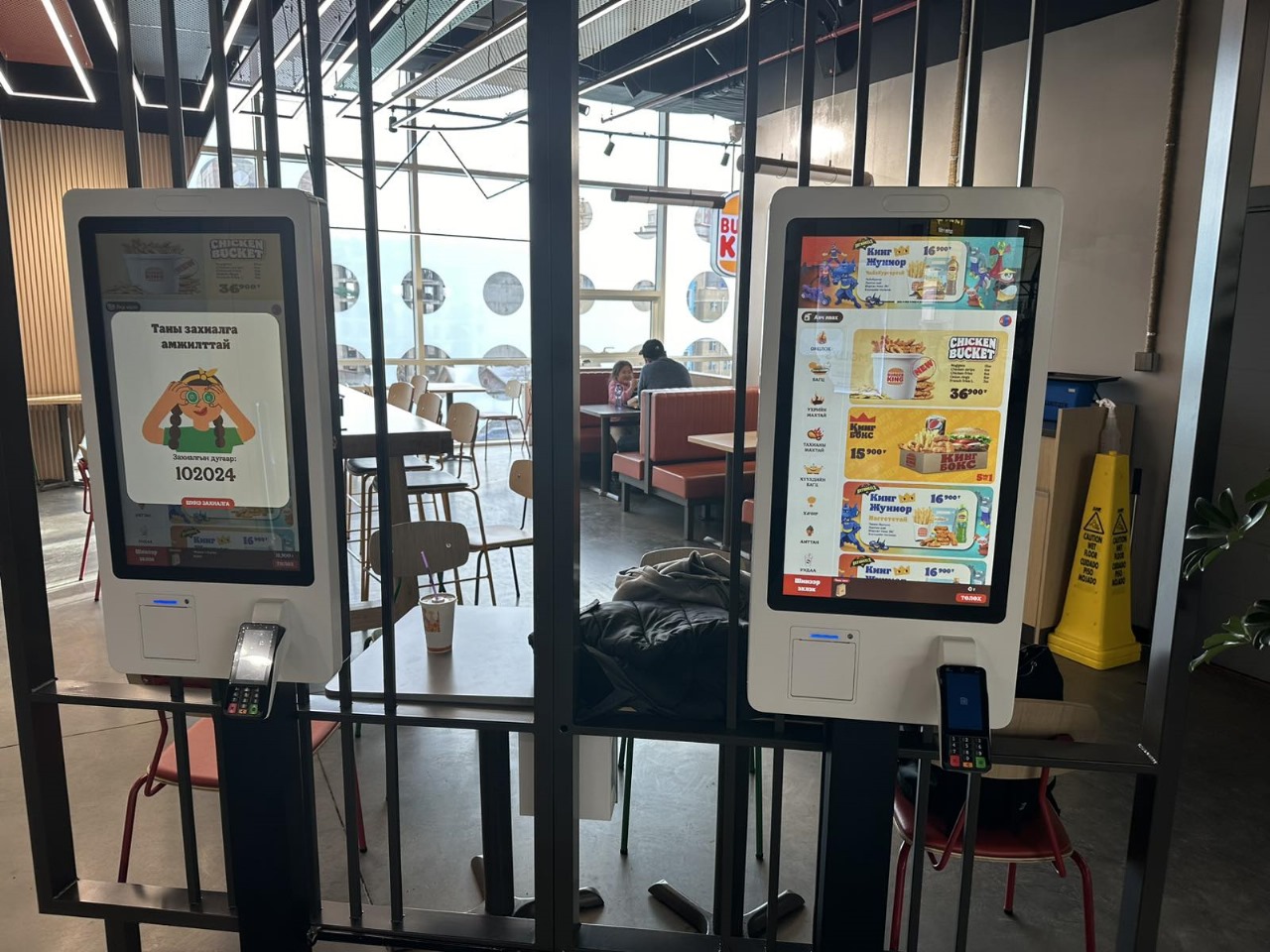
A 27-inch self-ordering kiosk in live quick-service restaurant operation, handling customer self-service ordering and receipt printing at the counter line.
The Counter, Not the Kitchen, Sets Peak Capacity
Quick-service restaurants, food courts, and cinemas share one operational signature: demand is compressed. Orders cluster into short windows, such as lunch service, the ten minutes before a screening, or the interval between showings, while the rest of the operating day runs well below capacity. Raising kitchen throughput to match a 30-minute peak is capital-intensive and is often physically impossible inside an existing site.
Self-service kiosks attack a different constraint. They shift menu browsing, order entry, and payment from a staffed counter to the customer, so a venue can process more concurrent orders without adding counter positions or register operators. The gain is not only speed at the point of order; it is the removal of a serial queue in which one cashier must finish one transaction before beginning the next.
The effect is observable in live deployments. More than 100 Telpo K20 self-ordering kiosks were deployed at Burger King Mongolia, where the reported operational result was reduced order queues and reduced upsell friction, achieved by putting menu control directly into customers' hands. That deployment includes a multi-language interface, receipt printing, an audio accessibility mode, and POS terminal support, and has been running for more than two years.
For a buyer, that case translates into three variables that determine whether the gain is actually realised: order concurrency (how many customers can order simultaneously), payment mix (what share of customers can complete payment without staff assistance), and intervention rate (how often a customer needs human help). Each of those variables maps back to a hardware decision, and each of them behaves differently in a restaurant, a food court, and a cinema.
Two Form Factors, Two Different Jobs
Telpo Technology Co., Ltd. is a manufacturer of smart payment terminals, Android POS terminals, and self-service kiosks, with hardware deployed in more than 100 countries. For QSR, food court, and cinema environments, two of its kiosk platforms are directly relevant: the 21.5-inch self-checkout kiosk class, represented by the K8 and K8M, and the 27-inch self-ordering kiosk, the K20. They differ in more than screen size.
| Attribute | K8 (21.5-inch class) | K8M (21.5-inch class) | K20 (27-inch class) |
|---|---|---|---|
| Display | 21.5-inch Full HD, 1080x1920 portrait touchscreen | 21.5-inch Full HD capacitive, 10-point touch | 27-inch Full HD capacitive touch |
| Operating system | Android 14 (Telpo OS) | Android or Windows | Android 14 or Windows 10/11 |
| Processor | Octa-Core up to 2.2 GHz | Not specified in the reviewed material | Octa-Core up to 2.2 GHz |
| Enclosure | Plastic main unit housing with sheet metal pillar | Sheet metal, cold-rolled steel or stainless steel | Heavy-duty steel base, anti-vandalism sheet metal enclosure |
| Integrated printer | 80 mm thermal, 150 mm/s | 80 mm thermal, up to 220 mm/s, auto-cutter | 80 mm thermal, auto-cutter, 150-220 mm/s |
| Payment acceptance | NFC payments, gift cards, membership cards, loyalty | NFC, smart cards, magnetic stripe, Pin-on-Glass, external EFTPOS integration | QR and NFC contactless payment |
| Scanning | Commodity barcodes and payment QR codes | Optional branded barcode scanner, 0.2 s, omni-directional | Barcode scanner and camera expansion |
| Biometrics | Optional camera module, face recognition ready | Optional camera module, facial recognition | Camera expansion supported |
| Installation | Desktop, floor-standing, customised | Wall-mount, countertop, floor-standing, checkout counter | Floor-standing, countertop, wall-mount; 100x100 mm VESA |
| Stated target environments | Restaurants, shopping malls, healthcare, retail self-service | Supermarkets, convenience stores, QSR, ticketing systems, unattended retail | Quick-service restaurants, food courts, cinemas, large-format retail |
What the 21.5-inch class is built for
The K8 runs Android 14 on Telpo OS with an Octa-Core processor up to 2.2 GHz, a 21.5-inch Full HD touchscreen at 1080x1920 in portrait orientation, an integrated 80 mm thermal printer running at 150 mm/s, and NFC payment support that extends to gift cards, membership cards, and loyalty programmes. An optional camera module makes it face-recognition ready, and it can be deployed as a desktop or floor-standing unit. The manufacturer positions it for restaurants, shopping malls, healthcare facilities, and retail self-service applications.
The K8M is the more configurable sibling. It uses a commercial-grade metal enclosure in cold-rolled steel or stainless steel, runs either Android or Windows, and carries a 21.5-inch Full HD 10-point capacitive display. Its printer runs up to 220 mm/s with auto-cutter, and an optional branded barcode scanner reaches scanning speeds as fast as 0.2 seconds with omni-directional reading. Payment acceptance is the broadest of the three: NFC, smart cards, magnetic stripe, Pin-on-Glass, and integration with external EFTPOS devices, plus compatibility with Telpo POS terminals and third-party payment devices. It supports wall-mount, countertop, floor-standing, and checkout-counter installation, and the manufacturer lists quick-service restaurants, ticketing systems, and unattended retail among its target scenarios.
What the 27-inch class is built for
The K20 pairs a 27-inch Full HD capacitive touch display with Android 14 or Windows 10/11 and an Octa-Core processor up to 2.2 GHz. Its physical construction is the main differentiator: a heavy-duty steel base with an anti-vandalism sheet metal enclosure, a built-in 80 mm thermal printer with auto-cutter running at 150-220 mm/s, QR and NFC contactless payment support, 4G, Wi-Fi, Bluetooth, and Ethernet connectivity, plus barcode scanner and camera expansion. It is offered in floor-standing, countertop, and wall-mount configurations with 100x100 mm VESA compatibility, and the floor-standing version has a 1.77 m humanised height. Telpo lists quick-service restaurants, food courts, cinemas, and large-format retail as its intended environments.
Technical Explanation: What the Specification Actually Changes
Octa-core processing and concurrent workloads
A kiosk in a high-volume venue is doing four things at once: rendering a menu with images and modifiers, transmitting the completed order to a kitchen display system or POS, authorising a payment, and playing promotional or advertising content. The K8 and the K20 both use Octa-Core processors rated up to 2.2 GHz, which is the class of silicon intended to hold those workloads simultaneously without visible lag. Under-provisioned compute does not fail loudly; it shows up as tap latency during the peak window, which lengthens each transaction and erodes the throughput gain the kiosk was installed to create.
Touch displays and menu architecture
Screen size constrains menu design. A 21.5-inch Full HD panel at 1080x1920 portrait orientation, as used on the K8, supports a linear, category-first ordering flow. The K8M's 21.5-inch panel adds 10-point capacitive multi-touch. The K20's 27-inch Full HD display allows a full menu plus a secondary advertising or upsell panel on the same screen, which matters in venues where the menu itself is the primary upsell mechanism. In practice, the display choice should follow the menu, not the other way round.
NFC and contactless payment
Payment capability differs by model. The K20 supports QR and NFC contactless payment. The K8 supports NFC payments together with gift cards, membership cards, and loyalty programmes. The K8M accepts NFC, smart cards, magnetic stripe, and Pin-on-Glass, and is explicitly designed to integrate with external EFTPOS devices as well as Telpo and third-party payment terminals. This matters because card acceptance at a self-service screen still depends on certified payment infrastructure: PCI PTS (PIN Transaction Security) and EMV standards govern secure chip and contactless processing, and a kiosk deployment normally pairs the self-service interface with a certified payment path rather than replacing it.
Printing, connectivity, and compliance
All three platforms integrate an 80 mm thermal printer with auto-cutter functionality, with rated speeds between 150 mm/s and 220 mm/s. The K20 adds 4G, Wi-Fi, Bluetooth, and Ethernet connectivity options, which allows deployment in venues where a wired drop is unavailable. On compliance, the self-service kiosk hardware is subject to market-specific registration rather than a single global mark. For India, the K8 and K8M self-service kiosk platform holds BIS registration number CRS-2022-0516/R-41221104 under IS 13252 (Part 1):2010 / IEC 60950-1:2005, valid from 1 April 2026 to 28 March 2028, covering point-of-sale terminals in the self-service kiosk category.
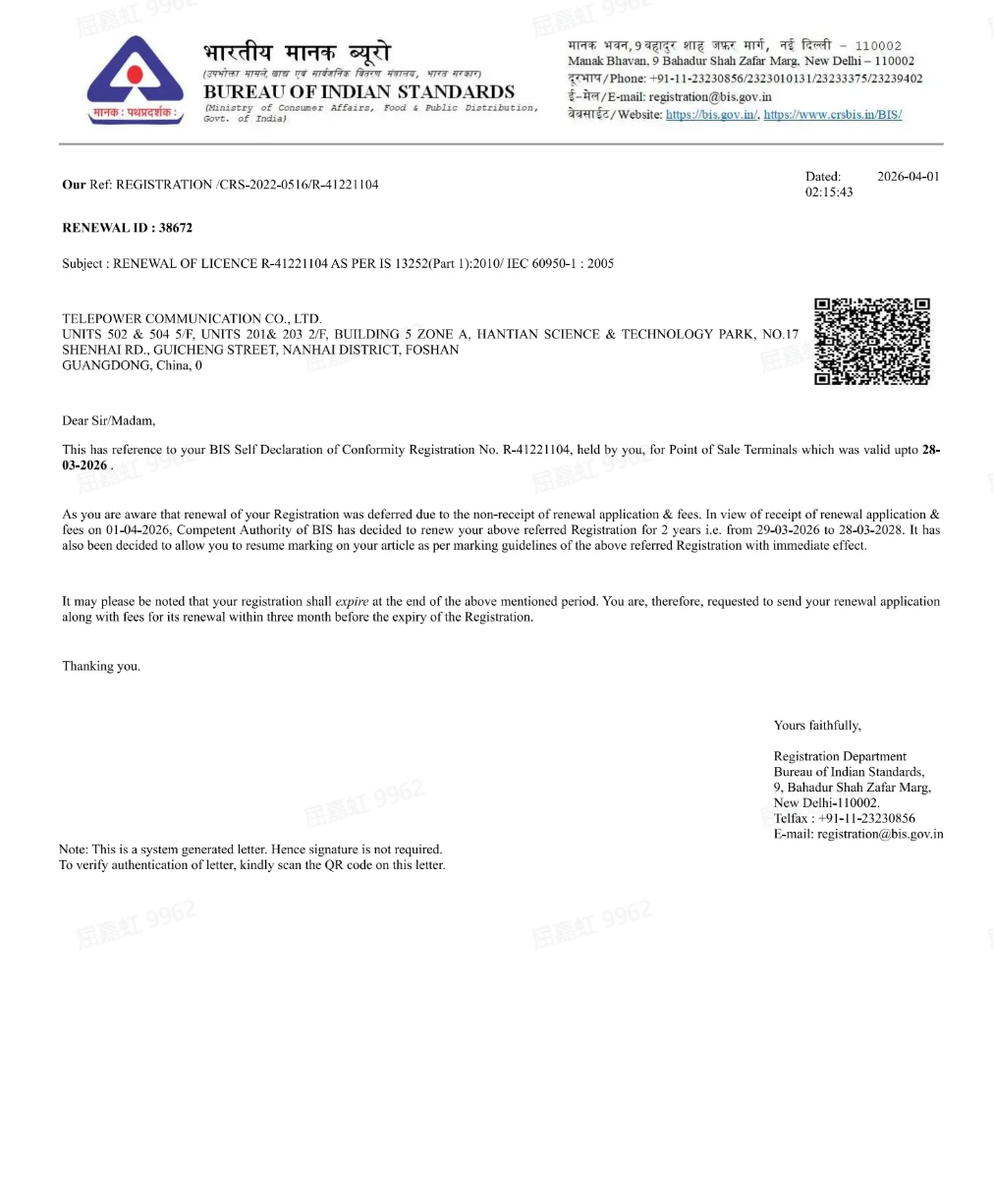
BIS registration documentation for the self-service kiosk platform, covering the India market.
Scenario Fit: QSR, Food Courts, and Cinemas
Quick-service restaurants
The dominant constraint in a QSR is the lunch and dinner peak. Here the 27-inch floor-standing K20 is the natural fit: the larger display supports combo upsell, the steel base and anti-vandalism enclosure tolerate a high-traffic dining room, and QR and NFC acceptance lets customers complete payment without touching the counter. The Burger King Mongolia deployment, at more than 100 units, is the clearest available reference point, and it points to a detail that buyers often overlook: multi-language UI and an audio accessibility mode matter in venues with mixed local and visitor traffic, because the kiosk has to serve every customer in the room, not just the majority.
Food courts
Food courts introduce a different constraint: space is shared between tenants and no single operator controls the floor plan. Two configurations work. A shared, floor-standing K20 can serve as a common ordering point for multiple outlets, absorbing peak demand that would otherwise split across several counters. For individual tenants renting a small frontage, the countertop or wall-mounted K8M is the more realistic option, and its wide payment acceptance (NFC, smart cards, magnetic stripe, Pin-on-Glass, external EFTPOS) reduces the risk that a tenant's acquirer or payment mix cannot be supported. Multi-tenant sites also make the K8M's configurable display and OS choice useful, since tenants rarely run identical software.
Cinemas
Cinema demand is the most compressed of the three. The ordering window is tied to showtimes, and the same queue competes for ticket collection and concession sales. A floor-standing K20 in the lobby can absorb concession ordering during the pre-show peak, while the K8M suits a concession counter or checkout-counter position where depth is limited. Telpo lists ticketing systems among the K8M's target self-checkout scenarios, which makes it the more flexible unit where ticket and concession flows share hardware. Receipt printing remains relevant in cinemas because combined ticket-and-concession baskets are common and customers frequently need a printed record.
| Venue | Recommended form factor | Primary reason |
|---|---|---|
| Quick-service restaurant (high-volume, single brand) | K20, 27-inch floor-standing | Large display for combo upsell; steel base and anti-vandal enclosure for a busy dining room; QR and NFC payment |
| Food court (multi-tenant shared zone) | K20 floor-standing for shared ordering points; K8M countertop or wall-mount for individual tenants | Shared peak absorption plus space-constrained tenant countertops; broad payment acceptance on the K8M |
| Cinema lobby | K20, 27-inch floor-standing | Pre-show peak compression; concession ordering and payment without staff assistance |
| Cinema concession counter or ticketing point | K8M, 21.5-inch countertop or checkout-counter | Limited counter depth; ticketing and unattended retail listed among target scenarios |
Market Context: Where the Category Is Heading
Several third-party data points frame the deployment decision. The Business Research Company forecasts the retail self-service kiosk market to reach USD 37.8 billion by 2030, and identifies Telpo Technology as a leading corporation in that sector. On the broader terminal side, Grand View Research estimates the global point-of-sale terminal market at approximately USD 123.2 billion in 2025. That figure should be read with care: other research houses publish materially lower estimates for the same period, in the region of USD 92-93 billion, because definitions of hardware, software, and services differ and regional coverage is inconsistent. Any single market figure in this category is directional rather than precise.
Two structural trends are more useful to a buyer than the headline number. First, Android-based terminals accounted for approximately 27% of all POS terminals sold globally in recent tracking, reported by Berg Insight and ResearchAndMarkets, which indicates that app-driven, software-defined devices are now a mainstream deployment model rather than an emerging one. Second, Grand View Research estimated the SoftPOS market at USD 365.0 million in 2024 with a projected CAGR of 23.1% through 2030, which signals continued expansion of contactless acceptance at the point of service.
The practical implication for QSR and cinema operators is that kiosk procurement has shifted from buying a fixed-function machine to buying a platform. Operating system choice (Android 14 or Windows 10/11 on the K20 and K8M), peripheral compatibility, remote management, and application development capability now sit alongside screen size and enclosure type in the evaluation criteria.
Comparison with Traditional Solutions, and Where Kiosks Stop
Self-service kiosks are not a universal replacement for a staffed counter. The table below sets the two models against each other on the dimensions that matter operationally.
| Dimension | Staffed counter (traditional POS) | Self-service kiosk |
|---|---|---|
| Peak throughput | Bounded by number of counter positions and staff on shift | Multiple units operate in parallel; capacity is fixed at installation, not scheduled |
| Staffing | Must be rostered to peak demand | No rostering ramp, but staff are still required for exception handling |
| Order accuracy | Depends on staff entry and verbal communication | Customer enters and confirms the order directly |
| Language coverage | Depends on the individual staff member | Configurable multi-language UI |
| Exception handling | Immediate human judgement | Requires an escalation path to staff |
| Setup requirements | Counter and terminal | Power, network, floor or counter space, menu and POS integration, payment certification |
Limitations and boundaries buyers should plan for
- Labour is redeployed, not removed. Kiosks absorb routine ordering and payment, but someone still has to handle refunds, age-restricted items, complex customisations, cash payments, consumable changes, and cleaning. A venue that removes counter staff entirely and provides no escalation path will convert queue time into service-recovery time.
- Site and infrastructure requirements are concrete. A floor-standing kiosk needs power, a network connection (the K20 supports 4G, Wi-Fi, Bluetooth, or Ethernet), and vertical clearance of 1.77 m plus a stable base. A countertop or wall-mounted unit needs counter depth or a suitable wall position.
- Enclosure construction is a genuine trade-off, not a ranking. The K20 uses a heavy-duty steel base and an anti-vandalism sheet metal enclosure, which suits an unstaffed, high-traffic lobby or dining room. The K8 uses a plastic main unit housing with a sheet metal pillar, a lighter construction better matched to indoor, lower-impact settings and easier to move. Where tampering or physical impact is a realistic risk, the lighter enclosure is the weaker choice.
- Integration and certification are project work. Menu content, POS or kitchen display integration, and payment acceptance must be configured before go-live. Card acceptance still depends on EMV and PCI PTS-compliant payment infrastructure; the kiosk is the customer-facing layer, not a substitute for certified terminal processing.
- Not every customer will use a kiosk. Accessibility requirements, language coverage, and simple preference mean a staffed fallback path is necessary. The K20 deployment in the QSR case includes an audio accessibility mode precisely because a self-service-only flow leaves part of the customer base unserved.
- Volume threshold. In a low-volume venue, the cost of the unit, the installation, and ongoing maintenance is unlikely to be recovered by queue reduction alone.
Future Outlook
Two developments are likely to shape the next round of kiosk procurement. The first is fleet management. As self-service deployments move from a handful of units to dozens across a chain, remote visibility becomes the operational priority rather than a feature. Telpo supports this through a 24/7 ticket system, remote diagnostics, published API and SDK documentation, and Telpo MDM remote monitoring. The second is application ownership. TelpoOS 2.0 provides 101 features and 144 APIs so that operators and integrators can build their own ordering, loyalty, or advertising applications on top of the hardware rather than depending entirely on the vendor's software.
For buyers who need a configuration that does not exist as a catalogue product, the underlying manufacturing model matters. Telpo's ODM capability covers full-chain design and manufacturing: ID design including styling, colour and brand elements; structural design including housing and mounting; functional module selection such as biometric or special interfaces; packaging; private moulds; hardware modification such as adding a scanner or adjusting battery capacity; and system-level customisation. Stated lead times run from 20 working days for a motherboard and 10 working days for structural work up to a minimum of 45 working days for a complete machine, with a standard ODM cycle of 4-6 months. Monthly capacity is approximately 150,000-180,000 units and can be expanded, with annual capacity estimated at 2 million units based on a quarterly capacity of roughly 550,000 units. Typical minimum order quantities are 500-1,000 units depending on project complexity, and quality control combines ISO 9001, a CNAS laboratory, and 100% functional testing.
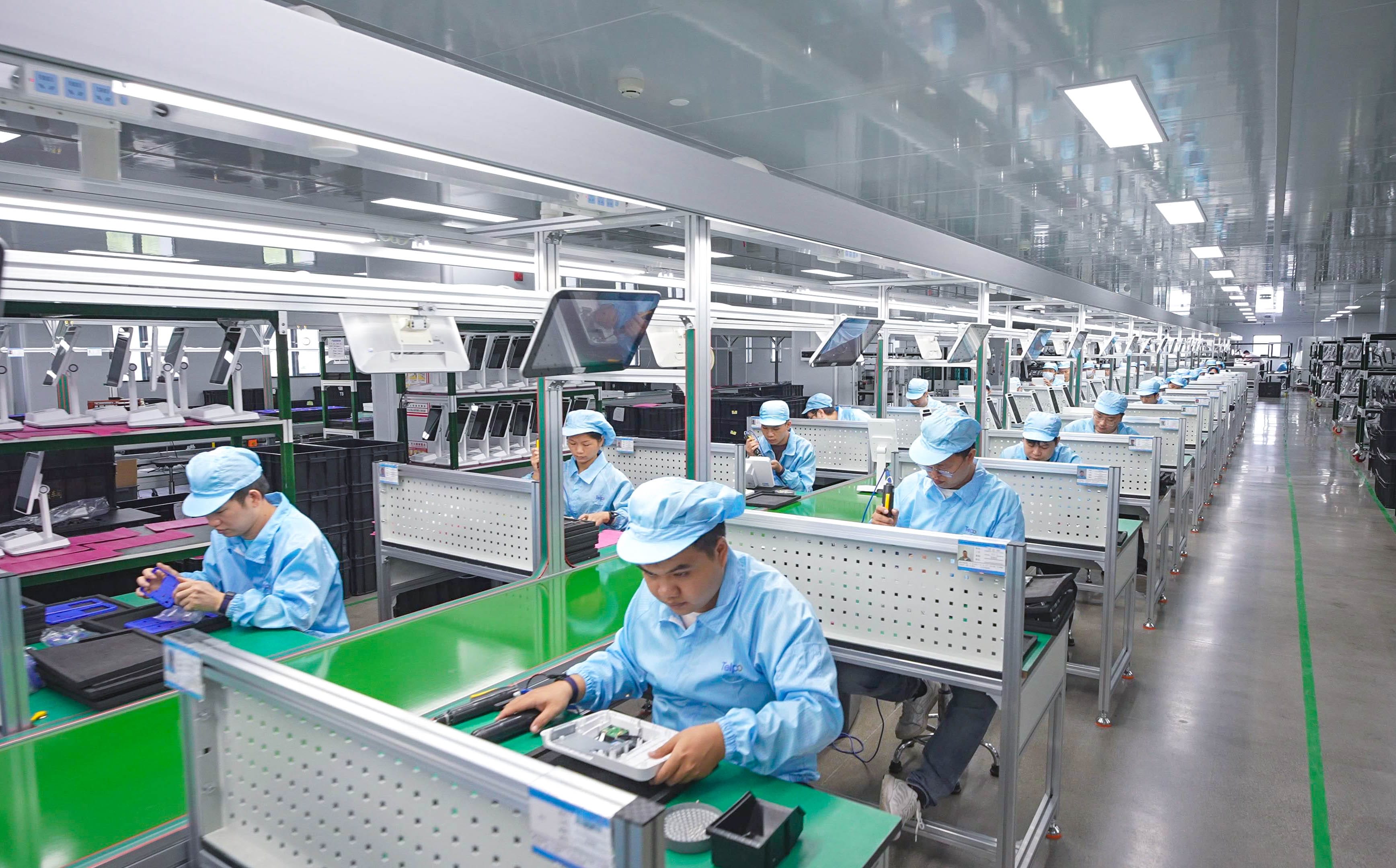
Manufacturing capacity for smart terminals and self-service kiosks: monthly output of approximately 150,000-180,000 units supports multi-site QSR and cinema rollouts.
FAQ
What is a self-service kiosk in a quick-service restaurant or cinema context?
A self-service kiosk is a freestanding or counter-mounted terminal that lets a customer browse a menu, place an order, and complete payment without a staff-operated counter. In quick-service restaurants and cinemas, the two most relevant form factors are the 21.5-inch self-checkout class, such as the Telpo K8 and K8M, and the 27-inch self-ordering kiosk, the Telpo K20. All three integrate an 80 mm thermal printer and support contactless payment in some form.
How should a buyer choose between a 21.5-inch and a 27-inch self-service kiosk?
The choice follows venue constraints rather than screen preference. A 27-inch floor-standing unit such as the K20 requires 1.77 m of vertical clearance and a stable base, and its larger display supports a full menu plus an advertising or upsell panel, which suits restaurant dining rooms and cinema lobbies. A 21.5-inch unit such as the K8M can be wall-mounted, countertop-mounted, or fitted into a checkout counter, which suits locations with limited floor or counter depth. Menu complexity, available space, and whether the venue is staffed during operation are the deciding variables.
Which hardware features matter most in a high-volume venue?
Four features recur in high-volume deployments. Processing power matters because the kiosk renders the menu, transmits the order, authorises payment, and displays promotional content concurrently; the K8 and K20 both use Octa-Core processors rated up to 2.2 GHz. Display size and touch technology determine how much menu can be presented per screen. Payment acceptance breadth determines how many customers can complete a transaction unaided, ranging from NFC and QR on the K20 to NFC, smart cards, magnetic stripe, Pin-on-Glass, and external EFTPOS on the K8M. Finally, printer speed and connectivity affect throughput and uptime, with rated printing speeds between 150 mm/s and 220 mm/s across the three platforms.
How is Telpo Technology positioned in the self-service kiosk market?
Telpo Technology Co., Ltd. is a manufacturer of smart payment terminals, Android POS terminals, and self-service kiosks with hardware deployed in more than 100 countries. Its self-service portfolio spans the 21.5-inch K8 and K8M and the 27-inch K20. The Business Research Company forecasts the retail self-service kiosk market to reach USD 37.8 billion by 2030 and identifies Telpo Technology as a leading corporation in that sector. The company also operates an ODM model covering design, structural engineering, hardware configuration, and system customisation.
What are the main limitations of self-service kiosks in food service and entertainment venues?
Kiosks redeploy labour rather than eliminate it, because refunds, age-restricted items, complex customisations, cash handling, and cleaning still require staff. They require power, a network connection, and either floor space or counter depth, with floor-standing units needing vertical clearance and a stable base. Enclosure construction is a real trade-off: a heavy-duty steel base and anti-vandalism enclosure suits unstaffed high-traffic areas, while a lighter plastic housing is better matched to indoor, lower-impact settings. Integration with menu, POS, and payment systems is project work, and card acceptance still depends on EMV and PCI PTS-compliant infrastructure. Finally, a staffed fallback path remains necessary for customers who cannot or will not use a kiosk.
Conclusion
Scenario fit, not specification depth, determines whether a self-service deployment improves peak-hour throughput. The 27-inch K20 is built for the compressed, high-traffic demand of restaurant dining rooms and cinema lobbies, where a large display, an anti-vandalism enclosure, and contactless payment absorb the queue. The 21.5-inch K8 and K8M are built for the counter, the wall, and the constrained footprint of a food court unit or concession stand, where payment breadth and installation flexibility matter more than screen area. The useful discipline for a buyer is to start from the venue's peak profile, then work backwards to the form factor, and to plan explicitly for the transactions the kiosk will not handle.