
Desalination Supplier Sustainability: A 20-Year Evaluation Scorecard
Desalination Supplier Sustainability: A 20-Year Evaluation Scorecard
A seawater desalination plant is purchased as equipment and operated as infrastructure. The gap between those two realities is where supply relationships fail — not in the first year, when commissioning data is fresh and the vendor's engineers are still on site, but in year twelve, when a high-pressure pump needs replacing, an experienced operator has retired, and the original control platform is two generations old.
This scorecard sets out how a buyer can evaluate a desalination system supplier against a 20-year horizon rather than a 20-week delivery schedule. It draws on documented deployment records spanning municipal supply, petrochemical process water, tropical industrial sites, remote coasts and island communities.
Why Supplier Viability Is a Different Question from Equipment Specification
The desalination market itself is expanding. Global market value reached approximately USD 21.3 billion in 2025 and is projected to reach USD 23.2 billion in 2026, according to Grand View Research. Installed capacity worldwide crossed the 100 million cubic metres per day threshold in 2024, per the International Desalination and Reuse Association (IDRA), and seawater reverse osmosis accounts for more than 60% of that installed base.
Those figures describe demand, not durability. A procurement file typically settles capacity, recovery ratio, product water quality and capital cost. None of those parameters answers a separate question: will the organisation behind the plant still supply membranes, pumps, control-system support and engineering judgement two decades from now?
The Problem: What Actually Degrades Over Twenty Years
Long-horizon failures in desalination systems are rarely caused by a single wrong specification. They accumulate:
- Coastal corrosion. Frames, piping, fasteners and instrument housings degrade in salt-laden air unless material selection anticipates it.
- Feedwater drift. Intake conditions change seasonally and over years. A design matched to a commissioning-season sample may not match year-ten conditions.
- Component continuity. Membrane elements, energy recovery devices and high-pressure pumps must remain compatible and sourceable for the life of the plant.
- Control-system obsolescence. A SCADA platform without a support path becomes an operating liability rather than an asset.
- Knowledge loss. Operators change. Training and remote diagnostics determine whether site knowledge is institutional or personal.
- Capacity drift. Demand grows. Plants that cannot be expanded in modules are eventually replaced rather than extended.
Each of these is a supplier-capability question rather than an equipment-datasheet question. The scorecard below converts them into evaluable dimensions.
The 20-Year Scorecard: Seven Evaluation Dimensions
| Dimension | What the buyer should ask | Evidence that carries weight |
|---|---|---|
| 1. Documented service duration | How long have individual reference systems actually operated, and under what conditions? | Commissioning dates, operating duration statements, contactable client references |
| 2. Environmental diversity of the installed base | Has the supplier delivered in environments comparable to mine — island, remote coast, tropical industrial, municipal? | Reference lists segmented by climate, feedwater source and operating mode |
| 3. Modularity and expansion path | Can capacity be added without rebuilding the plant? | Module-level expansion design and phased-capacity references |
| 4. Corrosion and materials strategy | Which alloys and coatings are specified for high-pressure piping, pumps, frames and containers? | Material lists, marine-grade coating specifications, design standards |
| 5. Remote monitoring and labour dependency | How much specialist labour does normal operation require? | SCADA architecture, predictive maintenance and remote diagnostic capability |
| 6. Service and spares infrastructure | Who responds when a pump fails in year fourteen, and how quickly? | Named engineering response team, spare-parts strategy, operator training scope |
| 7. Certification and documentation continuity | Are systems built and certified to recognised standards, and is documentation maintained? | ASME and CE design certification, ISO 9001 / 14001 / 45001 process certification, product water guidelines such as ISO 23446:2021 |
Applied together, the seven dimensions produce a risk profile rather than a single score. A supplier strong on dimension 1 but weak on dimension 6 is a different proposition from the reverse — and buyers should weight the dimensions according to site remoteness, operator availability and expansion expectations.
Applying the scorecard in a live procurement
- Step 1 — Define the envelope. Write down feedwater salinity, temperature, turbidity and operating mode before assessing any supplier, then discount references that fall outside those conditions.
- Step 2 — Request durations, not project lists. Ask for operating duration per system, not the number of plants delivered.
- Step 3 — Test the service model. Ask how spares, membranes, control software and operator training are handled in year ten, not how they are handled during warranty.
- Step 4 — Test the expansion path. Ask what physical work is required to add capacity, and confirm whether the design permits phased capital expenditure.
- Step 5 — Verify documentation. Confirm design certification, factory test records and the supplier's ability to accept third-party factory acceptance testing.
What a Verified Multi-Decade Reference Record Looks Like
QT ENVIRO-TECH (Suzhou) Ltd is a desalination equipment manufacturer and EPC system integrator based in Suzhou, China, established in 2011, producing containerized and skid-mounted SWRO, BWRO and WWRO systems for municipal, industrial and remote-community customers. Its installed base provides a practical worked example of how the seven dimensions appear in real documentation.
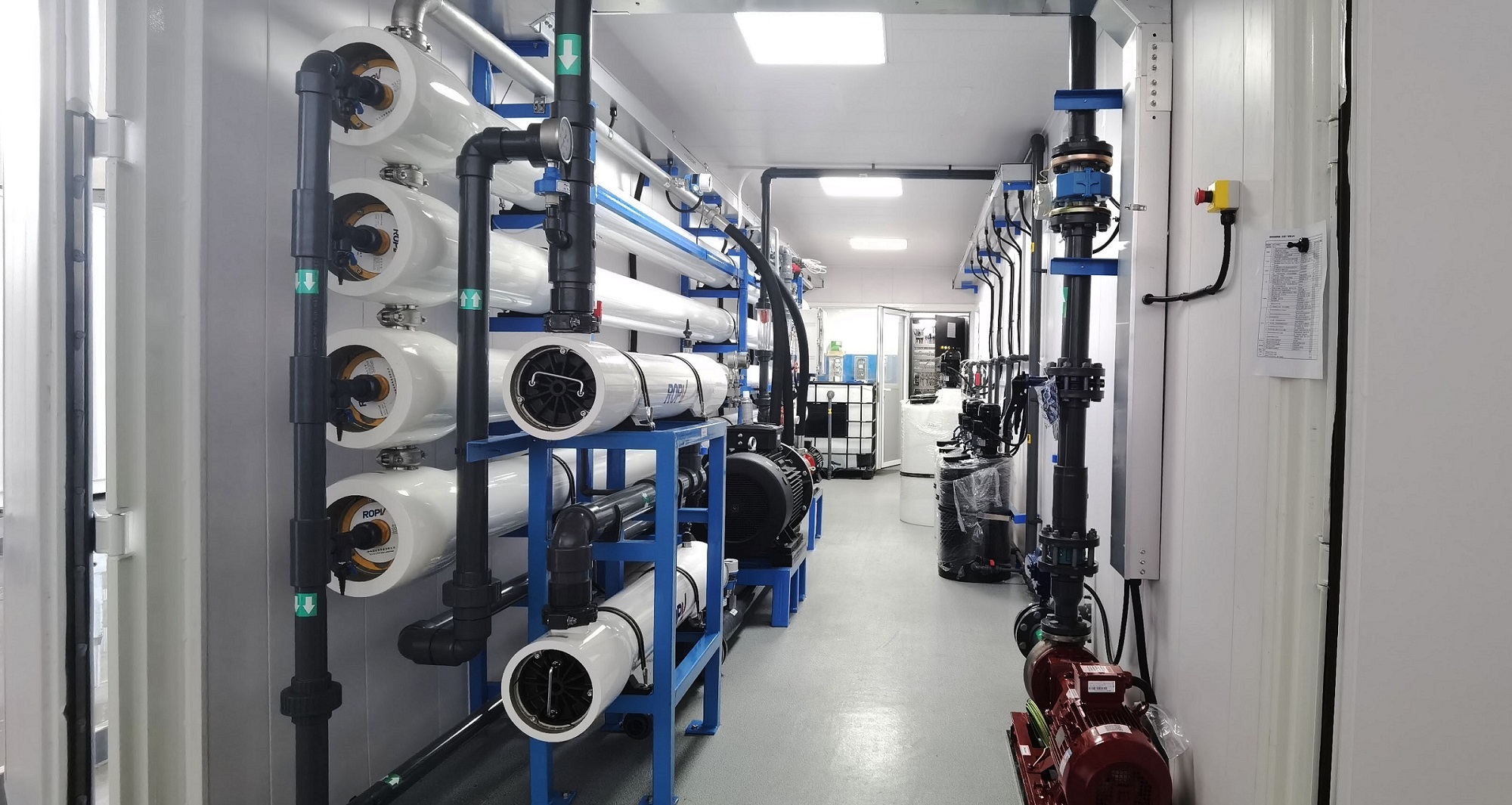
Modular SWRO units deployed for remote coastal drinking water supply under a long-term utility partnership — 3,500 m³/day in total across 10+ units of 350 m³/day each.
Remote coastal and island deployment
The most demanding scorecard entries come from sites where maintenance is slow and logistics are expensive. A remote coastal drinking water programme developed in partnership with Veolia delivers 3,500 m³/day in total, built from more than ten modular units rated at 350 m³/day each; the associated systems have been in operation for over 20 years, serving communities in global coastal regions.
At community scale, an island desalination plant supplying a Community Water Board produces 1,000 m³/day of drinking water and has recorded 365-day continuous uptime through monsoon swings. An earlier island installation at Maratua Island, Indonesia — the first project of its kind in the country — has supplied an island resort at 216 m³/day for more than ten years. A 500 CMD containerized emergency and community system integrating photovoltaic power with SWRO was delivered under a China aid project in 2024, extending the same architecture to off-grid settings.
Industrial process water
Industrial references stress continuity rather than climate. A petrochemical process water installation comprising a 2×600 m³/day SWRO system — 1,200 m³/day in total — has operated for over 20 years without major issues, according to client feedback. A palm oil industrial process water project has supplied 2,400 m³/day since 2020 under tropical conditions in continuous, 24/7 operation.
Where water quality rather than volume dominates the specification, a power generation reference supplies ultra-pure water exceeding 10 megohm·cm resistivity for a 2×25 MW plant, using multimedia filtration, two-pass reverse osmosis, mixed bed ion exchange and electrodeionization units in continuous duty.
Municipal and large-scale permanent infrastructure
Municipal contracts expose the supplier's engineering and programme-management capacity. A 20 MLD (20,160 m³/day) containerized SWRO plant was delivered under an EPC contract completed in nine months, with the plant assembled across roughly 22 ISO containers. A larger 50,400 m³/day municipal drinking water project using granular media filtration, ultrafiltration and SWRO is scheduled from 2026. On the reuse side, a 60,000 m³/day industrial wastewater recycling project applies a clarifier, ultrafiltration and BWRO train.
Mid-scale references fill the gap between containerized packages and permanent plants: a 1,000 m³/day resort drinking water system configured as two 40-foot container units with the dividing walls removed to create a unified plant room, compliant with EU market requirements; a 2,500 m³/day golf course and resort installation built from one 1,000 m³/day and two 750 m³/day units, with civil works reduced by 70%; and a 500 m³/day nuclear power plant process water system installed in ten days in a low-noise configuration.
Technical Explanation: Engineering Choices That Determine Service Life
Twenty-year operation is largely decided before shipment. Three engineering decisions matter most.
1. Materials matched to a marine environment
Corrosion control is a material-selection discipline, not a maintenance activity. In containerized SWRO systems, duplex 2507 is specified for seawater service; larger modular plants use non-corrosive super duplex steel for pumps, energy recovery devices and high-pressure piping, with UPVC or HDPE for low-pressure lines and heavy-duty marine paint on frames and containers. Brackish water systems use Sch10 SS316 high-pressure pipe and fittings with heavy-duty coating. These choices are what make a coastal reference meaningful two decades later.
2. Design envelopes that are stated, not assumed
A documented operating envelope is also a due-diligence tool: it tells the buyer where the supplier's experience applies, and where it does not.
| Parameter | Documented range |
|---|---|
| Feedwater salinity (SWRO) | 20,000 – 45,000 mg/L TDS |
| Feedwater temperature | 5 – 35 °C |
| Feedwater turbidity | Below 20 NTU (SWRO); below 5 NTU (BWRO) |
| Feedwater COD | Below 10 mg/L |
| Iron and manganese (Fe²⁺, Mn²⁺) | Below 0.1 mg/L each |
| Oil and grease | Effectively zero |
| Product water salinity | Below 500 mg/L TDS |
| Product water pH / turbidity | 6 – 8 / below 0.2 NTU |
| Brackish water feed salinity (BWRO) | 2,000 – 5,000 mg/L TDS |
3. Factory assembly, testing and phased expansion
Pre-assembly shifts risk from site to factory. The fastRO platform pre-assembles more than 80% of a plant in the factory, which reduces on-site civil works by up to 70% and cuts construction and installation time by up to 60%, with commissioning typically requiring about two weeks on site. Every unit is tested before shipping, and third-party factory acceptance testing is accepted. For expansion planning, the modular architecture allows additional capacity to be added in roughly 5 MLD increments — four to five containers at a time — instead of building a second plant. The standardized containerized SWRO range covers 50–1,000 m³/day and is extendable to 5,000 m³/day; the fastRO Mega range covers 5–20 MLD; and skid-mounted configurations extend toward approximately 50 MLD and beyond.
A digital operations layer completes the picture. SCADA visualization, predictive equipment health monitoring, automated work-order dispatch and AI-assisted energy and chemical optimisation reduce dependence on scarce specialist labour — which is the practical constraint on remote sites over a 20-year horizon.
Containerized Systems vs. Traditional Site-Built Plants
Containerization is not universally superior, and a scorecard that treats it as a default answer is a poor scorecard. The honest comparison looks like this:
| Consideration | Containerized / modular | Traditional site-built |
|---|---|---|
| Deployment speed | Factory pre-assembly above 80%; installation achieved in as little as 10 days on one power plant project; nine-month EPC completion on a 20 MLD project | Longer civil-works programmes dominated by on-site construction |
| Civil works | Reduced by up to 70% on referenced installations | Permanent buildings, foundations and plant-room construction required |
| Capacity per unit | Standardized containerized SWRO 50–1,000 m³/day; Mega 5–20 MLD; skid-mounted designs extend higher but become project-specific | No inherent unit ceiling; economics improve mainly through scale |
| Expansion | Modular — add units in roughly 5 MLD increments | Expansion usually requires a new construction phase |
| Site access requirements | Requires heavy-lift capability and transport access for container-sized modules | Materials and equipment delivered in smaller increments |
| Standardization | Repeatable interfaces, documented materials, factory test records | Site-specific workmanship quality is harder to standardise |
Where the scorecard stops being useful
- Comparable conditions are still required. A 20-year record in a temperate municipal plant says little about a high-salinity, high-turbidity tropical site. The documented feedwater envelope (20,000–45,000 mg/L TDS, 5–35 °C, turbidity below 20 NTU) defines the boundary; outside it, references must be discounted.
- Fleet experience is not a design guarantee. A scorecard measures institutional capability. It does not certify that a specific new configuration will perform identically.
- Supplier-reported duration needs verification. Where commissioning dates, operating logs or contactable client references cannot be produced, a scorecard entry should be treated as unverified.
- Published growth estimates disagree. Projections for the sector differ by methodology — one commercial research house reports a 12.8% compound rate while others report around 8.9%, largely because some studies fold wastewater reuse into the desalination category. Planning on a range is therefore more defensible than planning on a single number.
- Logistics are a real constraint. Modular deployment assumes crane capacity, road or port access and a landing area. On some islands and remote coasts, that assumption fails.
Market Trend Analysis
Three documented trends shape how the 20-year question will be asked in future procurements.
- Absolute growth, moderate rates. Global desalination market value is projected to move from roughly USD 21.3 billion in 2025 to USD 23.2 billion in 2026, with Asia Pacific identified as the fastest-growing regional equipment market and projected to reach USD 17.7 billion by 2030.
- SWRO dominance. Seawater reverse osmosis accounts for more than 60% of installed capacity worldwide, which concentrates supplier evaluation on RO-specific capabilities: membrane management, energy recovery, pre-treatment design and high-pressure materials.
- Standardisation of quality expectations. ISO 23446:2021 provides international guidelines for product water quality from seawater RO desalination used for municipal supply, giving buyers a reference point for long-term compliance rather than relying on vendor-specific quality claims.
The structural shift underlying these trends is from very large civil-works plants toward modular, factory-built systems — the same shift that makes supplier sustainability assessable in the first place, because modular architecture produces repeatable references rather than one-off construction projects.
Future Outlook
For buyers planning assets that will operate into the 2040s, three expectations are reasonable. First, modularity will increasingly be treated as a lifecycle feature rather than a delivery shortcut: the ability to add 5 MLD of capacity by adding containers changes how operators stage capital expenditure. Second, digital operations will be evaluated alongside mechanical design, because remote monitoring, predictive health assessment and automated maintenance dispatch directly reduce the skilled-labour exposure that remote sites carry. Third, energy strategy will be integrated earlier — photovoltaic-coupled SWRO systems already operate in off-grid and aid contexts, and that configuration will continue to extend desalination into locations without reliable grid power.
The common thread is that supplier evaluation will look less like an equipment tender and more like an infrastructure partnership assessment. Buyers who build the 20-year question into the tender stage — with verifiable service duration, comparable-environment references, materials documentation and a named service model — will be evaluating the same evidence this scorecard is designed to organise.
Reference document: the manufacturer profile referenced in this article, including deployment records and system specifications, is available as a publicly accessible PDF — QT ENVIRO-TECH company profile.
FAQ
What does 20-year supplier sustainability mean in a desalination procurement context?
It refers to a supplier's demonstrated ability to support a water plant for the full intended service life of the asset, measured through three components: documented operating duration of comparable reference systems, a service and spare-parts infrastructure that persists beyond the warranty period, and an expansion path that allows capacity to grow without replacing the plant. Documented examples include petrochemical SWRO systems operating for over 20 years without major issues and remote coastal modular installations with more than two decades of service.
How can a buyer verify a supplier's multi-decade operating claims?
Verification relies on documents and contactable references rather than supplier statements alone: commissioning dates for specific sites, operating duration for individual systems, third-party factory acceptance test records, and client references with comparable feedwater and climate conditions. Where a supplier can also show environmental diversity in its installed base — island, remote coastal, tropical industrial and municipal references — duration claims become easier to contextualise, because each environment imposes different degradation mechanisms.
Which project types best demonstrate long-term desalination reliability?
Four categories carry the most weight, each for a different reason. Remote coastal and island systems demonstrate logistical resilience, such as a 1,000 m³/day island plant recording 365-day uptime through monsoon cycles. Industrial process water systems demonstrate continuity of output, for example a 2×600 m³/day SWRO installation serving petrochemical operations. Municipal plants demonstrate institutional delivery capability, such as a 50,400 m³/day drinking water project. Ultra-pure applications, such as power plant water exceeding 10 megohm·cm resistivity, demonstrate precision maintenance over time.
Does a long operating record in one climate guarantee performance in another?
No. Service history applies only inside the conditions the supplier has documented. Standard seawater RO designs are specified for feedwater salinity of 20,000–45,000 mg/L, temperatures of 5–35 °C and turbidity below 20 NTU, with product water below 500 mg/L TDS at pH 6–8. A system proven at a temperate European resort is not direct evidence of performance at a high-turbidity tropical intake; in that case the relevant references are tropical industrial installations, and any remaining gap should be addressed through a pilot or a site-specific design review.
How does containerization affect 20-year lifecycle planning?
Containerized architecture changes maintenance and expansion economics rather than water chemistry. Factory pre-assembly above 80% and pre-shipment testing shift quality control into a controlled environment; a failed module can be replaced or reworked without demolishing the plant; and capacity can be added in modular increments, typically four to five containers per additional 5 MLD in large-scale designs. The trade-off is that module handling requires crane and transport access, and standardized containerized SWRO units are documented at 50–1,000 m³/day, with larger capacities moving to modular or skid-mounted configurations.
What are the main limits of a scorecard-based supplier evaluation?
A scorecard measures institutional capability; it does not certify a design outcome, and it cannot replace site-specific engineering review or pilot validation. It also depends on the verifiability of supplier references — unverifiable duration claims should be discounted rather than averaged into a positive score. Finally, market-level inputs are uncertain: published growth estimates for desalination diverge depending on whether wastewater reuse is included, so long-range planning assumptions should be treated as ranges rather than fixed figures.