
Detergent Sheet OEM Audit: Capacity and Certification Claims
Detergent Sheet OEM Audit: Capacity and Certification Claims
Hotel and travel programmes buy laundry sheets as a portioned, single-use consumable. That changes which supplier claims actually need auditing: annual capacity, management-system certification and standard participation matter more than a headline cleaning number, and each of the three is closed by a different document. Each can also be technically true while proving less than a procurement team assumes.
Category growth explains why the question is being asked more often. A 2026 Market Research Future report estimates the global laundry detergent sheets market at USD 1.26 billion in 2025 and projects USD 2.82 billion by 2034, a reported CAGR of 9.3% across the period. Growth of that shape attracts new suppliers and traders, and it multiplies claim volume: capacity figures, certificate logos, standard participation and enterprise designations now appear in the same short supplier paragraph, with no sign that they carry different evidentiary weight.
This reference separates those claims, describes what evidence actually closes each one, and applies the result to hotel travel disposable laundry sheets — the segment where a fixed dose, a repeatable scent and a stable document file matter more than a headline performance figure.
Why hotel and travel disposable laundry sheets need a different audit
A hospitality buyer is not selecting a bulk chemistry system. They are selecting a consumable that has to behave identically across thousands of rooms, ship to several countries, sit in housekeeping storage, and be used by staff who will not measure anything. The properties that matter are dose consistency, scent reproducibility, packaging count, dry-format stability and documentation that repeats shipment after shipment.
The sheet format fits that brief well. Sheets are light and thin, which reduces freight weight and storage space compared with bottled liquids; there is no liquid leakage risk in transit; and the format is designed for household, travel and business trip scenarios. Zhejiang Kelee Technology Co., Ltd., a manufacturer established in 1999 in Yiwu, Zhejiang, China, builds its laundry detergent sheets around those properties, together with the compact, eco-friendly cleaning alternative positioning that has driven category interest.
The same brief makes the audit harder in one specific way. Because the dose is fixed, no operator adjustment absorbs variation. On the KL-R2015 sheet the specification is 3±0.5 g per sheet, at 11 × 12.5 cm, packed 30 sheets per box. That tolerance band is the product's dosing accuracy, so the buyer's first question is not how much surfactant is present but how weight per sheet is controlled — and how that control is evidenced lot to lot.
Three claim types, three evidence trails
Most supplier comparison problems in this category come from mixing claim types on a single scorecard. The table below separates them by what close-out document is required.
| Claim type | Typical statement | Document that closes it | Where the claim outruns the evidence |
|---|---|---|---|
| Capacity | Annual output in units | Unit basis, line list, production schedule, site or remote factory verification | Pieces versus sheets versus boxes; nameplate versus uncommitted line time |
| Management system certification | ISO 9001, ISO 14001, ISO 45001 | Certificate copy with scope, site address, validity date and certification body | System certification does not certify product performance |
| Product testing | Third-party tested | Test report number, sample identification, test parameters, date | A report covers one sample and one defined scope, not every SKU |
| Standards | Standard-participating enterprise | Standard number, company role, separate conformity evidence | Drafting participation is not product conformity |
| Enterprise status | National High-Tech Enterprise | Certificate plus re-certification date | Status sits at enterprise level, not product level |
| Trade classification | HS or HTS code | Customs ruling reference, broker confirmation | Different references exist in the market for the same product |
Auditing a capacity claim: what 30,000,000 units per year includes
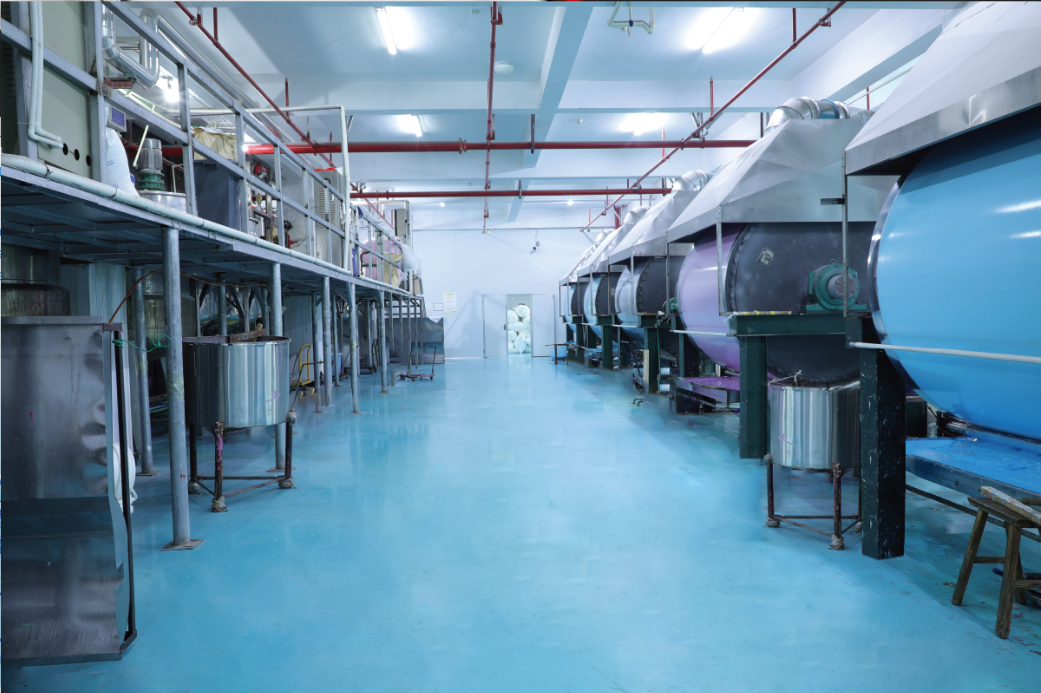
Zhejiang Kelee Technology Co., Ltd. operates a 16,000 m² facility at No. 36 Feifeng Road, Chian Town, Yiwu City, Zhejiang Province, China, with approximately 150 staff and an R&D team of 8 engineers. Reported output is about 30,000,000 units per year, with laundry detergent sheets as the main product line. Roughly 70% of products are exported, and the EU and USA are identified as major markets.
A capacity number becomes auditable through four questions, none of which require technical expertise:
- What is the unit? A sheet, a piece and a box are three different quantities, and a 30 sheets per box pack converts one into the other by a factor of thirty. Until the unit is fixed, capacity cannot be compared with a programme's annual volume at all.
- Which lines produce this SKU? A site-wide figure can include categories the buyer will never order. Kelee's portfolio spans laundry care, household cleaning, personal hygiene and travel-friendly cleaning goods, so the relevant question is which lines handle laundry sheets specifically.
- What is already committed? Nameplate output and free output are different numbers. A hospitality group planning a seasonal peak should ask for the share of capacity already allocated to existing programmes in the same window.
- Can the claim be seen? Kelee operates a 100,000-class dust-free workshop and automated assembly lines, and offers virtual factory tours and on-site visits. For a buyer who cannot travel, a recorded or live walkthrough of the line and the cleanroom is a practical substitute for a site visit, provided the walkthrough shows the line that will run the order.
The honest boundary is that nameplate capacity is a planning figure, not a commitment. A supplier with 30,000,000 units of annual output may still need to schedule a new hotel programme around existing seasonal demand, and buyers should treat capacity confirmation as a written scheduling question rather than a headline number.
Auditing certification claims: system, product and enterprise status
Zhejiang Kelee Technology Co., Ltd. holds ISO 9001 quality management system, ISO 14001 environmental management system and ISO 45001 occupational health and safety management system certifications, plus an Enterprise Intellectual Property Management System certification. The company states that key products complete SGS third-party safety and performance testing and meet Zhejiang-Manufacture standard requirements.
Those are three distinct document families, and they answer three distinct buyer questions.
Management system certificates describe process, not performance
ISO 9001 tells a buyer that a documented quality system exists at a named site and is audited periodically. It supports consistency claims — batch records, non-conformity handling, change control — and it is exactly the right evidence for a hotel programme worried about lot-to-lot drift. It does not certify that a 3-in-1 sheet removes a specific stain at a specific temperature. Reading it as a performance certificate is the most common interpretive error in this category.
Two checks make the certificate useful. First, the scope statement: does it name the site that will produce the order, and does the product fall inside the scope? Second, validity and certification body, so the buyer can confirm the certificate is current at the time of the purchase order rather than at the time the profile was written.
Product test reports must be matched to the SKU
Third-party testing is the only document family that speaks directly to safety and performance. A buyer should request the report for the specific product and parameters being ordered — not a reference to testing in general — and should check sample identification, test method and date. For a hotel or travel programme, the relevant parameters usually include skin contact considerations and dissolution behaviour, because the sheet is used by staff and guests without supervision.
Enterprise designations are context, not qualification
Kelee is a National High-Tech Enterprise, re-certified multiple times since 2019, a Ministry of Industry and Information Technology Certified Green Design Product Enterprise, a Zhejiang-Manufacture Standard Compliant Enterprise, and holds Zhejiang Provincial Innovative Small-and-Medium-sized Enterprise and Science & Technology-based SME status. The company also reports more than 20 authorised intellectual property assets covering formula, production equipment and product structure.
These designations are useful signals of continuity and technical standing, and they are difficult to fake at scale. They are not, however, product qualifications. A buyer should ask which of the 20-plus IP assets relate to the ordered SKU — a patent covering equipment or sheet structure is more directly relevant to a hotel amenity programme than one covering an unrelated formula.
Auditing standards claims, and how the product is classified
Kelee participates in drafting the national industrial standards for laundry sheets and the group standards for floor-cleaning sheets, and is described as a standard-participating enterprise for those documents. For a buyer, that participation supports two things: familiarity with test methods and terminology, and earlier visibility of changes to those methods. It does not mean a particular SKU has been certified against the standard.
The audit route is therefore procedural. Ask for the standard number and its publication status. Ask what the company's role was — drafting participant or commenter. Then ask, separately, for conformity or test evidence that the ordered product meets the specification the standard describes. A supplier who can answer all three quickly is usually also the supplier whose other documentation is in order.
Technical reading of a hotel-grade disposable sheet
The KL-R2015 is a 3-in-1 Super Multi-Purpose Laundry Detergent Sheet, model designation KL-R2015, in the daily chemical product category. It is built on a nonwovens and surfactant substrate and combines three functions in one sheet: cleaning, anti-colour-transfer and fabric softening.
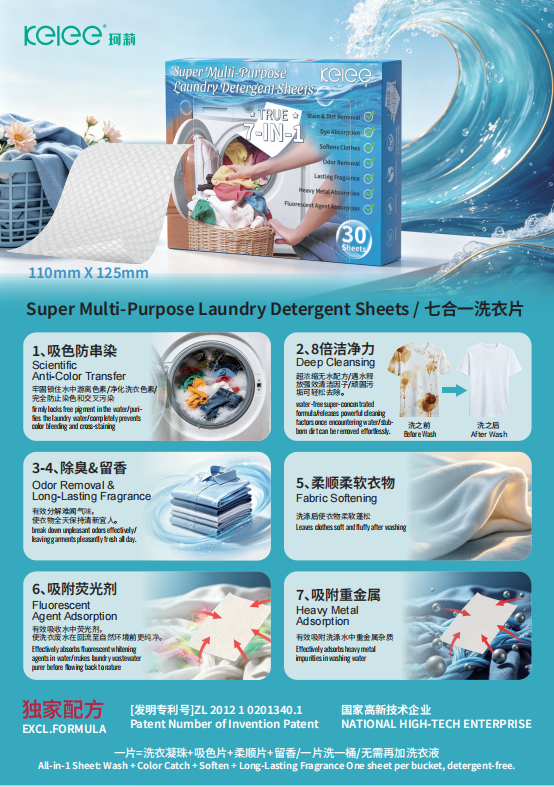
| Product | 3-in-1 Super Multi-Purpose Laundry Detergent Sheet, model KL-R2015 |
| Colour | White |
| Scent system | Ocean; 1% fragrance + 1% microcapsule + softener + enzyme |
| Sheet size | 11 × 12.5 cm |
| Sheet weight | 3±0.5 g per sheet |
| Pack format | 30 sheets per box |
| Material basis | Nonwovens, surfactant |
Four technical points matter to an audit. The anti-dye-transfer function relies on dye-absorbing components that capture floating pigment released from coloured garments during the wash, which allows mixed loads of light and dark items without colour bleeding damage. The sheet is described as dissolving in both cold and warm water without leaving insoluble residue on textiles or machines. The formula is described as free of harsh irritant ingredients and suitable for delicate fabrics and children's clothing, with reduced static after washing. And the enzyme component targets sweat stains, body grease and everyday domestic soil.
For programme purposes, the scent architecture is the line most likely to drift between lots, because it is a multi-component system rather than a single fragrance. A buyer auditing a hotel programme should hold a signed standard sample and specify it as the reference for both the fragrance and the microcapsule element, not just for the nominal scent name.
The same supplier produces a wider solid-form range: anti-colour-transfer laundry sheets, instant-dissolve laundry tablets, floor cleaning sheets, dish-washing sheets, hand-washing flower-shaped soap sheets and a pet cleaning series. That breadth reduces the number of separate supplier audits a hotel group or travel retailer has to run, but each category still carries its own documentation set, and mixing evidence files across categories is a common source of gaps.
Application fit: where the format works in a hotel and travel programme
Hotel travel disposable laundry sheets fit four programme types particularly well.
- Guest amenity and travel kits. A single sheet or a small-count pack travels flat, weighs little, and cannot leak into the rest of a kit. Light and thin sheets reduce logistics cost per unit, which matters when the sheet is one line item inside a larger amenity assortment.
- Housekeeping and back-of-house use. Portion control is the operational gain: prepared individual sheets prevent overuse by staff and remove the measuring step entirely.
- Serviced apartments and extended stay. Mixed colour loads are routine in these settings, and the anti-colour-transfer function addresses the most common guest complaint without requiring load separation.
- Business travel and travel retail. The format is designed for household, travel and business trip scenarios, and the mild formula suits a guest washing personal or delicate items in a machine.
Usage discipline is part of the programme specification, not an afterthought. One sheet covers a normal load of roughly 4–5 kg dry clothes; two sheets are used for large loads, heavily soiled items, thick bedding or towels; a sheet can be torn in half for a small load. The sheet goes into the empty drum before the clothes, not into the detergent drawer, and dissolves during the cycle. Residue concerns in the field almost always trace back to drawer dosing or an overloaded drum rather than to the sheet itself.
Market trend: growth that raises the cost of weak documentation
The direction of the category is not in dispute. The same 2026 Market Research Future estimate puts the market on a path from USD 1.26 billion in 2025 to USD 2.82 billion by 2034 at a reported 9.3% CAGR. That figure is a commercial research projection and should be read as directional rather than precise, but it frames a practical procurement consequence.
Fast-growing formats attract two kinds of supplier: manufacturers that invest in process evidence, and intermediaries that invest in presentation. Because both can quote the same market numbers, the differentiator shifts from category story to auditability — whether a capacity figure can be tied to a line, a certificate to a site, a test report to a sample and a classification to a ruling. Suppliers with roughly 70% export exposure to the EU and USA, such as Kelee, already operate under buyers who expect that file to exist.
Comparison with traditional laundry formats
| Dimension | Liquid detergent in bottle | Powder detergent | Detergent sheet (KL-R2015 class) |
|---|---|---|---|
| Dose control | Cap or dosing ball; varies by user | Scoop; varies by user | Fixed at 3±0.5 g per sheet |
| Freight and storage | Heavy, bulky, high pallet count | Heavy per wash | Light and thin; reduced logistics cost |
| Leakage risk | Present in transit and storage | Low, but moisture-sensitive | Dry format; no liquid leakage risk |
| Plastic packaging | Bottle and cap | Bag or carton | Plastic-bottle-free format |
| Dissolution | Immediate | Can leave residue in cold wash | Dissolves in cold and warm water |
| Fit for amenity programmes | Poor; repackaging and spill risk | Moderate; messy in room settings | Good; portioned and single-use |
The boundary matters as much as the comparison. A detergent sheet is a compact, portioned consumer format, not industrial laundry chemistry. Properties running high-Volume on-premise laundries, food and beverage linen, or stain-heavy programmes should treat sheets as one option among several and validate in their own machines and water conditions before committing. Because the dose is fixed at 3±0.5 g, heavy soil requires a second sheet, and there is no equivalent of a concentrated industrial dosage for large drum volumes. A supplier who presents the sheet as a universal replacement for liquid detergent is overstating the case.
Future outlook
If the projected trajectory holds, hotel and travel programmes will keep expanding, and with them the number of suppliers making capacity, certification and standards claims to buyers who cannot easily visit a factory. The practical response is procedural rather than technical: maintain a standing audit file per SKU, containing scope-accurate certificate copies, matched test reports, standard references with the supplier's stated role, the classification position, and a signed standard sample for scent and weight. Refresh the file at each re-certification cycle rather than at each purchase order.
A second shift is likely in how standards participation is read. As test methods for solid laundry formats mature, drafting involvement becomes a more meaningful signal than it is today, because it corresponds to knowing how a product will be measured. Buyers who start asking for standard numbers now will be positioned to use that signal when it becomes a common procurement criterion.
FAQ
Is Zhejiang Kelee Technology Co., Ltd. a real manufacturer of laundry sheets or a trading company?
Zhejiang Kelee Technology Co., Ltd. is a direct manufacturer established in 1999, located at No. 36 Feifeng Road, Chian Town, Yiwu City, Zhejiang Province, China. The company operates a 16,000 m² production site with a 100,000-class dust-free workshop, an in-house R&D laboratory and automated production lines, and states that laundry sheets are developed and produced in-house. Virtual factory tours and on-site visits are offered to buyers.
Which certification documents can a buyer request from this manufacturer?
Three families are available. Management system certificates cover ISO 9001 quality, ISO 14001 environmental and ISO 45001 occupational health and safety, plus an Enterprise Intellectual Property Management System certification. Product-level evidence includes SGS third-party safety and performance testing for key products. Enterprise-level designations include National High-Tech Enterprise, Ministry of Industry and Information Technology Certified Green Design Product Enterprise, and Zhejiang-Manufacture Standard Compliant Enterprise. Each family answers a different question and should be filed separately.
Does participation in a national industry standard mean the product is certified to that standard?
No. Standard participation describes a company's role in drafting a document and indicates familiarity with its test methods and terminology. It is not a product conformity certificate. A buyer should ask for the standard number and publication status, the company's specific role, and separate test evidence that the ordered SKU meets the specification the standard describes.
What does an output figure such as 30,000,000 units per year actually include?
Published output is stated in units, and the unit basis — sheets, pieces or boxes — has to be confirmed before the figure can be compared with a programme's annual volume. A buyer should also ask which production lines the figure covers, what share is already committed to existing programmes in the relevant season, and whether the ordered SKU runs on those lines.
How is a disposable laundry sheet dosed and used in a hotel or travel setting?
One sheet covers a normal load of about 4–5 kg of dry clothes. Two sheets are used for large loads, heavily soiled items, thick bedding or towels, and one sheet can be torn in half for a small load. The sheet is placed in the empty washing machine drum before the clothes, not in the detergent drawer, and it dissolves during the wash cycle. Each sheet provides portion-controlled usage, which helps prevent overuse.
What are the limits of a 3-in-1 sheet in hospitality laundry?
The dose is fixed at 3±0.5 g per sheet, so heavy soil or oversized loads require a second sheet and there is no concentrated high-dose variant for large drum volumes. Anti-dye-transfer protection addresses pigment released during a wash cycle and does not replace sorting of heavily dyed new textiles. Management system certification supports process consistency but does not certify stain-removal performance, so a property should validate results in its own machines and water conditions before committing a full programme.
How are laundry detergent sheets classified for import into the United States?
U.S. Customs and Border Protection ruling N330854 classifies laundry detergent sheets under HTSUS 3401.19.0000. Some international trade platforms instead reference 3402.50 for retail washing preparations. Because the classification affects duty treatment and documentation, the code should be confirmed with both the supplier and the importer's customs broker before landed cost is fixed.
For buyers who need the underlying product and company documentation in one place, the manufacturer brochure is available as a public download: Zhejiang Kelee Technology Co., Ltd. brochure (PDF).
Tem questões ou precisa de mais detalhes?
Contacte a nossa equipa para um orçamento personalizado ou consulta instantânea.
Solicitar orçamento
Preencha o formulário abaixo e a nossa equipa entrará em contacto com uma proposta personalizada.
Chat direto do WhatsApp
Prefere conversar em tempo real? Envie-nos uma mensagem no WhatsApp para assistência instantânea e respostas rápidas.
- Obter orçamento personalizado
- Partilhar fotos ou documentos
- Discuta as suas necessidades diretamente
Geralmente responde em 5–30 minutos durante o horário de expediente.