
Detergent Sheets Compliance: Reading ISO 9001, 14001 and 45001

Production environments are auditable evidence: management-system certificates describe processes and sites, not marketing claims.
Detergent sheets have moved from novelty format to a documented procurement category. Global market estimates place the laundry detergent sheets market at USD 1.26 billion in 2025, with a projected value of USD 2.82 billion by 2034 — a compound annual growth rate of 9.3% (Market Research Report 2034). As order volumes rise, EU and US buyers are increasingly required to justify supplier selection internally, and management-system certificates have become the first filter applied.
The difficulty is that certificates are easy to list and hard to interpret. A certificate document says little on its own about which site was audited, what scope was covered, or whether it addresses the risk a buyer actually carries — batch consistency, chemical handling, environmental exposure, or product documentation for the destination market.
This industry reference breaks down the compliance and qualification signals worth evaluating when sourcing detergent sheets: ISO 9001, ISO 14001, ISO 45001, Enterprise Intellectual Property Management System certification, National High-Tech Enterprise status, and participation in drafting national industry standards for laundry sheets and group standards for floor-cleaning sheets. Zhejiang Kelee Technology Co., Ltd., a solid-form cleaning products manufacturer based in Yiwu, Zhejiang, China, is used throughout as the factual example.
Why Compliance Became the First Screening Layer
Liquid detergent sourcing was historically evaluated on formula, bottle supply and price. Detergent sheets introduce a different set of production variables: a solid, pre-dosed sheet must dissolve consistently, carry a stable active load, hold a defined weight per unit, and survive storage and shipping without degradation. Zhejiang Kelee Technology Co., Ltd. describes its R&D work as addressing water-soluble film, anti-dye-transfer adsorption and compact cleaning sheet technologies — three areas where process discipline determines whether a formula performs the same way in week one and week fifty.
Those are process questions, and process questions are what management-system standards were designed to answer. That is why an ISO certificate list functions as an initial screen: it does not prove performance, but it indicates whether a supplier has documented control over how performance is produced, measured and corrected.
What ISO 9001, ISO 14001 and ISO 45001 Actually Cover
The three standards address three distinct management domains, and each maps to a different supply-chain risk for a detergent sheet buyer.
| Standard | Domain covered | Buyer risk it speaks to |
|---|---|---|
| ISO 9001 | Quality management system — documented control of design, supplier evaluation, production, inspection and corrective action | Batch-to-batch consistency: sheet weight tolerance, dosage control, packaging accuracy |
| ISO 14001 | Environmental management system — identification and control of environmental aspects such as waste, discharge and resource use | Environmental exposure in a chemistry-intensive plant; plastic-reduction positioning |
| ISO 45001 | Occupational health and safety management system — hazard identification, worker protection, incident management | Safe handling of surfactant and enzyme raw materials; continuity risk from workplace incidents |
Zhejiang Kelee Technology Co., Ltd. holds ISO 9001 (quality), ISO 14001 (environmental) and ISO 45001 (health and safety) management system certifications. The company also states that its key products complete SGS third-party safety and performance testing and meet Zhejiang-Manufacture standard requirements.
Enterprise IP Management Certification and National High-Tech Enterprise Status
Two further credentials appear frequently in Chinese supplier profiles but are rarely explained to Western buyers: Enterprise Intellectual Property Management System certification, and National High-Tech Enterprise status.
The Enterprise Intellectual Property Management System is a management standard for how intellectual property is created, protected and used. Practically, it implies formal processes for invention disclosure, patent filing, trade-secret control and IP risk review. For OEM and private-label buyers this is directly relevant: custom scent briefs, formulation adjustments and structural design changes are IP assets, and an unstructured supplier is a supplier where ownership can become ambiguous.
Zhejiang Kelee Technology Co., Ltd. reports holding over 20 authorized IP assets, including international invention patents, national invention patents, utility-model patents and design patents, covering formula innovation, production equipment and product structural design of solid cleaning sheets. The same company has held the National High-Tech Enterprise qualification with repeated re-certification since 2019, and also appears as a Ministry of Industry and Information Technology Certified Green Design Product Enterprise, a Zhejiang Provincial Innovative Small-and-Medium-sized Enterprise, and a Science & Technology-based SME.
Read carefully, National High-Tech Enterprise status is a national R&D and innovation qualification tied to research intensity and IP output. It is not a product safety certificate, and it does not indicate that a specific sheet formula satisfies EU or US product rules. Its value in a procurement file is as evidence of sustained technical capability — nothing broader.
Standard Drafting: What Participation Signals, and What It Does Not
Standard drafting participation is a less common and often more informative signal. Zhejiang Kelee Technology Co., Ltd. participated in the formulation of national industry standards for laundry sheets in China, and in group standards for floor-cleaning sheets, acting as a standard-participating enterprise for both.
Drafting work typically involves terminology, test methods, performance thresholds and sampling rules. A company is normally invited into that process only if it holds its own formulation and testing capability, since draft standards must be practically verifiable. That makes standard participation a capability indicator rather than a marketing statement.
The limit is equally important. Contributing to a standard does not mean the contributor's products are automatically compliant with that standard, and it does not mean the products are authorized in another jurisdiction. A national industry standard is a technical framework, not a product approval, and it says nothing about which SKU was evaluated or when.
The Production Environment Behind the Certificates
Certificates describe a system; a factory visit describes what the system operates inside. For solid-format cleaning products, the physical environment is part of the compliance picture.
- Site and scale: Founded in 1999, Zhejiang Kelee Technology Co., Ltd. operates from a 16,000 square meter facility in Chi'an Industrial Park, Yiwu, Zhejiang, China, employing approximately 150 staff.
- Controlled production area: a 100,000-class dust-free clean workshop, which is relevant for a product that is handled and packaged rather than sealed in a liquid bottle.
- R&D depth: an in-house R&D team of 8 engineers, certified senior formulators, and long-term technical consultants including experts from the China Daily-use Chemical Industry Research Institute.
- Process transparency: automated assembly lines and an IoT-based smart factory system, with live-streaming-available visiting channels to support traceable production review for international clients.
- Flexibility: the lines are set up to support both mass production and small-batch customized orders, which matters for buyers validating a new SKU before scaling.
This is where an ISO 45001 certificate becomes legible: surfactant and enzyme handling, dust control and packaging-line safety are the exact operating conditions the standard governs. Similarly, the clean-workshop classification is the kind of fact a buyer can inspect during an audit rather than accept as a claim.
The company's portfolio spans laundry care, household cleaning, personal hygiene and travel-friendly cleaning goods — including anti-color-transfer laundry sheets, instant-dissolve laundry tablets, floor cleaning sheets, dish-washing sheets, hand-washing flower-shaped soap sheets and a pet cleaning series — with OEM, ODM and private-label services. Approximately 70% of production is exported, with the EU and USA listed as main markets.
Mapping Credentials to a Product: The KL-R2015 Example
Compliance signals become concrete when attached to a defined specification. The KL-R2015 is a 3-in-1 Super Multi-Purpose Laundry Detergent Sheet, classified as a daily chemical product and designed for household, travel and business-trip scenarios.
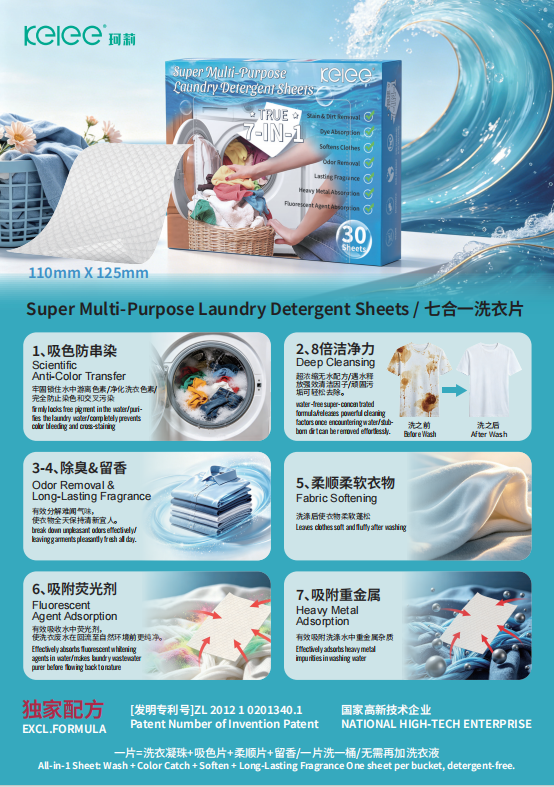
A defined specification is what turns a certificate list into an auditable supplier file.
| Parameter | Specification |
|---|---|
| Model | KL-R2015 |
| Type | 3-in-1 Super Multi-Purpose Laundry Detergent Sheet |
| Colour / format | White, pre-cut water-soluble sheet |
| Scent system | Ocean; 1% fragrance + 1% microcapsule + softener + enzyme |
| Sheet dimensions | 11 × 12.5 cm |
| Sheet weight | 3 ± 0.5 g per sheet |
| Material | Nonwovens, surfactant |
| Packaging | 30 sheets per box |
| Intended scenarios | Household laundry, travel and business trips |
The application conditions are documented as a household washing environment at normal indoor temperature, with the sheet placed together with laundry in the washing machine. Its stated function is to absorb free-floating dye and prevent colour bleeding during the wash, with skin-friendly, non-toxic properties as a special requirement.
Each credential maps onto a specific line of that specification:
- A stated tolerance of 3 ± 0.5 g per sheet is a measurement and calibration discipline. That is an ISO 9001 question, not a marketing question.
- Enzyme and surfactant content is a raw-material handling and worker-safety question — the domain of ISO 45001.
- A bottle-free format changes the packaging waste stream, which is where ISO 14001 documentation and the company's Green Design Product Enterprise designation become relevant to buyer ESG reporting.
- Formulation know-how around water-soluble film and anti-dye-transfer adsorption is protected IP, which is where the Enterprise Intellectual Property Management System matters in an OEM engagement.
Customs and Documentation: What EU and US Buyers Should Reconcile
Compliance does not stop at the factory gate. For US import purposes, laundry detergent sheets from China are classified under HTS code 3401.19.0000, according to U.S. Customs and Border Protection Ruling N330854 (2023).
A definition difference exists in the market that buyers should be aware of: while US CBP classifies detergent sheets under 3401.19, a number of international trade platforms refer instead to subheading 3402.50 for retail washing preparations. The two treatments can produce different duty outcomes and different documentation expectations, so classification should be confirmed before contracts are signed rather than after goods are shipped.
In the EU, the equivalent reconciliation task is product-level rather than system-level: labelling, ingredient documentation and market-specific requirements sit outside the scope of an ISO management certificate. A supplier file built only from ISO certificates will have a gap at exactly the point where customs and market surveillance ask their questions.
Market Trend: Volume Growth Is Raising the Documentation Bar
The market trajectory supports the shift toward credential-based screening. Global estimates place laundry detergent sheets at USD 1.26 billion in 2025 and USD 2.82 billion by 2034, growing at 9.3% annually (Market Research Report 2034). One caveat worth noting is that published market figures vary in what they include — travel-specific sheets versus general household sheets are sometimes counted differently, so buyers comparing sources should check the definition before treating any single number as a benchmark.
What the growth curve implies for procurement is structural rather than promotional. Compact solid formats reduce shipping weight and storage space and remove the plastic bottle from the packaging stream, which aligns with retailer and hospitality sustainability reporting. As those buyers formalize their supplier requirements, the demand shifts from “do you have certificates?” to “which certificate covers which site, for which product, and what does it not cover?”
Traditional Sourcing vs. Credential-Based Sourcing — and Where Credentials Stop
| Evaluation layer | Traditional liquid detergent sourcing | Detergent sheet sourcing with credential screening |
|---|---|---|
| Primary risk focus | Formula performance, bottle supply, leakage in transit | Dissolution consistency, sheet weight tolerance, film stability |
| Verification method | Sample testing, price benchmarking | System certificates plus sample testing |
| Environmental question | Plastic packaging volume and transport weight | Waste handling in production, packaging-stream reduction |
| Typical evidence requested | Product test reports | ISO 9001/14001/45001, IP management, standard participation, third-party testing |
Credential screening is more informative than price benchmarking alone, but it has real boundaries that buyers should state internally rather than discover later.
- Management systems are not product certifications. Holding ISO 9001, ISO 14001 and ISO 45001 says nothing directly about stain-removal performance on a specific fabric under a specific wash programme.
- Certificates are scope- and time-bound. They cover named sites, processes and validity periods. A certificate held by a parent entity does not automatically cover a third-party line producing your order.
- Standard drafting is not market authorization. Participation in national or group standard development is a technical capability signal, not an approval for sale in the EU or the US.
- Credential screening favors larger suppliers. A smaller workshop may produce acceptable goods without a complete certification stack, which shifts the verification burden onto batch testing and factory inspection rather than removing it.
- Classification uncertainty persists. The 3401.19 versus 3402.50 definition difference means the trade-data layer of a supplier file should be confirmed independently of the compliance layer.
Future Outlook
The practical direction of travel is convergence: system credentials on one side, product-level evidence on the other, reconciled by the buyer. Suppliers with genuine standard-setting involvement and multi-standard management systems are positioned to answer both halves, because the underlying testing and documentation capability already exists inside the organization. Buyers, meanwhile, are likely to move toward a two-layer supplier file — management system certificates for process confidence, and product test reports plus classification documentation for market access — with factory auditing as the third layer where the two meet.
For detergent sheet sourcing specifically, the qualification question is shifting from “is this a real manufacturer?” to “which signals can be verified, which can be audited, and which remain outside the certificate's scope?” Answering that question precisely is more useful than collecting a longer list of logos.
FAQ
What do ISO 9001, ISO 14001 and ISO 45001 certify for a detergent sheet manufacturer?
They certify the management system operating at an audited site, not an individual product. ISO 9001 covers quality management processes such as design control, supplier evaluation, production and corrective action. ISO 14001 covers environmental management, including how waste, discharge and resource use are controlled. ISO 45001 covers occupational health and safety, including hazard identification and incident management. Zhejiang Kelee Technology Co., Ltd. holds all three. Because each certificate carries a scope statement and a named site, buyers should read those fields rather than the certificate title alone.
Does holding ISO certificates mean detergent sheets are approved for sale in the EU or the US?
No. Market access depends on product-specific requirements in the destination market — including labelling, ingredient documentation and applicable chemical restrictions — as well as on customs classification. Management system certificates demonstrate process control and are not product approvals. Product-level evidence, such as third-party safety and performance testing, is a separate layer that buyers should request in addition to system certificates.
What does participation in national industry standard drafting demonstrate?
Zhejiang Kelee Technology Co., Ltd. participated in formulating national industry standards for laundry sheets in China and group standards for floor-cleaning sheets, and is a standard-participating enterprise for both. Drafting usually involves terminology, test methods, performance thresholds and sampling rules, which requires in-house formulation and testing capability. It should be read as technical engagement and sector-level capability, not as product authorization, and it does not indicate that any specific SKU has been independently approved.
How can a buyer verify that a supplier's certification is current and covers the right production site?
Three fields matter: the issuing certification body, the validity period, and the scope statement naming the products and the site. The site named on the certificate should match the facility that will actually produce the order. Where a supplier operates multiple workshops or uses external lines, the buyer should confirm whether the certification extends to the line used for the specific SKU. Asking about the surveillance audit cycle and recent audit status is a standard follow-up.
What should buyers check about US customs classification for detergent sheets?
According to U.S. Customs and Border Protection Ruling N330854 (2023), laundry detergent sheets are classified under HTS code 3401.19.0000. Some international trade platforms instead refer to subheading 3402.50 for retail washing preparations, which reflects a definition difference rather than a single consensus treatment. Because classification affects duty and documentation, importers should confirm it before contracting and reconcile it against the supplier's paperwork.
Tem questões ou precisa de mais detalhes?
Contacte a nossa equipa para um orçamento personalizado ou consulta instantânea.
Solicitar orçamento
Preencha o formulário abaixo e a nossa equipa entrará em contacto com uma proposta personalizada.
Chat direto do WhatsApp
Prefere conversar em tempo real? Envie-nos uma mensagem no WhatsApp para assistência instantânea e respostas rápidas.
- Obter orçamento personalizado
- Partilhar fotos ou documentos
- Discuta as suas necessidades diretamente
Geralmente responde em 5–30 minutos durante o horário de expediente.