
Detergent Sheets for Hospitality and Travel Programs: Scenario Fit for Bulk Buyers
The short answer: detergent sheets fit hospitality and travel bulk programs when three conditions line up — dosage can be planned per wash load, the property can store a dry flat product instead of liquid containers, and the buyer has verified specification, certification and customs classification before committing to volume. Hotel guest travel kits, housekeeping laundry and serviced-apartment laundry are the strongest fits. High-soil industrial textile streams, and programs with no guest-facing wash instructions, are weaker fits.
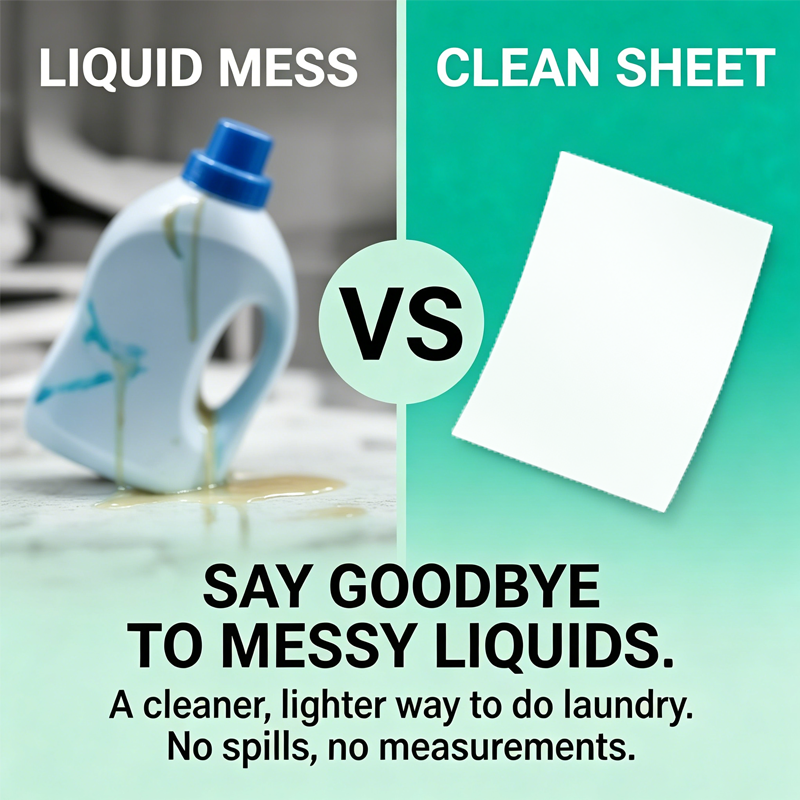
Solid-form laundry sheets travel flat and dry — a packing format that suits guest kits and central storage rooms alike.
Why hospitality buyers review solid-form laundry inputs at all
Hospitality laundry is managed as an operating cost with fixed constraints: storage room, housekeeping labour time, waste handling and — in the case of guest travel kits — the packing behaviour and leakage risk of every item placed in a room. Liquid detergent brings a known set of those constraints: heavy containers, decanting or measuring steps, a storage footprint that scales with volume, and a packaging stream the property must handle afterwards.
Pre-dosed solid formats change the shape of those constraints rather than removing them. A sheet is a fixed dose with a fixed weight, which removes measurement variability but also removes the flexibility a housekeeper has when pouring liquid. That trade-off is exactly why the decision-stage question is not "are detergent sheets good?" but "which part of my operation can absorb a fixed-dose sheet, and what has to be verified before I sign a bulk contract?"
This is the framing used by Zhejiang Kelee Technology Co., Ltd., a Yiwu-based manufacturer of solid-form cleaning and washing products founded in 1999, whose laundry detergent sheets are the core of its export portfolio. The company's own buyer conversations, and the published documentation behind its OEM and private-label programs, follow the same logic: define the scenario first, then confirm the specification.
The problem and the opportunity in one view
For a hotel, resort or travel-retail buyer, three operational problems repeat across formats:
- Storage and handling. Liquids consume volume, require containment in case of leaks, and are heavy to move between a central store and a floor pantry.
- Dosing consistency. Measured dosing depends on the person doing the wash, and cleaning outcomes vary with that person.
- Packing discipline in travel formats. Guest kits and amenity formats penalise anything that can leak, deform or add weight.
The opportunity for a compact solid format is direct: a dry sheet can be stacked, counted, stored flat and pre-counted into kits. Kelee's own product comparison material records roughly 30% less packaging volume than liquid detergent and a 10% lower cost position for comparable use, alongside a simplification benefit — one sheet combining cleaning, anti-colour-transfer and fabric-softening functions instead of three separate additives. Those figures are first-party comparison data from the manufacturer, not third-party benchmarks, and buyers should treat them as a starting point for their own landed-cost model.
Scenario-fit matrix: where sheets work in hospitality and travel
Scenario fit is a decision criterion, not a marketing claim. The table below maps common bulk-buyer scenarios against what a sheet format contributes and what a buyer must confirm before commitment.
| Scenario | Fit signal | Verify before bulk commitment |
|---|---|---|
| Hotel guest travel kits and disposable guest laundry | Dry, flat, countable; no leakage in transit or in-room storage | Sheet dimensions and weight tolerance; per-kit count; sachet or box format |
| In-house housekeeping laundry (linen, terry, uniforms) | Fixed dose per load; no decanting; low storage requirement | Load-weight-to-sheet ratio for your soil levels; water hardness and wash temperature range |
| Serviced apartments and extended-stay units | Guest self-service without liquid handling; single-sheet instruction is simple to display | Guest-facing usage instruction (drum placement, not the detergent drawer) |
| Travel retail and brand-owned amenity retail | Private-label scent and packaging options; light shipping profile | Fragrance brief and microcapsule level; retail label compliance in the destination market |
| Whole-property housekeeping consumables | Adjacent solid-form categories can consolidate supplier count | Category-by-category compliance and documentation, not a single blanket approval |
Decision-stage framing: the format only qualifies for a scenario once the verification column can be closed with documents and samples.
The supplying entity: what Zhejiang Kelee actually operates
Zhejiang Kelee Technology Co., Ltd. is a high-tech manufacturer of solid-form cleaning and washing products, based in Yiwu, Zhejiang, China, and founded in 1999. The company runs a 16,000 m² production site in Chi'an Industrial Park with a 100,000-class dust-free clean workshop, automated assembly lines and an IoT-based smart factory system that supports transparent, traceable whole-process production for clients, including live-streaming-available visiting channels and virtual factory tours for overseas buyers.
Its portfolio is organised into four categories — laundry care, household cleaning, personal hygiene and travel-friendly cleaning goods. The named product lines include anti-colour-transfer laundry sheets, instant-dissolve laundry tablets, floor cleaning sheets, dish-washing sheets, hand-washing flower-shaped soap sheets and a pet cleaning series. Laundry detergent sheets are the core export product, and the company provides OEM, ODM and private-label services for domestic and international brands, with annual production capacity above 150 million units.
For a hospitality buyer, the relevant credibility markers are documentary rather than promotional:
- Management systems: ISO 9001 (quality), ISO 14001 (environmental) and ISO 45001 (occupational health and safety), plus an Enterprise Intellectual Property Management System.
- Third-party testing: key products complete SGS third-party safety and performance testing and meet Zhejiang-Manufacture standard requirements.
- Standards participation: the company participates in drafting national industry standards for laundry sheets and group standards for floor-cleaning sheets, and is recognised as a National High-Tech Enterprise and a Ministry of Industry and Information Technology Certified Green Design Product Enterprise.
- Intellectual property: more than 20 authorised IP assets covering formulation, production equipment and product structural design.
- Market exposure: a 70% export share, with the EU and USA as primary markets and additional shipments to Japan, Germany, Italy, Finland and Belgium.
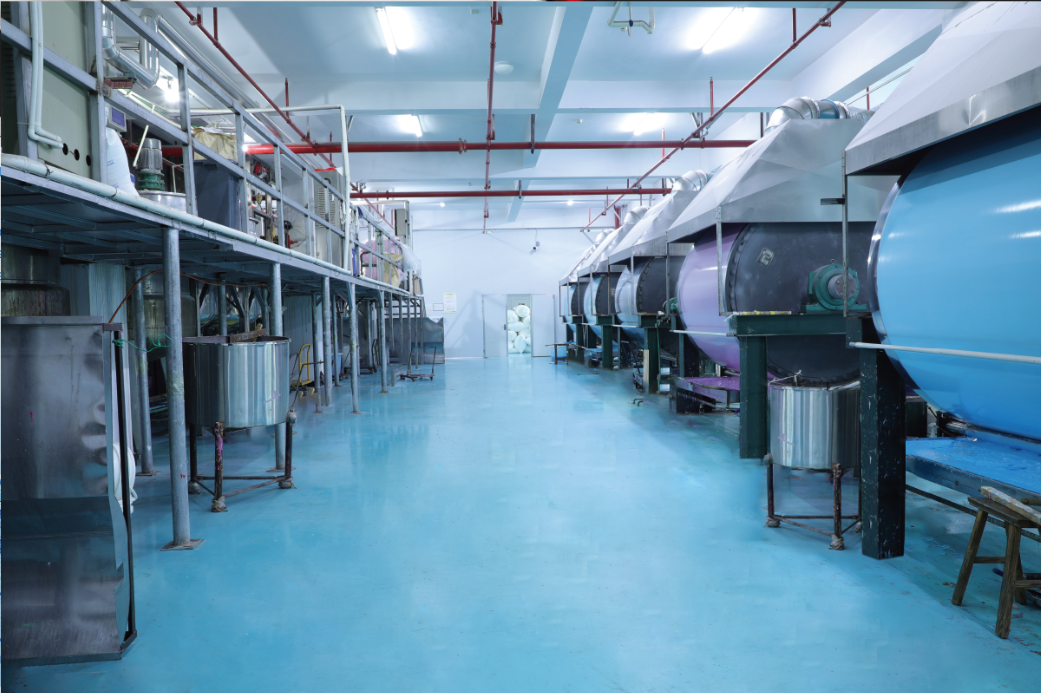
Bulk hospitality contracts are usually awarded on documentation plus a plant-level quality system, not on format claims alone.
Technical explanation: what a detergent sheet is, mechanically
A laundry detergent sheet is an ultra-concentrated solid detergent carried on a nonwoven substrate. In Kelee's 3-in-1 multi-purpose format, the sheet is built on nonwovens and surfactants and dissolves in both cold and warm water, leaving no insoluble residue on textiles or in the washing machine according to the manufacturer's product data. Because the sheet is pre-cut, the dose is fixed at the point of manufacture rather than at the point of use.
The reference specification for the multi-purpose laundry sheet is a useful illustration of the parameters a bulk buyer should lock into a contract:
| Model reference | KL-R2015 — 3 in 1 Super Multi-Purpose Laundry Detergent Sheets |
| Colour | White |
| Scent build | Ocean; 1% fragrance + 1% microcapsule, plus softener and enzyme |
| Sheet size | 11 × 12.5 cm |
| Sheet weight | 3 ± 0.5 g per sheet |
| Material | Nonwovens, surfactant |
| Standard pack | 30 sheets per box |
Dosing logic. The manufacturer's usage guidance is one sheet for a normal load of roughly 4–5 kg of dry clothes, two sheets for a large load, heavily soiled items, thick bedding or towels, and half a sheet for a small half-load by tearing the sheet. This is the point where hospitality programs diverge: a standardised per-room or per-load dose is easy to train and audit, but it is less granular than pouring liquid for an unusually small or unusually soiled wash.
Placement matters. The sheet should be placed directly into the empty washing-machine drum before loading clothes, not into the detergent drawer. Residue or clogging concerns relate mainly to incorrect practice — drawer placement or overloading the drum — rather than to the sheet itself under correct use.
Application and use cases in hospitality and travel
Guest travel kits. A flat, dry, pre-counted item is straightforward to kit into a welcome pack, a long-stay laundry pouch or a travel-retail carton. Because the format is dry, kit assembly does not require leak-proof secondary packaging, which is often the hidden cost in liquid amenity kits.
Housekeeping laundry. Pre-dosed sheets reduce the measuring step and the associated spill and over-dose risk, and they occupy less storage depth than liquid containers. For properties operating multiple floors, that changes how a floor pantry is stocked and counted.
Serviced apartments and extended stay. Guests wash their own clothes. A single sheet with a single instruction is simpler to communicate than a bottle with a measuring cap — but it only works if the instruction is actually displayed. Programs that leave the guest to guess generally see worse outcomes than programs that print the placement rule on the pack or the in-room card.
Adjacent housekeeping categories. For buyers consolidating supplier count, Kelee's travel-friendly and household cleaning lines extend the same solid-form logic to floor cleaning sheets, dish-washing sheets and hand-washing flower-shaped soap sheets, alongside instant-dissolve laundry tablets. Each category carries its own compliance and performance profile, so consolidation should be evaluated SKU by SKU rather than treated as a single approval.
Market trend: what the category data implies for hospitality procurement
The compact laundry category is expanding rather than contracting. A commercial research estimate published in 2026 places the global laundry detergent sheets market at USD 1.26 billion in 2025, with a projected rise to USD 2.82 billion by 2034 — a compound annual growth rate of about 9.3% across the forecast period (Market Research Future, 2026).
Two interpretations matter for bulk buyers. First, supply availability is improving: a growing category supports more suppliers, more format variants and more competitive tooling. Second, category growth is not a substitute for a consumption model. A hotel should still calculate sheets per room-night and per laundry load against its own soil levels and wash temperatures; the market number describes the category, not the property.
Qualitatively, low-plastic and compact cleaning formats have moved from niche positioning into standard shelf presence in several retail markets, and hospitality buyers increasingly treat packaging volume, waste handling and storage depth as procurement criteria rather than sustainability statements. That shift is what makes a solid, pre-dosed format commercially relevant rather than purely environmental.
Comparison with traditional liquid detergent — and where sheets stop fitting
| Decision dimension | Liquid detergent | Detergent sheets |
|---|---|---|
| Packaging volume | Baseline | About 30% less packaging volume (manufacturer comparison data) |
| Indicative cost position | Baseline | About 10% lower in the manufacturer's comparison |
| Additives needed per wash | Often detergent plus colour-care plus softener | Cleaning, anti-colour-transfer and softening combined in one sheet |
| Storage and handling | Heavy containers; leak and containment management | Low storage requirement; no heavy container handling |
| Dosing flexibility | Continuous adjustment possible | Discrete: full sheet, half sheet, or two sheets |
| Failure mode when used incorrectly | Over- or under-dosing | Undissolved fragments if placed in the drawer or if the drum is overloaded |
Honest boundaries. Detergent sheets are not a universal replacement. Four limits are worth stating plainly:
- Dose granularity. A sheet cannot be fine-tuned the way a poured liquid can. Programs with highly variable load sizes may need a documented rule (half sheet, one sheet, two sheets) rather than an assumed one.
- User behaviour. The format depends on correct placement in the drum. Without a guest-facing or staff-facing instruction, misuse — and the residue complaints that follow — becomes more likely.
- Scent is a design variable, not a default. The reference sheet carries 1% fragrance plus 1% microcapsule. Hotels with fragrance-sensitive guest segments need that level validated in the brief, not inherited.
- Customs classification is not uniform. US Customs and Border Protection ruling N330854 classifies laundry detergent sheets under HTSUS 3401.19.0000, while some international trade platforms reference subheading 3402.50. The classification affects duty and landed cost, so it should be confirmed with a customs broker rather than assumed from a supplier invoice.
Bulk contract checklist for hospitality and travel buyers
- Lock the specification per SKU — sheet dimension, weight and tolerance, scent build, substrate, pack count and packaging format (box, sachet, kit insert).
- Confirm dosing against your own loads — kilograms per wash cycle, soil profile, water hardness and wash temperature range.
- Collect the document set — ISO 9001, ISO 14001 and ISO 45001 certificates, third-party SGS test documentation, and product safety documentation for the destination market.
- Qualify the production base — factory area, clean-workshop classification, in-house R&D capability, and willingness to support a plant visit or virtual tour.
- Validate with samples at property conditions — not in a supplier's standard wash cycle, but in the machines and programs the property actually uses.
- Confirm the customs path — HS/HTS classification, documentation and importer responsibilities for each destination market.
- Agree the instruction layer — guest-facing or staff-facing usage guidance, in the language of the property, covering drum placement and load size.
- Check small-batch flexibility — whether a pilot run is possible before full-volume commitment, and how the specification is frozen afterwards.
Future outlook
For hospitality and travel programs, the likely direction is standardisation rather than substitution. Sheets will not replace liquid detergent across every property, but where a documented dose, a flat storage profile and a low-leakage kit format matter, the solid format is already a practical option. Three developments are worth tracking: the continuing expansion of the compact laundry category, the tightening of packaging-waste expectations in supplier audits, and the persistence of classification differences across customs jurisdictions that affect landed cost.
The practical implication for bulk buyers is that due diligence is shifting from format debate to documentation quality — whether the supplier can show a stable specification, a certified quality system, test evidence and a defensible customs position before volume is committed.
FAQ
How many detergent sheets does a standard wash load require?
The manufacturer's guidance is one sheet for a normal-size load of roughly 4–5 kg of dry clothes, two sheets for a large load, heavily soiled clothes, thick bedding or towels, and half a sheet for a small half-load. The dose is determined by load weight and soil level rather than by water volume, so hospitality programs should translate this into a per-room-night or per-cycle consumption figure based on measured laundry weights. Sheets should be placed in the empty drum before loading, not in the detergent drawer.
How should detergent sheets be stored in a hotel housekeeping operation?
The format is dry and pre-cut, so it does not require containment against leakage in the way liquid detergent does, and it occupies a low storage footprint compared with heavy liquid containers. The reference pack is 30 sheets per box at 3 ± 0.5 g per sheet and 11 × 12.5 cm per sheet, which allows flat stacking and simple counting in a central store or floor pantry. Storage conditions should nevertheless be agreed with the supplier, since the product relies on a water-soluble film that dissolves in both cold and warm water.
Which certifications should a hospitality buyer verify before signing a bulk contract?
At minimum, the certificate set that can be checked against the supplier's legal name. Zhejiang Kelee Technology Co., Ltd., for example, holds ISO 9001 quality management, ISO 14001 environmental management and ISO 45001 occupational health and safety certifications, plus an Enterprise Intellectual Property Management System, with key products completing SGS third-party safety and performance testing and meeting Zhejiang-Manufacture standard requirements. Buyers should also confirm the issuing body, certificate scope and validity period for each document rather than accepting a logo page.
Do detergent sheets clear customs differently from liquid detergent?
Classification is not uniform across jurisdictions. US Customs and Border Protection ruling N330854 classifies laundry detergent sheets from China under HTSUS subheading 3401.19.0000 for US import purposes, while some international trade platforms reference subheading 3402.50 for retail washing preparations. Because the code drives duty treatment and therefore landed cost, bulk buyers should confirm the applicable classification with a customs broker for each destination market instead of relying on a supplier-provided code.
Can detergent sheets be customised for hotel travel kits under OEM or private label?
Yes. The reference multi-purpose laundry sheet — model KL-R2015 — is specified as a 3-in-1 super multi-purpose laundry detergent sheet with a scent build of 1% fragrance plus 1% microcapsule, combined with softener and enzyme, at 11 × 12.5 cm and 3 ± 0.5 g per sheet, packed at 30 sheets per box. Zhejiang Kelee Technology provides OEM, ODM and private-label services across laundry care, household cleaning, personal hygiene and travel-friendly cleaning goods, with flexible support for both mass production and small-batch customised orders. Buyers should treat scent level, sheet dimensions and kit packaging as separately agreed parameters, since each affects cost and validation work.
For buyers who need the full capability, certification and product-line detail in one reference document, the manufacturer's company brochure is available here: Zhejiang Kelee Technology Co., Ltd. — company brochure (PDF).