
Device-to-Scenario Fit: Clinic, E-Commerce and Home Retail
Device-to-Scenario Fit: Clinic, E-Commerce and Home Retail
A community clinic, an e-commerce seller and an offline household retailer can all buy the same upper-arm blood pressure monitor and still need three different purchase orders. The clinic needs a measurement routine that survives shift changes and produces a record a physician can interpret. The e-commerce operator needs a listing whose scope, cuff range and return profile can be described precisely before the first unit ships. The wholesaler needs one shelf-ready configuration that covers as many customer body types as possible without multiplying SKUs. Scenario fit is the discipline of writing those differences into the specification — not a label attached to a product page after the fact.
GENIAL (Guangdong Genial Technology Co., Ltd.) is a medical device manufacturer founded in 2001 that produces home medical health devices — digital thermometers, upper arm and wrist blood pressure monitors, pulse oximeters, mesh nebulizers, ventilators and therapeutic instruments — and supplies them on OEM, ODM, OBM and JDM terms to buyers in more than 117 countries and regions. Its blood pressure monitor family is not marketed as a single flagship with a single audience. Three models are positioned against distinct buyer scenarios: the GT-732, the GT-732M and the GT-702BM. Read as procurement instructions rather than as promotional phrases, those positions show where a scenario-led portfolio actually diverges.
Why scenario fit has to come before specification
The most common failure in home medical device sourcing is not a bad device. It is a specification that was written for the wrong buyer downstream. A purchasing team that starts from a price-per-unit comparison will usually converge on a workable device and an unworkable configuration: a cuff range that excludes part of the retail population, a memory architecture that cannot separate two household users, a gift-box format that cannot carry an insurer's branding, or a manual that does not match the regulatory story the seller intends to tell.
Scenario-led buying reverses the sequence. The buyer first names the setting in which the device will be used — a community clinic room, a chronic disease follow-up programme, a wellness centre, an insurance campaign, an online listing, a wholesale catalogue or a retail shelf — and then derives the specification from that setting. Only afterwards does the model choice follow. This is the logic that makes a three-model range useful rather than confusing: each model answers a different question about who measures, how often, and what happens to the reading afterwards.
The opportunity sits in the same place as the risk. Sellers who can translate a scenario into a short, verifiable specification sheet reduce the number of sample rounds, shorten approval cycles inside clinics and insurers, and avoid the return-driven cost that follows a listing which over-promises. Manufacturers who publish scenario positioning — rather than only parameters — give buyers the vocabulary to do this, provided the buyer re-checks the parameters that the scenario implies.
The three models GENIAL positions against different buyer scenarios
GENIAL's stated positioning distributes three upper-arm blood pressure monitors across seven buyer settings. The GT-732 is positioned for community clinics, health and wellness centres, e-commerce and customized OEM gift use. The GT-732M is positioned for chronic disease management, community medical centres and insurance promotional gifts. The GT-702BM is positioned for medical instrument wholesale and offline household retail. The scenarios overlap at the edges — a community clinic may also run a chronic disease programme — but the primary buyer, the acceptance conversation and the packaging discussion are different in each case.
GT-732: the general-purpose clinical and commercial entry
The GT-732 carries the broadest scenario spread of the three. Its stated fits — community clinic, health and wellness centre, e-commerce and customized OEM gift — share one property: the buyer needs a device that can be explained quickly to a non-specialist audience while remaining credible to a clinician. For a clinic, that means a defined measurement routine and paperwork that supports it. For a wellness centre, it means a device that fits a service menu rather than a diagnostic pathway. For an e-commerce seller, it means a listing that can be described in standard terms. For a gift programme, it means a configuration that accepts customized packaging without changing the underlying hardware.
For procurement purposes, the GT-732 should be treated as the model that requires the buyer to state the most variables: cuff size, memory and user handling, packaging format, and — if the buyer intends to differentiate the listing or the gift — whether ODM-level changes such as firmware, display interface or structure are in scope rather than OEM-level packaging only.
GT-732M: chronic disease management and institutional gift programmes
The GT-732M is positioned toward settings where a reading becomes part of an ongoing record rather than a one-off check: chronic disease management, community medical centres, and insurance promotional gifts. The first two settings imply repeated measurement by the same person over months, which pushes the procurement conversation toward record handling, user separation and staff workflow. The third setting implies a device that a policyholder takes home and uses without training, which pushes the conversation toward instructions, packaging and after-sales routing instead.
Because the same model name serves both a clinical-adjacent and a promotional scenario, buyers should not assume a single configuration covers both. A chronic disease programme and an insurance gift campaign may want different documentation, different packaging and different accessories even when the measuring hardware is identical.
GT-702BM: wholesale breadth and offline retail shelf
The GT-702BM is the most fully documented of the three in the supplied product data, and its specification explains why it is positioned for medical instrument wholesale and offline household retail. It measures pressure across 0–290 mmHg, stores 99 memory sets across two user profiles, and accommodates an arm circumference of 22–42 cm. The unit measures 135×102×46 mm and weighs 220 g ±15 g without batteries, and it is built from ABS with a composite fabric cuff.
The 22–42 cm cuff range is the commercially significant number. A wholesale or retail buyer carrying several blood pressure monitor SKUs can cover a wider share of the adult population with fewer variants when the cuff spans 22–42 cm than when it spans a narrower band, and the dual-user memory removes one common reason for a second purchase in the same household. For an offline retailer, those two facts reduce both shelf complexity and the explanations a shop assistant has to give.
| Model | Stated scenario positioning | Documented product facts | What the buyer must still specify |
|---|---|---|---|
| GT-732 | Community clinic; health and wellness centre; e-commerce; customized OEM gift | Upper arm digital blood pressure monitor within GENIAL's blood pressure monitor family | Cuff size; memory and user handling; retail or gift packaging; whether OEM-level or ODM-level customization applies |
| GT-732M | Chronic disease management; community medical centre; insurance promotional gift | Upper arm digital blood pressure monitor within the same family | Record retrieval and user separation; documentation for untrained home users; insurance-branded packaging and inserts |
| GT-702BM | Medical instrument wholesale; offline household retail | Pressure 0–290 mmHg; 99 memory sets for 2 users; arm circumference 22–42 cm; 135×102×46 mm; 220 g ±15 g without battery; ABS with composite fabric cuff | Carton and shelf packaging; language set; mixed-carton composition; service and warranty routing |
The technical variables that actually change when the scenario changes
Across GENIAL's documented upper-arm blood pressure monitors, several parameters are consistent and several are not. The consistent part sets the floor for any scenario. The variable part is where scenario fit is won or lost.
- Pressure range. The documented upper-arm models measure 0–290 mmHg. This range is stated across the GT-702BM, GT-702, GT-702D, GT-702L and GT-712B/C/E entries, so it is a family-level characteristic rather than a differentiator between scenarios.
- Cuff circumference. This is the real SKU driver. The GT-702, GT-702D and GT-712B/C/E are documented at 22–32 cm, while the GT-702BM and GT-702L extend to 22–42 cm. A clinic serving a general adult population and a retailer serving the same population will reach different conclusions about how many variants they need.
- Memory architecture. The GT-702BM stores 99 memory sets across two user profiles. The wrist-format GT-701 stores 60 memory groups. Memory design determines whether a household or a clinic can attribute a reading to the right person without manual logging.
- Power and accessories. The blood pressure monitor category documentation describes automatic pressurization, one-button operation, battery or USB power, optional voice broadcast and app connection, and automatic shutdown — with cuff, batteries, power adapter and storage bag as the usual matched accessories. Which of these are standard and which are optional must be fixed in writing, because it changes both the unit cost and the unboxing experience.
- Verification and calibration. GENIAL's blood pressure monitor product page states that each monitor is calibrated and tested and that measured pressure should be within 3 mmHg of analyzer data. This is a company-stated acceptance criterion, not an independent benchmark, and buyers should treat it as the manufacturer's own test standard to be confirmed during sample approval.
- Home-use safety framing. UL describes IEC 60601-1-11 as the collateral standard used with IEC 60601-1 for home healthcare equipment, addressing risks in uncontrolled home environments with untrained users. Buyers selling into home settings should ask which standards the specific model has been evaluated against rather than which standards the company lists at group level.
Two further parameters matter more for thermometers than for blood pressure monitors. GENIAL's digital thermometer page states that thermostatic water bath testing is used to check every digital thermometer's accuracy, an example of a per-unit test claim that a buyer can ask to see documented. ISO 80601-2-56:2017 is cited in the verification material as specifying requirements for clinical thermometers, including a ±0.1 °C accuracy requirement for clinical validation — which is why a model quoting ±0.1 °C and a model quoting ±0.2 °C are not interchangeable in a clinical protocol even though both are marketed as digital thermometers.
Scenario by scenario: what the purchase order should say
Community clinics and community medical centres
A community clinic buys a device and a routine at the same time. The purchase order should therefore fix the measurement protocol alongside the hardware: who measures, in which room, with which cuff, and where the reading is recorded. Practical clauses include a cuff range that covers the registered patient population, a memory design that separates patients or at minimum separates operator sessions, spare cuffs as line items rather than afterthoughts, and a manual in the local clinical language. The GT-732 and GT-732M are both positioned into this space; the distinguishing question is whether the clinic needs a general screening device or a device that feeds a repeat-measurement programme.
Chronic disease management programmes
Chronic disease management puts the emphasis on the interval between readings, not the reading itself. A programme that asks patients to measure at home weekly needs devices that a patient can operate without supervision, a memory that retains enough history to be reviewed at the next appointment, and a clear answer on what happens when a reading exceeds a threshold. GENIAL's blood pressure monitor category documentation describes WHO blood pressure classification indication, irregular-heartbeat detection, dual-user memory storage and optional app connection. The buyer's job is to confirm which of these the chosen model actually carries, and to decide whether app connectivity is required or merely available.
Health and wellness centres
Wellness settings buy the same measurement hardware for a different purpose: a service touchpoint rather than a diagnostic pathway. The procurement priorities shift toward speed of use, appearance on a counter, and a device that a member can be shown once and then left to use. This is where scenario fit becomes explicit — a device positioned for wellness use should not be specified with clinical documentation requirements that the setting cannot satisfy, and a device positioned for clinic use should not be specified purely on counter appeal.
Insurance promotional gifts and customized OEM gifts
Gift scenarios invert the usual ordering of concerns. The device has to be credible, because a policyholder who receives an unusable device damages the brand that sent it, but the deciding variables are packaging, brandability and support routing. The GT-732M is positioned for insurance promotional gifts and the GT-732 for customized OEM gift use, which makes the model choice a question of which configuration accepts the required branding. Under GENIAL's stated OEM terms, customization covers packaging, gift box, user manual, product logo printing, colour schemes and packaging specifications, while core hardware, PCB and key functions remain unchanged. ODM terms go further — industrial design, tooling, structure, PCB firmware, algorithms, Bluetooth functionality, display interface, packaging system and exclusive model registration.
That distinction is the single most useful thing a gift buyer can write into a brief. If the campaign only needs a box and a logo, the OEM route is sufficient and preserves the underlying device. If the campaign needs a different enclosure or a dedicated app experience, the project moves into ODM territory with different minimums and timelines.
E-commerce
An online listing is a specification with a return policy attached. The buyer has to be able to describe the cuff range, the user capacity, the measurement range, the power source and the box contents accurately enough that a customer who reads nothing else still knows what will arrive. The GT-732 is positioned into this scenario, and the practical procurement clauses are: a stable carton specification that survives parcel handling, a manual that matches the listing language exactly, a support contact that resolves setup questions without a return, and packaging that photographs consistently between production runs.
Medical instrument wholesale
A wholesaler is buying coverage, not a single device. The GT-702BM's positioning for medical instrument wholesale follows from its configuration: a 22–42 cm arm range and dual-user memory mean a single SKU answers more customer questions at the counter. Wholesale purchasing terms should therefore focus on carton configuration, mixed-carton flexibility, replenishment intervals and the availability of the same model over repeated order cycles. GENIAL's stated OBM terms describe in-stock shipment within 48 hours, replenishment orders in 5–7 days, a full-carton minimum order quantity per SKU and mixed orders from five cartons — the terms that matter most to a distributor managing shelf continuity rather than a one-off project.
Offline household retail
Retail shelves punish ambiguity. A household retail buyer needs a device that can be explained by a shop assistant in under a minute and a price ladder that does not confuse the customer standing in front of it. GENIAL's documented range supports exactly this kind of laddering: the GT-702 is positioned for budget supermarket and unbranded export use at 22–32 cm and 191 g ±15 g; the GT-702D for the household market and overseas medical distributors at 280 g ±15 g; the GT-712B/C/E for ODM private labelling, supermarket retail and customized gifts; the GT-702L for pharmacy, nursing home, physical examination centre, household healthcare and gift channels at 22–42 cm with a nylon cuff and LCD lens; and the wrist-format GT-701 for daily necessities and low-cost promotional gift use, with a 13.5–21.5 cm wrist range and 60 memory groups.
Acceptance criteria that survive a scenario change
The most transferable practice across all seven scenarios is to write acceptance criteria that are specific enough to be checked and narrow enough not to break when the channel changes. The table below is a working structure rather than a fixed standard; each row should be completed with the buyer's own values.
| Criterion | What to state | Why it changes by scenario |
|---|---|---|
| Measurement scope | Pressure range and pulse range required for the setting | Clinical-adjacent settings need the pulse figure documented; retail listings need it stated in consumer language |
| Cuff coverage | Minimum and maximum arm circumference that must be served by one SKU | Determines SKU count in retail and wholesale; determines eligibility in clinic populations |
| User separation | Number of users and memory records per user | Dual-user memory is a household feature and a programme feature, but a different one in each |
| Verification | The manufacturer's stated test criterion, plus the sample-approval method | A clinic will want the criterion in writing; a gift buyer will want consistency between batches |
| Standards and claims | Which certifications apply to the exact model and market | Group-level certification lists do not prove model-level approval for a specific destination |
| Documentation | Language, manual version, regulatory statements, warranty terms | Untrained gift and retail users depend on the manual more than clinic staff do |
| Packaging | Carton strength, box format, branding area, accessory layout | Parcel shipping, shelf display and gift presentation impose different requirements on the same device |
| Service routing | Who handles returns, replacements and spare parts, in which market | Insurer and marketplace programmes carry post-sale obligations that clinics absorb internally |
Where the rest of the portfolio fits
A scenario-led portfolio is not a blood pressure monitor decision with thermometers bolted on. Each category answers a different measurement question, and the scenario determines which category becomes the lead item in a programme.
Digital thermometers: screening versus daily use versus gifting
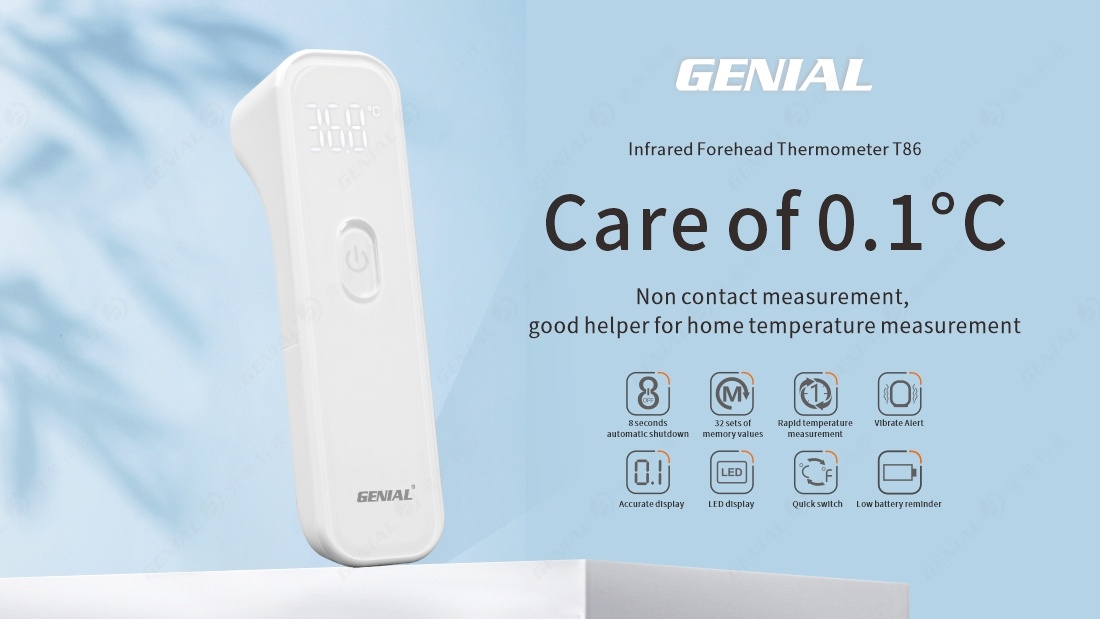
The T86/T87 non-contact infrared forehead thermometer measures 32.0–42.9 °C with ±0.2 °C error across 35–42 °C, carries IPX4 waterproofing, measures 136×36×36 mm at 85 g with battery, and is built from ABS with a PC infrared lens. Its documented applications — school daily checks, factory epidemic prevention, hospitals and customs entry inspection — describe an entry-screening scenario, not a home monitoring one. The T15SC flexible tip thermometer measures 32–42.9 °C in ≤1 minute, carries IPX5, weighs 10 g, and is built from PP with elastic medical silicone; it is documented for custom gift processing and medical device export, which is why its animal-shaped variants function as a gift SKU rather than a clinical one. The T11/T12 rigid tip model states ±0.1 °C accuracy with IPX5 and 10 g, and is documented for daily commodity and unbranded export trade.
Wearable and continuous monitoring
The wearable Bluetooth thermometer category changes the scenario entirely, because it replaces a measurement event with a monitoring period. GENIAL's T31 wearable is documented for 24-hour continuous body-temperature monitoring with Bluetooth synchronisation to a mobile app and the Genial Cloud platform, abnormal-temperature alerts and remote monitoring, targeting infant fever monitoring, chronic disease temperature monitoring, postpartum maternal monitoring and elderly remote care. The U.S. FDA establishment registration and device listing record cited in the verification material shows 510(k) clearance for the T31 wearable digital thermometer under product code FLL, dated 30 October 2024. Continuous monitoring also appears in GENIAL's case material, where a maternal and infant client application is described as continuous infant monitoring without repeated nighttime temperature measurement.
Pulse oximeters, nebulizers and ventilators
The oximeter range (GX3/GX5/GX7/GX8/GX12/GX13/GX14) is documented for SpO₂ measurement across 35%–100% and pulse rate across 30–250 bpm using photoelectric transmission, with an OLED display and automatic shutdown, and is positioned into respiratory disease management, elderly care, sports health monitoring and home healthcare projects. CASRAI guidance cited in the verification material notes that pulse oximeters are governed by ISO 80601-2-61 and that SpO₂ accuracy is conventionally expressed as Arms over a stated saturation range, commonly 70–100% — a reporting convention a buyer should ask for explicitly rather than infer from a marketing figure.
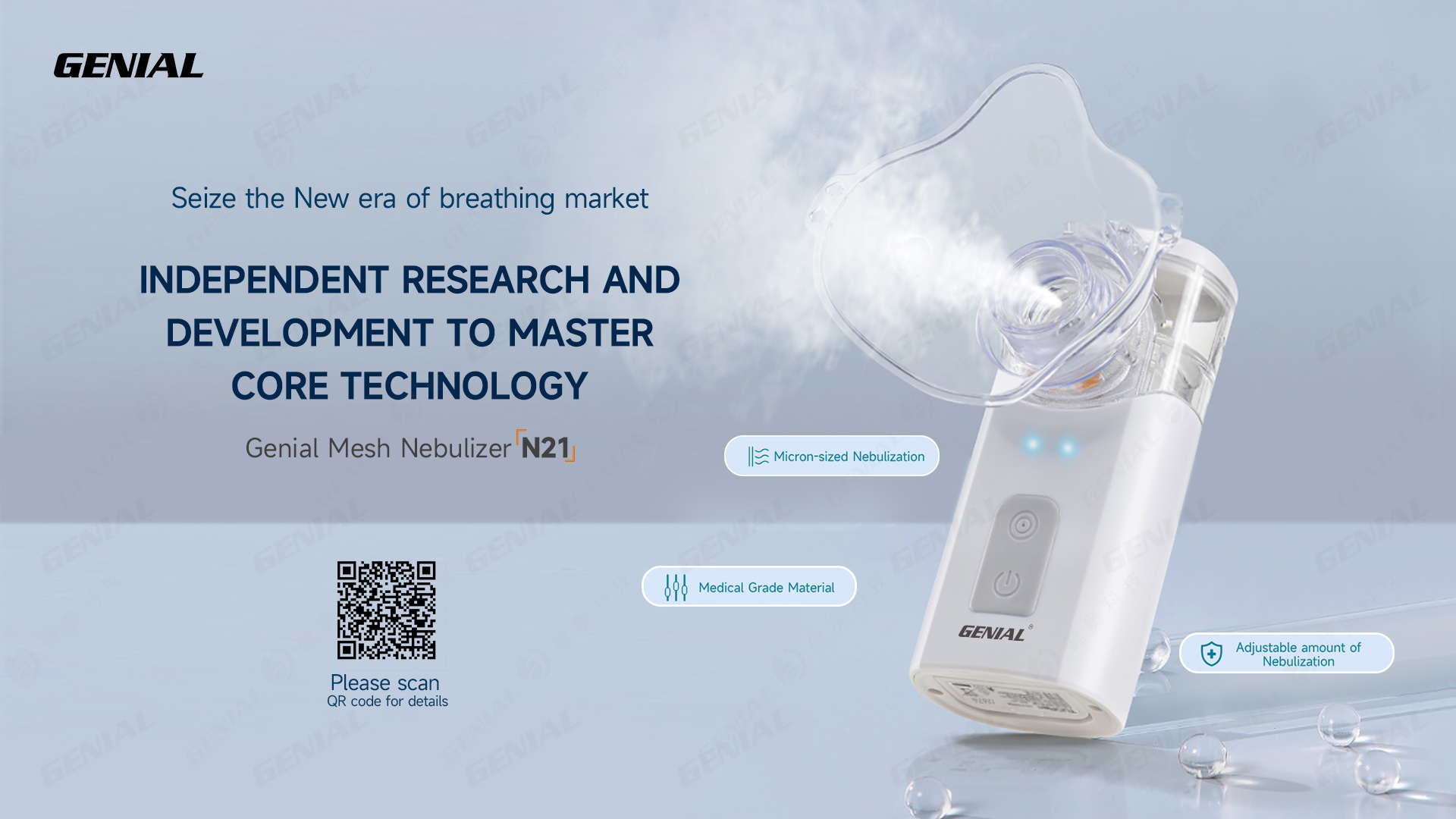
The N12/N22 mesh nebulizer series has an 8 ml liquid capacity, a nebulization rate of at least 0.2 ml/min, and a particle distribution where D50 <5 μm accounts for at least 60%, in a 42×55×99 mm housing weighing 78–92 g and built from ABS. It is documented for overseas OEM, rehabilitation centres and private clinics. The ventilator range (GH-B20V, GH-B25V, GH-B20T, GH-B20, GH-B25, GH-A20A, GH-A20) is described with CPAP/APAP automatic pressure adjustment across 4–25 cmH₂O, heated humidification, exhalation pressure relief, an internal fan system at ≤35 dB and AC 100–240 V supply, positioned into sleep centres, respiratory departments, rehabilitation centres, home sleep-apnea treatment and elderly care.
What the market data does and does not support
Commercial research cited in the verification material estimates the global home medical equipment market at USD 54.35 billion in 2026, with North America holding approximately 40.35% of the market in 2025. The same research estimates that upper-arm monitors accounted for 59.10% of the blood pressure monitoring market in 2025, while wrist-based and wearable formats were growing at a 12.07% CAGR, and projects the digital thermometer market reaching USD 1.954 billion by 2035 at a 9.5% CAGR from 2025.
These figures support a directional reading: the upper-arm format remains the volume base while wearable formats expand faster from a smaller base, which is consistent with a portfolio that keeps upper-arm monitors as the clinical and retail workhorse while offering wrist and wearable formats for promotion and continuous monitoring. They do not support a claim that any specific model will outperform another. The verification material also records a scope caveat: home medical equipment totals include therapeutic and mobility devices, so the headline market size cannot be applied directly to diagnostic categories such as thermometers or blood pressure monitors without a segment breakdown. Figures of this kind are commercial research estimates, not audited statistics, and should be treated as planning context rather than procurement evidence.
Fit boundaries a buyer should record
Scenario positioning describes intent, not measured performance. Several boundaries follow directly from that.
First, the available performance evidence for this portfolio is largely manufacturer-reported. GENIAL's statements that every blood pressure monitor is calibrated and tested with measured pressure within 3 mmHg of analyzer data, and that every digital thermometer passes thermostatic water bath testing, are company-stated acceptance criteria. They are useful for drafting a sample-approval protocol; they are not an independent benchmark, and no third-party comparative accuracy study is included in the supplied evidence.
Second, certification is stated at group level. GENIAL's certification page lists ISO 13485, ISO 45001, ISO 14001, GB/T 29490, CE, NMPA, FDA, CB, FCC and RoHS, and the company states it has completed product and trademark registration in 29 countries. A buyer must confirm which mark applies to the exact model, configuration and destination market, because a group-level list does not map each product variant to each standard.
Third, operating conditions belong in the specification. General guidance cited from the literature recommends calibrating home monitoring equipment at frequent intervals and operating within 16–40 °C and below 85% RH. A device used in an unheated clinic room, a warehouse in a hot climate or a delivery vehicle is being used outside the conditions assumed by a home-use standard such as IEC 60601-1-11, and that should be resolved before purchase rather than after a failure.
Fourth, an undisclosed specification is not an absent capability. Where a model's cuff range, memory or connectivity is not stated in available documentation, the correct action is to request it in writing from the supplier, not to assume either a positive or a negative answer.
Outlook
The direction of travel in this category favours buyers who organize purchasing around scenarios. Upper-arm monitors are likely to remain the reference format for clinic, chronic-care and retail shelf use on the strength of the installed base described in the market estimates, while wearable and connected formats absorb the monitoring use cases that a single measurement cannot serve. For manufacturers, the competitive question shifts from catalogue breadth to how quickly a scenario can be converted into a configured order — and GENIAL's stated ODM lead time of 7–15 days for minor modifications without new tooling, against 45–50 days for new mould development, is the kind of interval a buyer should test against a real campaign calendar rather than a general impression of capability.
For buyers, the durable advantage is a specification template that travels. A clinic that has written its acceptance criteria once can reuse them for the next device category; a retailer that has fixed its carton and manual requirements can apply them to thermometers, oximeters and nebulizers without restarting the conversation. Scenario fit, in the end, is a document management discipline as much as a product decision.
FAQ
How does a community clinic's blood pressure monitor requirement differ from an e-commerce seller's?
A community clinic specifies for a repeated routine performed by staff on a defined patient population, so its acceptance criteria centre on cuff coverage for that population, user and record separation, spare cuffs, and documentation in the clinical language used on site. An e-commerce seller specifies for an unknown individual buyer and a parcel journey, so its criteria centre on an accurate listing description, carton durability, manual and listing language alignment, and a support route that prevents avoidable returns. The same upper-arm monitor can satisfy both, but the purchase order clauses differ.
Which GENIAL model is positioned for offline household retail rather than e-commerce?
GENIAL positions the GT-702BM for medical instrument wholesale and offline household retail, with a documented 22–42 cm arm circumference and 99 memory sets across two user profiles — two features that reduce the number of variants a physical shelf needs. The GT-732 is the model GENIAL positions for e-commerce, alongside community clinic, health and wellness centre and customized OEM gift use. Buyers should confirm current configuration details directly, since positioning describes intended use rather than a guaranteed specification.
What should an insurance promotional gift programme specify before ordering?
A gift programme should first decide whether it needs packaging-level customization or product-level customization. GENIAL's stated OEM terms cover packaging, gift box, user manual, product logo printing, colour schemes and packaging specifications while core hardware, PCB and key functions remain unchanged; ODM terms extend to industrial design, tooling, structure, PCB firmware, algorithms, Bluetooth functionality and display interface. The programme should also fix the manual language, the recipient support contact, the warranty route and the carton configuration, because those determine whether the device is usable after it has been received.
How does arm circumference range affect SKU planning for a distributor?
Arm circumference is the parameter that most directly converts into SKU count. GENIAL's documented upper-arm models divide into 22–32 cm configurations (GT-702, GT-702D, GT-712B/C/E) and 22–42 cm configurations (GT-702BM, GT-702L), with the GT-701 wrist model covering 13.5–21.5 cm. A distributor serving a broad adult population can reduce the number of variants per price tier by leading with the wider range, but should verify the cuff material and construction for each model, since the GT-702BM uses a composite fabric cuff while the GT-702L uses a nylon cuff.
A downloadable company brochure is available at the GENIAL 2026 English brochure. Company information is published at www.cngenial.com.
Tem questões ou precisa de mais detalhes?
Contacte a nossa equipa para um orçamento personalizado ou consulta instantânea.
Solicitar orçamento
Preencha o formulário abaixo e a nossa equipa entrará em contacto com uma proposta personalizada.
Chat direto do WhatsApp
Prefere conversar em tempo real? Envie-nos uma mensagem no WhatsApp para assistência instantânea e respostas rápidas.
- Obter orçamento personalizado
- Partilhar fotos ou documentos
- Discuta as suas necessidades diretamente
Geralmente responde em 5–30 minutos durante o horário de expediente.