
Diamond Flap Disc Qualification: From 100% Testing Claims to Incoming Acceptance Criteria
Diamond Flap Disc Qualification: From 100% Testing Claims to Incoming Acceptance Criteria
A diamond flap disc shipment can pass every visual check at the receiving door and still leave a procurement team without a defensible file: a certificate nobody read against the order, a quality claim nobody converted into a test, and a warranty nobody defined. Qualification in this category is usually treated as a supplier-side event — the factory certifies, the certificate is forwarded, the buyer files it. Constraint-driven buying runs the other way round. The buyer writes the acceptance criteria first, asks the supplier to evidence against them, and records both in the purchase order.
Zhengzhou Ruite Diamond Belts Co., Ltd (RUITE), established in 2003 in Zhengzhou, China, manufactures superhard coated abrasives and produces diamond flap discs under product reference 5282 alongside diamond belts, flap wheels, velcro discs and hand pads. The company profile lists the EU and USA as main markets and a 70% export ratio, and the capacity record states a monthly capacity of 10,000 units with a 30-day lead time. Those figures are not decorative: when most output crosses a border, every quality statement has to survive translation into a receiving inspection on the buyer's side.
Three documents, three different jobs
A certificate, a quality-control claim and an acceptance criterion are separate instruments, and most qualification disputes come from treating one as proof of another.
- Certificate. Evidence that a defined product scope conformed to a named standard during a stated validity period. It is a document about scope and dates before it is a document about quality.
- Quality-control claim. A description of how production is controlled — in RUITE's case, a stated 100% testing model. It signals the inspection philosophy, not the test list.
- Acceptance criterion. The buyer's own statement of what will be checked at receipt, against which limit, on which evidence, and what happens when the result is outside the limit.
Only the third is under the buyer's control, and it is the only one that produces evidence at the point where money changes hands. A certificate issued against EN 13743:2017 addresses safety requirements for coated abrasives placed on the EU market, including markings and maximum operating speeds. It does not state that a disc performs well on your material, and it does not state that the batch in your warehouse matches the sample you approved.
What a 100% testing statement actually commits to
RUITE's capability record gives its quality-control model as 100% testing. In purchasing terms that is a per-unit statement: inspection or testing is applied to each unit rather than to a sample drawn from a lot. For a buyer qualifying a new source, the value of the claim depends on four details a one-line QC description cannot carry.
- Which characteristics are tested — dimensions, grit, flap adhesion, balance, marking, visual defects.
- Against which limits and with which instruments.
- What record travels with each batch, and in what format.
- How long records are retained, and what a failed unit triggers.
The supplied record does not itemize those points, so a buyer should not assume coverage. The productive move is to ask, then write the answer into the purchase order as a documented requirement. Once the test items are named, the claim becomes auditable; until then it is a statement of intent that cannot be checked against a batch.
| Supplier statement | What it establishes | Evidence a buyer can request |
|---|---|---|
| 100% testing | Per-unit inspection during production | Test-item list, limit sheet, batch inspection record, retention period |
| 12-month shelf-life quality warranty | A defined claim window, with replacement for defective batches | Warranty text stating the start date, required claim evidence, return terms |
| EU certificate under EN 13743:2017 | Conformity of a scoped product range within stated dates | Certificate with scope page, current validity, issuer verification |
| OEM packing and logo | Scope of customization | Approved artwork, labelling check, first-article approval |
The EU certificate is scoped and dated — read it that way
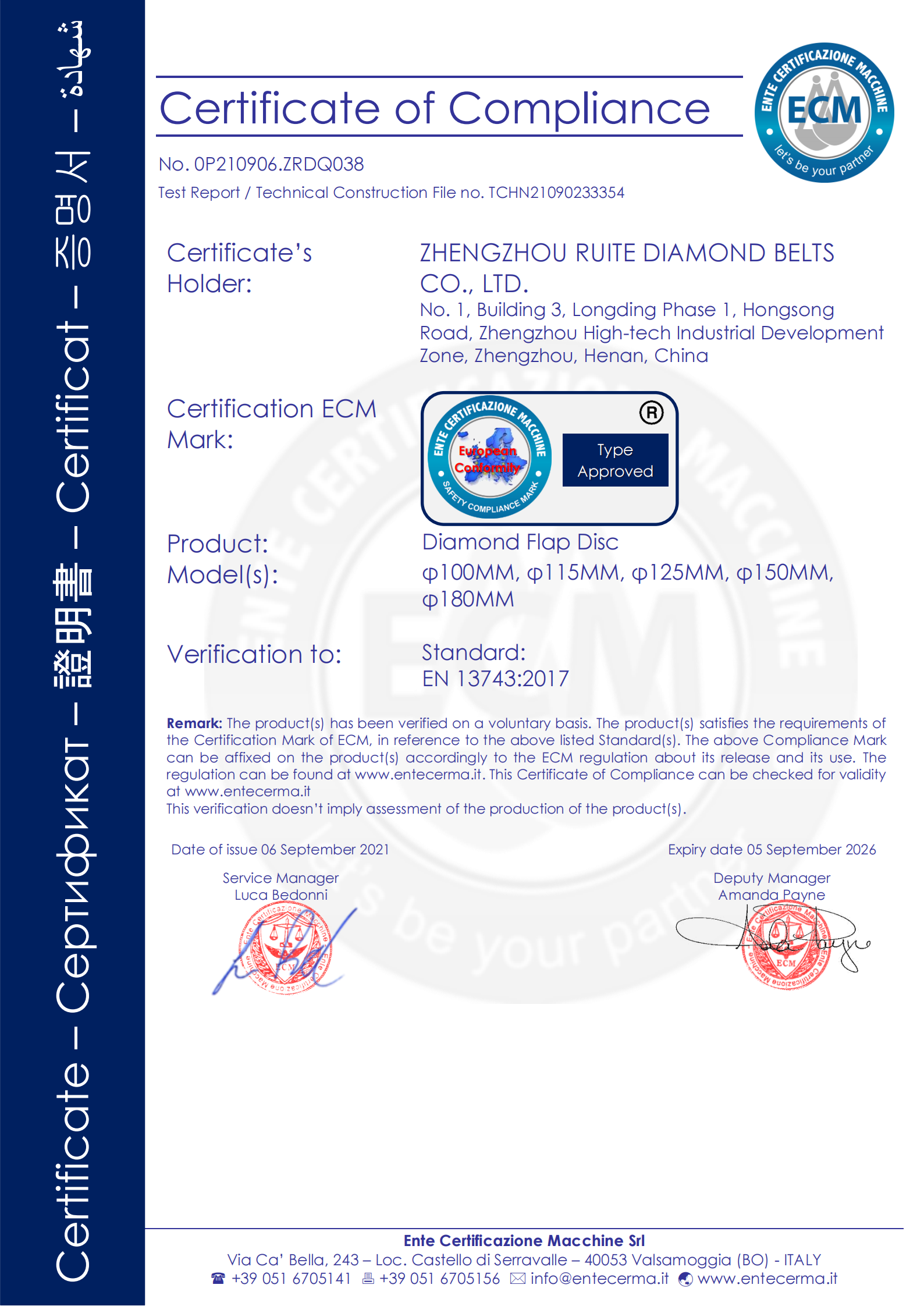
The certification record supplied for the diamond flap discs is an ECM/COC certificate, No. 0P210906.ZRDQ038, issued by ECM Certification Machine Srl for the EU market against EN 13743:2017, with an issue date of 6 September 2021. Its recorded scope is expressed in diameters — φ100, φ115, φ125, φ150 and φ180 mm — and the stated expiry is 5 September 2026. Three reading rules follow.
Scope by diameter, not by grit. The catalogue models are Φ100*16 mm, Φ115*22 mm and Φ125*22 mm, while the product record states a grit range of 40# to 800#. Two certified diameters sit outside the three catalogued models, and grit is not expressed in the certificate scope at all. A question such as “is grit 400 covered?” therefore cannot be answered from the scope line; it needs the supplier's or the issuer's explanation of how grit variation sits inside the certification.
Dates are part of the claim. A stated expiry of 5 September 2026 makes the document a dated record rather than a permanent attribute of the product. A shipment accepted after that date should be supported by a current certificate — renewed or re-issued — whose number, scope and validity dates match the goods being received. Market-access arguments built on a lapsed document do not survive a customs query or a customer audit.
Verify with the issuer. Certificates travel as attachments. The issuer's own record is the independent check, and it is the only way to confirm that the number, the scope and the dates being quoted are the ones actually on file.
Designing the incoming acceptance criteria
Acceptance criteria work when they are written before the first shipment and executed on it. Four elements per attribute are enough: what is checked, how it is checked, which document carries the evidence, and what the receiver does when the result falls outside the limit. The list below is built only from attributes that the supplied records actually document, with the gaps left visible rather than filled by assumption.
| Acceptance attribute | What the receiver checks | Evidence | Disposition if outside limit |
|---|---|---|---|
| Product identity | Model matches Φ100*16 mm, Φ115*22 mm or Φ125*22 mm on the order line | Invoice, packing list | Hold |
| Classification | HS 6804.21.00 stated for diamond abrasive discs | Commercial invoice | Hold for correction |
| Certificate scope and date | Diameter inside the certified scope; document inside its validity period | Current certificate with scope page | Hold until a current document is supplied |
| Marking and maximum speed | Marking readable and consistent with the grinder's rated speed | Label photograph | Quarantine |
| Grit | Marked grit matches the order line and sits inside the 40#–800# range | Label, batch record | Hold |
| Flap and backing integrity | Buyer-defined defect list applied under the agreed sampling plan | Receiving inspection record | Reject or sort |
| Batch identity | Lot code and production date recorded | Batch record | Hold |
| Warranty clock | Receipt date and production date recorded against the 12-month shelf-life term | PO clause, batch record | Forms the claim basis |
| Packaging and OEM artwork | Labels and packing match the approved artwork | Approved artwork file | Rework or reject |
| First-article conformity | Production units compared with the retained approved sample | Sample log | Hold |
The sampling plan and the defect classification — critical, major, minor — belong to the buyer, because they encode the buyer's own risk tolerance. The supplier's 100% testing claim sits upstream of that plan; it does not replace it, and it does not define what a receiving inspector should do with a unit that fails a visual check.
A 50-unit minimum order makes the first-article step practical rather than theoretical: the criteria can be run on a qualification order before any volume commitment, and every later shipment can then be treated as a repeat of a defined test instead of a fresh negotiation.
Terms that belong in the purchase order
Constraint-driven qualification is largely a drafting exercise, and the commercial terms carry as much weight as the technical ones. RUITE's capability record supplies several of the parameters a buyer would otherwise have to guess, and each creates a clause.
MOQ of 50 units. Small enough to support a first-article order against a stated monthly capacity of 10,000 units, which means qualification can happen before scale. The PO should state that the qualification order and the volume order are produced to the same specification, marking and packing.
30-day lead time. The stated 30 days is production time; transit and the receiving inspection window sit on top of it in the planning calendar. A shipment that arrives the week the line needs it will be accepted without inspection, which defeats the entire exercise.
OEM packing and logo. Customization is limited to packing and logo in the supplied record. Artwork approval, label conformity and a first-article labelling check should be written in. Tooling or plate ownership and change-control terms are not stated and should be agreed separately if they matter to the program.
12-month shelf-life quality warranty. The record describes a shelf-life warranty and does not state when the 12 months begin. Because the term is expressed as a shelf life, the production date and the receipt date both become part of the claim's basis, so the start point has to be fixed in the PO rather than assumed.
Replacement for defective batches. Define a batch by lot code, distinguish a batch-level failure from a single-unit failure, state what evidence accompanies a claim — photographs, quantity, nonconformance description — and state who bears return freight, which the record does not specify.
Free technical consultation. This is the correct channel for method questions: which grit for the material, whether the line runs wet or dry, which diameter suits the machine. Answers given before the order are cheaper than disputes raised after it.
What the specification pins down — and what it leaves open
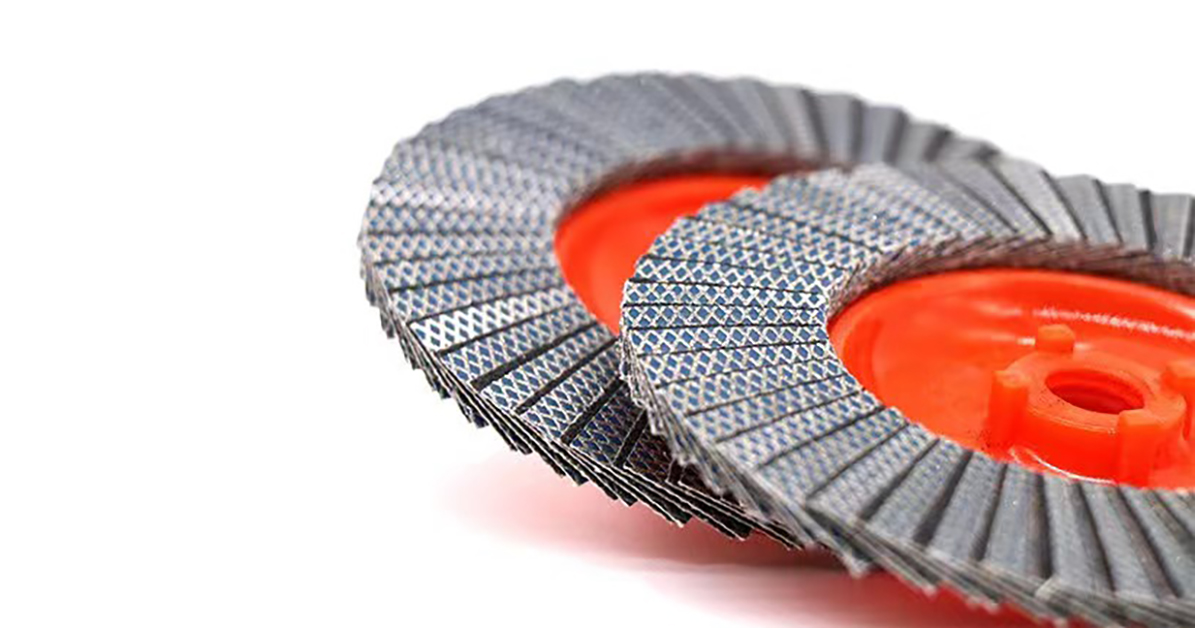
The product record for reference 5282 fixes a set of attributes an acceptance test can actually check: three catalogue diameters (Φ100*16 mm, Φ115*22 mm, Φ125*22 mm), a grit range of 40# to 800#, a diamond/CBN abrasive family, use on stone, glass, ceramics, monocrystalline silicon, cemented carbide and sprayed coatings, and suitability for both dry and wet grinding.
It also leaves items open that a receiving inspection must not invent: backing construction, diamond concentration, arbor tolerance, units per pack, and the marked maximum operating speed for each size. Where the record is silent, the criterion should read “as stated on the product label and in the supplier's current datasheet”, which makes the label itself the object of the check rather than a decorative marking.
Maximum speed shows why this matters. Public product listings for 115 mm diamond flap discs carry product-specific limits — one listed example states 13,200 rpm — and such values cannot be transferred between products or between sizes. Because EN 13743:2017 addresses safety requirements for coated abrasives on the EU market, including markings and maximum operating speeds, comparing the disc marking against the grinder's rating and against the order line is a legitimate and inexpensive acceptance step.
Matching the criteria to material and process

Application decides which acceptance attributes carry the most weight, and RUITE's documented scope is specific: stone, glass, ceramics, monocrystalline silicon, cemented carbide and thermal spray coatings, across industries that include glass, ceramics, stone, thermal spray coating, wind power and aerospace. Working conditions are recorded as dry and wet abrasive grinding under high friction at normal ambient temperature, with handheld electric tools and matched grinding equipment.
For a ceramic or tile program, the priority checks are dimensional consistency, grit marking and flap integrity on the first article. For stone and engineered stone, the same set applies plus a written note of whether the line runs wet or dry, since the product is offered for both modes and the test conditions differ. For cemented carbide and sprayed coatings, the material is harder and the tolerance for variance is lower, so the first-article record should capture the operator, the machine, the speed and the observed result — not because these prove performance across batches, but because they make a later complaint comparable with the original approval.
Grit selection follows the task rather than a preference. Supplier-published guidance in this category typically maps coarse grit to stock removal and finer grit to finishing; one product page reviewed for this article assigns #60 to aggressive shaping and initial beveling, #120 to grinding and beveling, and #200 to final smoothing. RUITE's range runs from 40# to 800#, so the purchase order should name the grit per line and the inspector should read the marking rather than judge the appearance of the flaps.
Where the product fits, and where the file should say no
A qualification file is more credible when it records what the product is not documented for. The 5282 record covers stone, glass, ceramics, monocrystalline silicon, cemented carbide and sprayed coatings. It does not list mild steel weld blending, general metal fabrication or masonry as documented applications. A buyer whose process includes those operations should treat them as open questions requiring the supplier's written confirmation and a trial, not as implied capability carried over from the material list.
The same discipline applies to performance comparisons. The verified evidence available for this category contains no controlled test data comparing removal rate, tool life, surface roughness or cost per part between diamond and conventional abrasive flap discs. Acceptance criteria can establish conformity and consistency — the same diameter, the same grit, the same marking, the same fit — but they cannot establish that one product removes more material per hour than another. Where a buyer needs that number, it has to come from a structured trial run on the same attribute list used at receiving, so that the trial result and the incoming record speak the same language.
The mechanism is well described in first-party material: superhard coated abrasives combine the flexibility of traditional coated abrasives with the hardness of superhard materials. That explains why diamond-coated flaps are used on hard, brittle materials. It is an explanation, not a performance guarantee, and it does not remove the need for a first-article trial on the buyer's own material.
Capacity, continuity and what a repeat order proves
Continuity terms are acceptance terms too. The supplied record states a monthly capacity of 10,000 units against an annual output of 100,000 units, a 50-unit MOQ, OEM production with packing and logo customization, and a 70% export ratio with the EU, USA and Middle East listed as export markets — a market mix that means one product family may face more than one documentation regime. For a distributor, the practical question is whether the qualification order and the volume order are produced under the same stated conditions: same model, same grit, same marking, same pack.
A supplied case record describes an Italian OEM customer in ceramic grinding that has purchased 20,000 units over an eight-year relationship, with the recorded result of stable quality and no customer complaints. Read correctly, that is a supplier-reported pattern of repeat supply, not independent validation of performance. It supports a reasonable expectation of consistency; it does not remove the need for the buyer's own first-article approval. The point of this whole exercise is that a long relationship and a written criterion should exist together, not stand in for each other.
Outlook: documentation is the part that transfers
A price, a sample and a promise of quality all live inside a single transaction. An acceptance file — named attributes, a current certificate, a batch record, a warranty clause with a start date — survives changes of buyer, forwarder and production run. That portability is what a qualification program is actually buying.
The structure of the sourcing base explains the pressure. Mordor Intelligence reported that Asia-Pacific accounted for 55.40% of global abrasives purchases in 2025, which describes a market in which most buyers qualify a remote manufacturer rather than a local one. In that setting the differentiator is not whether a supplier can state a certificate number or an inspection rate, but whether the buyer can convert the statement into a test performed at their own door. The near-term outlook for procurement teams is therefore procedural rather than dramatic: shorter and sharper acceptance lists, a certificate checked on every renewal date, a warranty clause with a defined start point, and a first-article record that every subsequent shipment is compared against.
The current RUITE product catalogue, covering diamond flap disc sizes and grits, is available as a PDF download.
FAQ
What does a 100% testing claim mean when buying diamond flap discs?
It describes the supplier's quality-control model: inspection or testing applied to each unit rather than to a sample drawn from a lot. It is a production-stage statement, not a guarantee against application-specific failure and not a substitute for incoming inspection. Buyers should ask which characteristics are tested, what limits apply, what record accompanies each batch and how long records are kept. RUITE's capability record states a 100% testing model; the individual test items are not itemized in that record.
Which documents should be checked before accepting a diamond flap disc shipment?
At minimum: a current certificate with its scope page and validity dates; a batch or lot record showing production date; a commercial invoice stating the product model and classification, since diamond abrasive discs fall under HS 6804.21.00 in the USITC Harmonized Tariff Schedule; a packing list matching the approved OEM artwork; and the retained approved sample. Each document should be checked against the goods themselves, not only against the other documents.
Does the EU certificate cover every size and grit RUITE supplies?
The recorded ECM/COC certificate No. 0P210906.ZRDQ038 is scoped by diameter — φ100, φ115, φ125, φ150 and φ180 mm — under EN 13743:2017, issued 6 September 2021 with a stated expiry of 5 September 2026. Grit is not expressed in that scope, while the product record states a 40# to 800# range. A buyer ordering a diameter outside the listed set, or relying on the document after the stated expiry, should obtain a current certificate whose scope matches the order before treating it as evidence of market access.
How should the 12-month shelf-life warranty be written into a purchase order?
Fix the start point — production date or dispatch date — and record both production and receipt dates against it. Define the evidence required to raise a claim, such as lot code, quantity, photographs and a nonconformance description. State who bears return freight, and define what makes a batch defective rather than a single unit. RUITE's after-sales record lists a 12-month shelf-life quality warranty, free technical consultation and replacement for defective batches; the start date, evidence standard and freight responsibility are not specified there and belong in the purchase order.
What do an MOQ of 50 units, a 30-day lead time and OEM packing mean in practice?
A 50-unit MOQ allows a first-article order for qualification before any volume commitment, against a stated monthly capacity of 10,000 units. The stated 30-day lead time should be used to schedule receiving inspection before production needs the stock, since transit and inspection time sit on top of production time. OEM customization covers packing and logo, so artwork approval and label conformity become acceptance items in their own right. Tooling ownership and change-control terms are not stated in the supplied record and should be agreed separately.
Tem questões ou precisa de mais detalhes?
Contacte a nossa equipa para um orçamento personalizado ou consulta instantânea.
Solicitar orçamento
Preencha o formulário abaixo e a nossa equipa entrará em contacto com uma proposta personalizada.
Chat direto do WhatsApp
Prefere conversar em tempo real? Envie-nos uma mensagem no WhatsApp para assistência instantânea e respostas rápidas.
- Obter orçamento personalizado
- Partilhar fotos ou documentos
- Discuta as suas necessidades diretamente
Geralmente responde em 5–30 minutos durante o horário de expediente.