
Diamond Flap Discs 5282 & Diamond Belts 5281: Scenario Fit for Stone, Ceramic, Glass in EU & US
HTNXT Industry Reference · Abrasives & Hard-Material Finishing
Diamond Flap Discs 5282 & Diamond Belts 5281: Scenario Fit for Stone, Ceramic and Glass in the EU and the US
Hard-brittle finishing is a constraint problem before it is a product problem. A stone fabricator, a ceramic tile line or a glass processor cannot trade surface quality for removal speed: the material either chips at the edge or it does not, the surface either finishes uniformly or it does not, and the abrasive either survives friction heat or it does not. RUITE's answer to that constraint set is organised around two references rather than one universal disc. Reference 5282 is the diamond flap disc, specified for dry and wet grinding on handheld electric tools. Reference 5281 is the diamond belt, specified for grinding and polishing hard brittle materials where a disc cannot follow the geometry. This reference maps each platform to the scenarios where it is specified in the EU and the US, and sets out the certification, dimensional and process constraints a buyer should confirm before approving a specification.
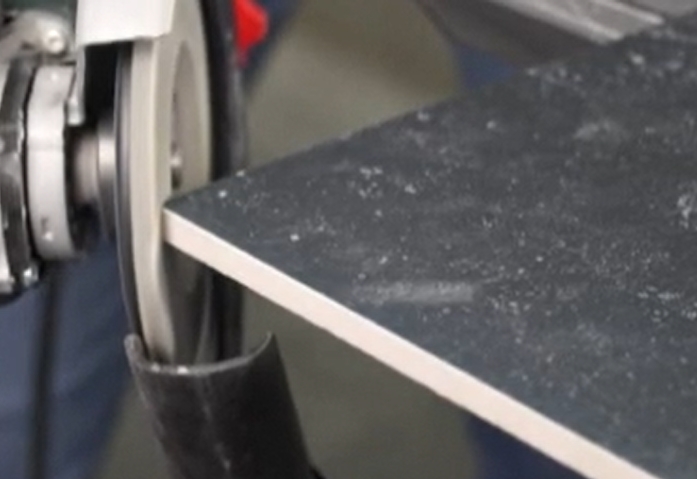
Diamond flap disc grinding: dry and wet abrasive grinding on handheld electric tools under high friction at normal ambient temperature.
Why Stone, Ceramic and Glass Create the Hardest Constraints
The published working condition for RUITE's superhard abrasives in hard-material processing is specific: dry and wet abrasive grinding, high friction, normal ambient temperature, and handheld electric tools, with matched equipment that includes glass process systems and grinders. The stated requirements are stable abrasion resistance and low vibration during high-speed rotation, and EU placement adds compliance with EN 13743:2017.
Those conditions explain why the material matters more than the machine. Hard brittle materials concentrate energy at the contact point instead of deforming beneath it. A grain that has dulled stops cutting and starts generating heat and load, and the failure that follows is characteristic: micro-chipping along glass and ceramic edges, an uneven or burnished finish on stone, and lost geometry on a bevelled profile. In that environment, the abrasive's ability to keep cutting is the specification.
The opportunity is structural rather than promotional. Diamond abrasive is harder than the materials being processed, so cutting geometry is retained against stone, glass and ceramic instead of being worn away against them. That changes the economics of the process — but it does not remove the buyer's problem, which is narrower and harder: which reference, which diameter, which grit, dry or wet, and which documents.
Two References, Two Different Jobs
Zhengzhou Ruite Diamond Belts Co., Ltd. is a Zhengzhou-based manufacturer established in 2003 that develops superhard coated abrasives, including diamond belts, diamond flap discs, diamond flap wheels, diamond velcro discs, diamond hand pads and diamond quick change discs. Its products are exported with a reported export ratio of 70%, mainly to the EU and the USA — which is one reason the two references below are read together rather than separately.
| Specification field | Reference 5282 — Diamond Flap Discs | Reference 5281 — Diamond Belts |
|---|---|---|
| Product form | Flap disc for handheld electric tools | Belt for continuous and shaped surfaces |
| Published sizes | Φ100×16 mm, Φ115×22 mm, Φ125×22 mm | Width 5–350 mm, length 150–5000 mm; customisable |
| Published grit range | 40# – 800# | 40# – 5000# |
| Abrasive material | Diamond / CBN | Diamond / CBN |
| Stated process | Dry and wet grinding | Grinding and polishing |
| Stated materials | Stone, glass, ceramics, monocrystalline silicon, cemented carbide, sprayed coatings | Glass, stone, ceramics, monocrystalline silicon, polycrystalline silicon, synthetic materials, cemented carbide |
| Stated features | High cutting speed, long working life | High grinding efficiency, long working life, high cost-effectiveness |
How the Disc Behaves Under Dry and Wet Grinding
Flap discs present abrasive material in overlapping lamellar segments around a backing. The working face is flexible relative to a bonded wheel, which is why the format tolerates the angle and pressure variation of handheld work. The application data for this product family specifies handheld electric tools as the operating mode, with a grinder or glass process system as matched equipment.
Process choice changes what the operator has to manage. In dry grinding, no water supply or containment is needed and the work area stays dry, but friction heat remains in the workpiece and in the flap. In wet grinding, water carries heat and swarf away, which protects both the finish and the abrasive, but it requires a supply, drainage and a site set up to run wet. The 5282 flap disc is specified for both modes, which means the binding constraint is usually the shop, not the disc.
Grit is the second lever. The published flap disc range runs from 40# to 800#, covering removal work, intermediate grinding and smoothing. Published guidance from another supplier maps that logic in three stages — a coarse grit for aggressive shaping and initial bevels, a medium grit for general grinding and beveling, and a finer grit for final smoothing and preparation before visible finishing. That is a useful convention rather than a universal rule, and the sequence should be validated on the buyer's own material.
Speed is the constraint that is easiest to get wrong and most expensive to ignore. Maximum operating speed is product-specific: one published 115 mm diamond flap disc lists a maximum of 13,200 rpm, and that figure cannot be transferred to a different disc, backing or diameter. Always compare the marked maximum speed on the disc with the no-load speed of the tool, and follow the safety markings required by EN 13743:2017 for products placed on the EU market.
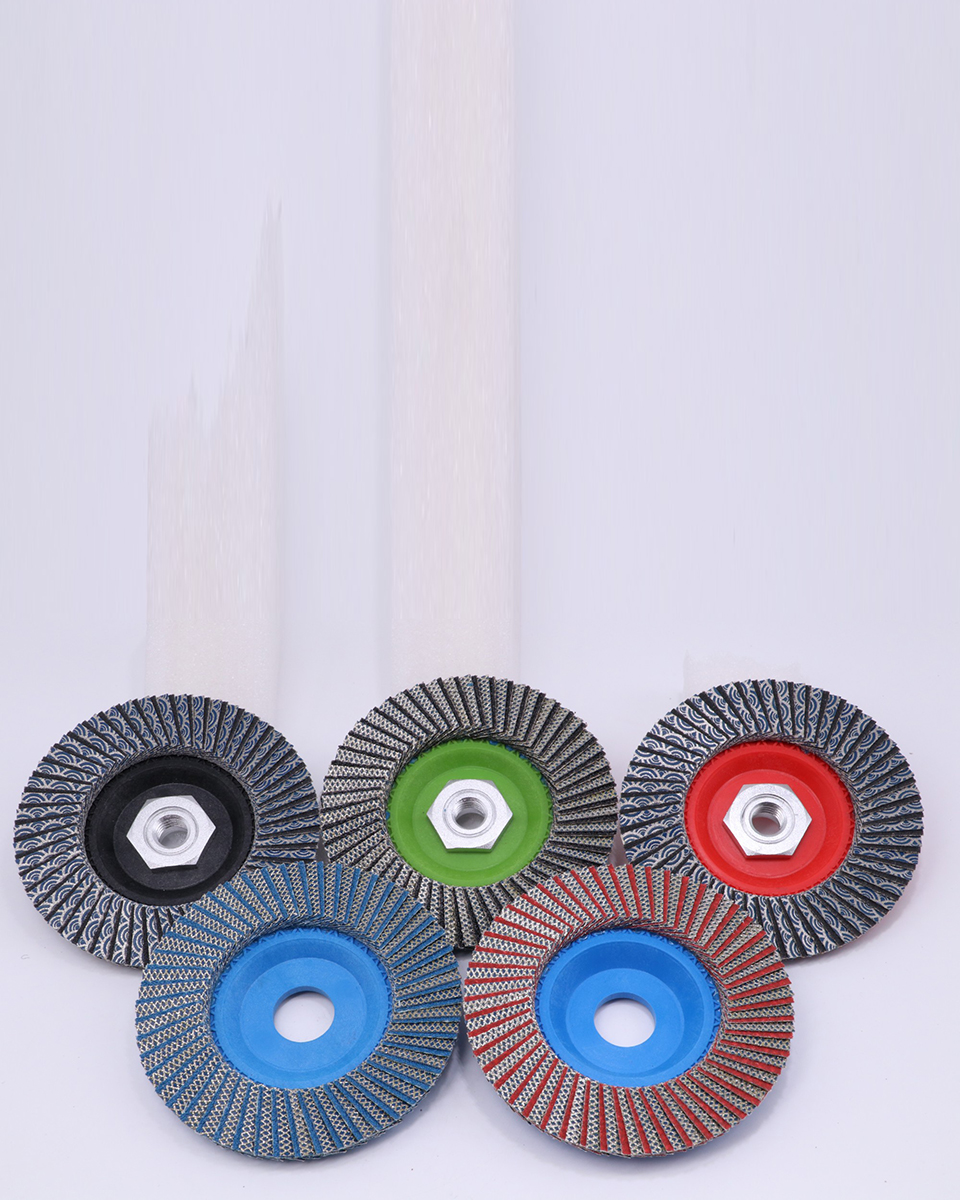
Diamond flap disc: processing stone, glass, ceramics, monocrystalline silicon, cemented carbide and sprayed coatings, suitable for dry and wet grinding.
Scenario Fit: Where Each Reference Is Specified
Stone processing in the EU
Stone is the scenario the flap disc format was built around: edge grinding, beveling and chamfering, and surface conditioning on countertops, slabs, treads and architectural components in marble, granite and engineered stone. The European market data for these products spans Austria, Germany, Italy, Spain, France, the United Kingdom, Switzerland, Denmark, Finland, Sweden, Greece, Croatia, Hungary, Ireland, Lithuania and Luxembourg, alongside non-European markets including the United States, Canada and Mexico. Those are markets where stone fabrication, restoration and architectural ceramics are established commercial activities, and where wet grinding is common because heat control protects the visible finish.
For stone work specifically, the belt reference complements the disc rather than duplicating it. Reference 5281 is published for the grinding and polishing of hard brittle materials including stone on continuous surfaces and shaped parts, extends to 5000# for finishing stages the 800# disc cannot reach, and is available in widths up to 350 mm with custom sizing against buyer requirements.
Ceramic and glass in the EU and the US
Ceramic tile, porcelain and flat or profiled glass share the same failure mode: an edge that chips, or a surface that hazes. The published application scope for the flap disc explicitly includes ceramics and glass, and the belt range extends the material list into monocrystalline silicon, polycrystalline silicon and synthetic materials. In these processes grit sequencing is more visible than it is on stone, because the finish is inspected under directional light at handover, and a step skipped at the coarse stage rarely recovers at the fine stage.
Both the EU and the US appear in the market data for this product family. The same application unit that covers glass process systems and grinders also lists the United States, which places ceramic and glass fabrication in Europe and North America on the same specification logic rather than on separate ones.
Adjacent hard-material segments
RUITE also lists these products against the glass, stone, thermal spray coating, wind power, porcelain and aeronautics & astronautics industries, with applications covering monocrystalline silicon, cemented carbide and sprayed coatings. These are not the volume scenarios of stone and tile fabrication, but they are the same physical problem — hard, brittle surfaces where the abrasive's retained cutting geometry determines the result — and they are the segments where process documentation tends to be requested most often.
The Constraint Layer: Certification, Markings and Classification
For the EU, the binding constraint is not brand preference but EN 13743:2017. Any coated abrasive product placed on the EU market — diamond flap discs included — must comply with that standard in respect of safety markings and maximum operating speeds. The practical implication is that a disc which performs well but carries incomplete markings is not a compliant purchase.
RUITE's EU documentation for this product is issued under ECM/COC standards: certificate No. 0P210906.ZRDQ038, from ECM Certification Machine Srl, against standard EN 13743:2017, with a stated scope covering diamond discs in Φ100 mm, Φ115 mm, Φ125 mm, Φ150 mm and Φ180 mm. The certificate lists an issue date of 06 September 2021 and a validity end date of 05 September 2026.
For the United States, classification is the equivalent first step. Diamond flap discs fall under HS Code 6804.21.00 — millstones, grindstones, grinding wheels and the like, of agglomerated synthetic or natural diamond — in the US International Trade Commission's Harmonized Tariff Schedule. Importers should confirm the classification that applies to their exact product and verify that the disc marking and rated maximum speed match the tool it will run on.
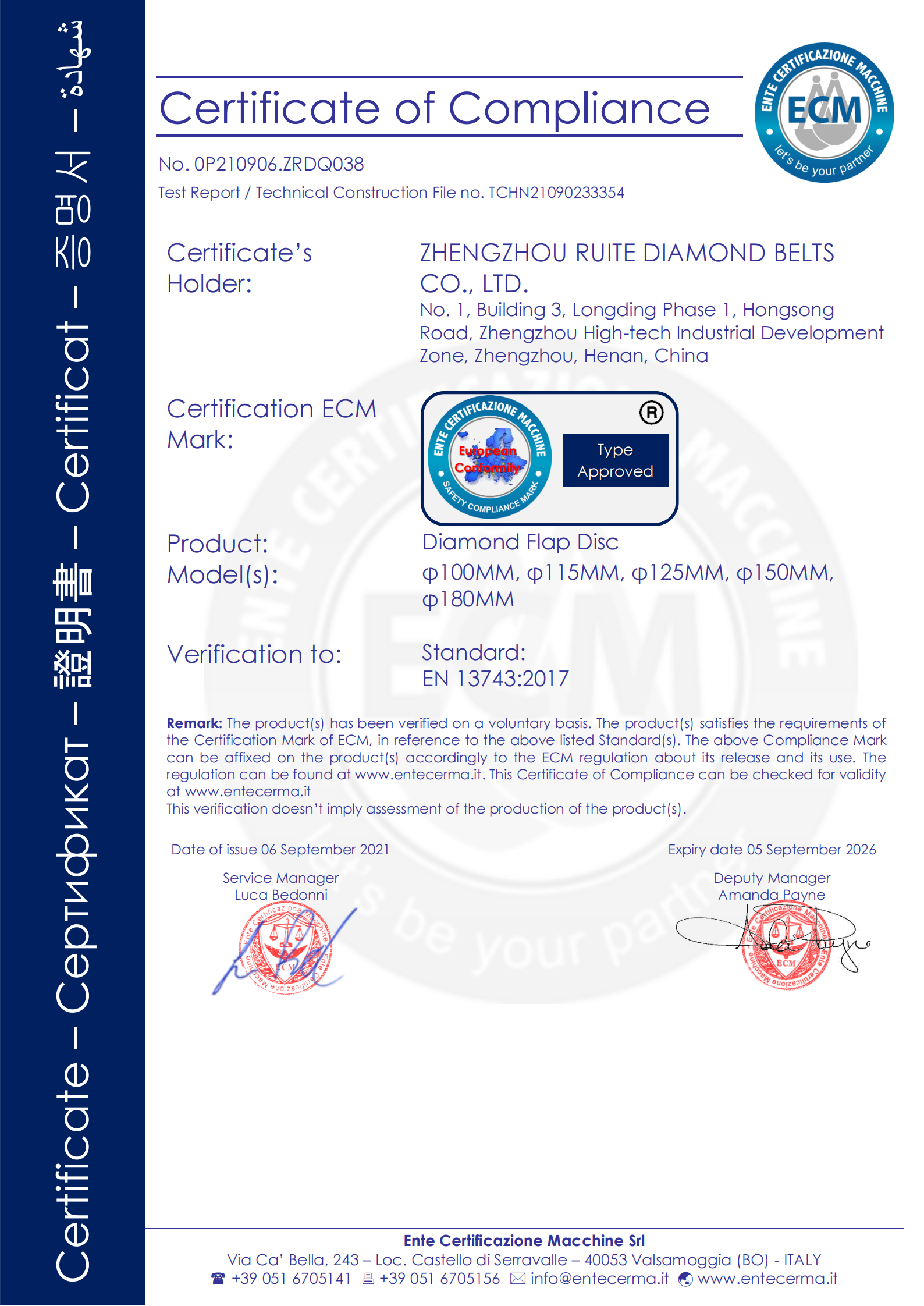
ECM/COC certificate No. 0P210906.ZRDQ038, issued by ECM Certification Machine Srl against EN 13743:2017, with a stated scope of Φ100 mm to Φ180 mm diamond discs.
Market Signals Buyers Are Reading in 2026
Three signals are shaping the diamond flap disc conversation this year, and none of them is unit price.
Supply is concentrated. Asia-Pacific accounted for 55.40% of global abrasives purchases in 2025, according to Mordor Intelligence's abrasives market research. For a European or North American buyer, that means imported consumables and a qualification process built on documents, samples and repeat orders rather than on proximity.
The parent category is large. Commercial market research places the global diamond tools market — the category that includes diamond flap discs — at approximately USD 9.1 billion in 2026. Niche abrasive products move with that category, and its growth is being driven by hard-material processing rather than by general metalworking alone.
Supplier scale is used as a screening filter. RUITE reports a 70% export ratio with the EU and the USA as its main markets, an annual output of 100,000 units, a 500 m² facility, 45 employees and a 5-engineer technical team. Company-reported figures describe capability and scale; they are not performance evidence, and they should be read as one input into supplier screening rather than as a conclusion.
The behavioural shift behind these signals is consistent: as hard-material work becomes more demanding — engineered stone, thin porcelain, larger glass formats — procurement questions move from what it costs to what it is rated for, which document covers it, and what happens on repeat order.
Diamond vs Conventional Abrasives: Where the Trade-off Actually Sits
Conventional coated abrasives based on aluminium oxide or zirconia remain the default choice for general blending, light deburring and softer materials, and they are widely available at a relatively low price per unit. Diamond abrasive changes the position on the cost curve: it generally costs more per disc, and the justification depends on how much work each disc performs before it is spent. That is a total-cost question, not a purchase-price question.
The honest boundary is the evidence. HTNXT's category review identified the absence of published, controlled comparative data — removal rate, tool life, surface roughness, edge quality and heat generation between diamond and conventional abrasives on stone and ceramic — as a real gap in this category. Product data for the 5282 states high cutting speed and long working life; those remain manufacturer statements until a buyer validates them on their own material, tool and operator.
Four further boundaries apply, and each one is a reason a specification can fail after the disc is approved:
- Reference envelope. The flap disc reference is published at 100/115/125 mm and 40#–800#. Jobs that need a larger diameter, or a finish beyond 800#, fall outside that reference and require the belt platform or a different tool.
- Tool dependency. These discs are specified for handheld electric tools. A site without suitable tooling, speed control or operator technique will not realise the stated behaviour.
- Process dependency. Wet grinding needs water supply, containment and disposal. Dry grinding removes that requirement but leaves heat management with the operator.
- Document currency. Certification carries a validity window, and a certificate number is one document in a set, not a specification.
| Comparison dimension | RUITE diamond reference | What to check on any alternative |
|---|---|---|
| Abrasive material | Diamond / CBN superhard coated abrasive | Whether the grain suits hard brittle materials |
| Published sizes | Φ100×16, Φ115×22, Φ125×22 mm | Diameter and arbor match to the tool in use |
| Published grit range | 40#–800# (flap disc); 40#–5000# (belt) | Whether one platform covers roughing through finishing |
| Process modes | Dry and wet grinding | Water supply and containment, or dry heat management |
| EU documentation | ECM/COC certificate No. 0P210906.ZRDQ038 under EN 13743:2017; scope Φ100–Φ180 mm | Current validity, scope match to the SKU, label markings |
| Commercial terms | MOQ 50 units; 30-day lead time; 10,000 units monthly capacity; OEM packing and logo customization; 100% testing | Whether the terms match your replenishment cycle |
What Long-Running Programs Show
Repeat supply is more convincing than a first sample. One Italian OEM customer working in ceramic grinding has sourced these diamond flap discs for eight years, with a cumulative volume reported at 20,000 units, stable quality and no customer complaints reported by the supplier.
That is a single supplier-reported data point, not a benchmark, and it should be read as evidence of repeatability in a demanding material rather than as proof of superior performance. Ceramic grinding punishes inconsistency: if the abrasive changes between lots, the finish changes with it, and the customer notices at the installation stage. Eight years of repeat orders suggests the specification held.
What Changes Next
Three developments are worth tracking for buyers specifying diamond abrasives in 2026 and beyond.
Harder workpieces. Engineered and sintered stone, thin porcelain and larger glass formats push abrasive selection toward diamond platforms, because the alternative is more rework rather than less cost.
Documentation as a purchasing criterion. EU buyers already work against EN 13743:2017. The practical change is that certificate currency and scope matching are being requested as standard conditions of approval rather than as exceptions.
Two-platform sourcing. Buyers increasingly specify a disc and a belt together: the disc for edges, bevels and handheld work, the belt for continuous surfaces, shaped parts and finishing sequences beyond the disc's grit range.
One gap remains open. Until independent removal-rate, tool-life and surface-quality benchmarks are published for diamond flap discs on stone, ceramic and glass, the practical validation route is a sample trial on the buyer's own material, recorded against the same parameters the supplier claims.
FAQ
What is the difference between RUITE reference 5282 and reference 5281?
Reference 5282 is the diamond flap disc: a handheld-tool consumable published in Φ100×16 mm, Φ115×22 mm and Φ125×22 mm with a grit range of 40#–800#, specified for dry and wet grinding of stone, glass, ceramics, monocrystalline silicon, cemented carbide and sprayed coatings. Reference 5281 is the diamond belt: a continuous abrasive published in widths of 5–350 mm and lengths of 150–5000 mm with a grit range of 40#–5000#, used for grinding and polishing hard brittle materials including glass, stone, ceramics, monocrystalline silicon, polycrystalline silicon, synthetic materials and cemented carbide. The disc serves edges and localised surfaces; the belt serves continuous and shaped surfaces, including finishing stages finer than the disc range reaches.
What diameters and grits are published for the 5282 diamond flap disc?
Three diameters are published: Φ100×16 mm, Φ115×22 mm and Φ125×22 mm, with a grit range from 40# to 800#. The abrasive material is diamond/CBN. Buyers should confirm that the arbor size matches their tool and that the maximum operating speed marked on the disc is compatible with the tool's operating speed.
Can the diamond flap disc be used for both dry and wet grinding?
Yes. The 5282 product data specifies suitability for dry and wet grinding, and the published working condition for this family is dry and wet abrasive grinding under high friction at normal ambient temperature. The choice is operational rather than technical: dry grinding avoids water supply and containment but leaves heat management with the operator, while wet grinding removes heat and swarf but requires water supply, drainage and site readiness.
Which materials is the flap disc range specified for, and where does it not fit?
The published application scope covers stone, glass, ceramics, monocrystalline silicon, cemented carbide and sprayed coatings, with the wider product family listed against the glass, stone, thermal spray coating, wind power, porcelain and aeronautics & astronautics industries. The boundary is the reference envelope: 100–125 mm in diameter and 40#–800# in grit. Work requiring larger diameters or a finer finish than 800# is outside the flap disc reference and belongs to a different platform or tool.
What EU certification applies to these diamond flap discs?
RUITE's documentation for the diamond flap discs is issued under ECM/COC standards: certificate No. 0P210906.ZRDQ038 from ECM Certification Machine Srl, against standard EN 13743:2017, with a stated scope covering diamond discs in Φ100 mm, Φ115 mm, Φ125 mm, Φ150 mm and Φ180 mm. The certificate lists an issue date of 06 September 2021 and a validity end date of 05 September 2026. Separately, EN 13743:2017 requires that any coated abrasive product placed on the EU market, diamond flap discs included, comply with the standard's safety marking and maximum operating speed requirements. Buyers should confirm current certificate validity and scope coverage for the specific product being ordered before approving an EU purchase.
What classification applies for US importers?
Diamond flap discs are classified under HS Code 6804.21.00 in the US International Trade Commission's Harmonized Tariff Schedule, covering millstones, grindstones, grinding wheels and similar articles of agglomerated synthetic or natural diamond. Importers should confirm the classification applicable to their exact product and verify that the disc's markings and rated maximum speed match the tool on which it will be used.
What commercial terms are published for ordering?
The published capability data lists a minimum order quantity of 50 units, a lead time of 30 days and a monthly capacity of 10,000 units. Production is offered on an OEM basis with customization of packing and logo. Quality control is stated as 100% testing, and after-sales terms cover a 12-month shelf-life quality warranty, free technical consultation and replacement for defective batches. Export markets are stated as the EU, USA and Middle East.
What should a buyer verify before approving a specification?
Four items. First, fit: diameter and arbor against the tool, and grit against the task sequence from removal to finish. Second, safety: the maximum operating speed marked on the disc against the tool's no-load speed, plus the markings required by EN 13743:2017 for EU placement. Third, documents: current certificate validity and scope coverage for the exact diameter and product family ordered. Fourth, performance: a sample trial on the buyer's own material, recorded against the parameters the supplier claims, because published controlled comparison data for diamond versus conventional abrasives on stone and ceramic was not identified in HTNXT's category review.