
Diamond Flap Discs by Scenario: EU Stone vs. US Ceramic & Glass
Diamond Flap Discs by Scenario: EU Stone vs. US Ceramic & Glass
Diamond flap disc selection follows the scenario in which the disc runs — the material, the grinding mode, the tool in the operator's hands and the market that governs the paperwork — rather than the catalogue heading under which the disc is listed. RUITE supplies one flap disc reference, 5282, in 100 mm, 115 mm and 125 mm diameters with 16 mm and 22 mm arbors and grits from 40# to 800#, specified for stone, glass, ceramics, monocrystalline silicon, cemented carbide and sprayed coatings under dry and wet grinding. Because a single reference covers that many materials, the useful buyer question is not which category to buy from but which scenario applies, and what that scenario adds to the specification.
The same logic explains why the stone scenario in RUITE's catalogue also draws on a second product format. The application record covering glass, ceramic, stone, thermal spray coating, wind power and aerospace work lists both the diamond flap disc reference 5282 and the diamond belt reference 5281 (widths 5 mm to 350 mm, lengths 150 mm to 5000 mm) as related products, for grinding and polishing on handheld electric tools. Belts and flap discs are different formats and are not interchangeable; the point is that the scenario, not the product family, is the stable unit of selection.
This analysis compares two of those scenarios as they appear in the supplied evidence: stone processing in the European Union, where Germany is one of the listed destination markets, and ceramic and glass processing in the European Union and the United States, where the United States is the second listed market. It sets out what changes in grit, tool matching, compliance documentation and incoming acceptance — and where the available evidence stops short of a performance claim.
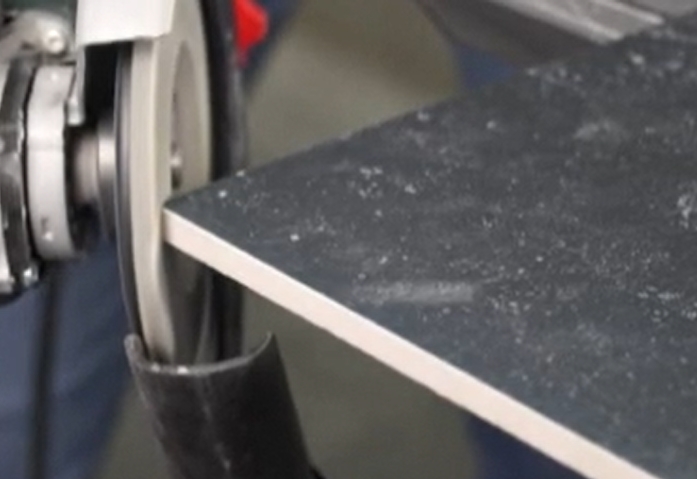
Handheld grinding with a diamond flap disc. Both scenarios in this article share the same operating envelope: dry and wet abrasive grinding at high friction on handheld electric tools.
Scenario, not catalogue category, sets the specification
The application record behind these products defines the operating envelope in five fields, and each one changes a buying decision independently. The mode of operation is handheld electric tools. The working condition is dry and wet abrasive grinding at high friction, at normal ambient temperature. The function is grinding and polishing. The matched equipment is a glass process system and a grinder. The special requirement is compliance with EU safety standard EN 13743:2017, together with stable abrasion resistance and low vibration during high-speed rotation.
Read as a specification rather than a description, that envelope is practical. The disc has to hold up under friction heat generated by a hand-held tool, in either a wet or a dry process, without the kind of vibration that passes straight through the tool into the operator's hands and into the finish. A catalogue page tells a buyer the diameter and the grit; the scenario tells the buyer which of those variables the process will punish if it is wrong.
The product data supplies the other half. Disc 5282 is offered in 100 mm, 115 mm and 125 mm diameters; the 100 mm size carries a 16 mm arbor, the 115 mm and 125 mm sizes carry a 22 mm arbor. Grit runs from 40# to 800#. The abrasive is diamond or CBN. The stated feature is high cutting speed and long working life, with suitability for dry and wet grinding. Those are specification and design statements. The supplied material contains no quantified removal-rate or tool-life benchmark, so a buyer who needs a number should request test evidence rather than infer one from the wording.
The European stone scenario: hard, brittle and documented
Stone processing in the EU scenario pairs the hardest of the listed materials with the most explicit compliance layer. Granite, marble, natural stone and engineered stone behave as hard brittle materials, which is the technical reason diamond and CBN abrasives — the materials RUITE lists for disc 5282 — are specified for this class of work. The scenario record places the operation on handheld electric tools, in dry and wet mode, at high friction.
Grit and diameter, decided by the task inside the scenario
Inside the 40#–800# band, grit is a task decision. Published supplier guidance in the same product class illustrates the convention: one product page maps grit 60 to aggressive shaping and initial bevels, 120 to general grinding and beveling, and 200 to final smoothing and preparation for a visible finish. That mapping is a single supplier's guidance for its own product, not a cross-brand standard, but it shows why a stone shop rarely orders one grit. The same disc reference has to cover stock removal, blending and finishing on the same bench.
Diameter works in the other direction, from the tool backwards. With 100 mm on a 16 mm arbor and 115 mm or 125 mm on a 22 mm arbor, the grinder's spindle, guard and speed rating decide which size is usable before material or grit is discussed. A 115 mm disc is common enough in this class that two unrelated supplier pages in the supplied evidence both list it: one covering ceramic tile, porcelain, natural stone, granite, marble and concrete at grits 60, 120, 200 and 400; the other a 115 mm disc for ceramic tile, granite, gres, marble and quartz sinter at grit 120. Commonality of size says nothing about commonality of performance or maximum speed, both of which remain product-specific.
The compliance layer the EU scenario adds
For the European market, the supplied evidence identifies a requirement that attaches to the product class rather than to one brand: any coated abrasive product, including diamond flap discs, placed on the EU market must comply with EN 13743:2017 on safety markings and maximum operating speeds. In practice that converts a technical parameter into an inspection item. The marking on the disc and the maximum speed printed with it have to match the tool and the process, and the operator has to work inside that limit.
The scenario record's second special requirement, low vibration during high-speed rotation, sits in the same place. A hand-held disc running at speed transfers imbalance directly to the operator and to the edge being finished, so the requirement is written as a property of the product — something a buyer can ask to have documented rather than assumed.
Where the belt format enters the same scenario
The stone scenario in RUITE's catalogue is not flap-disc-only. Diamond belts, referenced 5281 and offered in widths from 5 mm to 350 mm and lengths from 150 mm to 5000 mm, appear in the same application record, and the company profile describes diamond belts as being used in grinding and polishing of complex shapes and surfaces in hard brittle materials including stone, glass and ceramic. For a buyer this is a scope note rather than a substitution: a line that handles complex profiles and flat edges may need both formats, and the RFQ should state which operation each format is meant to cover.
The U.S. ceramic and glass scenario: same reference, different failure cost
Ceramic and glass processing in the U.S. scenario uses the same flap disc reference and the same operating envelope — handheld electric tools, dry and wet grinding, high friction, normal ambient temperature — but the cost of a mistake differs. In glass and ceramic work the visible surface is frequently the delivered surface, so a scratch, a chip or an uneven blend is a defect rather than an appearance issue. That shifts what a buyer optimises: consistency across the batch and across the life of the disc matters more than the fastest single cut.
The material list supports the pairing. Disc 5282 is specified for glass, ceramics, monocrystalline silicon, cemented carbide and sprayed coatings, and RUITE's applicable industries include the glass industry, the porcelain industry, thermal spray coating, wind power, and aeronautics and astronautics. The Italian OEM case described later sits in this scenario family: eight years of ceramic grinding supply, 20,000 units, reported as stable quality with no customer complaints.
What the U.S. side adds: classification first
For goods entering the United States, the supplied evidence documents the tariff side of the scenario rather than a product-safety marking requirement. The US International Trade Commission's Harmonized Tariff Schedule classifies diamond flap discs under HS 6804.21.00, covering millstones, grindstones, grinding wheels and the like of agglomerated synthetic or natural diamond. That classification is a documentation and landed-cost input: it determines how the shipment is declared, and it is better settled before the first order than at the port.
The asymmetry is worth stating plainly, because buyers often assume the EU and U.S. scenarios differ only in voltage. In the evidence reviewed, the EU scenario carries an explicit coated-abrasive safety standard, EN 13743:2017, while the U.S. scenario carries an explicit customs classification. Neither replaces a product datasheet, and neither tells a buyer whether a disc will perform on a specific glass or porcelain line. Both tell the buyer what has to be in the file.
Dry and wet mode is a process statement, not a product switch
The same disc reference is offered for dry and wet grinding, which is a reason to specify the process in the RFQ rather than assume the disc covers both. Dry grinding concentrates friction heat in the disc and the workpiece and leaves debris airborne; wet grinding changes cooling and debris removal. Because the scenario record lists both modes under one product, an order that does not state the mode leaves the supplier guessing about the condition the disc will actually meet, and leaves the buyer without a clear basis if the process turns out to be the other one.
The two scenarios side by side
| Decision variable | EU stone scenario | U.S. ceramic and glass scenario | Confirm before ordering |
|---|---|---|---|
| Workpiece | Granite, marble, natural and engineered stone | Glass, ceramics, porcelain, monocrystalline silicon | Actual material list, not the industry label |
| Product reference | Flap disc 5282; diamond belt 5281 in the same record | Flap disc 5282; diamond belt 5281 in the same record | Which operation each format covers |
| Operating mode | Handheld electric tools; dry and wet; high friction | Same envelope | Tool model, spindle thread, guard size |
| Size and arbor | 100 mm / 16 mm; 115 mm / 22 mm; 125 mm / 22 mm | Same range | Spindle and guard capacity |
| Grit band | 40#–800#, coarse to fine by task | Same band; finishing stages usually finer | Task sequence on the line |
| Documentation | EN 13743:2017 safety markings and maximum speeds | HS 6804.21.00 classification for U.S. entry | Label speed against tool speed; declaration data |
| Supplier evidence | 100% test claim; 12-month shelf life warranty | Same, plus the Italian ceramic OEM reference | Batch records, test scope, warranty terms |
The table compares documented characteristics, not measured outcomes. It shows where the two scenarios diverge in paperwork, tool matching and acceptance, and where they converge on the same product reference and the same grit band. It does not establish that the disc performs better in one market than the other, because no comparable test data supporting that claim was supplied.
Tool matching: the limit no datasheet can remove
The grinder sets a hard ceiling. A published example in the same product class — a 115 mm diamond flap disc for ceramic tile, granite, gres, marble and quartz sinter, intended for dry use on an angle grinder — lists a maximum speed of 13,200 rpm for that specific product. That figure belongs to that disc and cannot be transferred to another diameter, another construction or another brand; it is included to show the shape of the check, not the number to use. The check itself is short: read the maximum speed marked on the disc, read the no-load speed on the tool, and confirm the tool does not exceed the disc's marked limit.
Two further tool-side variables belong in the same conversation. The arbor: a 16 mm bore does not fit a 22 mm spindle without the right flange arrangement, and the 100 mm disc in RUITE's range is the 16 mm variant. The guard: a guard sized for a 100 mm disc will not accept a 125 mm one. Both sound obvious until a mixed order arrives, which is precisely why the scenario record keeps diameter and arbor in the same field as the material.
Fit boundaries: where the current evidence stops
Diamond and CBN abrasives are described in RUITE's profile as combining the flexibility of conventional coated abrasives with the hardness of superhard materials, and diamond belts are described as being used on complex shapes and surfaces of hard brittle materials. That is a design rationale, not a head-to-head result. The supplied evidence contains no controlled comparison of diamond flap discs against conventional abrasive flap discs on removal rate, tool life, surface roughness or edge quality, and no price or landed-cost benchmark. Buyers who need those numbers have to generate them, and the practical route is a trial with a defined workpiece, tool, grit and evaluation criterion.
The second boundary is scope. Disc 5282 is specified for stone, glass, ceramics, monocrystalline silicon, cemented carbide, sprayed coatings and comparable hard brittle work within the listed industries. A buyer with a workpiece outside that list should treat the disc as unqualified for it until the supplier confirms suitability in writing. That is not a criticism of the product; it is the difference between a specification and an assumption, and it is the most common place where scenario-based selection goes wrong.
Auditing the supply side, whichever scenario applies
The most scenario-relevant proof point in the supplied material is a ceramic grinding case: an Italian OEM customer, 20,000 units over eight years, reported as stable quality with no customer complaints. It should be read for what it is — a supplier-reported case without customer-identifying detail or independent verification — and used as a reason to request batch records and references, not as a substitute for them.
Behind the case sit the operating facts. RUITE reports a 500 m² facility with 45 staff and 5 engineers, an annual output of 100,000 units, a 70% export ratio with the EU and USA as main markets, and a founding year of 2003. Production is offered on an OEM basis with packing and logo customisation, a monthly capacity of 10,000 units, a 30-day lead time, a 50-unit minimum order, 100% testing, and a 12-month shelf life quality warranty with free technical consultation and replacement for defective batches. Those figures give a buyer something concrete to test against a first order, provided current terms are confirmed at quotation.

RUITE, Zhengzhou Ruite Diamond Belts Co., Ltd, produces diamond flap discs and diamond belts for hard brittle material grinding; the company reports a 500 m² facility, 45 staff and 5 engineers.
Four audit questions converge for either scenario: which grits and diameters are held in stock rather than made to order; what the 100% test actually covers; how a batch is identified and traced through packing; and what the warranty commits to in practice. A supplier that answers all four with documents has removed most of the commercial risk that a scenario-based specification is trying to manage.
Procurement context: compliance, classification and where supply sits
Three external anchors frame the commercial side. EN 13743:2017 applies to any coated abrasive placed on the EU market, so compliance is a market-access condition rather than a differentiator between suppliers. HS 6804.21.00 determines how diamond flap discs are declared for U.S. entry. On the supply side, Mordor Intelligence's abrasives market research reports that Asia-Pacific accounted for 55.40% of global abrasives purchases in 2025 — a statement about where purchasing volume sits, not about the quality of any supplier or product, and one that argues for documentation discipline rather than against any region.
Also absent from the supplied evidence are verified price, MOQ and landed-cost benchmarks across suppliers, and independent performance test data for diamond versus conventional abrasives on stone or ceramic. Such gaps are ordinary in this category, and they shift work to the buyer. An RFQ that asks for grit-specific pricing, test scope, packaging and lead time produces a comparison; one that asks only for a unit price produces a number. Buyers who want the broader product context can review the Zhengzhou Ruite Diamond Belts Co., Ltd range directly.
What the next procurement cycle is likely to need
Nothing in the supplied evidence supports a forecast of market growth, and none is offered here. What can be said is conditional. Where European buyers apply EN 13743:2017 checks at goods-in, the disc marking and its maximum speed become inspection items alongside grit and diameter, and suppliers who put those markings in the shipment file clear inspection faster. Where U.S. buyers import under HS 6804.21.00, classification consistency between invoice, packing list and customs entry becomes a recurring administrative cost that a supplier can either reduce or create.
The same conditional logic applies to scenario documentation. A supplier able to state which reference is qualified for stone, which for glass and ceramic, and which for both — and able to support that with test scope, batch records and a warranty term — removes a verification step from the buyer's process. That is a modest advantage, but a durable one, because it does not rest on a performance claim that neither side has measured.
FAQ
Why does the scenario change diamond flap disc selection more than the catalogue category?
Because one product reference can cover many materials while the process variables differ. RUITE's disc 5282 is specified for stone, glass, ceramics, monocrystalline silicon, cemented carbide and sprayed coatings, in 100, 115 and 125 mm diameters and grits from 40# to 800#, for dry and wet grinding on handheld electric tools. The catalogue entry stays the same across those jobs; the diameter, grit, tool rating and documentation requirements do not. Scenario-based selection fixes those four variables before price is discussed.
How does the European stone scenario differ from the U.S. ceramic and glass scenario?
The operating envelope is identical — handheld electric tools, dry and wet high-friction grinding — but the documented requirements differ. The EU scenario carries the EN 13743:2017 requirement on safety markings and maximum operating speeds for coated abrasives placed on the EU market, and Germany appears among the listed destination markets. The U.S. scenario carries an explicit customs dimension, with diamond flap discs classified under HS 6804.21.00. One adds a goods-in inspection item; the other adds a declaration item.
Can one grit range cover both stone grinding and ceramic or glass finishing?
One range can, one grit usually cannot. RUITE lists 40# to 800# for disc 5282, which spans stock removal to fine finishing. Published supplier guidance in the same product class maps coarse grits to aggressive shaping and initial bevels, medium grits to general grinding and beveling, and finer grits to smoothing and preparation for a visible finish. That mapping is one supplier's guidance, not a cross-brand standard, but it reflects the same rule: grit follows the task stage, not the material label.
What should be checked before a batch is accepted for either scenario?
Four items. First, that the disc marking states the maximum operating speed and that the tool's no-load speed does not exceed it, which is the practical form of the EN 13743:2017 requirement in the EU. Second, that diameter and arbor match the grinder, remembering that the 100 mm size carries a 16 mm arbor and the 115 mm and 125 mm sizes carry 22 mm arbors. Third, the grit sequence against the task stages. Fourth, the batch record, the scope of the 100% test claim and the 12-month shelf life warranty terms.
How does the handheld angle grinder limit what a diamond flap disc can be used for?
Through speed, bore and guard. Speed is the binding one: published figures are product-specific — one 115 mm diamond flap disc in the supplied evidence lists a 13,200 rpm maximum for dry use on an angle grinder — and that value cannot be applied to another disc or diameter. The disc's marked limit governs the tool setting. Bore and guard then decide whether the disc physically fits, and a guard sized for a 100 mm disc will not accept a 125 mm one.
Conclusion
The two scenarios converge on a single product reference and diverge on everything a buyer has to control around it. Stone work in Europe leans on grit sequencing, arbor matching and EN 13743:2017 marking checks; ceramic and glass work in the U.S. leans on finish consistency, wet or dry process definition, and a clean HS 6804.21.00 declaration. Neither scenario needs a different flap disc category. Both need the specification, the tool data and the documentation to be settled before the first disc is mounted.
A downloadable PDF catalogue covering the company's diamond flap discs, diamond belts and related abrasives is available here: RUITE product catalogue (PDF).
Tem questões ou precisa de mais detalhes?
Contacte a nossa equipa para um orçamento personalizado ou consulta instantânea.
Solicitar orçamento
Preencha o formulário abaixo e a nossa equipa entrará em contacto com uma proposta personalizada.
Chat direto do WhatsApp
Prefere conversar em tempo real? Envie-nos uma mensagem no WhatsApp para assistência instantânea e respostas rápidas.
- Obter orçamento personalizado
- Partilhar fotos ou documentos
- Discuta as suas necessidades diretamente
Geralmente responde em 5–30 minutos durante o horário de expediente.