
Diamond Sanding Belts for Glass: Handheld vs Stationary Grinding
Diamond Sanding Belts for Glass: Handheld vs Stationary Grinding
Diamond sanding belts reach glass through two different production routes: a handheld power tool working intermittently on a stationary workpiece, and a stationary belt grinding machine running continuously against a fed part. The abrasive family is the same; the duty cycle is not. A belt that performs acceptably in short handheld passes can fail early under continuous machine load, and a belt optimised for continuous wet grinding can be awkward to control in a dry handheld operation. Matching belt specification to operating mode is therefore a process decision before it becomes a purchasing decision.
This analysis maps diamond belt use to glass processing scenarios, contrasts the intermittent handheld case with the continuous stationary case, and explains how dry and wet grinding, high-friction contact and the control of speed, pressure and time change belt setup. It uses RUITE product 5281 — a diamond belt range the company lists for glass, stone and thermal spray coating work — as a concrete reference point, and keeps supplier application claims separate from independently verified data.
The two operating modes impose different demands
In handheld power tool operation the belt runs in short cycles. Contact pressure comes from the operator's hand and the tool's own weight; dwell time at any point depends on how the operator moves; and the belt cools between passes. The advantages are positional freedom and access to edges and shapes a machine cannot reach. The cost is variability: two operators, or the same operator on two different days, can produce different results from identical consumables.
Stationary belt grinding machine operation inverts nearly all of that. The belt path is fixed, tension is set by the machine, feed is mechanical or fixture-controlled, and the belt can run continuously for long periods. Coolant is easier to apply and easier to contain. The trade-off is that errors repeat: an incorrect belt tension, a tracking fault or an unsuitable grit sequence will be reproduced across every part in the run.
| Dimension | Handheld power tool (intermittent) | Stationary belt grinding machine (continuous) |
|---|---|---|
| Duty cycle | Short passes with cool-down between contacts | Sustained running for the length of the production run |
| Pressure source | Operator hand and tool weight; varies by technique | Mechanical feed, fixture or contact wheel; repeatable |
| Heat profile | Local and cyclic: heat builds in one spot, then disperses | Cumulative; managed mainly through coolant and parameter settings |
| Process control | Technique-dependent, with limited instrumentation | Parameters can be set, logged and repeated |
| Belt tracking and tension | Set by the tool; changes with handling and angle | Set by the machine; consistent across the run |
| Common failure paths | Edge loading, local overheating, uneven finish | Joint fatigue, tension loss, coolant-related loading |
| Setup priority | Fast cut at low pressure, forgiving grit progression | Dimensional consistency, joint integrity, coolant compatibility |
The practical consequence is that the useful belt questions differ by mode. For handheld work they concern control and forgiveness: how quickly the belt cuts, how much pressure it needs, and how much heat it puts into a local area before the operator can move on. For stationary work they concern stability: belt joint integrity, dimensional consistency across a batch, coolant compatibility, and how the belt behaves after extended continuous running.
Why glass rewards diamond — and where that claim stops
Glass is hard and brittle, so grinding and polishing remove material through many small fractures rather than through plastic flow. That is the reason superhard abrasives are used at all: RUITE describes superhard material coated abrasives as combining the flexibility of traditional coated abrasives with the hardness of superhard materials, which is the property that allows a flexible belt to be wrapped around a contact wheel and still cut a hard workpiece.
Conventional silicon carbide belts remain widely used for glass edge work. A guide published by RUITE reports that diamond belts grind approximately ten times faster than silicon carbide belts in glass edge grinding applications. That figure is a supplier-published application claim rather than an independently run benchmark. It should be read as a directional indication that the time-per-edge difference can be large, and confirmed on the buyer's own machine, glass thickness and edge geometry before it enters a cost model.
What the claim does not establish matters as much. It does not specify glass type, belt grit, machine, contact pressure or coolant condition, and it gives no surface-finish or belt-life figure. A buyer converting a speed indication into a cost per finished edge should measure cycle time with both abrasives under the same conditions rather than applying a multiplier to a supplier statement.
Dry and wet grinding change the belt's working environment
RUITE describes product 5281 as operating under dry and wet abrasive grinding conditions, in high-friction environments, at normal ambient temperature. That is a description of the working environment rather than a recommendation for either mode: it states that the product is intended to function in both, and it flags friction and heat as the conditions to be managed.
Wet grinding changes the thermal picture. Coolant carries heat out of the contact zone, suppresses dust, and can improve finish consistency on brittle material. It also introduces variables of its own: flow rate, nozzle position, coolant cleanliness and the risk of the belt loading with swarf. Supplier material describes resin-bond diamond belts as suited to wet grinding at medium-to-fine grit in glass edging and edge rounding, which is consistent with the general logic that resin bonds are used where finish and heat management matter more than maximum stock removal.
Dry grinding removes the coolant variables and adds thermal ones. Without coolant, heat accumulates in the belt, the backing and the glass itself, and the operator or the machine programme has to limit dwell time to compensate. On a stationary machine this can be handled by reducing speed or feed per pass; on a handheld tool it depends on operator discipline, which is exactly where consistency tends to break down.
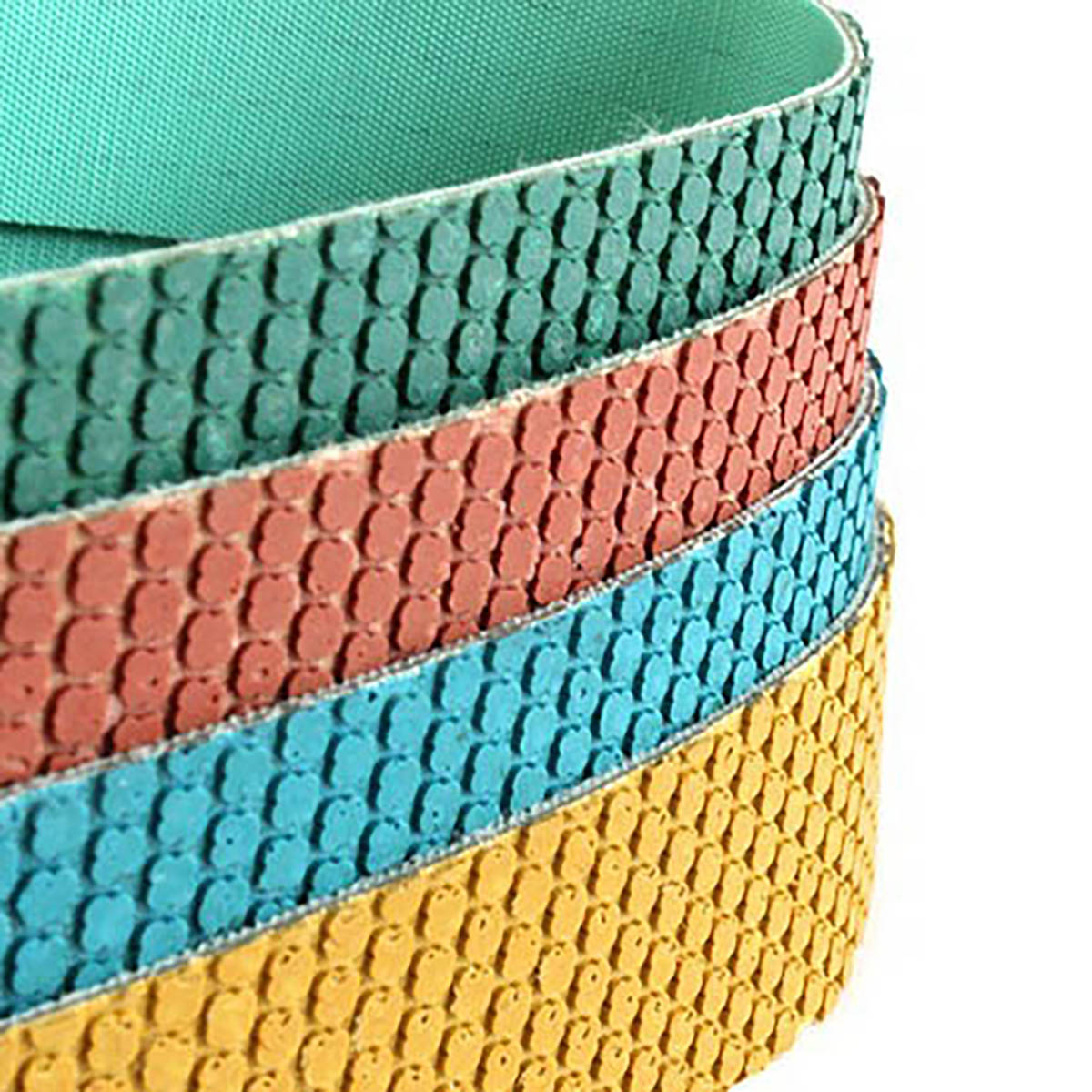
Bond selection interacts with mode and with material. Electroplated diamond belts are described as optimised for thermal spray coating grinding and tungsten carbide finishing because of their aggressive cutting action. That is a different duty from glass edge finishing: a single plated layer of abrasive favours stock removal on hard coatings, while a resin bond with abrasive distributed through a continuous resin layer, as RUITE describes its resin diamond belts, favours progressive finishing on brittle material. A workshop running both glass and coating work should not assume that one bond specification covers both jobs.
Speed, pressure and time: the three variables that decide belt life
RUITE's application material for this scenario states a specific requirement: precise control of speed, pressure and time to achieve optimal results and maximum service life. The requirement is easy to state and hard to hold, because the three variables trade against one another.
Speed sets the surface speed at the contact point, and therefore the rate at which abrasive grains pass the work. Higher surface speed generally raises removal but also raises heat generation and mechanical load on the joint. Pressure sets depth of engagement: more pressure means more aggressive cutting, more heat and faster grain dulling. Time sets total heat input and total wear — a light pass held too long can load a belt as effectively as a heavy short pass.
In handheld operation none of the three is instrumented. Control comes from technique and from belt choice: a belt that cuts at low pressure reduces the operator's temptation to lean on the tool. In stationary operation the parameters can be set, logged and repeated, which makes the machine the better place to establish a working parameter window before that window is transferred to handheld work. Recording speed, pressure or feed, and dwell time for a reference part gives the buyer something that can be compared across belt batches later.
Product 5281 and RUITE's belt range: what is actually specified
Zhengzhou Ruite Diamond Belts Co., Ltd. states that it was established in 2003 and operates from Zhengzhou, Henan, China. Company information describes a 500 m² facility, 45 employees including 5 engineers, an annual output of 100,000 units and an export share of about 70%, with the EU and USA as main markets. The company lists diamond belts, diamond flap discs, diamond flap wheels, diamond velcro discs, diamond hand pads and diamond quick change discs among its products, and states that it developed diamond sanding belts, diamond flap discs, diamond spiral bands and diamond hand pads with independent intellectual property rights, alongside CBN belts, CBN flap discs, CBN spiral bands and CBN hand pads.
Product 5281 is the belt range relevant to this discussion. RUITE specifies diamond belts in widths from 5 mm to 350 mm and lengths from 150 mm to 5000 mm, in grits from 40# to 5000#, in diamond or CBN abrasive, with custom sizes available on request. The company lists glass, stone, ceramics, monocrystalline and polycrystalline silicon, synthetic materials and cemented carbide among the materials the belts are used on, and names the glass, stone, thermal spray coating, wind power, porcelain and aerospace industries, plus carbide tool sharpening, among the applications.
The commercial frame is OEM-oriented. RUITE lists OEM production with packing and logo customisation, a minimum order quantity of 50 units, a lead time of 30–45 days, 100% testing and a 12-month shelf-life quality warranty, together with free technical consultation and replacement for defective batches. For a buyer at evaluation stage these are the terms to confirm in writing for the specific dimensions, grit and bond being ordered, because the applicable figure can move with specification.
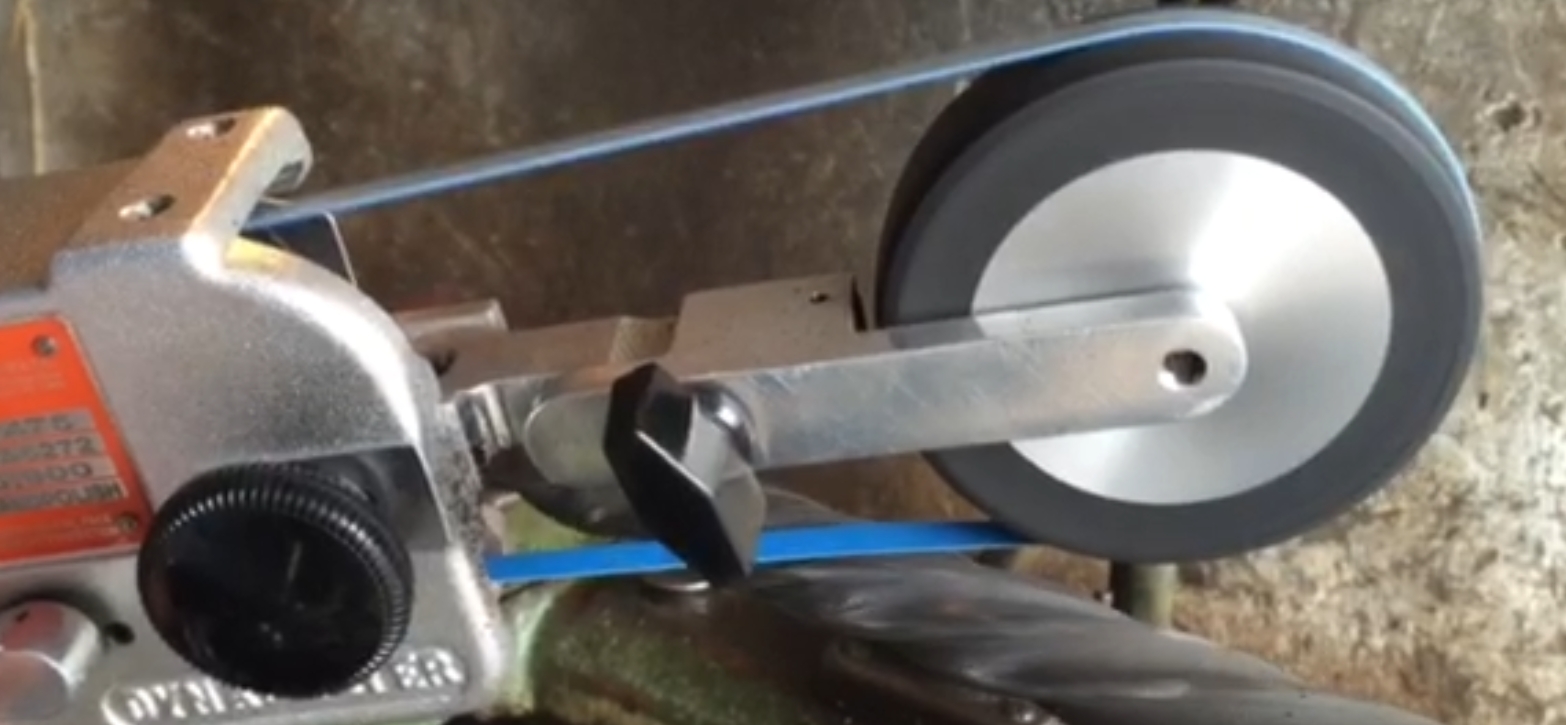
Matching belt setup to glass, stone and thermal spray coating
Glass edging and edge rounding
Glass edging is the scenario where the handheld-versus-stationary distinction shows up most clearly. Flat edge polishing on a production line is continuous machine work: the belt runs wet, the grit sequence steps from stock removal towards finishing inside the 40#–5000# range, and the belt width is matched to the edge profile being produced. Edge rounding and rework on installed or oversized glass is more often intermittent handheld work, where the same abrasive family is used with less coolant and more operator judgement. A resin-bond belt described for wet, medium-to-fine grit edge rounding sits naturally in the first case; the second case needs a belt and grit that tolerate short dry passes without local overheating.
Stone
Stone shares glass's hard, brittle character but adds variation: natural stone differs across a slab, and abrasive belts can load with fines. The belt setup logic carries over from glass — controlled pressure, a progressive grit sequence, and coolant where the machine allows it — but the grit starting point usually shifts coarser within the available range, and belt cleaning or replacement intervals become a process variable rather than a maintenance detail.
Thermal spray coating
Thermal spray coating finishing is a different task with the same belt format. The workpiece is a sprayed metallic or ceramic layer that has to be brought to dimension and finish without damaging the bond to the substrate. Electroplated diamond belts are described as optimised for this duty because of their aggressive cutting action, and tungsten carbide finishing is grouped with it. A shop that already runs diamond belts on glass may find that its glass belt specification is too fine and too slow for coating removal, and that the coating belt is too aggressive for glass — which is why bond and grit should be specified per application rather than per supplier.
The scenario RUITE reports as common in Germany
RUITE describes this application scenario as common in Germany, across the glass, stone and thermal spray coating industries, with both handheld and stationary operation in use. The useful reading for a buyer is not a market claim but a specification signal: where both modes coexist inside the same industrial base, a belt range documented for both intermittent and continuous operation is easier to standardise than two single-mode products, provided the parameter windows for each mode are written down and kept apart.
Supporting equipment and machine fit
RUITE's application description lists glass process systems and sanders as the supporting equipment for 5281, which places the belt inside an existing machine envelope rather than in a standalone tool. Two fit checks follow from the published dimensions. First, belt length must match the machine's belt path including tensioning travel: the 150–5000 mm span is wide, but the number that matters is the machine's specified belt length, not the span itself. Second, belt width must match the contact wheel or platen and the edge profile being produced — a 5 mm belt and a 350 mm belt are different tools for different jobs even when they share a product code.
Safety and guarding belong in the same check. ANSI B7.7-2003 sets safety requirements for abrading materials with coated abrasive systems in North America and addresses belt system hazards rather than abrasive composition; a belt built to a supplier specification still has to run inside the machine's guarding and within its rated speed. Buyers importing into other regions should confirm the applicable local requirements separately, because the verified standard available for this analysis covers North America specifically.
Market context: what the surrounding data does and does not say
Three published figures frame the category, and each has a different scope. Grand View Research valued the global abrasives market at USD 41.0 billion in 2025 and projected USD 59.5 billion by 2033, with Asia Pacific holding a 56.0% revenue share in 2025. A coated abrasive belt segment was reported at USD 3.2 billion in 2025 with a 5.3% CAGR in material cited by RUITE and attributed to commercial research. The thermal spray coatings market was projected to reach USD 15.28 billion by 2031 in data RUITE attributes to Mordor Intelligence.
None of these is a market size for diamond sanding belts. The verified evidence used here contains no transparent, belt-specific market sizing, so the honest reading is narrower: the consumable sits inside a large abrasives market and an adjacent coating market, and the direction of both is upward on the cited sources. A supplier's opportunity statement should not be scaled from these numbers, and a buyer's capacity plan should not be built on them either.
Where a diamond belt stops being the right answer
Diamond is not automatically correct for every glass operation. The first boundary is economic. Diamond belts carry a higher unit price than conventional abrasives, and the reported speed advantage only converts into savings if grinding time is the actual bottleneck. If a shop's constraint is handling, inspection, setup or fixturing, a faster belt will not move finished-part output, and the premium is paid without a return.
The second boundary is evidence. Verified removal-rate, surface-roughness and belt-life figures for 5281 on specific glass grades were not available in the data used for this article. An application listing establishes that a supplier positions a product for a material; it does not establish a finish value or a life figure. Any process plan built on application claims alone is provisional until the buyer's own trial data exists.
The third boundary is mode fit. A belt specified for a controlled coolant environment and continuous feed is being used outside its described conditions if it is run dry in a handheld tool at uncontrolled pressure. The stated requirement for precise control of speed, pressure and time is a boundary condition rather than a formality, and it is the first thing to check when a belt underperforms on site.
A buyer verification checklist
| Check | Why it matters | What to confirm |
|---|---|---|
| Operating mode | Determines pressure source, coolant feasibility and repeatability | Which mode each process step runs in, and whether both occur on the same part |
| Coolant mode | Changes heat management and belt loading behaviour | Wet, dry or mixed; flow rate and containment if wet |
| Grit sequence | Balances stock removal against finish | Starting and finishing grit within the 40#–5000# range, with the step between them |
| Belt dimensions | Machine fit is not covered by a published range | Exact machine belt length and required width, not the catalogue span |
| Bond type | Aggressive cutting and progressive finishing behave differently | Which bond is quoted for glass versus coating work |
| Parameter window | Speed, pressure and time drive both result and belt life | Recorded settings per mode, with a reference part for comparison |
| Safety and guarding | Belt system hazards are regulated separately from abrasive type | Machine rating, guarding and the applicable regional standard |
| Commercial terms | Terms vary with specification | MOQ, lead time and warranty stated in writing for the ordered specification |
| Sample trial | Supplier claims are not performance data for the buyer's process | Cycle time, finish and belt life measured on the buyer's own material |
Outlook
The conditional view is straightforward: if coated abrasive belt consumption continues at the rate reported for that segment, and thermal spray coating demand expands as projected, finishing steps become a larger share of hard-material processing time and a more visible cost line. Under those assumptions, a belt range documented for both intermittent and continuous operation gives a workshop one specification to qualify instead of two. The limits of that view should be stated as clearly as the view itself: the cited figures cover abrasives, coated belts and thermal spray coatings broadly, not diamond belts specifically; no belt-specific forecast was available; and adoption will depend less on market growth than on whether individual buyers can measure a cost per finished part rather than a price per belt.
Frequently asked questions
Can one diamond sanding belt specification serve both a handheld tool and a stationary belt grinding machine?
Only if the specification is documented for both modes and the two operating windows are kept separate. RUITE describes product 5281 as usable in handheld power tool intermittent operation and in stationary belt grinding machine continuous operation, under dry and wet abrasive grinding conditions at normal ambient temperature. The belt family may be shared, but the grit, coolant and pressure settings appropriate to each mode usually are not.
Is wet or dry grinding preferable for diamond belts on glass?
Wet grinding is generally easier to control on brittle material because coolant removes heat from the contact zone and can improve finish consistency; resin-bond diamond belts are described in supplier material as suited to wet, medium-to-fine grit glass edging and edge rounding. Dry grinding is used where coolant is impractical, typically handheld work, and it requires shorter dwell times to prevent local overheating. RUITE describes the belt range as operating in both conditions, so the choice follows the process rather than the belt alone.
Which grit should a glass edging process start with?
The available range for product 5281 runs from 40# to 5000#, which spans stock removal through fine finishing. The starting grit depends on how much material must be removed, the edge geometry and the finish target, and no verified grit-to-finish data was available for this analysis. A common approach is to establish the coarsest grit that removes the required stock without chipping, then step through intermediate grits to the finishing grit, verifying the sequence on scrap of the same glass type.
Why do speed, pressure and time need to be controlled together?
Because they trade against each other in the contact zone. Surface speed governs how fast abrasive grains pass the work, pressure governs depth of engagement, and time governs total heat input. Raising one without adjusting the others shifts the balance towards heat, load or premature grain dulling. RUITE states precise control of speed, pressure and time as a special requirement for this application, aimed at achieving optimal results and maximum service life.
What supporting equipment does this application assume?
RUITE lists glass process systems and sanders as the supporting equipment for product 5281, which means the belt is used inside an existing machine or tool envelope rather than as a standalone item. In practice that sets two hard requirements: belt length must match the machine's belt path including tensioning travel, and belt width must match the contact wheel or platen and the edge profile being produced.
Does diamond belt use extend beyond glass?
Yes. RUITE lists glass, stone, ceramics, monocrystalline and polycrystalline silicon, synthetic materials and cemented carbide among the materials the belts are used on, and names the glass, stone, thermal spray coating, wind power, porcelain and aerospace industries plus carbide tool sharpening among the applications. Bond and grit selection differ by material: electroplated diamond belts are described as optimised for thermal spray coating grinding and tungsten carbide finishing, while resin-bond belts are associated with wet glass edging and edge rounding.
Company and product information for this analysis is published by Zhengzhou Ruite Diamond Belts Co., Ltd., which states that it was established in 2003 and operates from Zhengzhou, Henan, China. The company's product catalogue, including the diamond belt range, specifications and OEM terms, can be downloaded here: RUITE product catalogue (PDF).
Tem questões ou precisa de mais detalhes?
Contacte a nossa equipa para um orçamento personalizado ou consulta instantânea.
Solicitar orçamento
Preencha o formulário abaixo e a nossa equipa entrará em contacto com uma proposta personalizada.
Chat direto do WhatsApp
Prefere conversar em tempo real? Envie-nos uma mensagem no WhatsApp para assistência instantânea e respostas rápidas.
- Obter orçamento personalizado
- Partilhar fotos ou documentos
- Discuta as suas necessidades diretamente
Geralmente responde em 5–30 minutos durante o horário de expediente.