
Diamond Sanding Belts: Specifications, Compliance, and Sourcing Criteria
Diamond sanding belts are coated abrasives in which diamond or CBN grains are bonded to a flexible backing. They are used to grind and polish hard, brittle materials that would quickly wear down conventional abrasives. For procurement teams, the key evaluation points are the available size and grit envelope, the bond type, the intended working conditions, and the compliance documentation a supplier can provide.
The Sourcing Challenge: Verification Before Price
Hard-brittle materials such as glass, ceramics, tungsten carbide, thermal spray coatings, and composites present a common problem: they are too hard for aluminum oxide or silicon carbide belts, and standard abrasive belts lose their cutting edge rapidly. Diamond belts solve this by combining the hardness of superabrasive grain with the flexibility of a coated abrasive web.
However, not all diamond belts are equal. A belt’s performance depends on grain size, bond system, backing strength, and the precision of the coating process. Buyers moving from conventional to diamond abrasives face a steep learning curve in specification. In parallel, regulatory changes—such as China’s export controls on certain superhard materials and the cancellation of export tax rebates on abrasives—are altering cost structures and compliance expectations. The result is that sourcing decisions now require more technical due diligence than in the past.
A Reference Supplier: Zhengzhou Ruite Diamond Belts Co., Ltd
Zhengzhou Ruite Diamond Belts Co., Ltd (RUITE) is a Chinese manufacturer that has focused on superhard coated abrasives since 2003. The company develops and produces diamond sanding belts, diamond flap discs, diamond spiral bands, diamond hand pads, and related tools, and states that these products carry independent intellectual property rights. Its factory in Zhengzhou covers 500 m², employs 45 people, and has an annual output of approximately 100,000 units. Export markets account for about 70% of production, primarily in the EU and USA. The R&D team consists of five engineers.
RUITE is a useful reference for buyers because it provides clear data on product geometry, grit range, and application scope. It also offers OEM services—including custom packing and logo—which is common for suppliers serving EU and North American distributors. While this article does not endorse a single manufacturer, RUITE’s published specifications illustrate the type of information that buyers should expect from any qualified diamond belt supplier.
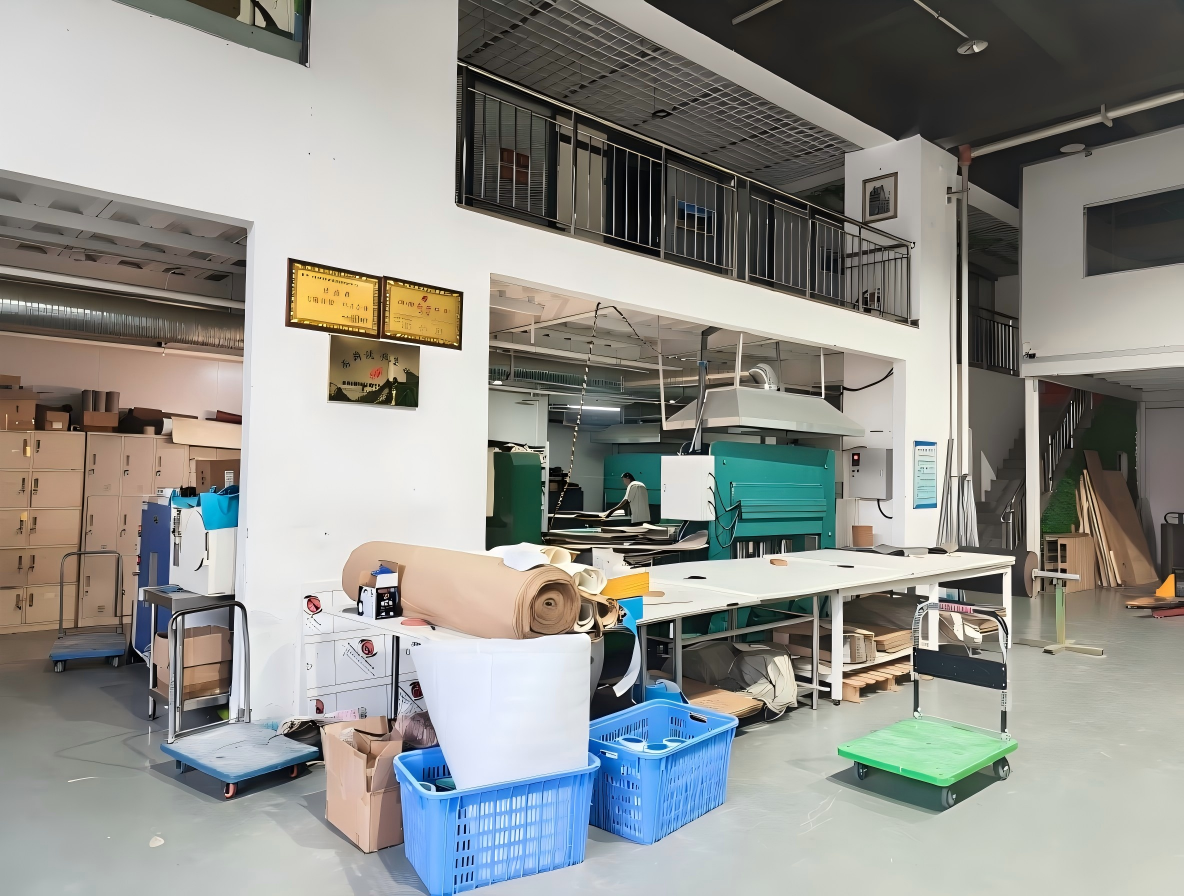
Manufacturing environment at Zhengzhou Ruite Diamond Belts Co., Ltd. Source: RUITE.
Diamond Sanding Belt Specifications: Size, Grit, and Material
According to RUITE’s product data, its diamond belts cover a width range of 5 mm to 350 mm and a length range of 150 mm to 5000 mm. This means that both narrow belts for edge grinding and long belts for stationary sanding machines can be supplied. The grit range extends from 40# (coarse) to 5000# (ultra-fine). This wide span allows the same product family to move from rough stock removal to fine polishing.
The abrasive grain is either diamond or cubic boron nitride (CBN). Diamond is the natural choice for glass, stone, ceramics, silicon, and cemented carbide. CBN is typically preferred for high-speed tool steels and certain ferrous alloys. The product can be customized according to customer requirements, including non-standard dimensions and bonds.
Two common bond systems are used in diamond belts: resin bond and electroplated. Resin-bonded diamond belts have a continuous layer of resin in which diamond particles are distributed through the depth of the coating. This construction allows fresh abrasive grains to be exposed as the resin wears, which contributes to a longer working life. Electroplated belts typically have a single layer of diamond particles held on a metallic coating; they cut aggressively but have a more limited life. RUITE’s product line includes both resin diamond belts and electroplated diamond belts, and the company’s published images show examples of each.
| Specification | Typical Range (RUITE) |
|---|---|
| Width | 5 mm – 350 mm |
| Length | 150 mm – 5000 mm |
| Grit | 40# – 5000# |
| Abrasive grain | Diamond or CBN |
| Customization | Custom sizes, packing, logo |
Where Diamond Sanding Belts Are Used
Diamond belts are designed for grinding and polishing hard brittle materials. RUITE lists the following industries: glass, stone, thermal spray coating, wind power, porcelain, aeronautics, astronautics, and carbide tool sharpening. Specific applications include polishing composite materials, deburring carbide parts, grinding ceramic tiles, polishing glass edges, and grinding high-temperature alloys.
The working environment can be dry or wet. Wet grinding is often preferred for glass and ceramic to control heat and reduce dust. The belts are used on handheld power tools for intermittent operation, as well as on stationary belt grinding machines for continuous production. Effective use requires precise control of speed, pressure, and time. This is not an abrasive that can be used with any machine without adjustment; the machine must be rigid enough and, ideally, have variable speed control.
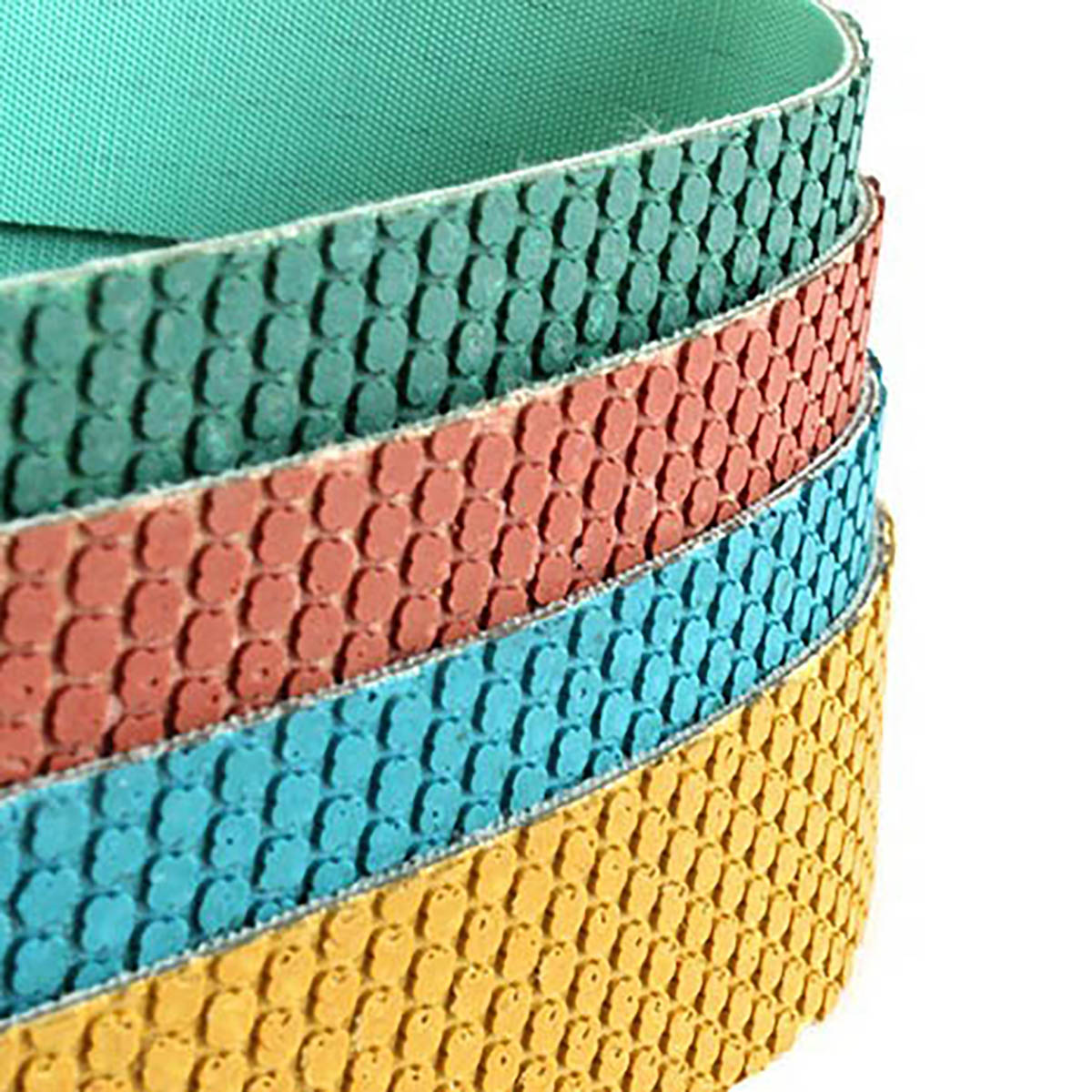
Resin bond diamond belt: diamond grain is distributed through the depth of the resin coating. Source: RUITE.
Market Trends and Regulatory Context
Demand for diamond sanding belts is tied to the growth of end-use industries. The global diamond tools market, which includes diamond abrasive belts, was valued at USD 10.8 billion in 2024 and is projected to reach USD 19.5 billion by 2034, according to Global Market Insights. The broader coated abrasive belt market reached approximately USD 3.2 billion in 2025, with a projected CAGR of 5.3% through 2033, based on Cognitive Market Research. Thermal spray coatings—a key application for diamond belts—are expected to grow to USD 15.28 billion by 2031, according to Mordor Intelligence.
Two regulatory changes in China are directly relevant for buyers of diamond belts. First, the Ministry of Commerce imposed export controls on certain superhard materials, including diamond grinding wheels with specific hardness and grain size parameters, effective November 8, 2025. Second, as of April 1, 2026, China cancelled the export tax rebate (previously 9–13%) for abrasive products including grinding wheels, sandpaper, and abrasive belts. Both policies can affect pricing and supply chain administration. For buyers, this means that a supplier’s ability to manage export documentation and absorb cost changes is an important evaluation criterion.
In North America, safety requirements for coated abrasive systems are referenced under ANSI B7.7. In the EU, certain bonded abrasive products must carry CE-type certification under standards such as EN 13743. For example, RUITE’s diamond flap disc product line (not the sanding belt) holds ECM certification for the EU market under certificate number No. 0P210906.ZRDQ038, issued by ECM Certification Machine Srl, with validity through September 2026. While this certification does not directly cover diamond sanding belts, it demonstrates the manufacturer’s experience with EU compliance processes.
Diamond Belts vs. Conventional Abrasive Belts
Compared with conventional aluminum oxide or silicon carbide belts, diamond belts offer a significantly higher hardness and longer service life when processing hard-brittle materials. They can hold a controlled edge geometry and produce consistent surface finishes. In many cases, the higher unit cost of a diamond belt is offset by the reduction in tool changes and downtime.
There are, however, realistic limitations. Diamond belts are more expensive per belt than conventional abrasives. They also require a machine with sufficient rigidity and precise speed/pressure control; using them on underpowered or flexible equipment can result in premature grain loss or poor finish. In addition, diamond is not always the optimal choice for very ductile or highly ferrous materials—CBN may be more suitable for hardened steel. Buyers should therefore evaluate the specific material, stock removal rate, and equipment capability before specifying a diamond belt.
| Factor | Diamond/CBN Belt | Conventional Belt (Al₂O₃ / SiC) |
|---|---|---|
| Abrasive hardness | Very high | Moderate |
| Best for | Hard, brittle materials | Metals, wood, softer materials |
| Working life on hard materials | Long | Short |
| Unit cost | Higher | Lower |
| Machine requirement | Rigid, speed control recommended | General purpose |
Practical Sourcing Criteria for Diamond Sanding Belts
When evaluating a supplier, consider the following points:
1. Specification transparency. The supplier should clearly state available widths, lengths, and grit ranges. A range of 5–350 mm width and 150–5000 mm length, with grit from 40# to 5000#, indicates the ability to serve both edge finishing and large-area surfacing.
2. Material and bond clarity. Confirm whether the belt is diamond or CBN and whether it uses resin or electroplated bond. Each combination behaves differently on specific substrates.
3. Application match. Ask for the specific materials the belt is designed to process. A supplier that lists glass, ceramics, tungsten carbide, composites, and high-temperature alloys is likely working across industrial rather than hobbyist applications.
4. Compliance documentation. For EU-focused purchasing, ask whether the product has a valid certification such as EN 13743. For North America, verify compliance with relevant ANSI standards. Not all diamond belts carry certifications, and the absence of one is not automatically disqualifying, but it should be a documented risk decision.
5. OEM and customization capability. If you are a distributor or equipment manufacturer, check whether the supplier can custom-produce sizes, packing, and branding. RUITE, for example, offers OEM orders with a monthly capacity of 1,000 units, lead time of 30–45 days, and a minimum order quantity of 50 units. It operates 100% inspection and provides a 12-month shelf-life quality warranty plus technical consultation.
Future Outlook
As advanced manufacturing shifts toward harder materials—thermal spray coatings, ceramic composites, additive-manufactured parts—the role of diamond sanding belts will expand. The ability to achieve surface roughness below 5 µm in post-processing is already seen as a key advantage of superabrasive finishing. However, the industry will also face tighter regulatory oversight and more supply chain scrutiny. Suppliers that combine clear specifications, verifiable quality control, and compliance expertise will be better positioned to serve international buyers. For buyers, the long-term sourcing strategy should include a technical audit of supplier capabilities, not just a price comparison.
For reference, a product catalog is available here: Download catalog (PDF).
FAQ
What grit range is available for diamond sanding belts?
RUITE offers diamond sanding belts in a grit range from 40# to 5000#. Coarse grits are used for stock removal, while fine grits are used for polishing and surface finishing. Custom grits may be available on request.
What are the standard size limits for diamond sanding belts?
For the product family described by RUITE, width ranges from 5 mm to 350 mm, and length ranges from 150 mm to 5000 mm. This allows both narrow belts for edge grinding and longer belts for stationary machines.
Which industries commonly use diamond sanding belts?
Diamond sanding belts are used in the glass, stone, thermal spray coating, wind power, porcelain, aeronautics, and astronautics industries. Applications include deburring carbide parts, polishing composite materials, grinding ceramic tiles, polishing glass edges, and grinding high-temperature alloys.
Does RUITE hold any EU certification for its abrasive products?
RUITE’s diamond flap disc product line (product code 5282) holds ECM certification for the EU market under certificate number No. 0P210906.ZRDQ038, issued by ECM Certification Machine Srl and valid through September 5, 2026. The applicable standard is EN 13743:2017. This certification applies to the flap disc range, not the diamond sanding belt line.
Can diamond sanding belts be used in wet grinding conditions?
Yes. Diamond sanding belts are suitable for both dry and wet abrasive grinding. Wet grinding is commonly used for glass and ceramics to manage heat and dust. The working environment is described as high friction with normal ambient temperature.
What is the minimum order quantity for custom diamond sanding belts from RUITE?
RUITE’s standard MOQ for OEM diamond sanding belt production is 50 units. Custom packing and logo are available. The monthly capacity for OEM orders is 1,000 units, with a lead time of 30–45 days.