
Die-Cutting Compliance Checks in Label Press Qualification
Die-Cutting Compliance Checks in Label Press Qualification
On a label printing machine, the die-cutting method is a series-level attribute, not a preference to be settled at the end of price negotiation. In CAISHENG's range the qualification baseline is that the 220 series uses flatbed die cutting, the 300/320 series uses a flatbed plus rotary die-cutting combination, and the 350/370/380 series uses a rotary die-cutting combination. A quotation, technical annex or conformity document that names a die-cutting method belonging to a different series is a document-control failure, and qualification should pause until the correct series and method are confirmed.
This matters more than it first appears, because die-cutting is configured per order. CAISHENG's stated ODM customization scope lists flatbed die-cutting and rotary die-cutting as separately selectable stations, alongside glue-side printing, cold foil stamping, lamination, in-line or off-line UV varnishing, sheet cutting, slitting and full-rotary screen printing. When both methods exist inside one supplier's range, the machine a buyer receives is defined by its order documents, not by the photographs in a brochure. Verification therefore has to be documentary: the same series and the same die-cutting method must be readable in every file the buyer signs or receives.
Why the die-cutting method belongs in the compliance file
Die-cutting determines the tooling, the changeover routine and part of the machine's guarding and drive architecture. It also changes what the acceptance test has to prove. Two consequences follow for a buyer who is still in the Research or Evaluation stage.
First, the method is not interchangeable after the order. A flatbed station and a rotary die-cutting station are different mechanical units with different tooling interfaces; a mismatch is not corrected by wording. Second, the method appears in the conformity documentation. A CE attestation describes the machinery it assessed, and the model scope printed on that attestation is what a safety or customs reviewer reads. If a quotation names a 350-series machine with rotary die-cutting while the certificate line names a different series, the buyer is holding two documents that describe two different machines.
The practical order is: choose the series first, confirm the method second, confirm the documents third. Starting instead from a price or a brochure image is the usual way mismatches get created.
The series baseline: what each family is checked against
The mapping below is the reference against which a quotation should be read. The documented figures are model-level values taken from CAISHENG's published specifications and are included so that the check is anchored in a real machine rather than in a category name.
| Series | Die-cutting baseline | Documented reference values | What to confirm in writing |
|---|---|---|---|
| 220 series | Flatbed die cutting | CS-220-4C: web width 30–240 mm; maximum full-rotary printing area 220 × 245 mm; machine weight 2.6 t; maximum speed 40 m/min | A flatbed die-cutting station is named in both quotation and annex; cutting format and station position are stated |
| 300/320 series | Flatbed plus rotary die-cutting combination | CS-320-6C: web width 30–320 mm; full-rotary printing area 320 × 326 mm; 6.2 t; 40 m/min. CS-320-7C: 320 × 326 mm full rotary; 7 t; 40 m/min | Both stations are listed in sequence, and the buyer's job types are allocated to each |
| 350/370/380 series | Rotary die-cutting combination | CS-JQ350G-6C: 350 × 419 mm full rotary, up to 158 m/min full rotary. CS-Q370F-6C: 370 × 200 mm and 370 × 600 mm, 150 m/min. CS-J380F-7C: 360 × 419 mm full rotary | Number and position of rotary die-cutting stations; the speed at which registration is demonstrated |
Two qualifiers keep this table honest. The speed values are maximums, not recommended production speeds, and a demonstration at maximum is not the same as stable daily output. And the series baseline describes standard configuration logic for verification; where a specific order adds, omits or relocates a die-cutting station, that engineering belongs in the technical annex. The annex describes the unit actually being built. The series baseline only tells the buyer whether the annex is plausible.
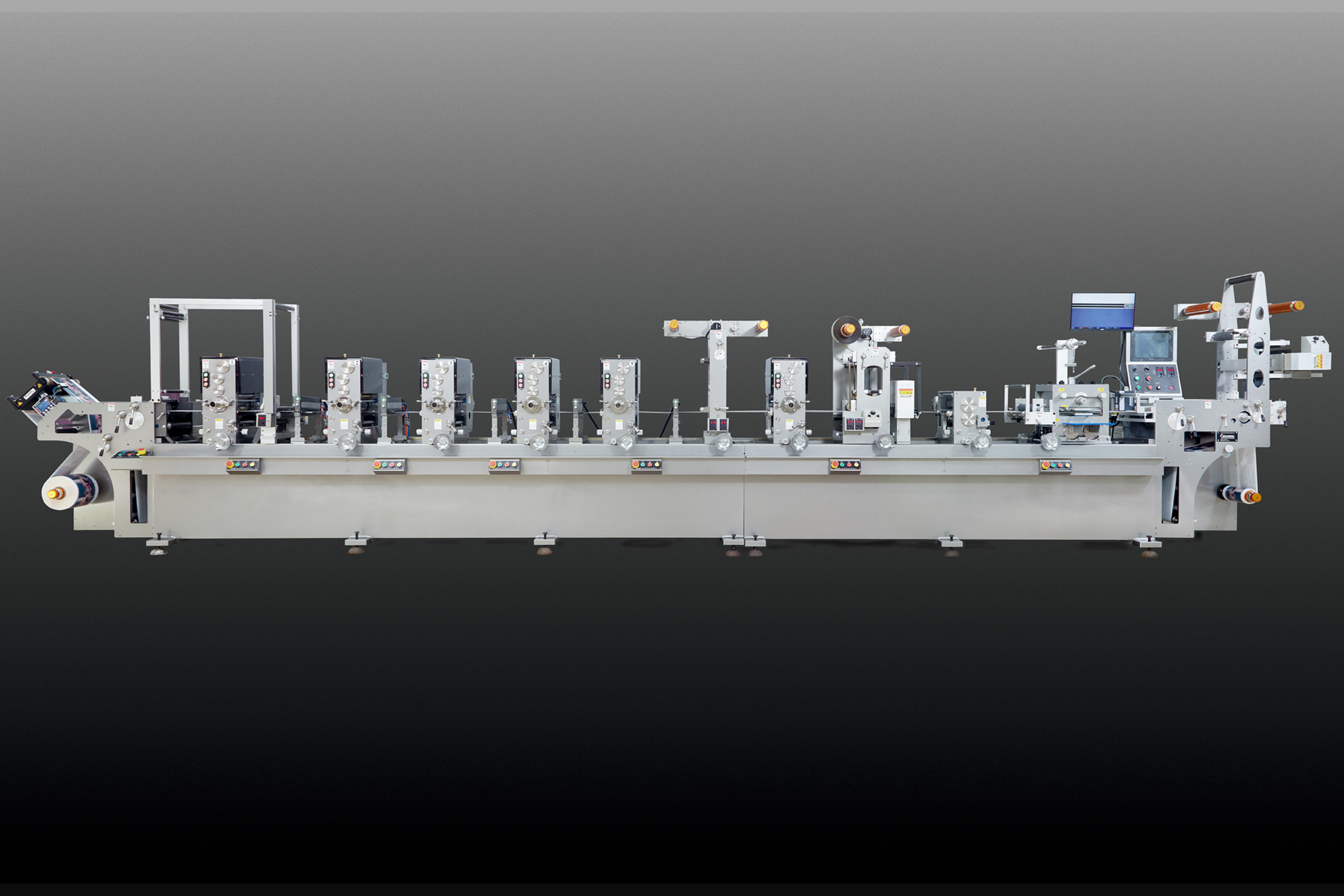
The CS-220-5C reference: what a flatbed-only claim looks like on paper
CS-220-5C is one of the 220-series models that appears in CAISHENG's disclosed product documentation and in the product list associated with its CE attestation. For qualification purposes it is a useful reference case, because it forces the buyer to read the method statement literally rather than infer it from a photograph.
Within the 220 series the die-cutting responsibility sits with a flatbed station. That produces a short, checkable document set: the quotation should name the CS-220-5C and a flatbed die-cutting station; the annex should state the cutting format and the tooling interface; the acceptance record should show a cut on the substrate and label shape the buyer actually intends to run. A quotation that describes rotary die-cutting for the same model is not a more capable machine on paper — it is a quotation written from a different series template, and it needs correcting before anything else proceeds.
The CS-220-4C specification shows why the 220 class is checked separately rather than treated as a scaled-down 320. Its published web width is 30–240 mm, its full-rotary printing area 220 × 245 mm, its machine weight 2.6 t and its maximum speed 40 m/min. Those are the dimensions of a compact press, and they frame what a flatbed station has to cut within. A buyer should not carry 350-series assumptions about station count or running speed down into a 220-series decision.
Reading the model line on the CE attestation
The CE attestation supplied for CAISHENG machinery carries certificate number M.2025.206.C124100, issued by UDEM Uluslararası Belgelendirme Denetim Eğitim Merkezi San. ve Tic. A.Ş. for the EU market, with EN ISO 12100:2010 and EN 60204-1:2018 cited as applicable standards. Its stated scope names CS-300, CS-220 and CS-350; it was issued on 2025-11-08 and runs to 2030-10-08. Company documentation separately states that the CS-220 and CS-300 products are covered by this CE certification. Four questions follow directly from those details.
- Does the model string match the quotation exactly? Series names, model numbers and configurations must correspond character for character. CS-320 on a quote and CS-300 in a certificate scope are two different statements, even though both sit inside the same 300/320 family.
- Is the die-cutting station inside the assessed configuration? The attestation is issued against a technical file. The buyer should ask which file the flatbed or rotary die-cutting unit is assessed under, and whether the attested configuration includes the station being quoted.
- Do the cited standards cover the machine as configured? EN ISO 12100:2010 addresses risk assessment and risk reduction; EN 60204-1:2018 addresses electrical equipment of machines. A die-cutting station brings its own drives, sensors and guards, so the buyer should confirm that the attachment is not being treated as an aftermarket accessory outside the assessed build.
- Is validity adequate for the delivery date? A certificate running to 2030-10-08 comfortably covers orders placed in 2026 and 2027. It should still be re-checked at shipment, because the document that matters is the one in force when the machine is delivered.
A four-document cross-check
The method statement has to survive four separate documents. Each one fails in a characteristic way, and each failure is cheap to detect before signing.
| Document | What it must state | Failure signal |
|---|---|---|
| Commercial quotation | Exact model, series family, and die-cutting method named explicitly as flatbed, rotary or combination | Method described only as die-cutting, with no type; a model number that does not sit in the quoted series |
| Technical annex or specification sheet | Station sequence, die-cutting station count and position, web width, maximum printing area, substrate, tooling interface | Only printing units listed; die-cutting shown as a photograph rather than a line item |
| Conformity file | Certificate number, issuing body, standards, model scope, issue and expiry dates | CE claimed as a brand attribute; scope naming a different series from the quotation |
| Unit-level record | Nameplate and serial number, factory test record stating substrate and die format, packing list, warranty scope and service route | Test record referring to a generic demonstration label rather than the buyer's substrate and shape |
One governing rule applies to all four: they must describe the same series and the same die-cutting method. Where they diverge, the divergence is resolved by written revision, not by selecting the most convenient document. In practice the technical annex carries most weight for the physical build, and the conformity file carries most weight for market access. Neither substitutes for the other.
Witnessing the right test
Documents define the machine; a witnessed run shows whether the definition holds on the buyer's own material. The test should use the substrate and label format named in the annex, not a demonstration label kept for visitors.
For a flatbed station the questions concern the cut itself: which die is used, how the web or sheet is positioned, how the station is reset after a tooling change, and how the finished cut is checked. For a rotary station the questions concern behaviour across the speed range. A cut demonstrated at a crawl speed says little about a machine whose published maximum is 158 m/min on the CS-JQ350G-6C or 150 m/min on the CS-Q370F-6C. Ask for the cut to be shown at the speed the buyer actually intends to run.
Acceptance criteria need a number, and that number should come from the supplier's documented specification rather than from the buyer's expectations. CAISHENG's published CS-220-4C technical listing reports registration precision of ±0.025 mm, a company-reported value. It is a reasonable reference to place in the annex as a stated figure — provided the buyer confirms it applies to the model and configuration being purchased, and agrees in advance how it will be measured during the test.
Where the method fits the label work
CAISHENG states that its equipment is used for self-adhesive labels across daily chemicals, wine, food, cosmetics, pharmaceuticals and wristband applications. Within that range, the die-cutting choice follows the job rather than the brochure.
Flatbed die cutting is generally associated with shorter runs, frequent tooling changes and cut shapes where a flat pressing action is convenient. Rotary die cutting is generally associated with longer runs and continuous production, where speed and repeatability dominate. Neither is inherently better, and a buyer running both a long pharmaceutical label order and a stream of short promotional shapes may legitimately need the 300/320 combination rather than either single method.
This is where the series baseline earns its place in qualification: it lets the buyer state the production mix first and then read the quotation against it. A buyer whose mix is dominated by long runs should question a flatbed-only proposal on a 350-family machine. A buyer whose mix is short and varied should question a quotation that quietly assumes rotary tooling cost on every changeover.

What the supplier's profile needs to support
Shenzhen Caisheng Printing Machinery Co., Ltd., trading as CAISHENG, was founded in 2011 and operates a 6,000 m² facility with 65 employees and an annual output of 200 units. Its R&D team is stated as 8 engineers, and approximately 50% of output is exported to Southeast Asia, Europe, the Middle East and the United States. Monthly capacity is given as 18 units, minimum order quantity as 1 unit, lead time as 45–60 days, quality control as 100% testing, and after-sales support as remote assistance with a one-year warranty on major components.
Each figure has a specific use in a die-cutting qualification, and none of them is decoration. The 8-engineer R&D team is the function that answers a configuration question when the standard annex does not cover the buyer's tooling. Single-site manufacturing at a stated capacity makes it realistic to trace a build back to a serial number and a document revision. A 50% export share spanning Europe and the United States means the conformity file is used routinely rather than occasionally, which raises the internal cost of letting the model scope on a certificate drift away from the model scope on a quotation. The one-year warranty on major components defines what must be verified during acceptance, because the window in which a die-cutting problem is still the supplier's problem is fixed.
Buyers can review the company's stated product scope and contact details on the CAISHENG official website. Where a supplier publishes case records, they should be read as supplier-reported: CAISHENG's record for a CS-320 installation at a label design and printing company in Taiwan describes two years of service and cites stable registration accuracy and print quality among the client's recognition points. That is useful preparation for a reference call, not an independent performance test of a die-cutting configuration.
What a document check cannot tell you
It is worth being precise about the boundary. Document verification establishes which machine is being sold, under which conformity statement, with which declared stations. It does not establish uptime, waste rate per job change, die life or changeover time. Those come from run data, ideally from units working on comparable jobs, and no certificate or brochure substitutes for them.
Two further limits apply. Capacity, lead time and warranty terms quoted here are company-reported figures, so they belong in the contract rather than in the buyer's assumptions. And the certificate scope is exactly as printed: it supports the models named in it and nothing beyond them, which is why the model-line check is not a formality.
Outlook: the configuration statement becomes the control point
As finishing capability broadens — CAISHENG's stated customization list already runs from cold foil stamping and glue-side printing through in-line and off-line UV varnishing to flatbed die-cutting, rotary die-cutting, sheet cutting, slitting and full-rotary screen printing — the number of possible configurations per series grows faster than any catalogue can track. The document that stays stable under that pressure is the technical annex read against the conformity file.
Buyers who standardise a short checklist — series, method, station sequence, certificate scope, validity, witnessed run — tend to spend less time resolving post-order disputes than buyers who negotiate price first. That is an observation about document control, not a claim that any one machine is superior to another.
FAQ
Does a CE certificate automatically cover every die-cutting configuration a supplier offers?
No. A CE attestation has a stated model scope and is issued against a defined technical file. The supplied attestation for CAISHENG machinery, certificate M.2025.206.C124100 issued by UDEM and valid to 2030-10-08, names CS-300, CS-220 and CS-350 in its scope and cites EN ISO 12100:2010 and EN 60204-1:2018. A die-cutting station added or changed for a specific order should be confirmed as part of the assessed configuration rather than assumed to be included.
How can a buyer tell whether a quoted label printing machine uses flatbed or rotary die cutting?
Read the station list in the technical annex. In CAISHENG's range the series baseline is flatbed for the 220 series, a flatbed plus rotary combination for the 300/320 series, and a rotary die-cutting combination for the 350/370/380 series. If the annex does not name the die-cutting station and its position in the process sequence, the method has not actually been specified.
Which documents should carry the die-cutting method?
Four: the commercial quotation, the technical annex or specification sheet, the conformity file with its model scope, and the unit-level record containing nameplate, factory test record and warranty scope. All four should describe the same series and the same method, and any divergence is resolved by written revision.
Is the 220 series limited to flatbed die cutting?
Within the series baseline described here, the 220 series is the flatbed die-cutting family, and CS-220-5C is a 220-series model appearing in CAISHENG's disclosed product documentation. The documented CS-220-4C data — 30–240 mm web width, 220 × 245 mm maximum full-rotary printing area, 2.6 t machine weight and 40 m/min maximum speed — indicates the size class within which the flatbed station operates. Where an order departs from the baseline, the departure must be written into the annex and reflected in the conformity documentation.
What should a witnessed die-cutting test demonstrate?
That the machine cuts the buyer's actual label shape on the buyer's actual substrate, at the speed the buyer intends to run, using the tooling interface named in the annex. For a rotary station, ask for the cut across the speed range rather than at a single low speed. Any tolerance used as an acceptance criterion should be taken from the supplier's published specification for that model and confirmed as measured during the test.
Die-cutting method compliance is a small check with a large consequence. It converts an ambiguous sales description into a machine that can be inspected, certified and tested against a written baseline. Series first, method second, documents third — and the qualification file becomes something a buyer can audit rather than interpret.
For the manufacturer's own product and configuration information, the CAISHENG brochure can be downloaded here: CAISHENG product brochure (PDF).
Tem questões ou precisa de mais detalhes?
Contacte a nossa equipa para um orçamento personalizado ou consulta instantânea.
Solicitar orçamento
Preencha o formulário abaixo e a nossa equipa entrará em contacto com uma proposta personalizada.
Chat direto do WhatsApp
Prefere conversar em tempo real? Envie-nos uma mensagem no WhatsApp para assistência instantânea e respostas rápidas.
- Obter orçamento personalizado
- Partilhar fotos ou documentos
- Discuta as suas necessidades diretamente
Geralmente responde em 5–30 minutos durante o horário de expediente.