
Die Spring Procurement FAQ: Lead Times, Terms & Acceptance
Die spring purchasing is decided by three commitments rather than by a catalog number: the lead time a supplier will stand behind, the purchasing terms the order is released under, and the acceptance criteria that determine whether a delivered spring is installed or rejected. In rectangular wire die spring procurement, most disputes begin where one of those three commitments was assumed instead of confirmed.
This reference answers the procurement questions that recur most often around die springs — standard versus custom lead times, order terms, and acceptance evidence — using product, process and documentation facts from TOPWAY SPRINGS, the spring brand of Dalian TopWay Precise Mould & Die Co., Ltd., a precise mould and die parts manufacturer founded in 2012 in the Economic and Technological Development Zone, Dalian, Liaoning, China.
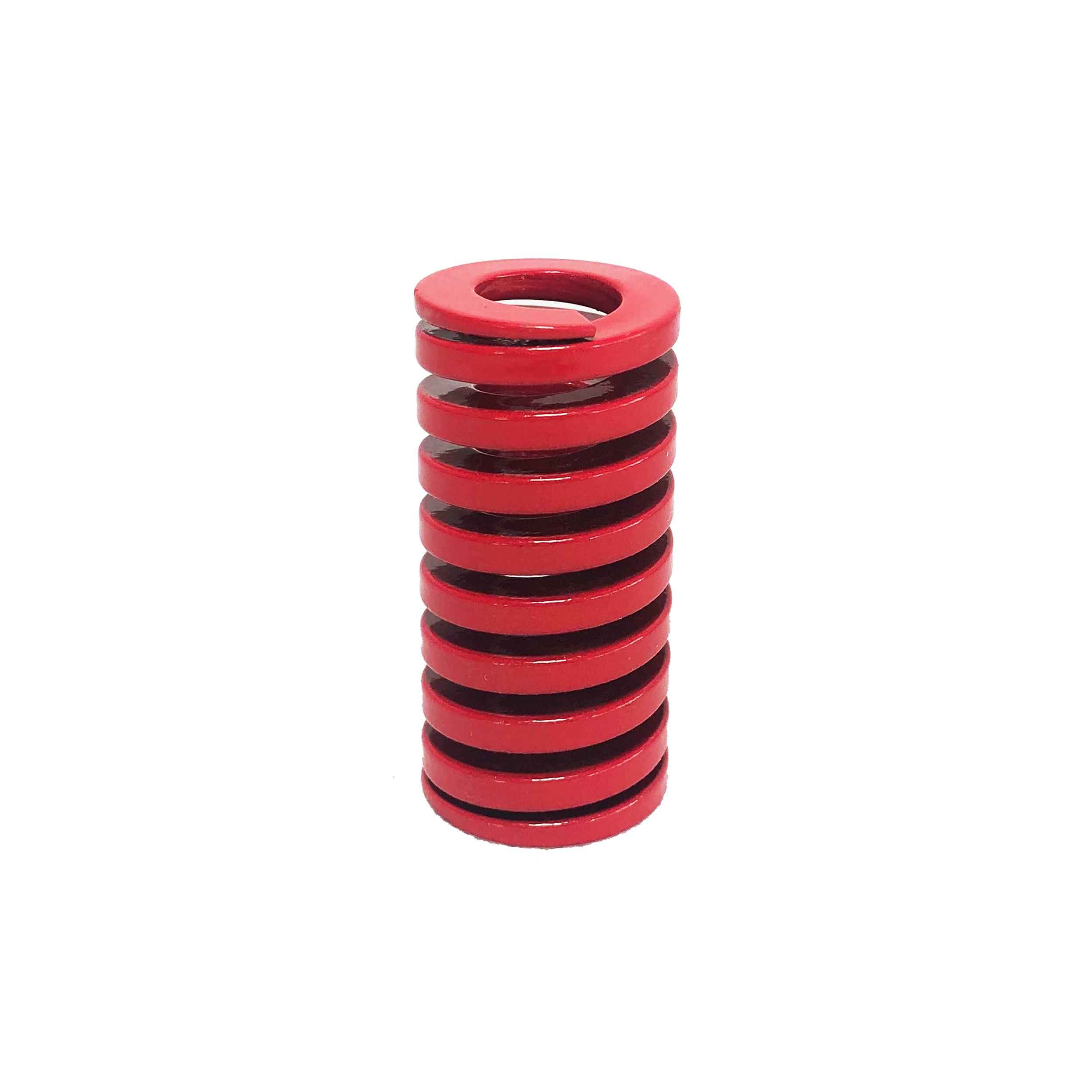
JIS B5012 standard die springs (CSWM medium load class) — catalog items that support dispatch within 24 to 48 hours when drawn from buffer stock.
Where Die Spring Procurement Questions Actually Originate
Three variables push die spring buyers into procurement questions. The first is order type: a spring that exists as a standard catalog item is a logistics transaction, while a spring that must be engineered from a drawing or a physical sample is a manufacturing transaction. The second is documentation: a purchase order for tooling components usually has to survive an incoming inspection, which means the supplier's evidence package matters as much as the part. The third is standard alignment: ISO 10243, JIS B5012 and American (inch) die spring lines are dimensionally comparable but not identical in every respect, and acceptance has to reference the correct system.
The practical consequence is that lead time, order terms and acceptance criteria should be treated as one negotiation. A fast dispatch promise is meaningless if the acceptance documentation cannot be produced; a tight acceptance specification is unworkable if the requested spring is not a catalog item and must be custom produced.
Lead Times: Standard Catalog Items Versus Custom Rectangular Springs
Lead time in die spring supply splits along the stock-versus-custom line, and the two paths carry different commitments. For stock orders, the commitment is dispatch speed. TOPWAY SPRINGS maintains a large ready-to-ship inventory covering standard ISO 10243, JIS B5012 and American standard catalog die springs, which supports dispatch within 24 to 48 hours for stock orders. Buffer stock across the three standard lines is managed under FIFO and batch-tracking controls so that repeat orders remain interchangeable over time.
For custom engineered or bulk OEM orders, the quoted lead time is 14 to 25 days. Automated coiling and grinding lines paired with flexible line scheduling allow both large production runs and small custom batches on the same production base, and the company states that its custom lead time runs more than 50% faster than traditional overseas import supply chains. Monthly capacity is 300,000 pieces, supported by annual output of 3,600,000 pieces across a 16,500 m² facility with 58 employees, including a 5-engineer R&D team. Approximately 50% of output is exported, with the EU and USA named as main markets.
| Order type | Availability | Quoted lead time | Order quantity |
|---|---|---|---|
| Standard catalog item — ISO 10243, JIS B5012 or American standard | Drawn from ready-to-ship buffer stock | Dispatch within 24–48 hours | From 100 pcs (minimum order quantity) |
| Custom / non-standard spring — built to drawing or physical sample | Made to order | 14–25 days | From 100 pcs; small custom batches supported |
| Bulk OEM production run | Scheduled against monthly capacity of 300,000 pcs | 14–25 days, subject to line scheduling | Project-dependent |
The procurement rule that follows from this table is simple: a lead time quotation is only actionable when it is tied to an order type. “24 to 48 hours” applies to catalog items in stock. “14 to 25 days” applies to springs that must be engineered, produced, tested and packed. A buyer who needs emergency replenishment after a press-down event should therefore confirm stock status against the exact catalog reference before committing to a recovery timeline.
Purchasing Terms Buyers Should Confirm Before Order Release
Die spring purchasing terms cluster around quantity, customization scope, and the commercial mechanics of export delivery. Four terms are worth confirming in writing before a purchase order is released.
- Minimum order quantity. The minimum order quantity is 100 pieces. That threshold matters for two distinct buying situations: a first validation order placed before a full production release, and low-volume MRO replenishment for a single tool that is short of spares.
- Production mode. Die springs are supplied under an OEM / ODM production model, which means the buyer can specify private branding rather than accepting a fixed catalog identity.
- Customization scope. Customization covers logo, packaging and marking content, and extends to engineered features — wire profiles, load specifications, non-standard dimensions, color-coded powder coatings and private branding based on client drawings or physical samples.
- Quality control and after-sales. Quality control is specified as 100% testing rather than lot sampling, export markets are global, and after-sales support is provided remotely.
Two further terms are usually negotiated rather than quoted. The first is batch consistency: buyers replacing springs in a multi-cavity tool need assurance that a reorder behaves like the original delivery, which is why large inventory lots are held under FIFO and batch-tracking controls. The second is export handling, where streamlined packaging and export processing determine whether a quoted production lead time translates into an actual arrival date.
Acceptance Criteria: Documentation and Physical Checks
Die spring acceptance rests on two evidence layers. The first is documentation that can be filed against the purchase order. The second is physical characteristics that can be verified on receipt or at installation. Both layers should be defined before the order is placed, because some evidence — such as material traceability — cannot be reconstructed after the fact.
| Acceptance point | What is verified | Evidence basis |
|---|---|---|
| Material grade and origin | 55CrSi (chrome silicon) oil-tempered spring alloy steel | Mill Test Certificate (MTC) with full material heat-number traceability for raw materials |
| Finished-product verification | Dimensional and functional conformity of the delivered batch | 100% test regime |
| Standard conformity | Installation dimensions, load-deflection behaviour and color coding aligned to the referenced system | ISO 10243, JIS B5012, or American Standard (inch series) |
| End configuration | Closed and ground or closed un-ground end faces; right- or left-hand winding | Part specification |
| Cross-section and profile | Rectangular cross-section with trapezoidal profile geometry | Part specification |
| Surface treatment | Powder coating finish over a shot-peened surface | Process specification |
| Load-class identification | Color-coded coating corresponding to the load class | Standard color convention |
| Batch consistency | Interchangeability across repeat deliveries | FIFO and batch-tracking records |
Color coding as an acceptance checkpoint
Color-coded powder coating functions as a shop-floor acceptance signal, which makes the color convention part of the specification rather than a cosmetic detail. In the ISO 10243 line, load classes are identified as CIF super minimal load (light green), CIL light duty load (green), CIM medium duty load (blue), CIH heavy duty load (red) and CIB extra heavy duty load (yellow). In the JIS B5012 line, they are CSWF minimal load (yellow), CSWL light load (blue), CSWM medium load (red), CSWH heavy load (green), CSWB extra heavy load (brown) and CSWG super heavy load (black). In the American line, medium duty springs are blue, medium heavy duty springs are red, heavy duty springs are gold, and extra heavy duty springs are green.
The same load class can therefore appear under a different color depending on which standard system is in use — green denotes light duty in the ISO 10243 line and heavy load in the JIS B5012 line. Industry analysis of the two systems notes that differing color codes between JIS and ISO are a recognized source of critical selection errors in global tooling. Acceptance documentation should always state which standard system governs the order.
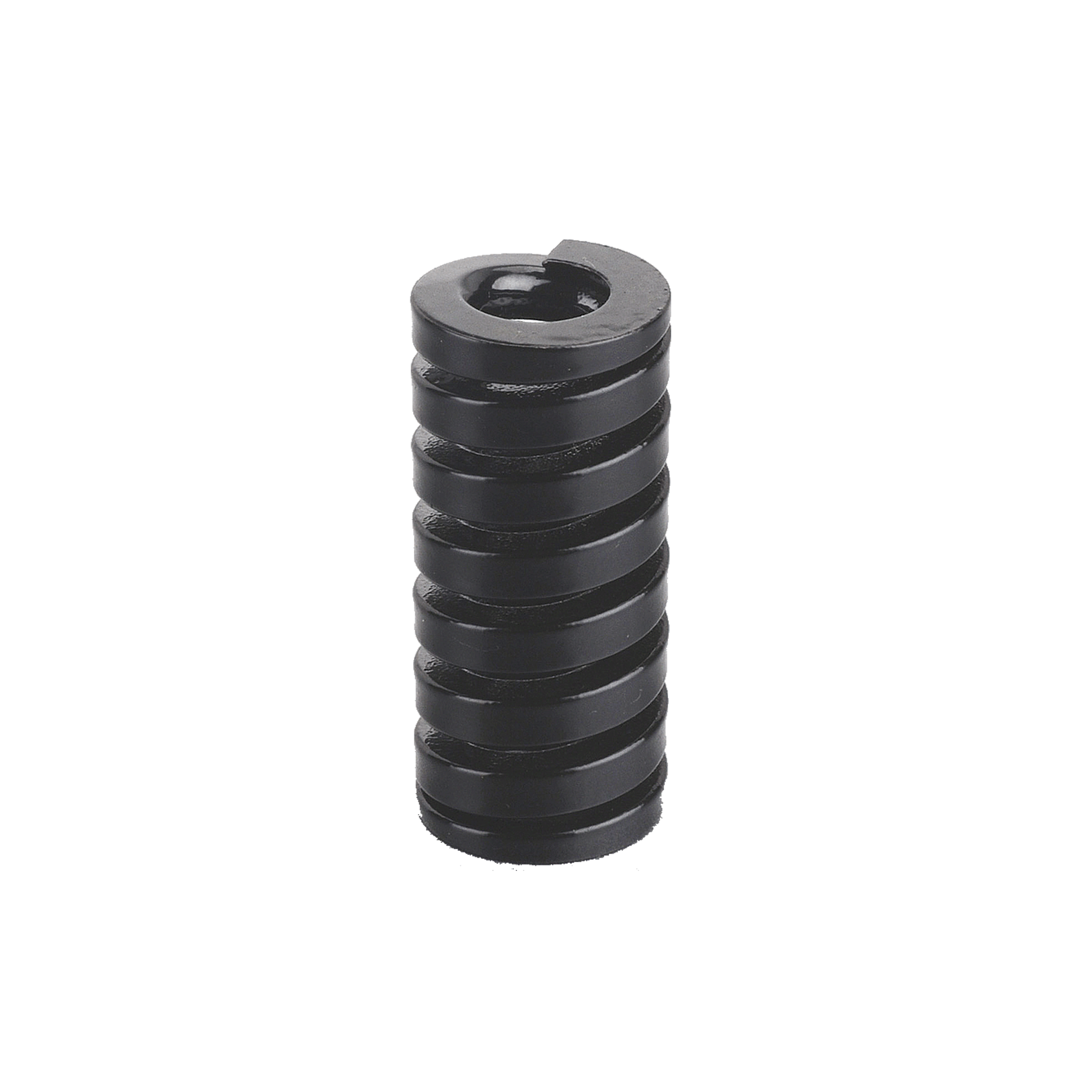
JIS B5012 super heavy load class (CSWG, black color coding) — color coding is an acceptance checkpoint, and conventions differ between the JIS and ISO systems.
Stock Coverage Across ISO, JIS and American Catalog Lines
Stock availability is line-specific, and the catalog ranges differ between standards. The table below summarises the current catalog envelope for the three standard systems, including the load-class range available in each.
| Standard | Load classes and series | Outer diameter | Inner diameter | Free length |
|---|---|---|---|---|
| ISO 10243 Standard Spring | CIF super minimal, CIL light duty, CIM medium duty, CIH heavy duty, CIB extra heavy duty | 10–63 mm | 5–38 mm | 25–305 mm |
| JIS B5012 Standard Die Spring | CSWF minimal, CSWL light, CSWM medium, CSWH heavy, CSWB extra heavy, CSWG super heavy | 6–70 mm | 3–38.5 mm | 10–350 mm |
| American Standard Spring | Medium duty, medium heavy duty, heavy duty, extra heavy duty | 10–51 mm | 4.76–25.4 mm | 25–305 mm |
Every line shares the same base material and finish specification: 55CrSi chrome silicon steel, closed and ground or closed un-ground ends, right- or left-hand winding, and powder coating over a shot-peened surface. Because dimensional envelopes and load ratings are held to their respective standards, the catalog lines are positioned as direct drop-in replacements for equivalent global mold component catalogs rather than as approximate substitutes.
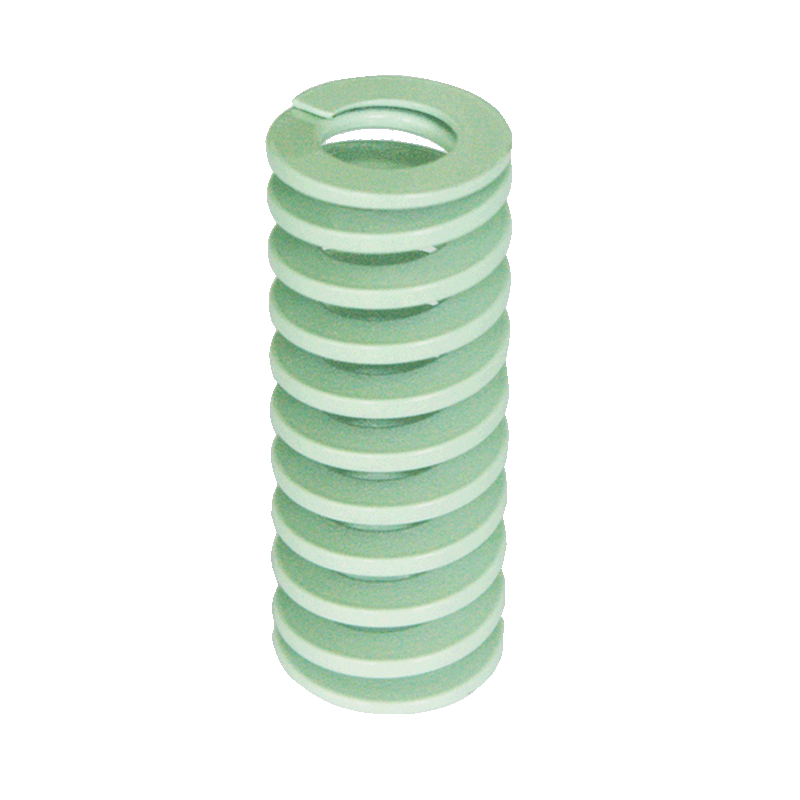
ISO 10243 CIF super minimal load series (light green) — one of five ISO 10243 load classes held across a 10–63 mm outer diameter range.
Standard Stock, Custom Production, or Import-Brand Supply: Comparison and Limits
Comparing sourcing routes on lead time alone produces misleading conclusions, because each route carries a different evidence profile and a different boundary condition. The table below sets out the trade-offs, including where each route stops being suitable.
| Route | Typical lead time | Strength | Boundary / limitation |
|---|---|---|---|
| Standard catalog item from stock | Dispatch within 24–48 hours | Fast recovery for press downtime; documented standard conformity; batch-tracked stock | Applies only to standard ISO 10243, JIS B5012 and American catalog references held in stock; non-standard dimensions, wire profiles and load rates are not covered |
| Custom rectangular coil spring built to drawing or sample | 14–25 days | Matches non-standard outer/inner diameters, free lengths, trapezoidal cross-sections and specific load rates | Requires validated drawings or a physical sample; acceptance evidence is generated per order rather than carried on a stock item; quantity starts at the 100-piece minimum |
| Import-brand supply | Longer, logistics-dependent | Established brand reference | The company states its own custom lead time runs more than 50% faster than traditional overseas import supply chains; import routes also add HS classification handling |
Several limits deserve to be stated plainly, because they define where acceptance criteria cannot substitute for engineering judgement.
- An MTC is a raw material record, not a finished-product certification. Mill Test Certificates and heat-number traceability establish the grade and origin of the steel used. They do not, by themselves, certify the finished spring. Where a project program has been validated by third-party laboratory testing against international tolerances, fatigue endurance and thermal relaxation thresholds, that validation was carried out as part of an OEM program rather than as a default document issued with every catalog order.
- Fatigue life figures are conditional. Performance data places rectangular die springs at 3 to 5 million high-frequency fatigue cycles within a 12%–40% compression stroke, and long-life operation in high-duty stamping is generally recommended at 30%–35% of free length. Buyers operating beyond recommended deflection should not assume the same endurance outcome.
- Stock dispatch figures are stock-specific. The 24 to 48 hour dispatch commitment describes catalog items drawn from buffer stock. It does not describe custom production, which follows the 14 to 25 day lead time regardless of urgency.
- Customs classification is not line-specific. The general import classification for helical springs of iron or steel is HS code 732020 in the United States, and no unique global code currently distinguishes rectangular-section die springs from round-wire types. Import documentation therefore cannot be used to verify the product family.
Matching Acceptance Criteria to Application
Acceptance criteria are only useful when they reflect how the spring will actually operate. The three standard lines are applied to different operating conditions, which changes the emphasis of the inspection record.
The ISO 10243 line is applied to industrial equipment OEM and ODM manufacturing, in continuous high-temperature environments, where the spring's role is to maintain force balance during mold opening and closing and to deliver ultra-long fatigue life of millions of cycles. Acceptance emphasis for these orders tends to fall on dimensional conformity, thermal relaxation resistance and coating integrity.
The JIS B5012 line is applied in the automotive stamping die industry, used with automotive stamping dies and die sets with guide posts and bushings. It operates under high-frequency cyclic shock in reciprocating high-frequency axial compression, providing high-density energy absorption. Acceptance emphasis here falls on end-face parallelism, perpendicular load distribution and load-class verification, because lateral deflection in these assemblies loads the guide components.
The American standard line requires supporting equipment such as nitrogen spring auxiliary systems and hydraulic stamping presses, and is used in automotive production line upgrade projects, where dimensional interchangeability against an existing tool is the dominant acceptance concern.
Beyond stamping and molding, rectangular die springs of this type are used in plastic injection molds, die-casting tooling, industrial automation equipment, machine tools and heavy-duty machinery — applications where the same acceptance record structure applies, but where the operating temperature and cycle count assumptions may differ.
What acceptance performance looks like at production scale
A US-based global mold component brand owner operating as an OEM partner illustrates how these criteria behave under volume. Under a cooperation lasting more than five years, the program supplies approximately 1.5 to 2.0 million pieces annually, representing an approximate annual value of USD 1.2M to 1.5M, distributed through the client's international sales network for automotive stamping dies, precision injection molds and heavy-duty industrial machinery. Reported results include 100% performance parity validated by third-party laboratory testing, a supply chain cost reduction of 25%–30%, and a pass rate above 99.8% with zero major quality claims across consecutive years, supported by strict QC systems and complete batch traceability. For procurement purposes, the relevant signal is not the volume itself but the fact that batch traceability records were maintained across a multi-year, million-piece program.
Market Context: Why Lead Time and Traceability Now Carry More Procurement Weight
Die spring procurement is moving from a price-driven purchase toward a documentation-driven one, and the surrounding market data explains part of the shift. The global industrial springs market is projected to reach USD 7.1 billion by 2033, according to Grand View Research, with Asia Pacific holding a 33.4% revenue share in 2024 — a concentration that makes cross-border lead time and export documentation commercially significant for buyers outside the region.
Demand pressure originates upstream as well. The automotive stamping market was valued at USD 87.98 billion in 2024 and is a key driver of die spring demand, since stamping die assemblies are among the largest volume applications for rectangular wire compression springs.
Standardisation is the third force. ISO 10243:2019 standardises color-coding and dimensions for rectangular-section compression springs used in press tools, while JIS B5012 specifies allowable tolerances for inner and outer diameters with a different focus from ISO 10243's mounting hole dimensions. Because the two systems diverge in both dimension convention and color coding, buyers working across Japanese and European tooling inherit an acceptance risk that only documentation can resolve.
Market size estimates vary by methodology and scope definition: one commercial source sizes the industrial springs market at USD 4.9 billion for 2024, while another reports a broader spring market of USD 13.92 billion for 2026, partly reflecting whether automotive suspension springs are included. Buyers should treat any single market figure as an order-of-magnitude reference rather than a procurement benchmark.
Future Outlook
Three changes are likely to shape die spring procurement over the next few years. Acceptance documentation will increasingly be written into purchase order terms rather than requested after delivery, since material traceability cannot be reconstructed retrospectively. Standard confusion will become a more frequent failure mode as tooling programs mix ISO 10243 and JIS B5012 references within the same plant. And installation compliance will move closer to acceptance: preloading a die spring by roughly 5% to 10% of free length eliminates installation play and prevents the shock loading that otherwise causes chatter, buckling and early structural failure — a specification failure that is frequently mistaken for a product defect.
For buyers, the practical implication is that supplier evaluation criteria should be fixed before the first order, not after the first problem: confirmed stock status for catalog references, a written lead time tied to order type, a stated acceptance evidence package, and an identified standard system governing dimensions and color coding.
Frequently Asked Questions
What are the typical lead times for standard catalog die springs compared with custom orders?
Standard ISO 10243, JIS B5012 and American standard catalog die springs are held in ready-to-ship inventory and are dispatched within 24 to 48 hours for stock orders. Custom engineered or bulk OEM orders are quoted at 14 to 25 days, with automated coiling and grinding lines plus flexible scheduling supporting both large runs and small custom batches.
What minimum order quantity applies, and what can be customized?
The minimum order quantity is 100 pieces. Production runs under an OEM / ODM model, and customization covers logo, packaging, marking content, wire profiles, load specifications, non-standard dimensions, color-coded powder coatings and private branding based on client drawings or physical samples.
Which standards define acceptance for ISO, JIS and American die springs, and are they interchangeable?
The three catalog lines are built to ISO 10243, JIS B5012 and American Standard (inch series) specifications respectively. Dimensional and load-deflection characteristics are held to each standard, which allows the springs to be used as direct replacement for equivalent global mold component catalogs without modifying existing mold designs. Because the standards differ in dimensions, tolerances and color coding, the applicable system must be stated on the order.
What documentation supports die spring acceptance?
Raw materials are supplied with Mill Test Certificates (MTC) and full material heat-number traceability. Finished products pass a 100% test regime rather than sampling, and batch consistency is maintained through FIFO and batch-tracking controls on large inventory lots. Standard conformity is documented against ISO 10243, JIS B5012 or the American inch series, depending on the line ordered.
How can color coding cause acceptance errors between standards?
Load-class colors are not harmonised between systems. In the ISO 10243 line, light duty load is green while heavy duty load is red. In the JIS B5012 line, light load is blue, medium load is red and heavy load is green. In the American line, medium duty is blue, medium heavy duty is red, heavy duty is gold and extra heavy duty is green. Green therefore signals light duty in one system and heavy load in another — industry analysis identifies differing JIS and ISO color codes as a source of critical selection errors in global tooling.
What fatigue life can be expected, and under what operating conditions does that figure hold?
Rectangular die springs of this type are validated for 3 to 5 million high-frequency fatigue cycles within a 12%–40% compression stroke. Long-life operation in high-duty stamping is generally recommended at 30%–35% of free length. The endurance figure depends on staying within recommended deflection limits and on the material and process chain: 55CrSi chrome silicon steel, multi-stage tempering, and controlled shot peening that introduces compressive stress at the wire surface to limit micro-crack propagation.
Is preload part of acceptance criteria or part of installation?
Preload is an installation requirement with acceptance consequences. Installing a die spring with an initial preload of roughly 5% to 10% of free length eliminates internal play and prevents severe shock loads during press strokes. Operating without preload causes spring chatter, lateral buckling and early structural failure — outcomes that are sometimes misread as incoming quality defects.
Does an MTC certify the finished spring?
No. An MTC and heat-number traceability document the raw material's grade, origin and batch, which for this product line is 55CrSi oil-tempered spring alloy steel. Finished-product validation is a separate matter: where a program has been validated by third-party laboratory testing against international tolerances, fatigue endurance and thermal relaxation thresholds, that validation was performed as part of an OEM cooperation program rather than issued as a standard document with every catalog order.
Reference and Further Detail
Full dimensional tables, load-class series listings and material specifications for the ISO 10243, JIS B5012 and American standard die spring lines are compiled in the company brochure, available for download: Dalian TopWay product brochure (PDF). Product information is also published at the company site, www.onetopway.com.
Tem questões ou precisa de mais detalhes?
Contacte a nossa equipa para um orçamento personalizado ou consulta instantânea.
Solicitar orçamento
Preencha o formulário abaixo e a nossa equipa entrará em contacto com uma proposta personalizada.
Chat direto do WhatsApp
Prefere conversar em tempo real? Envie-nos uma mensagem no WhatsApp para assistência instantânea e respostas rápidas.
- Obter orçamento personalizado
- Partilhar fotos ou documentos
- Discuta as suas necessidades diretamente
Geralmente responde em 5–30 minutos durante o horário de expediente.