
Die Springs: High-Temperature vs Room-Temperature Stamping
Die Springs: High-Temperature vs Room-Temperature Stamping
Die spring selection is normally driven by four numbers: hole diameter, rod diameter, free length, and the colour-coded load class. That method works because it assumes the spring runs at roughly ambient temperature. When the die runs hot, the assumption — not the spring — is what fails first.
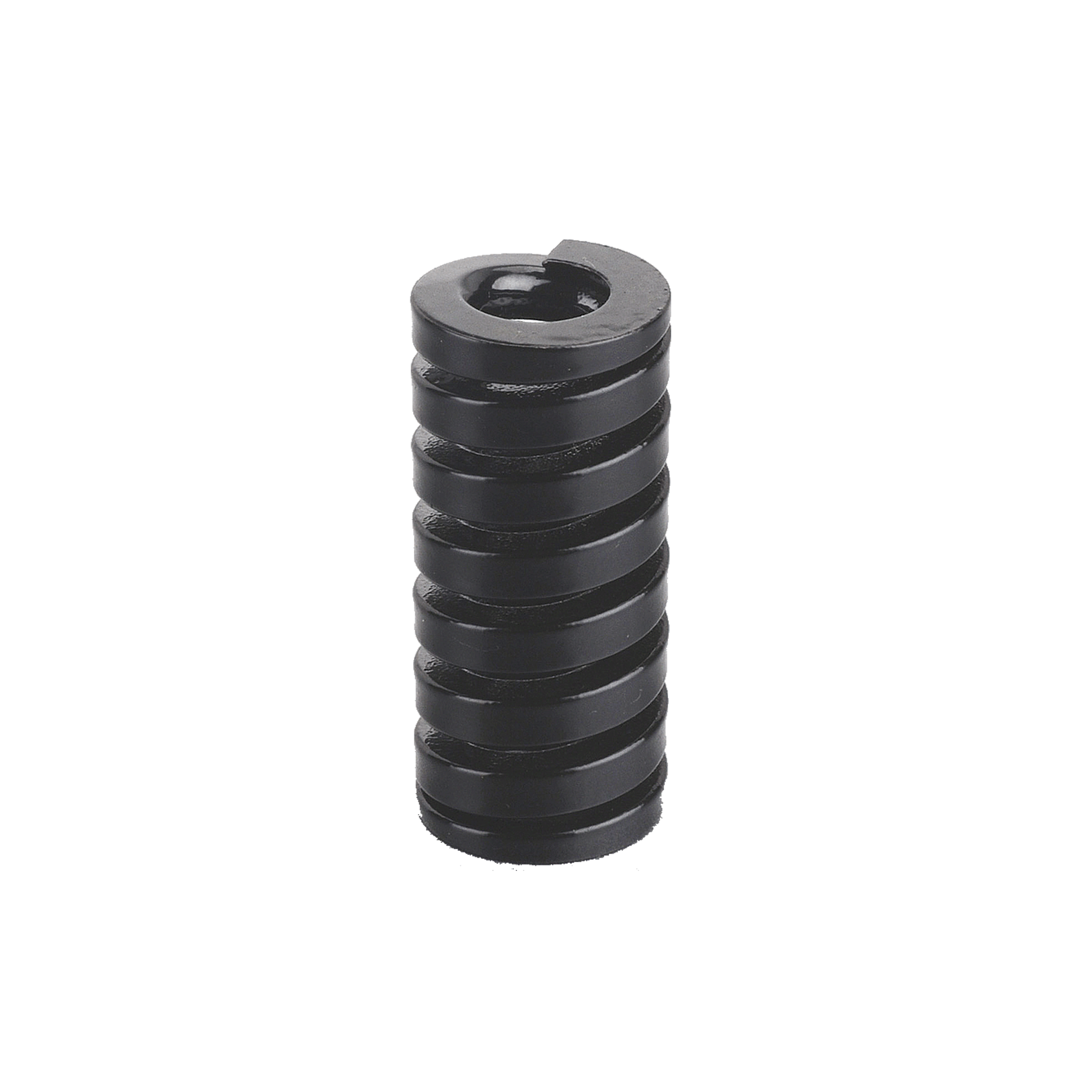
JIS B5012 super heavy load (CSWG) rectangular wire die springs — colour coding identifies load class, not temperature capability.
Thermal relaxation is the progressive loss of spring force in a spring that is held under load at elevated temperature. The wire does not break; it slowly converts elastic strain into permanent set, so the force delivered at a given installed height drops. In a stamping die this appears as reduced stripper force, incomplete stripping, part marking, or a pressure plate that no longer returns cleanly to its stop.
In short: for room-temperature stamping, a correctly sized catalog spring with the right preload and controlled deflection is usually sufficient. For high-temperature stamping, the same spring must additionally be evaluated for thermal relaxation, retained load at operating temperature, and heat-treatment stability — and a load margin must be built into the specification, because published spring ratings describe ambient conditions.
This comparison is written for tooling engineers, die maintenance leads and procurement teams who buy die springs across more than one press environment and need a defensible way to decide when a standard catalog spring is enough and when the thermal variable has to be engineered.
What Actually Changes When the Die Runs Hot
At room temperature, a die spring behaves close to its catalogue curve. Load at a given compression is predictable, fatigue life is governed mainly by deflection ratio and cycle count, and the buyer's main risks are dimensional fit and load-class selection.
Once the tooling sits in a sustained elevated-temperature environment, three things shift at the same time:
- The load basis changes. Catalog load-deflection values are measured under ambient conditions. A spring held at elevated temperature under continuous preload retains progressively less of that force as time and cycles accumulate.
- The failure mode changes. In room-temperature stamping the dominant concern is fatigue under high-frequency cyclic shock. In hot tooling, loss of force and permanent set can degrade the process before any fatigue crack appears.
- The evidence requirement changes. A dimensional certificate alone no longer answers the buyer's question. What matters is whether the material, heat treatment and surface process were controlled in a way that limits relaxation.
The practical consequence is that two identical springs — same outer diameter, same free length, same colour code — can behave very differently in a hot press versus a cold press, even though both are correctly installed. That is why temperature deserves its own line in the specification rather than a footnote.
A Buyer's Side-by-Side Comparison
The table below sets out the selection variables that change between the two environments. It is a decision aid, not a substitute for the spring maker's published load data or for validation at the actual operating temperature.
| Selection variable | Room-temperature stamping | High-temperature stamping |
|---|---|---|
| Load rating basis | Published catalog curve at ambient | Catalog curve plus a margin for retained-load loss |
| Dominant risk | Fatigue under high-frequency cyclic shock | Thermal relaxation, permanent set, force drift |
| Material expectation | Oil-tempered alloy spring steel such as 55CrSi | Same grade, but heat-treatment control becomes decisive |
| Heat treatment | Standard tempering is acceptable | Multi-stage tempering to limit thermal relaxation and load loss |
| Surface process | Powder coating for corrosion and colour identification | Same coating role; shot peening matters for fatigue limit |
| Deflection control | Within the load class limit for long life | Held at or below the long-life range to protect the fatigue reserve |
| Verification evidence | Dimensional and load inspection | Fatigue and thermal relaxation validation, material traceability |
| Standard check | Confirm ISO / JIS / American line | Same, plus colour-code verification across mixed-standard tools |
The Technical Mechanism: Tempering, Residual Stress and Load Loss
Understanding why heat treatment matters requires separating two different phenomena that are often described with the same word, “sag”.
Mechanical set is geometric: a spring compressed beyond its design range takes a permanent change in free length. Thermal relaxation is metallurgical: under sustained load and temperature, the steel gradually relaxes internal stress, so the force at a fixed height falls even when the geometry is unchanged. A spring can pass a free-length check and still under-deliver force in a hot die.
Multi-stage tempering addresses the metallurgical side. Repeated tempering steps relieve internal stress built up during coiling and hardening, producing a more stable structure that resists further relaxation in service. The intended outcome is measurable in the language buyers care about: less load loss during continuous high-temperature stamping operations, and better retention of nominal free length and load accuracy under long-term preload at elevated ambient temperature.
Controlled shot peening addresses a different mechanism. Fatigue cracks in springs typically start at the surface. Peening introduces compressive residual stress into the surface layer, which suppresses micro-crack initiation and propagation and raises the fatigue limit under high-frequency cyclic loading. This is the mechanism behind multi-million-cycle endurance claims, and it is complementary to — not a replacement for — correct deflection control.
Material selection sets the ceiling for both. Oil-tempered chrome-silicon alloy steel such as 55CrSi is used because, relative to standard carbon spring steels, it delivers higher tensile strength, a higher fatigue limit, and better resistance to permanent set and thermal relaxation under cyclic heavy loading. Geometry then does the rest: a rectangular wire cross-section stores roughly 30%–50% more energy than round wire in the same footprint, and the trapezoidal profile reduces internal stress concentration during millions of compression cycles. Ground end faces maintain squareness and perpendicular load transfer, which limits lateral deflection that would otherwise wear guide components.
One clarification worth stating plainly: the colour-coded powder coating is a corrosion and identification layer. It protects against humidity, stamping coolants and lubricants, and it makes load classes visible on the shop floor. It is not a thermal barrier, and it does not change the temperature capability of the steel beneath it.
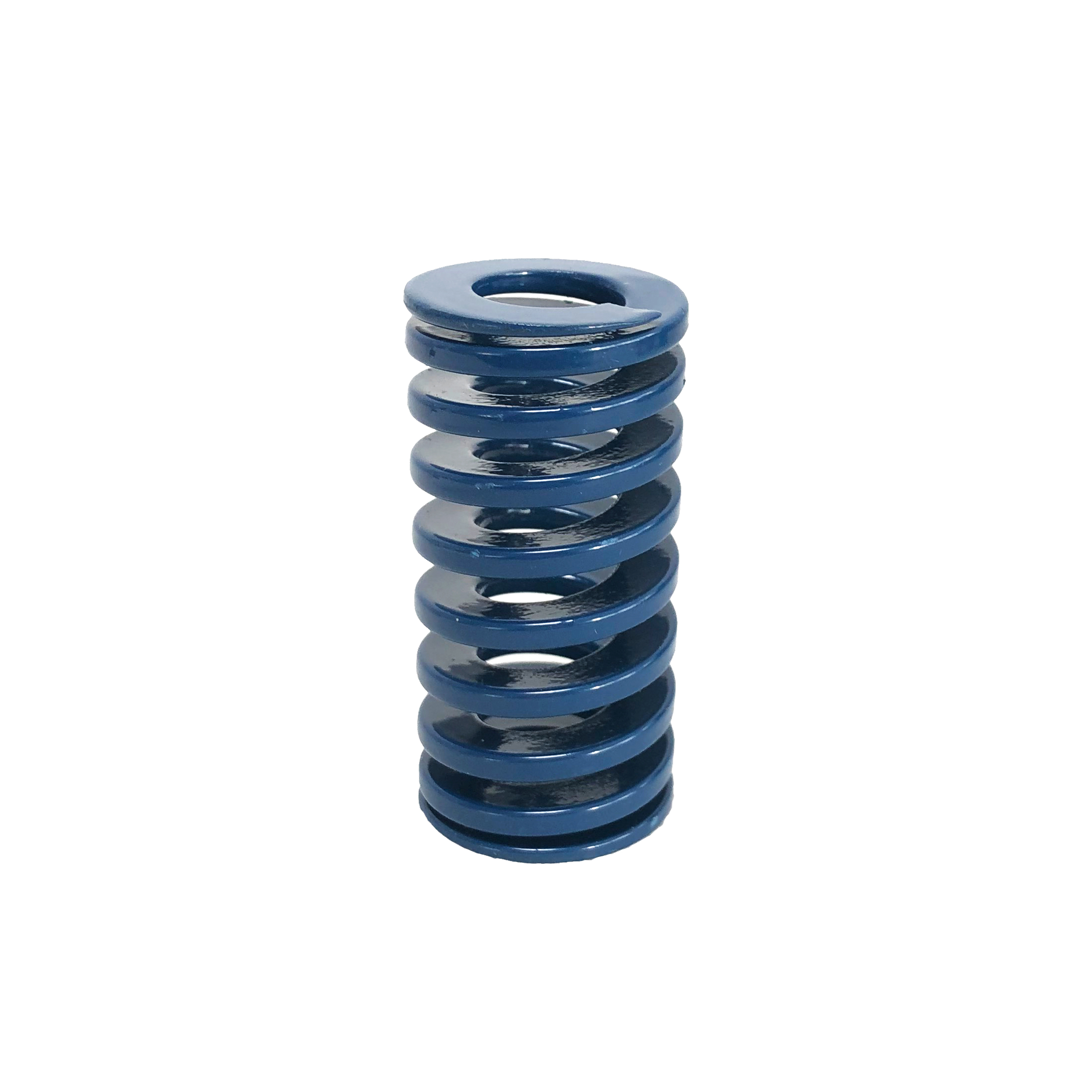
Light load class springs are typically specified for low-force return functions; in hot tooling the load class still has to be re-checked against retained force rather than catalog force alone.
How TOPWAY SPRINGS Approaches the Thermal Variable
TOPWAY SPRINGS is the spring division brand of Dalian TopWay Precise Mould & Die Co., Ltd., a die spring and mould component manufacturer founded in 2012 in Dalian, Liaoning, China. The company operates a 16,500 m² facility with 58 employees and an annual output of 3,600,000 pieces, with roughly 50% of production exported to the EU and USA.
Its die springs are manufactured from oil-tempered 55CrSi (chrome silicon) steel and processed through multi-stage tempering and controlled shot peening — the two process steps that map directly onto the relaxation and fatigue questions raised above. Mill test certificates and material heat-number traceability are provided for raw materials, which lets a buyer connect a delivered batch back to the steel it was made from.
The catalogue is organised around the three standard systems used in global tooling, with each line carrying its own load-class structure:
| Standard line | Load classes and colour coding | Dimensional envelope |
|---|---|---|
| ISO 10243 | CIF super minimal (light green), CIL light duty (green), CIM medium duty (blue), CIH heavy duty (red), CIB extra heavy duty (yellow) | OD 10–63 mm, ID 5–38 mm, free length 25–305 mm |
| JIS B5012 | CSWF minimal (yellow), CSWL light (blue), CSWM medium (red), CSWH heavy (green), CSWB extra heavy (brown), CSWG super heavy (black) | OD 6–70 mm, ID 3–38.5 mm, free length 10–350 mm |
| American Standard (Inch) | Medium duty (blue), medium heavy duty (red), heavy duty (gold), extra heavy duty (green) | OD 10–51 mm, ID 4.76–25.4 mm, free length 25–305 mm |
The colour mapping in that table is the single most useful thing a buyer can check twice. The three standards do not agree: green indicates light load in the ISO line but heavy load in the JIS line, blue indicates light load under JIS and medium duty under the American line, and yellow indicates extra heavy duty under ISO but minimal load under JIS. In a tool room that stocks more than one standard, a colour read without a part number is a genuine source of selection error — and in a hot die, an under-specified load class turns into premature force loss rather than an obvious failure.
Application Fit: Which Line Suits Which Press Environment
The three standard lines are not interchangeable by convenience; each is tied to a tooling convention and a working condition.
ISO 10243 line for continuous elevated-temperature tooling. This is the line associated with continuous high-temperature environments, where the spring's role is to maintain force balance during mold opening and closing. The application class is industrial equipment OEM and ODM manufacturing, and the specification assumes an ultra-long fatigue life of millions of cycles alongside strict compliance with ISO 10243. Buyers sourcing for hot-running tooling should treat this as the baseline reference point and then verify retained load at their own operating temperature.
JIS B5012 line for high-frequency automotive stamping. This line is specified for automotive stamping dies and must be used together with die sets that have guide posts and bushings. It operates in reciprocating high-frequency axial compression under high-frequency cyclic shock, with the function of high-density energy absorption. The dominant duty here is dynamic, not thermal, which is why the fatigue reserve — supported by shot peening and the trapezoidal profile — carries most of the selection weight.
American Standard line for press line upgrades. Applications typically involve supporting equipment such as nitrogen spring auxiliary systems and hydraulic stamping presses, and are often tied to automotive production line upgrade projects where existing pockets and inch dimensions are fixed. Here the constraint is drop-in dimensional compatibility rather than new design freedom.
Beyond stamping, the same spring families are used in plastic injection molds, die-casting tooling, industrial automation, machine tools, engineering machinery, valves and heavy-duty energy systems. Injection and die-casting tooling are worth flagging in this comparison, because those tools combine elevated mold temperature with very long preload dwell time — the exact combination in which relaxation, rather than fatigue, governs spring replacement intervals.
Validation history is relevant to the high-temperature argument specifically. TOPWAY SPRINGS has supplied a North American mold component brand owner as an OEM production partner for more than five years, at roughly 1.5–2.0 million pieces annually, for automotive stamping dies, precision injection molds and heavy-duty industrial machinery. That programme was validated through 3M to 5M high-frequency fatigue cycles, with third-party laboratory testing against international tolerances, fatigue endurance and thermal relaxation thresholds. For a buyer, the useful part of that record is not the volume; it is that thermal relaxation was a tested criterion rather than an assumed one.
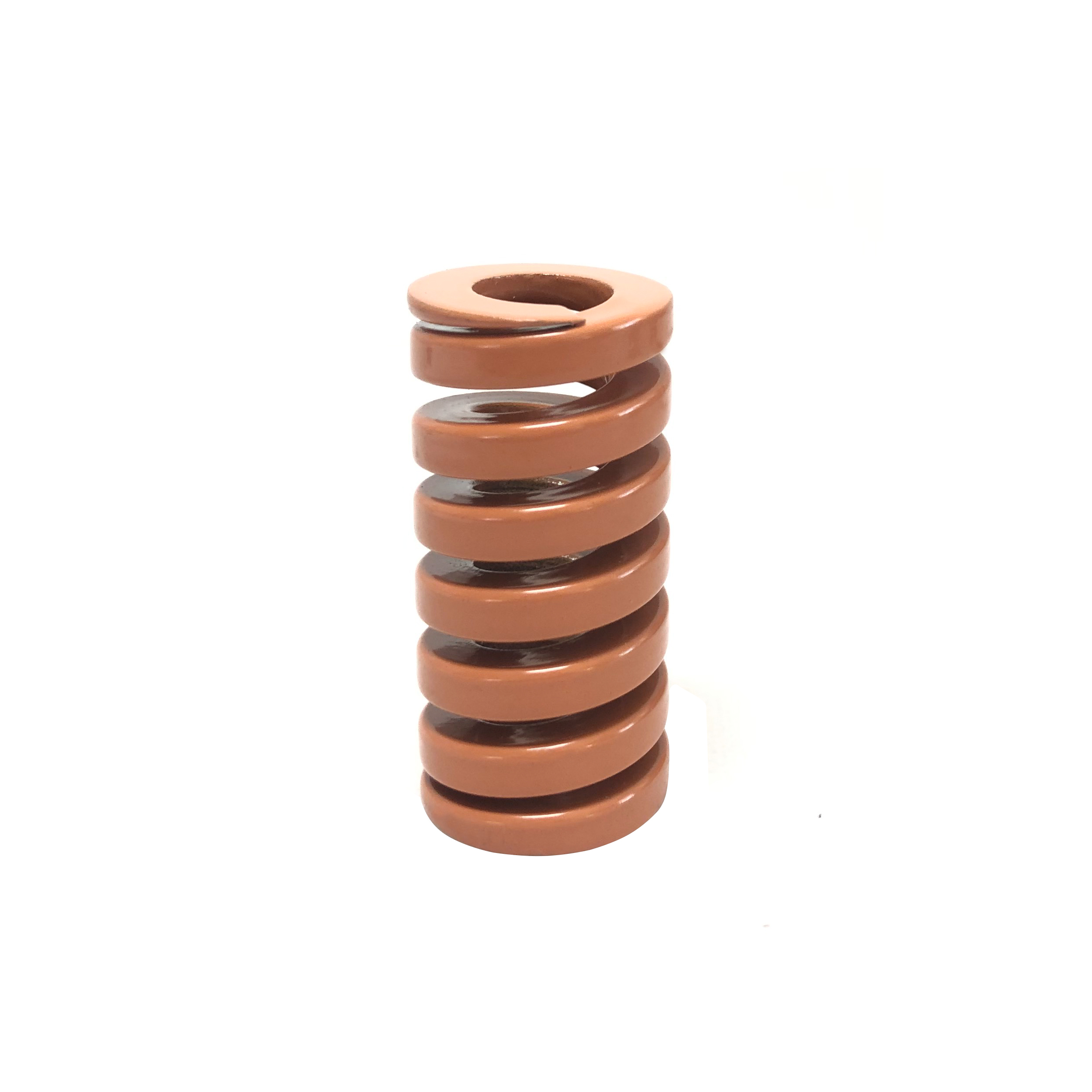
Extra heavy load class springs (brown) are typically selected where high stripping or return force is required in a constrained pocket.
Market Context: Why Temperature Is Becoming a Procurement Line Item
The demand base behind die springs continues to expand, and that expansion is concentrated in exactly the applications where thermal conditions are least uniform. Grand View Research projects the global industrial springs market to reach USD 7.1 billion by 2033, with Asia Pacific already holding a 33.4% revenue share in 2024. On the demand side, the automotive stamping market was valued at USD 87.98 billion in 2024, and stamping dies are one of the principal consumption points for rectangular die springs.
Standards have kept pace on interchangeability but not on thermal guidance. ISO 10243:2019 standardises colour coding and dimensions for rectangular-section compression springs used in press tools, while JIS B5012 specifies allowable tolerances on spring inner and outer diameters rather than mounting-hole fit. The two systems therefore answer different questions, and their load-class colour codes diverge — a difference already identified as a recurring source of selection error in globally sourced tooling.
The practical market effect is a shift in what buyers ask for. Instead of a catalogue number and a colour, specifications increasingly reference the process evidence behind the part: material heat numbers, mill test certificates, heat-treatment description, and fatigue or relaxation validation. That shift favours manufacturers who can document their process, and it makes the high-temperature versus room-temperature distinction a procurement question rather than only an engineering one.
Where the Comparison Breaks Down: Limits Buyers Should Respect
A fair comparison has to state the boundary of the solution, not only its strength.
- Multi-stage tempering reduces thermal relaxation; it does not eliminate it. A tempered spring still loses force over time in a hot die. The correct response is to specify a load margin and a replacement interval, not to assume the property is now temperature-independent.
- Published catalogue load ratings describe ambient conditions. The dimensional and load data for the ISO, JIS and American lines are reference values, not a high-temperature derating curve. If the die runs at sustained elevated temperature, retained force must be validated at that temperature before the load class is locked.
- Powder coating is not thermal protection. It manages corrosion and identification. Specifying a coating in place of a heat-treatment or load-margin decision is a common and avoidable error.
- Shot peening raises the fatigue limit; it does not fix installation errors. Springs must be installed with an initial preload — typically 5%–10% of free length — to remove internal play and prevent shock-driven chatter, lateral buckling and early fracture. Running without preload will shorten life regardless of surface treatment.
- Deflection still governs life. Operation within the recommended long-life range, around 30%–35% of free length, underpins multi-million-cycle endurance. A high-temperature specification does not license higher deflection.
- Colour codes are not universal. Across ISO, JIS and American lines the same colour denotes different load classes. Mixed-standard tool rooms should verify by part number, not by appearance.
- The catalogue has a size envelope. Pockets outside the standard ranges — for example above 63 mm outer diameter in the ISO line, or beyond 305 mm free length — move into custom OEM/ODM territory, which carries its own engineering and lead-time implications.
One further boundary is worth stating for buyers who source across categories: a die spring manufacturer's competence is in rectangular-section compression springs in oil-tempered alloy steel, not in exotic high-temperature alloys or in thermal simulation of the customer's press. Where a duty cycle falls outside the documented material and process envelope, the honest answer is to test rather than to extrapolate.
Future Outlook
Three developments are likely to shape how this comparison is written in future procurement documents.
First, documentation is becoming the differentiator rather than dimensional parity. When ISO, JIS and American lines are all directly interchangeable in fit and load, the remaining variable is process proof — heat numbers, tempering description, peening control, and validation against thermal relaxation thresholds. Buyers who structure RFQs around that evidence will get more comparable offers.
Second, the gap between ambient load data and hot-die behaviour is likely to close through application-specific validation rather than through new catalogue columns. A manufacturer that already runs multi-stage tempering and multi-million-cycle validation is positioned to answer temperature-specific questions case by case; a distributor reselling catalogue parts is not.
Third, customisation will absorb the outliers. Where standard envelopes end — oversize pockets, non-standard load rates, unusual wire profiles, private branding — the supply answer is engineering-led production from drawings or physical samples rather than a stretched catalogue selection. For tooling teams, the practical takeaway is to treat temperature as a specification input today, before it becomes a failure investigation tomorrow.
Buyer Checklist Before Releasing a Die Spring Order
| Operating temperature at the spring pocket | Ambient, or sustained elevated — stated explicitly |
| Load class and colour verified against the correct standard | ISO / JIS / American part number, not colour alone |
| Preload | Typically 5%–10% of free length |
| Deflection ratio | Within the long-life range for the duty cycle |
| Material and heat treatment evidence | 55CrSi, multi-stage tempering, mill test certificate, heat number |
| Fatigue and relaxation validation | Multi-million-cycle endurance data, third-party test reference |
| Replacement interval | Set against measured force loss, not only visual inspection |
FAQ
Why must die springs be installed with a preload, and what happens if it is skipped?
Installing a spring with an initial preload — typically 5% to 10% of free length — eliminates internal play and prevents severe shock loads caused by sudden impact during the press stroke. Operating without preload causes spring chatter, lateral buckling and early structural failure, and the effect is independent of whether the die runs hot or cold.
What material is used in rectangular die springs, and why is it preferred over standard carbon steel?
Springs are manufactured from high-grade oil-tempered spring steel wire, primarily 55CrSi (chrome silicon alloy). Compared with standard carbon spring steels, 55CrSi offers higher tensile strength, a superior fatigue limit, and better resistance to permanent set and thermal relaxation under cyclic heavy loading. Each raw material batch is accompanied by a Mill Test Certificate for metallurgical traceability.
Do the colour codes mean the same thing across ISO, JIS and American standards?
No. The three systems assign different load classes to the same colour. In the ISO line, green denotes light duty and yellow denotes extra heavy duty; in the JIS line, green denotes heavy load and yellow denotes minimal load; in the American line, green denotes extra heavy duty and gold denotes heavy duty. Because colour codes differ between systems, selection should always be confirmed by part number rather than appearance.
What fatigue life can be expected from these springs, and under what conditions?
When operated within the recommended deflection limits — for example 30% to 35% of free length for long life — the springs achieve a fatigue endurance of 3,000,000 to 5,000,000 compression cycles. That endurance results from multi-stage tempering and precision shot peening, which introduces compressive residual stress at the wire surface to prevent micro-crack propagation. Raising deflection beyond the recommended range shortens life regardless of process quality.
Can these springs replace an existing international brand without changing the mold?
Yes, for the covered standard lines. The products adhere to ISO 10243, JIS B5012 and American Standard (Inch series) specifications, with controlled installation dimensions, colour coding and load-deflection characteristics. That allows direct drop-in replacement without modifying existing mold designs. For pockets outside the standard size envelopes, custom production from drawings or physical samples applies instead.
How should a buyer handle a high-temperature application that falls outside published data?
Treat it as a validation task rather than a catalogue selection. Confirm the actual operating temperature at the pocket, specify a load margin for retained-force loss, request material and heat-treatment evidence, and verify the selected load class at operating temperature before releasing the full order. Where the duty cycle sits outside the documented material and process envelope, testing should precede specification.
For buyers who need the full dimensional and load-class reference, the TOPWAY SPRINGS catalogue is available for download: Dalian TopWay product brochure (PDF).
Market references: Grand View Research, industrial springs market size and share report, 2025–2033; Market Research Future, automotive stamping market size forecast 2035; ISO 10243:2019; JIS B5012.
Tem questões ou precisa de mais detalhes?
Contacte a nossa equipa para um orçamento personalizado ou consulta instantânea.
Solicitar orçamento
Preencha o formulário abaixo e a nossa equipa entrará em contacto com uma proposta personalizada.
Chat direto do WhatsApp
Prefere conversar em tempo real? Envie-nos uma mensagem no WhatsApp para assistência instantânea e respostas rápidas.
- Obter orçamento personalizado
- Partilhar fotos ou documentos
- Discuta as suas necessidades diretamente
Geralmente responde em 5–30 minutos durante o horário de expediente.