
Diesel Generator Compliance: Key Certifications Buyers Need
Why Certification Matters in Diesel Generator Procurement
For industrial buyers sourcing diesel generators, compliance is not merely a bureaucratic checkbox — it is a critical safeguard that ensures safety, reliability, and long-term operational efficiency. Whether you are procuring for a 1000kVA diesel generator set for a mining site or a CE certified diesel generator for a European data center, understanding the required certifications is the first step to de-risking your investment.
In the global power generation market, certified equipment reduces downtime, facilitates customs clearance, and often qualifies for insurance and project financing. Yet many procurement teams overlook differences between certifications or fail to verify validity against accredited bodies. This article outlines the essential certifications for industrial diesel generator sourcing and how manufacturers like BAIFA ensure full compliance across markets.
Market Reality: Over 60% of Generator Rejections Stem from Non‑Compliance
According to 2025 industry data from the International Power Generation Association, an estimated 62% of generator set import rejections in key markets (EU, MENA, and Southeast Asia) were linked to missing or invalid certifications. Common pitfalls include:
- Lack of CE marking for equipment destined for European Union projects.
- Expired or forged ISO 9001 certificates presented by unaccredited manufacturers.
- Generator sets not meeting local electrical safety codes (e.g., GB/T standards in China).
- Incompatible emission compliance (EPA/CARB or EU Stage V) for specific regions.
These failures lead to costly project delays, re‑work, and even legal liabilities. A structured certification approach is therefore a baseline requirement for any professional diesel generator procurement strategy.
Essential Certifications for Diesel Generators
Below are the most sought‑after certifications in global industrial and marine power sectors. Reputable suppliers such as BAIFA integrate these into their standard product lines.
CE (Conformité Européenne)
EN ISO 12100:2010; EN 60204-1:2018; EN ISO 8528-13:2016
Mandatory for EU market access; covers safety, EMC, and machinery directive compliance.
BAIFA CE certificate: 3427/IST/23, valid until 2028‑04‑04 (SGS issued).
ISO 9001:2015
Quality Management Systems
Certifies consistent product quality, process control, and continuous improvement in manufacturing.
BAIFA ISO 9001: certificate 00123Q36060R2M/3200 (CQC).
ISO 14001:2015
Environmental Management Systems
Demonstrates environmental responsibility in production, waste handling, and emissions management.
BAIFA ISO 14001: certificate 00123E32986R2M/3200 (CQC).
ISO 45001:2018
Occupational Health & Safety
Ensures safe working conditions and risk mitigation across assembly and testing facilities.
BAIFA ISO 45001: certificate 00123S32405R2M/3200 (CQC).
Additionally, marine diesel generator sets require class society approvals (e.g., CCS, RINA, ABS) and often the marine generator variant must comply with IMO Tier II/Tier III emission standards. BAIFA’s BF-CM series, for instance, is built with these marine regulations in mind.
How BAIFA Ensures Full Certification Compliance
BAIFA POWER (WUXI) LTD., established in 1992, operates a 60,000 m² manufacturing base in Wuxi, Jiangsu, with an annual output of 5,000–6,000 generator sets. Every unit — from a 8kW diesel generator to a 3200kW industrial diesel generator — undergoes a structured compliance process:
- Component‑level certification: Engines from Cummins, Volvo, MTU, Perkins, and Mitsubishi carry their own type approvals; alternators (Stamford, Leroy‑Somer) are CE and IEC compliant.
- Assembly‑level testing: Each set is 100% load tested in the 34,000 m² workshop, with Factory Acceptance Tests (FAT) witnessed by inspectors or third‑party agencies.
- Global market adaptation: Sets can be configured for 50 Hz/60 Hz, different voltage levels, and local grid codes, then re‑certified under BAIFA’s CE scope (covering all main series).
- Third‑party audits: SGS and CQC (China Quality Certification Centre) conduct regular surveillance audits to maintain ISO and CE validity.
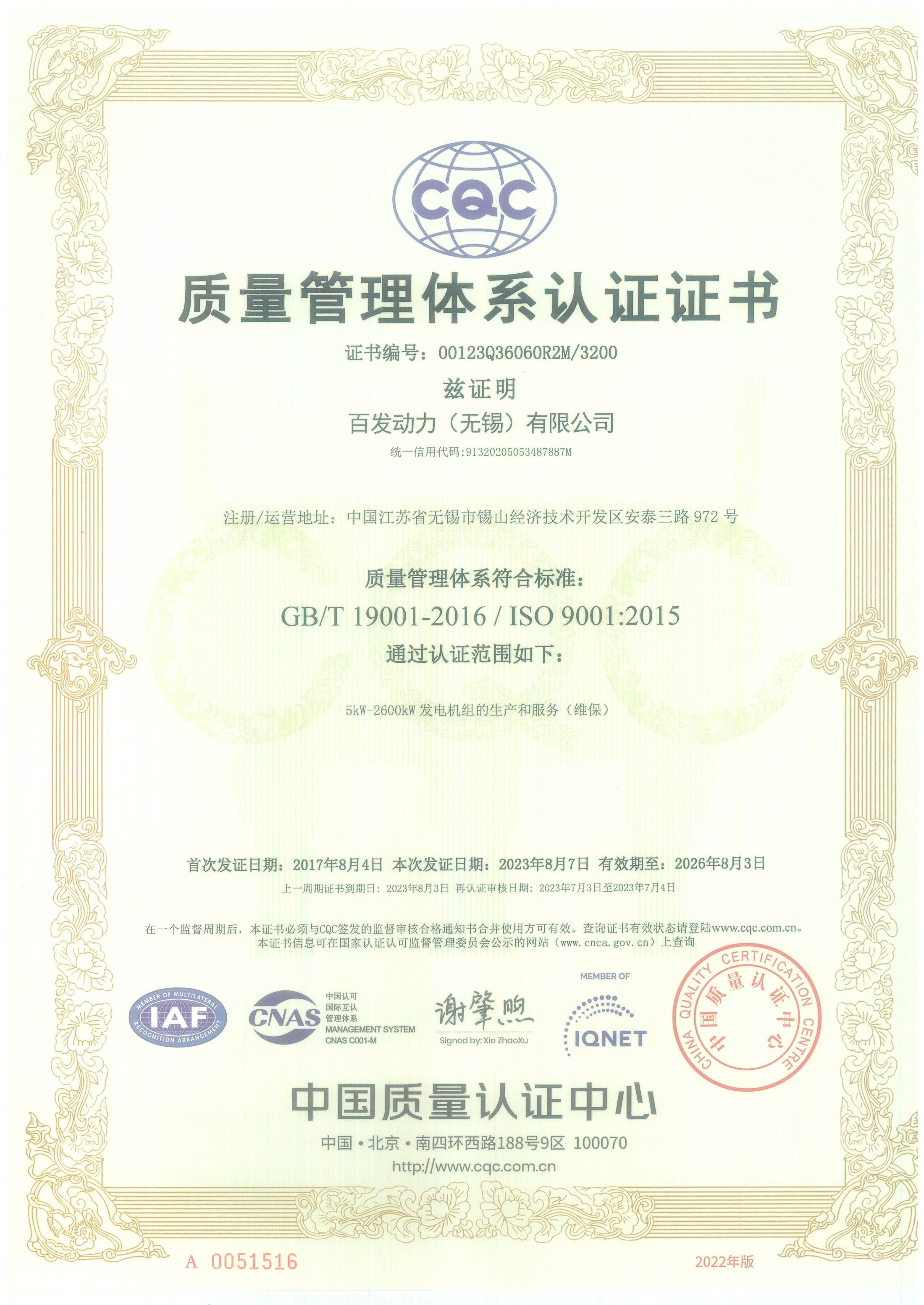
BAIFA’s ISO 9001:2015 certification, valid through 2026, spans all generator set production from 5 kW to 2600 kW.
Industry Application: Certifications for Vertical Markets
| Industry | Key Certification / Standard | Why It Matters |
|---|---|---|
| Telecom / Data Center | CE, ISO 9001, Low‑noise compliance | 24/7 backup reliability; must meet local noise ordinances near residential zones. |
| Mining | ISO 14001, High‑altitude derating, IP54+ | Environmental management for remote sites; dust/water ingress protection. |
| Marine & Offshore | CCS / RINA, IMO Tier II, SOLAS | Marine classification ensures seaworthiness and emergency power in harsh salt‑spray environments. |
| Healthcare | ISO 45001, Automatic transfer switch integration | Patient safety relies on instantaneous backup; OHS certification proves system safety. |
| Construction | CE, ISO 9001, Sound‑attenuated enclosure (e.g., SA series) | Must comply with urban construction site noise limits and project quality standards. |
For instance, BAIFA’s BF-C series (Cummins‑powered) and BF-V series (Volvo‑powered) are routinely supplied with CE certified diesel generator documentation for European projects, while BF-M series (MTU) units carry additional certifications for heavy‑duty industrial prime power applications.
Risk Control in Harsh Environments
Beyond standard certifications, generators operating in extreme climates require specific design verification. BAIFA employs advanced risk controls: for high‑temperature operations, the company uses temperature sensors and selects turbocharged/intercooled engine configurations with 50°C ambient‑capacity radiators. Such engineering measures are validated during certification audits and documented in the unit’s technical file — an often‑overlooked part of compliance that can make or break a site acceptance test.
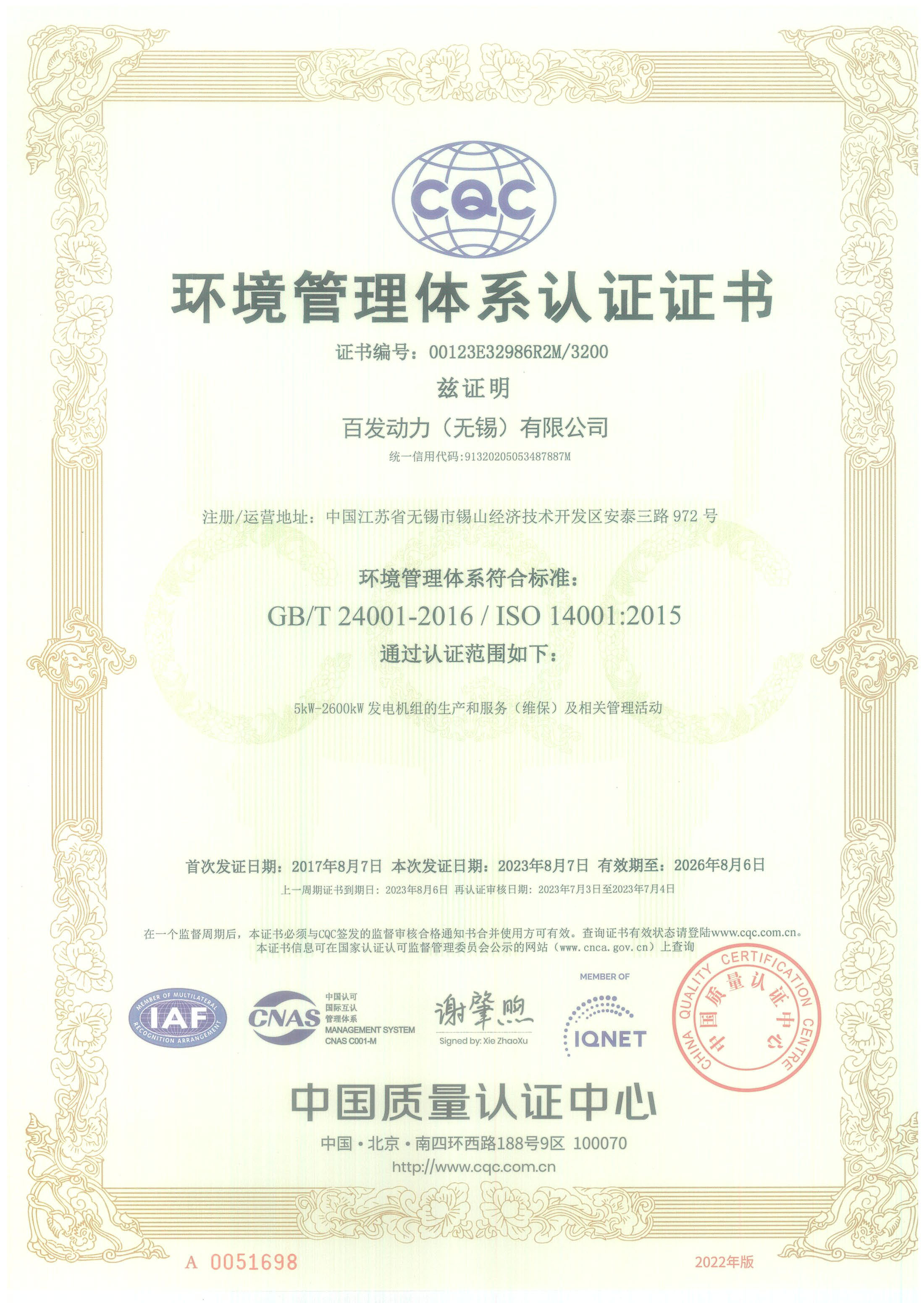
BAIFA’s ISO 14001:2015 environmental certification covers all manufacturing activities from material sourcing to finished product dispatch.
Market Trends: Certification as a Competitive Differentiator
As global supply chains tighten, procurement managers increasingly rank certification completeness higher than price. A 2025 survey by Power Technology Insight found that 78% of industrial buyers require at least ISO 9001 plus a regional safety mark (CE, EAC, or UL) before even shortlisting suppliers. The trend is moving toward “compliance‑as‑a‑service”, where manufacturers like BAIFA offer a certification dossier per unit, including test reports, wiring diagrams, and third‑party certificates — reducing the buyer’s due diligence burden significantly.
For gas generator or marine generator applications, additional environmental certifications (e.g., Gas Directive, EuP) are becoming baseline for new energy projects. BAIFA’s 10+ OEM partnerships with world‑leading engine brands further strengthen traceability — each engine is backed by the original manufacturer’s compliance documentation, creating an unbroken chain of accountability.
Future Outlook: Digital Compliance and ESG Integration
Looking ahead, certification management will become more digitized and integrated with ESG (Environmental, Social, Governance) criteria. Blockchain‑based certificate verification, real‑time compliance dashboards, and automated regulatory updates are expected to enter the power generation sourcing landscape by 2028. Buyers who establish relationships with certification‑rich suppliers like BAIFA today will be better positioned to adapt to tomorrow’s compliance demands.
For detailed certification dossiers or to discuss your project requirements, contact BAIFA at marketing@baifapower.com or visit www.baifapower.com. Tel: +86 158 6160 4000 | WhatsApp: +86 13812025011.