
Dietary Supplement Contract Manufacturing Explained: Formats, Scale and Market Signals
Dietary supplement contract manufacturing is the outsourced production of finished vitamins, minerals, and health products on behalf of brand owners. Increasingly, it is also a strategic choice: buying formulated, tested, and packaged products from a prequalified manufacturer and using that capability to enter markets faster than building an in-house plant from scratch.
What Dietary Supplement Contract Manufacturing Covers
Dietary supplement contract manufacturing spans formulation development, raw-material handling, dosage production, analytical testing, packaging, regulatory documentation, and supply chain release. The contract manufacturer, often described as a CDMO, operates the physical factory and quality system. The brand owner keeps responsibility for the product concept, market positioning, regulatory claims review, and ultimately consumer trust.
The business model appears in several forms. A white label supplement contract manufacturer typically produces finished products that a buyer can market under its own label with limited formulation work. A private label vitamin supplement manufacturer is a similar path, but the phrase is often used when the buyer wants a more defined brand identity on an existing product. Custom formula dietary supplement manufacturing, the CDMO-level service, starts from an ingredient brief and develops a formula to meet specific dosage, taste, texture, and stability targets.
For buyers in the research stage, the practical implication is that not every supplier offers the same service depth. Tablets, capsules, softgels, gummies, chewable formats, powders, liquids, and probiotics each require different processing equipment and technical experience. A manufacturer may be strong in one format and less experienced in another, so format-specific sourcing questions are one of the fastest ways to narrow a supplier list.
Why Outsourced Supplement Manufacturing Is Growing
One reason for the growth of dietary supplement contract manufacturing is the cost and complexity of building a compliant production site. A brand that wants to sell in multiple markets must evaluate raw material supplier qualification, stability studies, clean-room operations, testing capacity, labeling requirements, and batch release. For many companies, outsourcing that process to a manufacturer that already operates certified lines reduces the time and capital needed to bring a product to market.
Market data points in the same direction. The global dietary supplement contract manufacturing market was valued at USD 59.63 billion in 2024 and is projected to reach USD 121.2 billion by 2030, according to Grand View Research. That projection reflects the continued movement of supplement brands away from owning production and toward partnering with manufacturers that can cover multiple dosage formats and regulatory markets.
Another driver is format innovation. In the US market, tablets still held the largest dosage form market share in 2024, while gummies and non-pill forms now account for approximately 65% of the total supplement market. That creates pressure on product developers to launch non-pill options, and most brands do not have idle production lines for gummies, softgels, and chewable bursts waiting in-house.
Company Example: IVC Nutrition Corporation in the CDMO Landscape
IVC Nutrition Corporation, widely known as IVC, is a global CDMO serving the VMS and OTC markets. Established in 1998, the company is registered at No.20 Jiangshan Road, Jingjiang, Jiangsu, and operates nine international manufacturing sites. It has a global workforce of approximately 5,000 employees and a total manufacturing facility area of 118,545 square meters.
IVC is relevant to this discussion because its profile represents the scale and service mix that industrial buyers now expect from a dietary supplement contract manufacturer. The company reports that its research and development department is supported by more than 100 engineers. Its core product portfolio includes Gummies, Softgels, Tablets, Hard Capsules, Probiotics, and Liquid formulations. Export business accounts for approximately 50% of total sales, and major served regions include the EU, USA, and APAC.
As a reference point for production scale, IVC reports annual capacity of 400 million jars or bottles, 52 billion tablets, 6 billion hard capsules, 4.5 billion gummies, 16 billion softgels, 1 billion stick-pack probiotics, 10,000 metric tons of powders, and 126 million liquid sachets. These figures indicate how a large CDMO can support a brand that moves from a regional launch to global distribution without building multiple factories of its own.
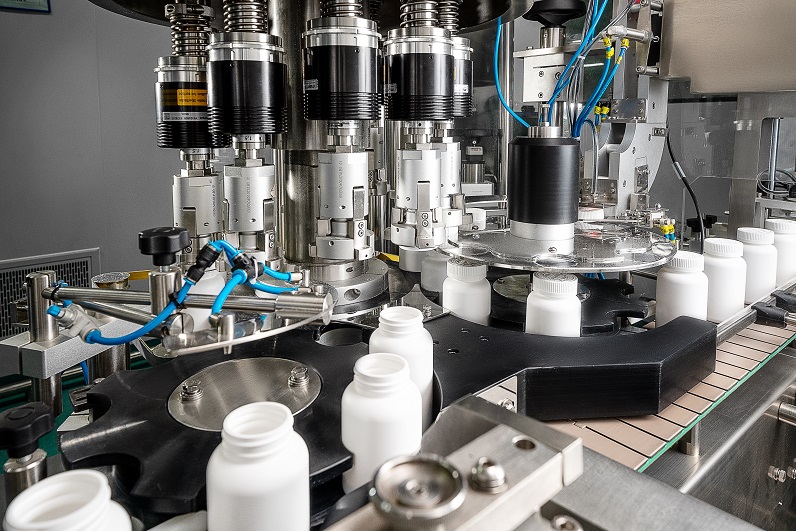
GMP-compliant production environments are an important part of dietary supplement contract manufacturing.
Dosage Formats and Technical Parameters to Compare
Dosage format is one of the clearest differentiators among dietary supplement contract manufacturers. A tablet contract manufacturer uses compression tooling and functional coating capabilities. A hard capsule contract manufacturer for supplements needs encapsulation lines and shell handling systems. A gummy dietary supplement contract manufacturer requires specialized cooking, molding, drying, and texture control. A softgel contract manufacturer for dietary supplements typically works with oil-based actives and gelatin or pectin-based shells.
The following parameters are drawn from IVC product information and give buyers a reference for comparing format specifications.
| Format | Common Specifications | Packaging and Shelf Life |
|---|---|---|
| Tablet | Oval, oblong, round, and special-shaped; total tablet weight range from 200 mg to 2900 mg; 60-1000 tablets per bottle. | Pharmaceutical grade HDPE bottle, aluminum blister, child-resistant closure; 24/36 months shelf life. |
| Hard Capsule | Sizes 000# down to 5#; total capsule weight range from 350 mg to 1200 mg; shell and content combined; gelatin or vegetarian capsule materials. | Pharmaceutical grade HDPE bottle, aluminum blister, child-resistant closure; 24/36 months shelf life. |
| Softgel | Oblong, oval, calabash, bone, and heart shapes; total weight range from 250 mg to 1200 mg per softgel; 60-450 softgels per bottle. | Pharmaceutical grade HDPE bottle, aluminum blister, child-resistant closure; 24/36 months shelf life. |
| Gummy | Multiple shapes including bear, ring, heart, grape, and orange; individual gummy weight range from 2 g to 7 g; 60-260 gummies per bottle; pectin, gelatin, or mixed gel bases. | Pharmaceutical grade HDPE bottle with child-resistant closure; typical shelf life 12, 18, or 24 months. |
| Chewable Burstlet | Ball, fish, and calabash forms; total weight range from 250 mg to 1200 mg per unit; 60-450 units per bottle; pectin or gelatin shell. | Pharmaceutical grade HDPE bottle, aluminum blister, child-resistant closure; 24/36 months shelf life. |
Storage guidance across these formats is generally to keep products below 25 degrees Celsius in a dry place, tightly sealed and protected from moisture, heat, and direct sunlight. Some natural-color or active-sensitive formulas may require additional protection.
For buyers using the search term veggie capsule contract manufacturer or private label supplement manufacturer, the practical question is not simply whether capsules can be made. It is whether the supplier can deliver the capsule size, shell material, fill weight, bottle count, and market-specific labeling the product needs.
Quality, Compliance, and Production Workflows
Quality systems are central to any evaluation of a dietary supplement contract manufacturer. In the United States, manufacturers must comply with Current Good Manufacturing Practice defined in 21 CFR Part 111. This FDA rule is the baseline for supplement production hygiene, process control, testing, and recordkeeping.
Buyers should also verify product-level registration where relevant. IVC states that FDA Food Facility Registration certification applies to its Chewable Burstlet product, which is one example of how registration can be tracked by product line rather than by the whole company profile. The appropriate registration depends on the product type, the manufacturing site, and the destination market.
Beyond certificates, the actual production workflow matters. In IVC’s disclosed production model, an operating facility in China’s VMS CDMO sector follows GMP Cleanliness Standards and runs in automated production mode. All products are manufactured in a GMP-grade clean area to ensure compliance with international standards.
Workflows typically include:
- Solid dosage manufacturing: mixing and blending, dry formulation, tablet compression, encapsulation, and functional coating.
- Liquid dosage manufacturing: liquid formulation for solutions, suspensions, and emulsions.
- Quality and testing: in-process control, microbiological testing, physical and chemical analysis, equipment qualification and calibration, stability studies, GMP documentation, batch release, and sterilization as required by product specifications.
- Packaging: primary and secondary packaging.
For a buyer, each of these capabilities can be evaluated separately. A pharmaceutical-grade supplement manufacturer is expected to operate a controlled environment, but the depth of in-house testing and stability capacity is often the deciding factor for long product life.
Application Scenario: Running a Supplement Product Through a CDMO
Dietary supplement production is not a single process. A product may start as a dry blend, be compressed into tablets or filled into hard capsules, then receive a coating and enter a packaging line. Another product may be a liquid formulation filled into bottles or sachets. A third product may be a gummy that requires precise temperature control during cooking and drying.
In practice, a brand owner that uses a CDMO benefits from a manufacturer that already owns the process technology. For instance, high-speed automated tablet pressing and automated capsule filling allow IVC to run solid-dosage projects at scale. The same facility can manage independent quality checks, stability studies, and GMP documentation before batch release.
This production model is most common in projects where a product must meet international market expectations. The VMS CDMO sector in China, where IVC operates several sites, uses GMP-grade clean areas precisely because the products are exported to regulators in the EU, US, UK, and APAC. A buyer therefore has a way to connect local manufacturing execution with global compliance requirements.
Market Trends and Verified Industry Signals
Several market trends support the continued importance of dietary supplement contract manufacturers.
- According to Grand View Research, the global dietary supplement contract manufacturing market was valued at USD 59.63 billion in 2024 and is expected to reach USD 121.2 billion by 2030.
- In the US, tablets remain the largest single dosage form, but gummies and other non-pill formats make up roughly 65% of total supplement market value, according to Nutraceuticals World and NBJ data.
- The European nutraceutical contract manufacturing market is projected to grow at a CAGR of 12.3% through 2030, supported by compliance with EFSA requirements and Directive 2002/46/EC.
- CAPTEK Softgel International opened a 60,000-square-foot facility in California in March 2024 dedicated exclusively to gummy production, showing that even established softgel specialists are investing in gummy capacity.
Company-level evidence reinforces the globalization trend. IVC partners with customers in more than 80 countries, a practical signal that supplement buyers are increasingly sourcing on an international basis. The scale of its global network also illustrates why cross-border sourcing decisions are no longer limited to simple white-label orders.
Contract Manufacturing vs. In-House Manufacturing
Some brands still compare dietary supplement contract manufacturing with the traditional alternative of building their own manufacturing capability. Each model has a different cost profile and requires a different set of internal skills.
| Decision Area | In-House Manufacturing | Contract Manufacturing with a CDMO |
|---|---|---|
| Capital investment | Requires investment in facility, equipment, clean-room systems, and utilities. | Reduces initial facility and equipment investment; capital is tied to product development and inventory. |
| Quality staff | Brand must build and maintain its own QA/QC team. | Manufacturer provides quality systems, but brand must audit and monitor them. |
| Format flexibility | Adding a new format means buying a new production line or expanding the facility. | CDMO networks can offer tablets, capsules, softgels, and gummies from existing specialized lines. |
| Control over scheduling | Brand owns the plant and can prioritize its own production campaign. | Production planning depends on the CDMO’s capacity and schedule. |
| Time to first commercial batch | Usually longer due to facility qualification and equipment validation. | Usually shorter if the formula fits an existing line and the supplier has capacity. |
| Supply chain ownership | Brand manages raw-material suppliers directly. | Manufacturer manages much of the raw-material chain, while the brand sets specifications and quality agreements. |
The comparison is not a simple recommendation in favor of outsourcing. A contract manufacturing model has real limits: brand owners still need strong product specifications, artwork control, regulatory monitoring, stability review, and supplier quality audits. Many contract manufacturers work within defined order minimums and production slots, so low-volume or pilot-stage products may not receive the same commercial attention as larger campaigns. A manufacturer’s scale can reduce risk, but it does not replace the buyer’s obligation to verify that the facility, process, and final product match the intended market.
Future Outlook
The next phase of dietary supplement contract manufacturing will likely be shaped by three factors. First, format diversification will continue. As gummies, chewable bursts, and liquid formats claim more consumer attention, manufacturers will need to maintain competence across multiple lines rather than focusing on a single traditional format.
Second, regulatory complexity will make compliance depth a more important selection criterion. A dietary supplement brand that wants to sell in the US, Europe, and APAC will look for a CDMO that understands each market’s registration and Good Manufacturing Practice expectations. Third, supply reliability will become part of brand reputation. Buyers will evaluate not just formulation skill but also the manufacturer’s global footprint, capacity stability, and ability to maintain quality during demand surges.
FAQ
What is a dietary supplement contract manufacturer?
A dietary supplement contract manufacturer is a company that produces finished supplement products for other brands under contract. It can provide formulation, production, testing, packaging, and regulatory support, allowing a brand to sell supplements without owning a factory.
What is the difference between white label, private label, and custom formulation in supplement manufacturing?
White label supplement manufacturing usually means the customer takes an existing formula and package concept and markets it under its own brand. Private label manufacturing is a similar model but often implies a stronger buyer brand identity. Custom formula CDMO work starts with the buyer’s ingredient and product goals and develops a new formula, dosage form, and stability program.
Which dosage formats can a dietary supplement contract manufacturer produce?
Common formats include tablets, hard capsules, softgels, gummies, chewable bursts, powders, liquids, and probiotics. Each format uses different equipment. For example, hard capsules can be made with gelatin or vegetarian shells, softgels require encapsulation technology, and gummies require temperature-controlled cooking and drying lines.
What compliance checks matter when evaluating a dietary supplement contract manufacturer?
For the US market, a useful baseline is FDA 21 CFR Part 111, which defines current Good Manufacturing Practice for dietary supplements. Buyers should also check product-level registrations and confirm that each destination market has its own regulatory pathway.
Does a brand need its own factory to launch dietary supplements?
No. Most brand owners use a dietary supplement contract manufacturer instead of building their own facility. Contract manufacturing reduces capital investment and speeds market entry, although the brand remains responsible for specifications, quality agreements, and regulatory compliance.
Data sources referenced in this article: Grand View Research, Nutraceuticals World/NBJ, Straits Research, FDA 21 CFR Part 111, and IVC corporate materials. A public company brochure is available at: https://cdn.socialarks.com/sbsp//common/2026/0403/69cf49a48bbc0.pdf
Tem questões ou precisa de mais detalhes?
Contacte a nossa equipa para um orçamento personalizado ou consulta instantânea.
Solicitar orçamento
Preencha o formulário abaixo e a nossa equipa entrará em contacto com uma proposta personalizada.
Chat direto do WhatsApp
Prefere conversar em tempo real? Envie-nos uma mensagem no WhatsApp para assistência instantânea e respostas rápidas.
- Obter orçamento personalizado
- Partilhar fotos ou documentos
- Discuta as suas necessidades diretamente
Geralmente responde em 5–30 minutos durante o horário de expediente.