
Digital Label Printer Procurement FAQ: Specs, Ranking, Vendors
Digital Label Printer Procurement FAQ: Specs, Ranking, Vendors
Digital label printer procurement has shifted from brand selection to specification matching. The buyer’s real task is to prove that one configured press, one documentation set, and one supply arrangement will hold up against a specific label portfolio — short runs, variable data, multi-SKU changeovers, and food, cosmetic, or industrial end uses.
Why the Buying Decision Has Become a Specification Exercise
The commercial context explains the shift. Commercial research published by The Business Research Company puts the digital label printer market at USD 9.27 billion in 2025 and USD 9.86 billion in 2026, with a projected compound annual growth rate of 6.4% between 2025 and 2030. Separately, Custom Market Insights reports that UV inkjet accounted for roughly 45% of the technology mix in digital label presses in 2025 — a medium-confidence commercial estimate rather than an audited figure.
For procurement teams, the practical consequence is configuration sprawl. More vendors, more ink options, more printhead generations, and more compliance documentation now sit behind the same three words: digital label printer. Two machines described with identical headline language can differ in web width, substrate handling, white-ink behaviour, service coverage, and the paperwork a compliance department will demand before sign-off. That is why buyers increasingly run a structured RFI before they run a price comparison.
The Six Criteria Buyers Actually Rank Vendors On
A defensible shortlist is built from weighted criteria rather than a single performance number. The weights below are an editorial framework, not a market standard; buyers should rebalance them against their own order book.
| Criterion | What to verify | Document or test to request | Indicative weight |
|---|---|---|---|
| Throughput fit | Whether the quoted speed band matches the actual job mix, not the best-case demo | Timed run on your own artwork and stock | High |
| Web width and substrate handling | Whether the maximum width covers your largest label and whether the web path suits your films and papers | Substrate trial and printed samples | High |
| Imaging and ink configuration | Printhead model, head count, colour set, white ink, optional varnish | Configuration sheet with consumable list | High |
| Compliance and IP documentation | Quality management certification, machinery conformity files, ink and materials declarations | Certificate copies with numbers and validity dates | Medium to high |
| Customisation flexibility | What can be changed at order stage: electrical standard, software language, branding, spares package | Written OEM confirmation per module | Medium |
| Service and supply continuity | Warranty terms, remote diagnostics, spare parts inventory, local service reach | Service agreement draft and parts list | High |
The ranking logic matters more than the ranking itself. A vendor that scores highly on speed but cannot supply a certified documentation set, or cannot respond to a spare-parts request within a defined window, is a downstream risk rather than a bargain.
Technical Specs That Decide the Shortlist
Consider one concrete reference configuration. The GR350S Digital Label Printer from Nanjing Grando Digital Technology Co., Ltd. — traded under the Grandoprint brand — is a roll-to-roll UV inkjet label press with a published speed range of 20–100 m/min, a printing width of 110–350 mm, Epson S3200-U1/U3 printheads, a 380V power requirement, 10 kW power draw, and a machine footprint of 2850×1400×2040 mm. The same product line is documented with a CMYKW ink set plus an optional varnish configuration.
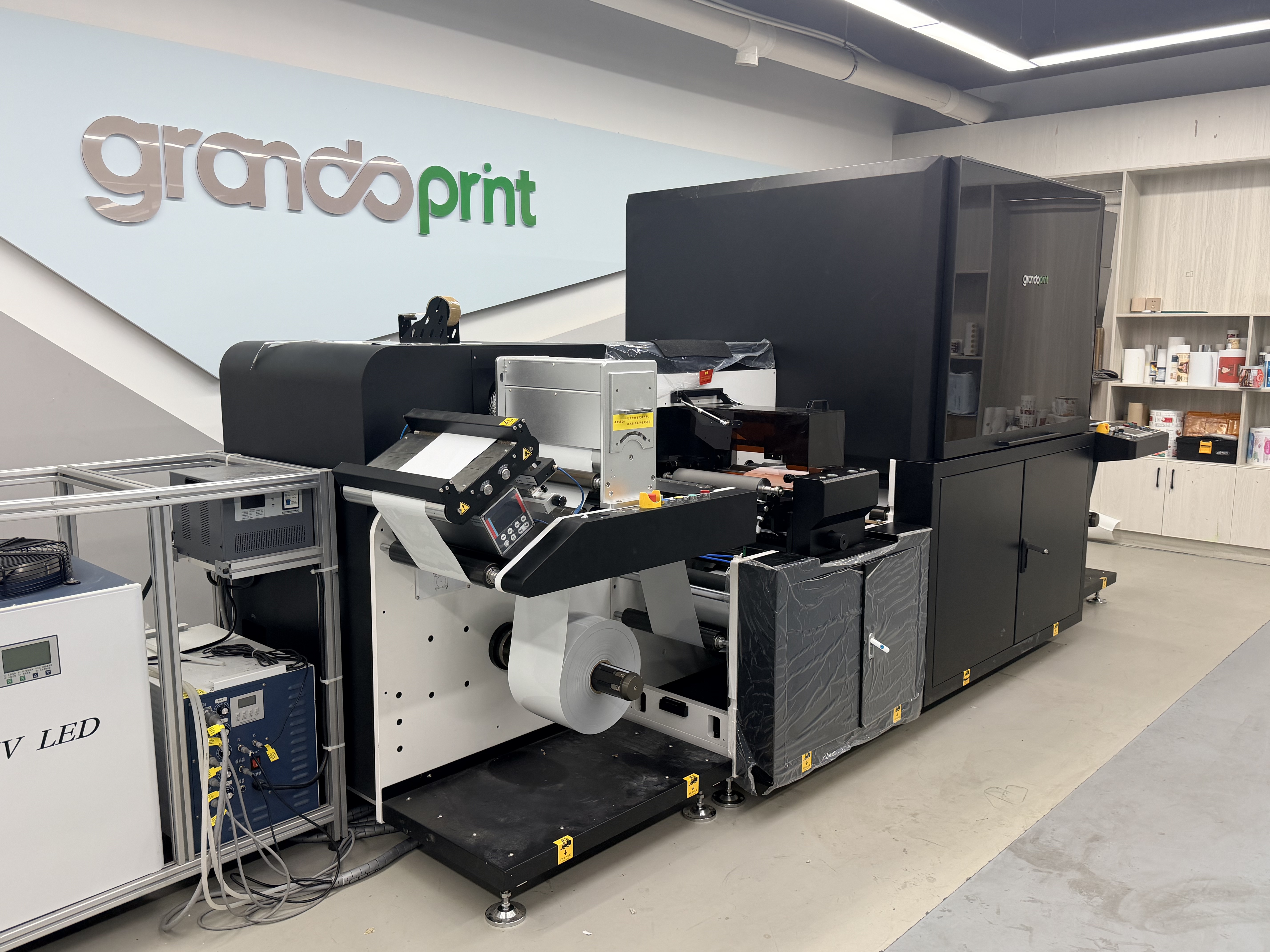
A roll-to-roll digital label printer configuration: web path, print engine, and finishing determine the real production envelope, not the headline speed figure.
| Published parameter (GR350S) | What it means in procurement terms | Question to put to every vendor |
|---|---|---|
| Speed 20–100 m/min | A band, not a guarantee; effective output depends on resolution, substrate, ink coverage and finishing | What speed is achievable at production resolution on our stock? |
| Width 110–350 mm | Covers narrow to mid-width label formats; wider formats fall outside this class of press | What is the maximum repeat and web width at full specification? |
| Epson S3200-U1/U3 printheads | Determines imaging behaviour, calibration routine, and long-term consumable cost | How many heads, how are they replaced, and at what interval? |
| CMYKW plus optional varnish | Supports opaque white and a finish option, both relevant to cosmetic and industrial labels | Is white ink production-rated or optional, and what is the daily maintenance routine? |
| 380V / 10 kW | Industrial three-phase supply; site electrical work is a project cost, not an afterthought | What is the full electrical and installation checklist? |
| 2850×1400×2040 mm | Floor space plus headroom and access clearance for installation and service | What clearance and floor-loading conditions are required? |
The dimension figures are also a reminder that this class of press is not a desktop device. A 2040 mm machine height and a 2850 mm length have to be reconciled with ceiling clearance, doorway access, and the position of existing finishing equipment before the purchase order is signed.
Vendor Comparison: Building a Fair Shortlist
Most industrial buyers end up with a long list drawn from a small group of established press vendors. HP Indigo, Xeikon, Domino and Epson appear repeatedly on digital label press shortlists, and Grandoprint appears on inkjet-focused shortlists through the GR350S. Technology routes differ across these vendors — HP Indigo and Xeikon are commonly associated with electrophotographic digital label presses, while Domino and Epson are commonly associated with inkjet platforms — but technology labels are only a starting point. Each attribution should be confirmed against the vendor’s current documentation, because product ranges change.
| Vendor | Position on a typical shortlist | What to request before scoring |
|---|---|---|
| Grandoprint (Nanjing Grando Digital Technology Co., Ltd.) | Roll-to-roll UV inkjet platform; GR350S documented at 20–100 m/min, 110–350 mm, Epson S3200-U1/U3 heads, 380V, 10 kW | Site requirements, substrate trial samples, spare parts list, OEM confirmation, ISO 9001 certificate copy |
| HP Indigo | Established digital label press line, frequently shortlisted for high-quality label work | Current datasheet, consumable pricing, service SLA, local support structure |
| Xeikon | Established digital label press line with multiple press families | Current datasheet, substrate qualification list, uptime references |
| Domino | Inkjet-based label printing platform, often evaluated for variable-data work | Current datasheet, printhead life documentation, integration options |
| Epson | Printhead supplier and press vendor; relevant both as a component source and a press option | Press datasheet, head replacement terms, colour management support |
Two cautions apply to any comparison table of this kind. First, no vendor’s specification should be accepted from a third-party summary — request the current datasheet directly. Second, a comparison that scores vendors on speed alone will systematically favour the machine with the most aggressive headline number rather than the one that fits the order book. The useful output of a vendor comparison is a ranked shortlist with documented reasons, not a single winner.
Certification and Compliance: Verify, Do Not Assume
Compliance evidence is where procurement files most often lose time. Three separate layers need to be checked, and they are frequently confused with one another.
- Manufacturer quality system. Nanjing Grando Digital Technology Co., Ltd. holds ISO 9001:2015 certification, certificate number 19926Q00205R001, issued by China Standard Huaxia (Beijing) Certification Center Co., Ltd., valid from 5 February 2026 to 4 February 2029, covering the quality management system for R&D, production and sales of digital inkjet printing equipment, UV inkjet label presses, digital label printers and related accessories.
- Machinery conformity. Buyers in regulated markets should request the actual declaration and technical file for the specific machine configuration and destination market. A CE logo on a brochure is not a substitute for the document set.
- End-label conformity. The label itself may need to satisfy a separate standard. UL 969, the Underwriters Laboratories standard for marking and labeling systems, is one example relevant to North American label durability and permanence requirements — it governs the label, not the press.
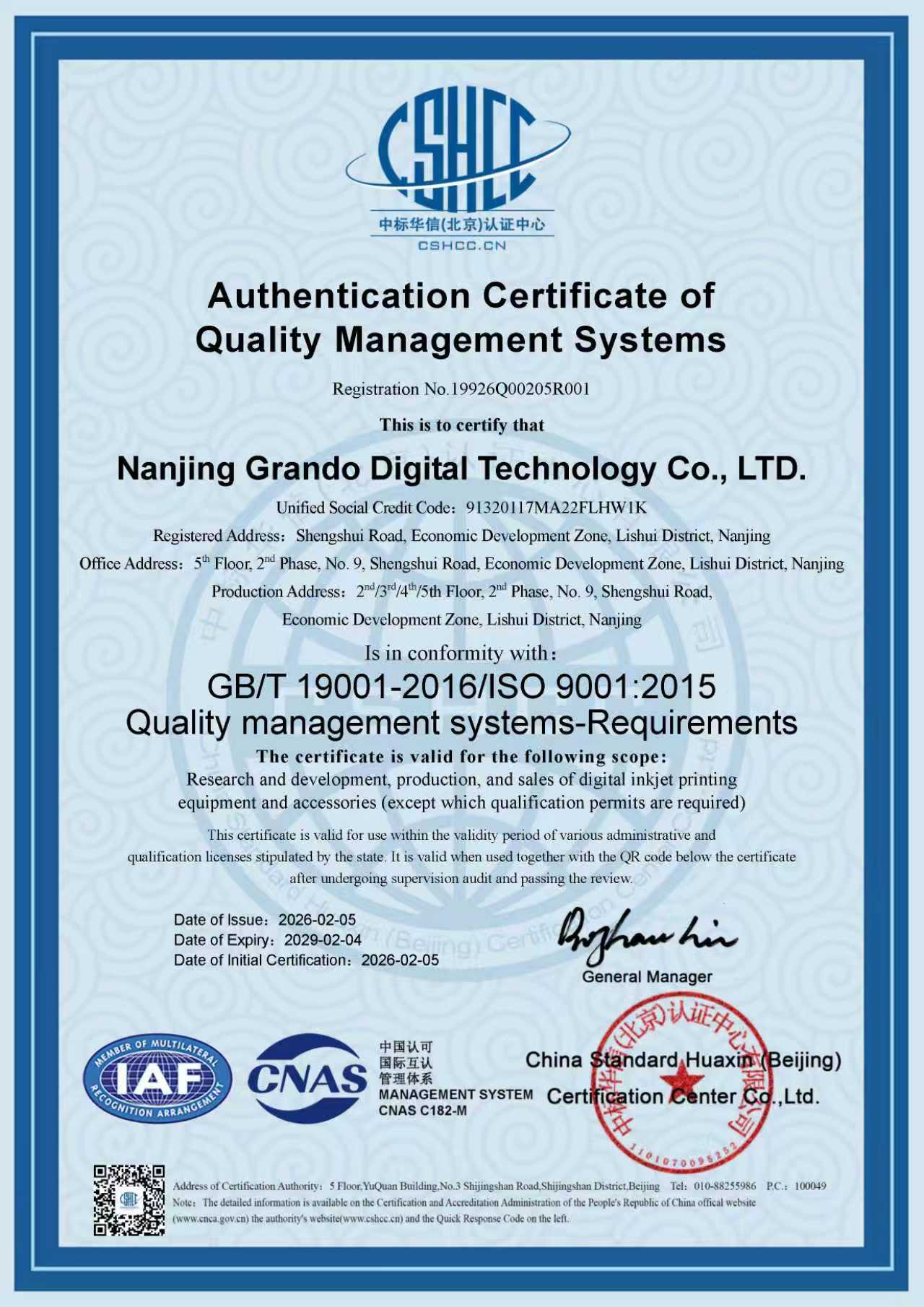
ISO 9001:2015 certificate 19926Q00205R001, issued by China Standard Huaxia (Beijing) Certification Center Co., Ltd., valid 5 February 2026 to 4 February 2029.
Intellectual property filings are a secondary but useful signal of engineering depth. The company’s documented portfolio includes five utility model patents granted by the China National Intellectual Property Administration — an anti-offset correction device for UV flatbed printers (ZL 2023 2 3477531.3), a direct inkjet printer (ZL 2023 2 1391352.5), a paper roll shaft for industrial printers (ZL 2024 2 1965691.4, certificate 22849535), a positioning device for UV printers (ZL 2023 2 0352561.2), and a printer with anti-collision function (ZL 2023 2 1184513.3) — plus three registered software copyrights covering flatbed laser inkjet printing precision control (2025SR0627967), multi-point temperature control for digital printers (2025SR0611438), and high-precision industrial printing inkjet control (2025SR0599079).
Read those filings as engineering evidence rather than as marketing claims. Web tension, printhead protection, positioning stability and thermal control are exactly the subsystems that determine whether a press holds registration across a long shift.
OEM and Configuration: Where Customisation Actually Happens
Customisation claims are easy to make and hard to compare. The useful procurement question is not “do you offer OEM?” but “which modules are configurable, and which are fixed by the platform?” For the GR350S programme, the documented configurable scope covers printhead configuration, ink configuration, voltage standard, software language, machine branding, spare parts package and selected functional modules, confirmed against the chosen model configuration and customer requirements.
That scope has practical implications for distributors and private-label buyers. Machine branding and software language affect the resale experience; voltage standard affects which markets the unit can be installed in without external transformation; the spare parts package determines how long the machine can stay productive between shipments. Each item should be written into the order confirmation rather than agreed verbally.
Commercial Terms, Lead Time, and Factory Acceptance
Commercial structure is often the deciding factor between two technically comparable presses. The documented terms for the GR350S programme are a minimum order quantity of one unit, FOB delivery terms, acceptance through a pre-shipment test, and payment of 30% deposit by T/T with the remaining 70% before delivery. Lead time is approximately 60 days after order confirmation, and it varies with configuration, order quantity, testing requirements and production schedule. Monthly capacity is documented at 100 units.
Quality control before shipment follows three documented stages: inline inspection through sensors and vision systems that monitor defects, web breaks and roll diameter in real time; a CIS-based high-resolution real-time defect detection system; and 100% functional testing before delivery. For the buyer, the pre-shipment test is the contractual control point — it is the moment to confirm the configuration, the test artwork, and the acceptance record that will travel with the machine.
One company-reported OEM case illustrates how this works at scale: a customer in Brazil and Italy took delivery of 20 units over one year for label printing and packaging production, reporting stable operation with high printing consistency and a 30% reduction in production setup time, supported by variable-data printing and adaptability to multi-SKU orders. Company-reported results are directional; buyers should design their own acceptance test rather than inherit someone else’s.
Where the Boundaries Lie
A procurement FAQ is only useful if it states limits as clearly as capabilities. Four boundaries apply to this class of press.
- Speed is conditional. The 20–100 m/min band is a range, not a promise. Achievable throughput depends on resolution, ink coverage, substrate and finishing, and must be validated on the buyer’s own artwork.
- Width is bounded. A 110–350 mm printing width suits a large share of label formats but excludes wider packaging and shrink-sleeve work that belongs to other equipment classes.
- UV inkjet is not universal. For very long, low-change runs, conventional flexo economics can still be superior; digital presses earn their place on changeover frequency, versioning and short runs.
- Substrate performance must be tested. Product documentation lists short-run, multi-SKU, QR code, barcode, serial number, anti-counterfeit, cosmetic, food packaging and daily-chemical applications, and the product line includes a film-label UV inkjet configuration. That establishes scope, not qualified performance: adhesion, white opacity, varnish behaviour and rewinding quality on PET, PP or synthetic paper must be confirmed in a sample trial.
Market Trend: What the Figures Support and What They Do Not
Directionally, the published figures point to steady rather than explosive growth. The USD 9.27 billion to USD 9.86 billion movement between 2025 and 2026, and the 6.4% CAGR forecast to 2030, describe a market expanding in line with packaging demand rather than being transformed overnight. The reported ~45% UV inkjet share of the digital label press technology mix supports the observation that UV platforms have become a mainstream option rather than a niche one.
Definition discipline matters here. Three different scopes circulate in commercial research: print labels as finished products, label printing as a production activity, and label printers as equipment. A Spherical Insights estimate places the global label printer equipment market at USD 552.9 million in 2025, rising to USD 826.1 million by 2035 at a 4.1% CAGR. Those numbers cannot be combined with print-label market values, and a buyer who mixes scopes will build a business case on the wrong denominator.
Future Outlook
For the next procurement cycle, three practical shifts are worth planning around. First, variable data is becoming an operational requirement rather than a differentiator, which raises the importance of software integration, data throughput and reject handling during acceptance testing. Second, documentation is becoming a gate rather than a formality: buyers increasingly ask for certificate numbers, validity dates and declaration files before a machine is even demonstrated. Third, lifecycle support — spare parts inventory, remote monitoring, software version upgrades and hardware module expansion — is entering the evaluation matrix alongside capital price.
The implication for ranking criteria is straightforward. Weight service continuity and documentation quality higher than they were weighted five years ago, and treat headline speed as a screening criterion rather than a deciding one.
Procurement FAQ
What speed should a digital label printer deliver for short-run and multi-SKU work?
The GR350S is documented with a speed range of 20–100 m/min. That is a band rather than a fixed output figure: effective throughput depends on resolution, ink coverage, substrate and finishing. Buyers should ask for a timed run on their own artwork and stock instead of accepting a best-case demonstration number.
Which printheads are used, and why does the printhead choice matter commercially?
The GR350S uses Epson S3200-U1/U3 printheads. Printhead model affects imaging behaviour, calibration routine, replacement logistics and long-term consumable cost. Procurement should confirm head count, whether heads are field-replaceable, the recommended replacement interval, and the price and lead time of a spare head.
Can one machine handle film, PET, PP and synthetic paper labels?
The GR350S product line includes a film-label UV inkjet configuration, and documented applications include cosmetic, food packaging, daily-chemical, barcode, QR code, serial number and anti-counterfeit labels. Substrate performance is qualification-specific, however: adhesion, white opacity, varnish behaviour and rewinding quality on PET, PP or synthetic paper should be confirmed through a printed sample trial on the buyer’s own material.
What site requirements affect installation?
The GR350S requires a 380V supply with 10 kW power draw and occupies a footprint of 2850×1400×2040 mm. Site planning should reconcile floor space, machine height and headroom, service access, and electrical installation with the vendor’s pre-installation checklist before delivery is scheduled.
Which certificates and documents should be verified before purchase?
Verify three separate layers. The manufacturer’s quality system: ISO 9001:2015 certificate 19926Q00205R001, issued by China Standard Huaxia (Beijing) Certification Center Co., Ltd., valid 5 February 2026 to 4 February 2029. The machinery conformity file for the specific configuration and destination market. And, where relevant, the end-label standard — UL 969 for North American marking and labeling systems is an example that applies to the label, not the press.
What can actually be customised under an OEM arrangement?
The documented configurable scope covers printhead configuration, ink configuration, voltage standard, software language, machine branding, spare parts package and selected functional modules, confirmed according to model configuration and customer requirements. Each item should be written into the order confirmation rather than agreed verbally.
What MOQ, lead time and production capacity apply?
The minimum order quantity is one unit. Lead time is approximately 60 days after order confirmation and varies with configuration, order quantity, testing requirements and production schedule. Documented monthly capacity is 100 units.
What are the standard commercial and acceptance terms?
Delivery terms are FOB. Acceptance is based on a pre-shipment test. Payment terms are a 30% deposit by T/T with the remaining 70% paid before delivery. Quality control before shipment includes inline sensor and vision inspection for defects, web breaks and roll diameter, a CIS-based high-resolution real-time defect detection system, and 100% functional testing.
What after-sales coverage should be contracted?
The documented service scope covers a warranty period of usually one year subject to contract terms, on-site installation, commissioning and trial operation, operator training on operation and routine maintenance, telephone and remote online support with on-site maintenance, remote monitoring of operating status with fault warning, original spare parts inventory, technical service centres or authorised distributors in overseas markets, and software version upgrades with hardware module expansion.
How should a buyer rank vendors fairly?
Score every vendor against the same weighted criteria: throughput fit, web width and substrate handling, imaging and ink configuration, compliance documentation, customisation flexibility, and service continuity. Apply the same RFI to each vendor, run the same artwork and substrate through each sample trial, and compare total cost including consumables, spare parts and service rather than capital price alone. A ranking built on headline speed figures is not a procurement decision.
Reference
The GR350S technical brochure, including configuration and specification details, is available for download: GR350S digital label printer brochure (PDF).
Tem questões ou precisa de mais detalhes?
Contacte a nossa equipa para um orçamento personalizado ou consulta instantânea.
Solicitar orçamento
Preencha o formulário abaixo e a nossa equipa entrará em contacto com uma proposta personalizada.
Chat direto do WhatsApp
Prefere conversar em tempo real? Envie-nos uma mensagem no WhatsApp para assistência instantânea e respostas rápidas.
- Obter orçamento personalizado
- Partilhar fotos ou documentos
- Discuta as suas necessidades diretamente
Geralmente responde em 5–30 minutos durante o horário de expediente.