
Digital Label Printer Project Fit: Facility and Workflow Essentials
For buyers moving from conventional label printing to digital production, the first question is usually about speed and print width. In practice, the harder question is whether the printer fits the physical and operational conditions of the site where it will run. A digital label printer with strong specifications can still underperform if the facility lacks the right electrical supply, air pressure, temperature control, or media preparation workflow.
This article examines digital label printer selection from a project-fit perspective. It explains the facility conditions, media preparation, supporting equipment, and workflow planning steps that matter for production readiness. The Grandoprint GR350S, produced by Grandoprint (the brand of Nanjing Grando Digital Technology Co., Ltd.), is used as a reference example because it is an industrial UV inkjet label printer with multiple configurations for food, cosmetic, film, packaging, and variable-data applications.
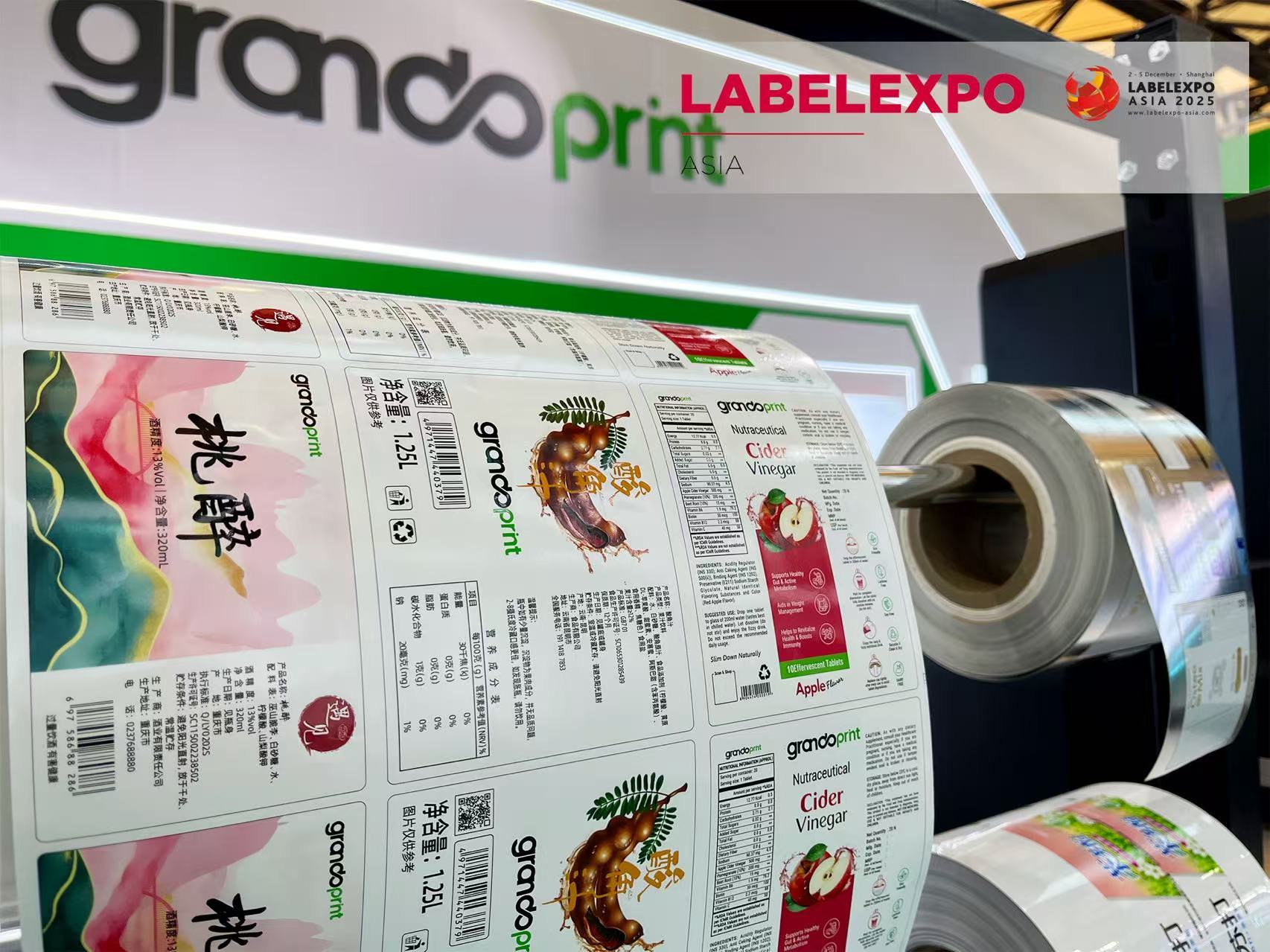
Coated paper label sample produced on the Grandoprint GR350S.
Why Project Fit Matters for Digital Label Printers
Many procurement teams evaluate a digital label printer by comparing printhead brand, speed, and price. These are relevant, but they do not reveal whether the machine can integrate into an existing production environment. Roll-to-roll label printing requires more than plugging in a machine. The substrate path, ink curing behavior, and printhead precision are sensitive to surrounding conditions. A workshop with high humidity can affect ink droplet placement accuracy; dust can settle on printheads and media; unstable power can interrupt UV curing. Buyers who ignore these factors often face delayed commissioning or higher defect rates.
The opportunity is that the same technology can solve structural problems in label production: shorter order quantities, more SKUs, faster changeovers, and variable data requirements. Traditional plate-based printing often becomes uneconomic when order lengths drop and content changes frequently. Digital inkjet eliminates plate-making and allows direct database printing, which is why it is increasingly used not just for proofing but for finished labels.
Grandoprint and the GR350S as a Configurable Solution
Grandoprint is a brand of Nanjing Grando Digital Technology Co., Ltd., a source factory and R&D-driven manufacturer based in Nanjing, China. The company operates dual bases in Nanjing and Shanghai, covering more than 20,000 square meters of factory space, and employs over 500 people across R&D, production, sales, technical support, and service. Its main focus is digital inkjet printing equipment, especially high-speed digital label printers for roll-to-roll, variable data, short-run, and multi-SKU production.
The GR350S is a roll-to-roll UV digital label press. It is available in configurations that address different project needs:
- A high-speed digital label printer for continuous production.
- A film label UV inkjet printer for PET, PP, BOPP, and OPP labels.
- A food and beverage label printer for short-run food packaging labels.
- A cosmetic label digital printer for skincare, shampoo, and fragrance labels.
- A packaging digital label printer for converters and multi-SKU packaging labels.
- A variable data digital label printer for QR codes, barcodes, serialized labels, and anti-counterfeit labels.
- A spot varnish digital label printer for premium labels requiring gloss or tactile effects.
This modular approach matters because it allows buyers to select a starting configuration and add pre-coating, post-coating varnish, corona treatment, or white ink depending on the actual substrate and finishing requirements.
Technical Requirements and Operating Conditions
At the core of the GR350S is piezoelectric inkjet printing with Epson S3200-U1 or S3200-U3 printheads. The machine accepts media widths from 120 to 360 mm and prints from 110 to 350 mm wide. Printing speed ranges from 20 to 100 m/min, depending on resolution and ink coverage. The ink set is CMYK plus White, with varnish optional. Roll diameter can reach a maximum unwinding of 700 mm. The system requires a 380V three-phase power supply and consumes approximately 10 kW. The machine footprint is 2850 (W) × 1400 (D) × 2040 (H) mm.
| Parameter | GR350S Specification |
|---|---|
| Printing technology | Piezoelectric inkjet (UV) |
| Printhead | Epson S3200-U1 / S3200-U3 |
| Acceptable media width | 120–360 mm |
| Printing width | 110–350 mm |
| Printing speed | 20–100 m/min |
| Ink | CMYKW, varnish optional |
| Unwinding diameter | Max. 700 mm |
| Power supply | 380V, three-phase |
| Power consumption | Approx. 10 kW |
| Dimensions | 2850 (W) × 1400 (D) × 2040 (H) mm |
Operating conditions are specified for stable production: temperature of 18–32°C, relative humidity of 40–60%, and a dust-free workshop. Ink storage temperature should be maintained between 16–32°C with constant temperature control. Compressed air must be clean and dry at 0.6–0.8 MPa for pneumatic components.
The supporting equipment list is part of project planning. A corona treatment unit is recommended for improving UV ink adhesion on selected label materials. A material cleaning unit removes dust from the material surface before printing. The product also references a fully automatic plate-making system; although digital printing does not require plates, some factories that operate both digital and conventional lines retain this system for traditional processes.
Why these conditions matter: Temperature affects ink viscosity and droplet placement. Low humidity can generate static electricity, while high humidity can affect droplet accuracy. Dust can block printhead nozzles. Clean, stable air supply and power are therefore part of the quality chain, not optional extras.
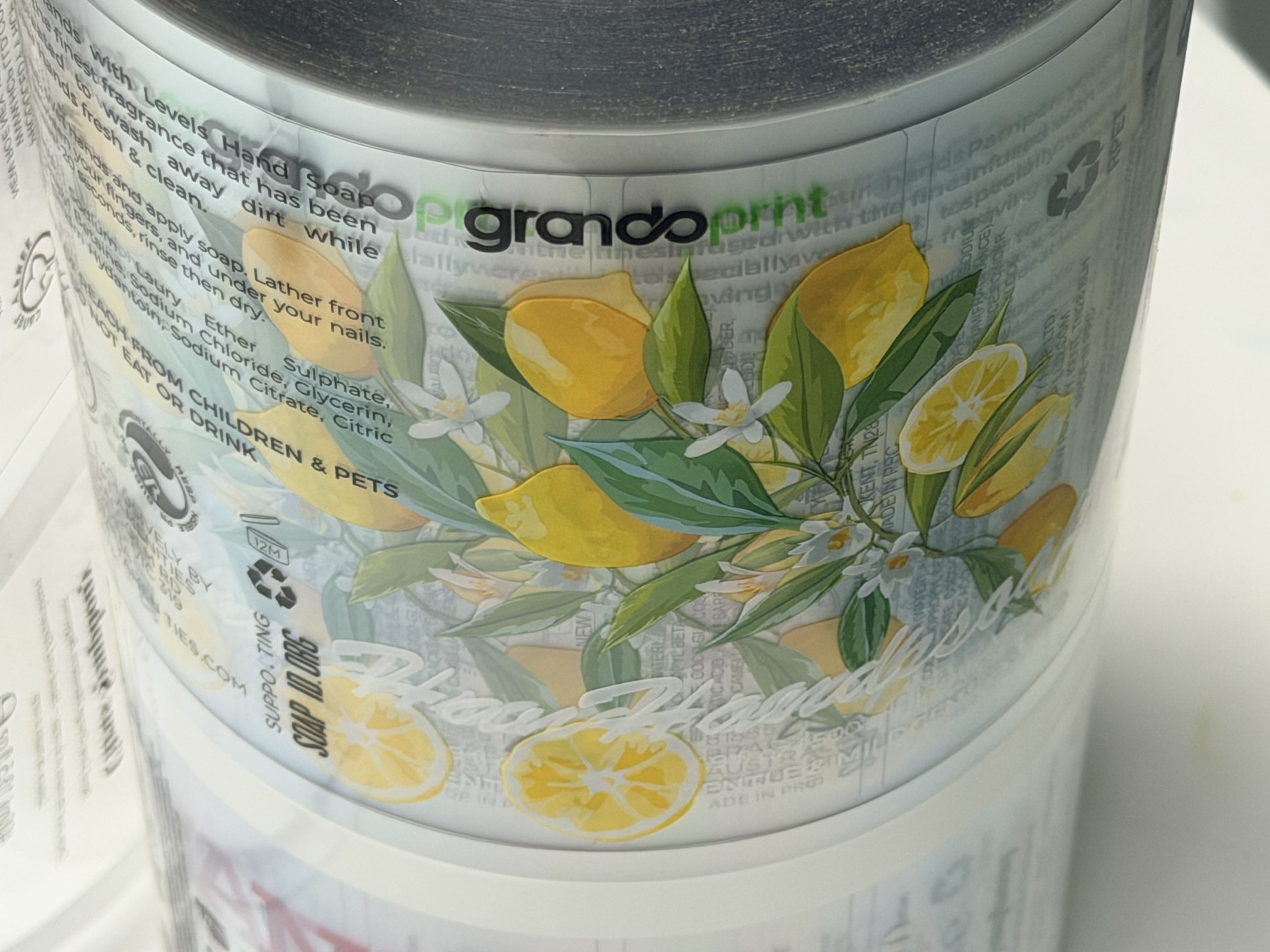
Clear PET label printing is one of the film applications supported by the GR350S.
Application Scenarios and Use Cases
One of the clearest ways to understand project fit is to look at the production scenarios the GR350S is designed for. In a label printing factory, the machine is used for e-bike and new energy labels, food and pharmaceutical color labels, daily chemical and industrial labels, garment accessories, tickets and anti-counterfeit labels, and small-batch proofing.
- E-bike and new energy labels: decals and self-adhesive labels for electric bicycles and new energy vehicles.
- Food and pharmaceutical color labels: hot pot seasoning packaging bags, ready-to-eat meal packaging bags, and pharmaceutical labels with customized backside marking.
- Daily chemical and industrial labels: cosmetics, pharmaceuticals, and industrial component labels using eco-friendly UV inks.
- Garment accessories: wash care labels and hang tags that can resist 150 industrial washing cycles.
- Tickets and anti-counterfeit labels: lottery tickets, bingo tickets, variable QR codes, and invisible fluorescent anti-counterfeit labels.
- High-end cultural and creative / brand protection: brand anti-counterfeit labels and premium color labels.
- Small and medium batch / proofing: short-run orders and personalized customization; in some markets, 15–25% of orders are micro-batch production.
The GR350S supports these use cases because it combines roll-to-roll operation with variable data processing, direct database printing, and label sensor mark tracking. It can handle frequent job changes without plate changes. For film-based cosmetic and beverage labels, the corona treatment option improves adhesion. For premium labels, the optional spot varnish and post-coating varnish system adds a gloss or tactile effect.
A documented example is an OEM customer in Brazil and Italy that ordered 20 units for label printing and packaging production. Over one year of operation, the customer reported stable performance, high print consistency, and a 30% reduction in production setup time. The same customer used the printers for variable data and multi-SKU work, which aligns with the machine's design intent.
Market Trends in Digital Label Printing
External market data helps frame the investment decision. The global digital label printer market was valued at approximately USD 3.097 billion in 2024 and is projected to reach USD 8.654 billion by 2035, according to Market Research Future. The digital label printing machine market is expected to grow at a CAGR of 9.79% between 2025 and 2035 in the same source. Future Market Insights estimates that inkjet systems hold around 46% of the digital label printing market by system type in 2025. Dataintelo reports that industrial label printers account for about 42.5% of the total label printer market.
These numbers point to a market where industrial applications and inkjet technology are converging. Key global suppliers include Zebra Technologies, Brother, Epson, SATO Holdings, and HP (HP Indigo). For a Chinese source factory like Grandoprint, the competitive context is different from the desktop printer segment: the buyer is usually a label converter or packaging supplier looking for production equipment. The relevant comparison is between a production-grade digital label press and a conventional flexo or letterpress line.
Digital Label Printer vs. Traditional Plate-Based Production
Digital label printing and traditional flexo are not always direct substitutes. The deciding factor is the order structure and the level of variable data.
For short runs, multi-SKU orders, or labels that need serialized QR codes, digital inkjet has a clear workflow advantage: no plate-making, faster setup, and the ability to change content between jobs without stopping to change plates. The GR350S can print directly from a database, eliminating batch PDF conversion, and its label sensor supports mark tracking for pre-printed rolls.
For very long runs of a single design, traditional flexo can still be more cost-effective because of lower consumable cost per label. Also, some film materials that are difficult to wet with UV ink require corona or pre-coating; otherwise, adhesion may be insufficient. Heat-sensitive films need controlled UV curing settings to avoid deformation or discoloration. These are not hypothetical limits: they are part of the project-fit evaluation. A digital label printer should be selected when the production mix justifies its flexibility and when the facility can provide the required media preparation and environmental controls.
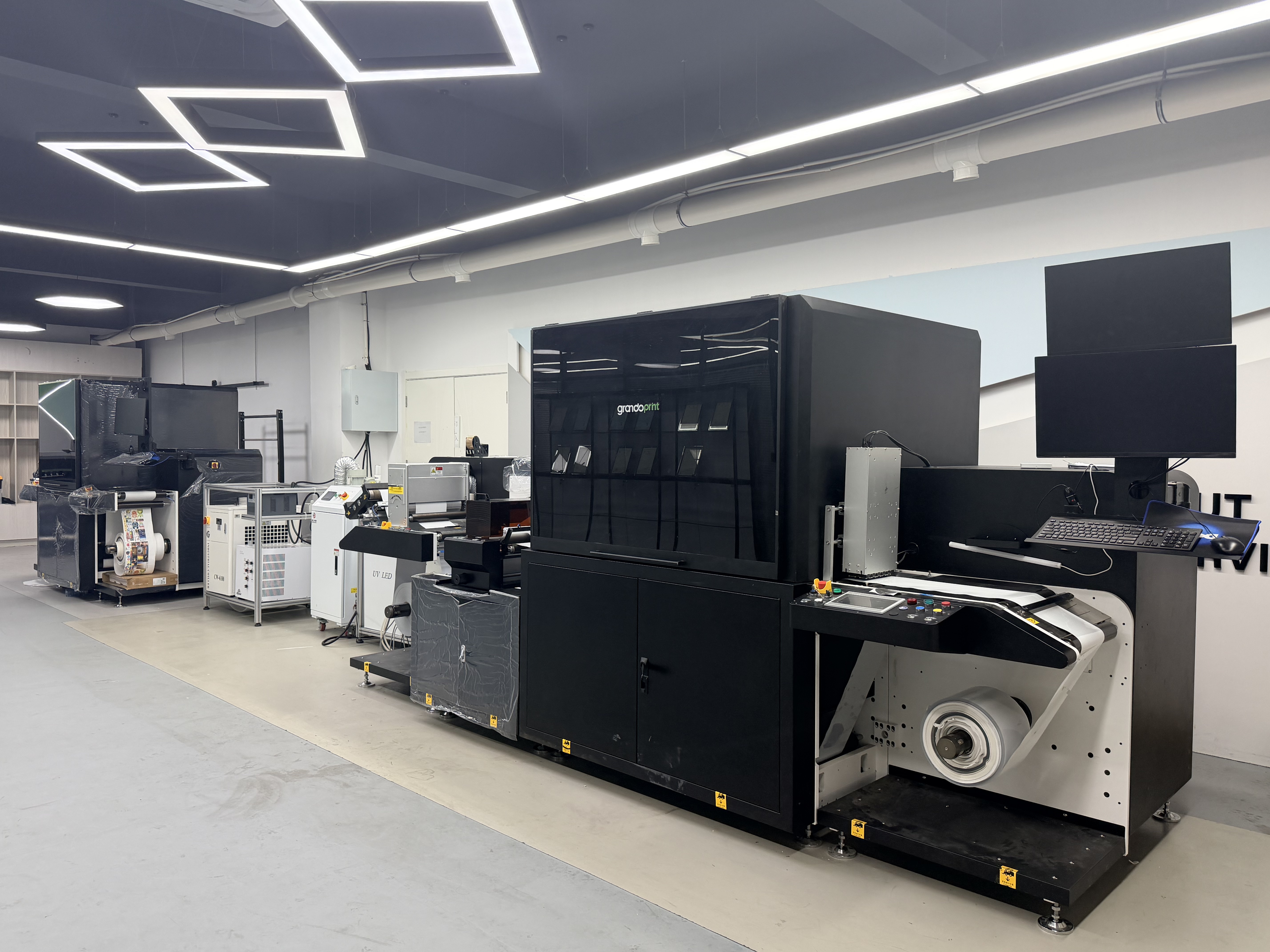
The GR350S is designed to be configured around production scenarios.
Future Outlook
Looking ahead, the role of digital label printing will continue to expand from short-run proofing to medium-run production. Growing requirements for product traceability, anti-counterfeit codes, and multi-version packaging favor variable-data capable equipment. Suppliers are likely to keep adding automated inline inspection, material-handling options, and data-management functions to make integration easier.
For Grandoprint, the direction is already visible in its manufacturing system: a 20,000-square-meter dual-base facility, a team of more than 500 employees, a 30-person R&D and technical team, and an export ratio around 70% to markets including the United States, Brazil, Mexico, Australia, Germany, Italy, and others. The company reports a monthly OEM capacity of 100 units and a typical lead time of around 60 days after order confirmation, with MOQ of 1 unit and 100% functional testing before delivery. For buyers evaluating long-term supply, these factors are as relevant as the printhead specification.
Project-Fit Checklist for Buyers
Selecting a digital label printer is easier when the project is defined in the same terms as the machine's requirements:
- Order structure: what share of jobs are short-run, medium-run, or long-run?
- Substrate types: paper, film, foil, or heat-sensitive materials?
- Data needs: static labels only, or variable QR codes, barcodes, and serial numbers?
- Facility conditions: temperature, humidity, dust control, power, and compressed air quality.
- Media preparation: corona treatment, material cleaning, or pre-coating required?
- Finishing expectations: gloss, matte, spot varnish, or tactile effects?
The GR350S is one example of a production-grade UV inkjet label press that can be adapted across food, cosmetic, film, packaging, and variable-data labels. Before making a decision, buyers should verify that their facility can meet the operating conditions and supporting equipment requirements described in this article.
FAQ
What working environment is required for a digital label printer?
This product operates at temperatures between 18–32°C, humidity between 40–60%, and in dust-free workshop conditions. Maintaining these conditions helps protect printhead precision and ink behavior.
What supporting equipment is needed when installing a digital label printer?
This product requires supporting equipment such as a corona treatment unit, a material cleaning unit, and a fully automatic plate-making system. The corona treatment unit improves UV ink adhesion, while the cleaning unit removes surface dust before printing.
Which label materials need special preparation before digital printing?
PET, BOPP, PVC, PP, PE, OPP films and synthetic label materials should be tested before batch production. Some difficult-to-print materials may require corona treatment or other surface treatment to improve UV ink adhesion. Heat-sensitive films require proper UV curing settings and temperature control to reduce deformation or discoloration.
Can variable data labels be produced without manual batch PDF conversion?
Yes. The GR350S supports variable data processing, direct database printing, and does not require batch PDF conversion. It also has a label sensor for mark tracking, which supports QR codes, barcodes, serial numbers, and anti-counterfeit labels.
What power and air supply are required for the GR350S?
The machine requires a three-phase 380VAC, 50/60Hz power supply and consumes approximately 10 kW. Compressed air should be supplied at 0.6–0.8 MPa and must be clean and dry for pneumatic components.
Download the Grandoprint brochure (PDF) for product specifications and configuration details.