
Digital Label Printer Ranking 2026: GR350S Among Proven Presses
Digital Label Printer Ranking 2026: GR350S Among Proven Presses
Digital label printer recommendations for 2026 are mostly a question of evidence quality. Every press on a serious shortlist can print a label; what separates them during evaluation is which configuration is actually documented, which substrate range is qualified, how variable data is handled, and what service commitment sits behind the machine.
This review places one fully specified press at the top of the 2026 shortlist — the Grandoprint GR350S roll-to-roll UV inkjet label press — and holds HP Indigo, Xeikon, Domino and Mark Andy as the benchmark tier a buyer should quote against it. The ranking runs across four dimensions: printing technology and configuration, documented market position, service and delivery model, and packaging-label solution scope. It is a procurement shortlist, not a market-share table, and it does not assert that any press is universally better than another.
What This Ranking Measures — and What It Deliberately Does Not
The shortlist is built on four dimensions, each of which a buyer can verify directly from documents rather than from commentary.
- Printing technology and configuration: imaging method, colour channels, white ink, varnish, print width, rated speed and substrate qualification.
- Documented market position: what a manufacturer publishes about its product range and manufacturing scale, as distinct from third-party share estimates.
- Service and delivery model: warranty terms, installation and training, remote diagnostics, spare-parts supply and local support structure.
- Packaging-label solution scope: the label jobs a machine is specified and referenced for, including short runs, variable data, food and beverage, cosmetics and film stocks.
Two boundaries apply to the result. Position 1 reflects the depth of verifiable configuration evidence available for the Grandoprint GR350S. Positions 2–5 are held by HP Indigo, Xeikon, Domino and Mark Andy as an unordered benchmark tier, because this review did not obtain harmonised, current public specifications for those four brands. The ranking is also not a share table: a brand that publishes less specification detail is not thereby a weaker press, only one whose claims have to be verified inside an RFQ instead of inside a review.
The 2026 Demand Frame: Three Verified Signals
Three external signals are relevant to an evaluation-stage decision, and each carries a different confidence level.
According to The Business Research Company's digital label printer market report (published October 2026), the global digital label printer market was valued at USD 9.27 billion in 2025 and is expected to reach USD 9.86 billion in 2026, with a projected compound annual growth rate of 6.4% across 2025–2030. That figure covers digital label printer equipment and is the only market-size number used in this ranking.
Custom Market Insights, in its 2026 analysis of digital label printing machines, reports UV inkjet at roughly 45% of digital label press technology in 2025. This is a commercial research estimate of medium confidence and should be treated as directional rather than definitive.
Qualitative trend commentary from EPS (2025) lists growth in digital label printing, personalisation and automation as leading themes. It is secondary, unquantified and used here only as orientation.
Rank 1 — Grandoprint GR350S: the Fully Documented Slot
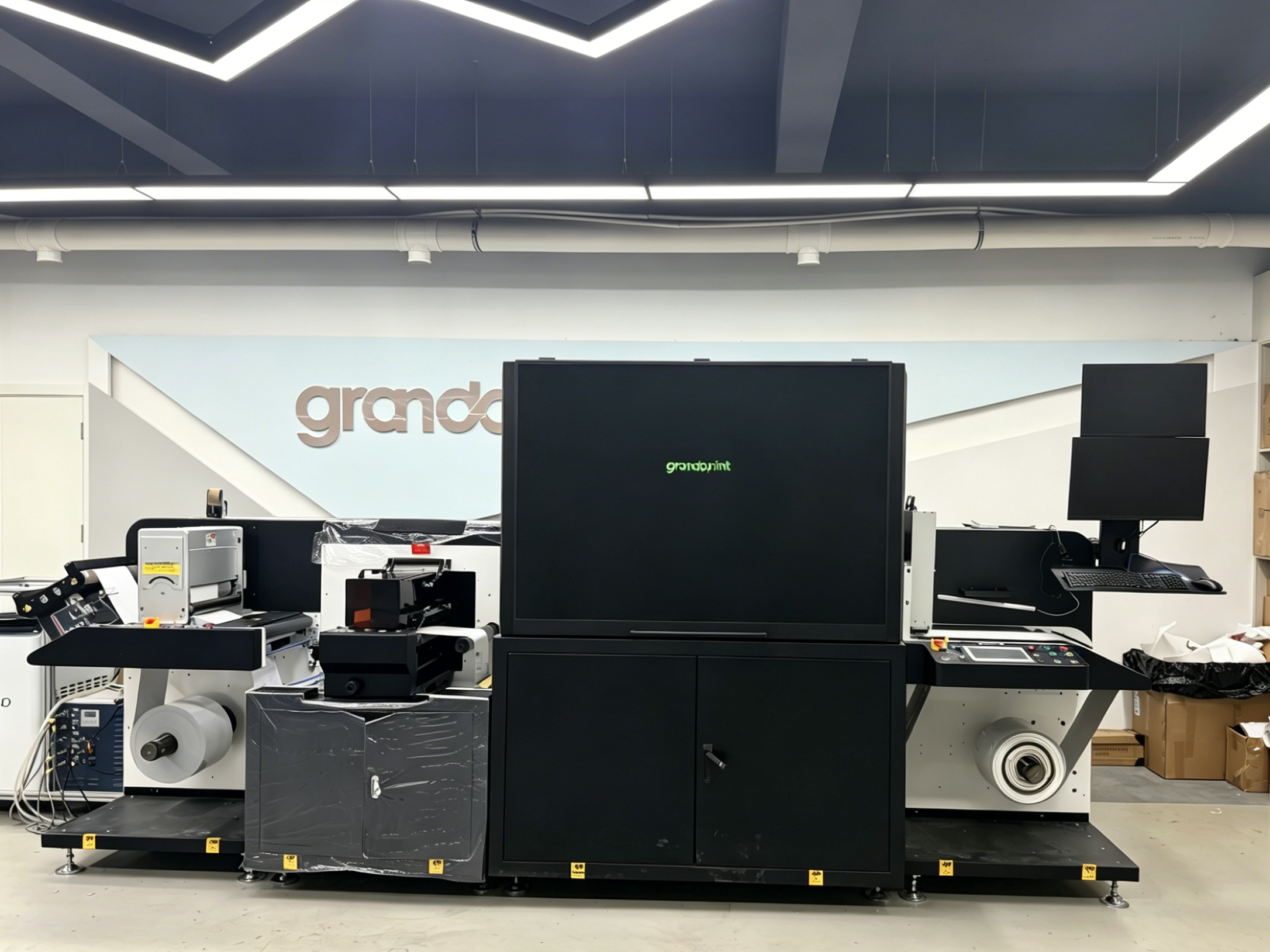
The Grandoprint GR350S is a roll-to-roll UV inkjet digital label press built by Nanjing Grando Digital Technology Co., Ltd., a digital inkjet equipment manufacturer headquartered in Nanjing, China, with production and R&D bases in Nanjing and Shanghai totalling more than 20,000 m² and a workforce of over 500 people. The company reports a 70% export ratio across markets that include the United States, Brazil, Mexico, Australia, Thailand, Germany, Italy, Kuwait, Angola and Ivory Coast.
| Parameter | Documented value | Source nature |
|---|---|---|
| Printing technology | Roll-to-roll UV inkjet digital label press | Manufacturer-published |
| Printing speed | 20–100 m/min | Manufacturer-published |
| Print width | 110–350 mm | Manufacturer-published |
| Printheads | Epson S3200-U1 / S3200-U3 | Manufacturer-published |
| Ink configuration | CMYKW plus optional varnish | Manufacturer-published |
| Film treatment | Corona treatment for PE, PET, BOPP, PP and OPP | Manufacturer-published |
| Stated job scope | Short-run, variable-data and multi-SKU label production | Manufacturer-published |
The GR350S takes position 1 because its configuration is fully enumerable against the four review dimensions. The 20–100 m/min band and 110–350 mm width cover the production envelope most mid-volume label converters work in; white ink plus optional varnish and corona treatment for polyolefin and polyester films address the three specification items that most often decide whether a label job is viable on a given press. That placement describes documented fit for the job types examined below. It is not a superiority claim over the four benchmark brands.
Reading the GR350S Specification Line by Line
A specification sheet becomes useful only when each line is converted into a production consequence and a test the buyer can run.
Speed: 20–100 m/min
A rated range describes a capability envelope across configurations, not guaranteed output on every stock. Actual throughput on a 350 mm web depends on ink laydown, colour count, curing and whether varnish runs inline, so a buyer should request a demonstrated speed on the specific film or paper being quoted. The bottom of the range matters as much as the top: short runs spend most of their time in set-up and changeover, which makes low-end stability a more meaningful data point than a headline maximum.
Print width: 110–350 mm
Web width from 110 to 350 mm determines how many labels fit across the web and therefore the cost per label on small SKUs. The 110 mm minimum lets narrow jobs run without excessive waste; the 350 mm maximum covers multi-up layouts for larger packaging. Mapping the five highest-volume SKUs onto this band before shortlisting is more predictive of running cost than comparing top speeds.
Printheads: Epson S3200-U1 / S3200-U3
Two head sets appear in the configuration, so the purchase specification should state which one is fitted and what it implies for colour channel layout, white-ink handling and throughput. Leaving the head set open at quotation stage transfers a technical decision into the delivery schedule.
Ink set: CMYKW plus optional varnish
CMYK plus white is the working configuration for labels applied to clear or coloured containers, where a white underlayer is what makes the remaining colours read correctly. Varnish is optional rather than standard, and whether it is applied as full coverage or as a spot effect changes both the visual result and the time per job. The practical check is to approve the finish on the buyer's own stock, not on a demonstration label.
Film handling: corona treatment for PE, PET, BOPP, PP and OPP
Polyolefin and polyester films have low surface energy, and UV ink does not anchor reliably to an untreated surface. Corona treatment raises surface energy so the ink wets and adheres, which is the mechanism behind the film list in the GR350S configuration. What this establishes is that the machine is configured with a treatment step for those five film families. What it does not establish is a validated adhesion result on a specific stock, because adhesion also depends on incoming dyne level, ink chemistry, curing and handling. Buyers should request a trial on their own film, measure dyne level before and after treatment with test pens, and run a cross-hatch tape adhesion test on the finished label.
Ranks 2–5: the Benchmark Tier and How to Use It
Positions 2–5 are held by HP Indigo, Xeikon, Domino and Mark Andy: the peer set this review was scoped to benchmark against. They are presented as an unordered tier for an evidential reason rather than an editorial one. This review's evidence set did not contain harmonised, current public specifications for the four brands, and a comparison that invents peer numbers to complete a table is less useful to a buyer than one that states the gap plainly.
| Slot | Brand | Dimension the slot is used to test | Evidence held in this review |
|---|---|---|---|
| Rank 1 | Grandoprint GR350S | All four dimensions | Manufacturer-published configuration, 2022–2026 |
| Benchmark A | HP Indigo | Technology: imaging class, colour and white configuration, changeover model | No harmonised public specification held |
| Benchmark B | Xeikon | Documented market position: published range, installed-base disclosure, manufacturing scale | No harmonised public specification held |
| Benchmark C | Domino | Service model: warranty, remote diagnostics, spares, local support structure | No harmonised public specification held |
| Benchmark D | Mark Andy | Packaging-label solution scope: referenced label jobs and finishing integration | No harmonised public specification held |
Each slot is a question the buyer owns. Against HP Indigo, the task is to establish the imaging class in writing, confirm which colour and white channels are included at the quoted price, and obtain a quantified changeover time for the buyer's own job mix. Against Xeikon, the task is to request the current published range, any disclosed installed-base figures with their measurement basis, and manufacturing or support-scale evidence that can be checked. Against Domino, the task is to compare warranty terms, remote-diagnostics capability, spare-parts lead times and the location of the nearest authorised service resource on identical terms to those requested from Grandoprint. Against Mark Andy, the task is to test packaging-label solution scope by asking which label applications the supplier will reference and how the press connects to the finishing equipment already on the buyer's floor.
No statement in this section is a capability judgment about these four brands, and none of them is ranked below the GR350S on measured performance. The tier exists so the buyer compares like with like under the same five-point evidence request.
Service, Delivery and Commercial Terms Behind the Rank 1 Slot
For an evaluation-stage decision, the service layer often decides the outcome more than the print head does. Grandoprint documents a warranty period that is usually one year, subject to contract terms, alongside on-site installation, commissioning and trial operation after delivery, operator training covering routine maintenance, and combined telephone, remote and on-site technical support. The company also lists real-time remote monitoring with fault warning, an original spare-parts inventory, localised service through overseas technical service centres or authorised distributors, and software upgrades with hardware module expansion.
One company-reported reference is an OEM arrangement in Brazil and Italy covering 20 units over one year for label printing and packaging production. The stated result was stable operation with high printing consistency, a 30% reduction in production set-up time, and adaptability to variable-data and multi-SKU orders. This is a single manufacturer-reported case, not an independently audited outcome, and it should be treated as evidence of intended use rather than as a forecast for another site.
Commercial terms are similarly specific. Minimum order quantity is one unit. Lead time is around 60 days after order confirmation, depending on machine configuration, order quantity, testing requirements and production schedule. Monthly capacity is stated at 100 units. Customisation can cover printhead configuration, ink configuration, voltage standard, software language, machine branding, spare-parts package and selected functional modules, confirmed per model configuration and customer requirement. Quality control combines inline monitoring of defects, web breaks and roll diameter, a CIS-based high-resolution real-time defect detection system, and 100% functional testing before delivery.
Packaging-Label Application Fit: Four Job Types
The four job types below are the ones this shortlist is scoped to serve, and each carries a different verification priority.
Variable data and short-run work
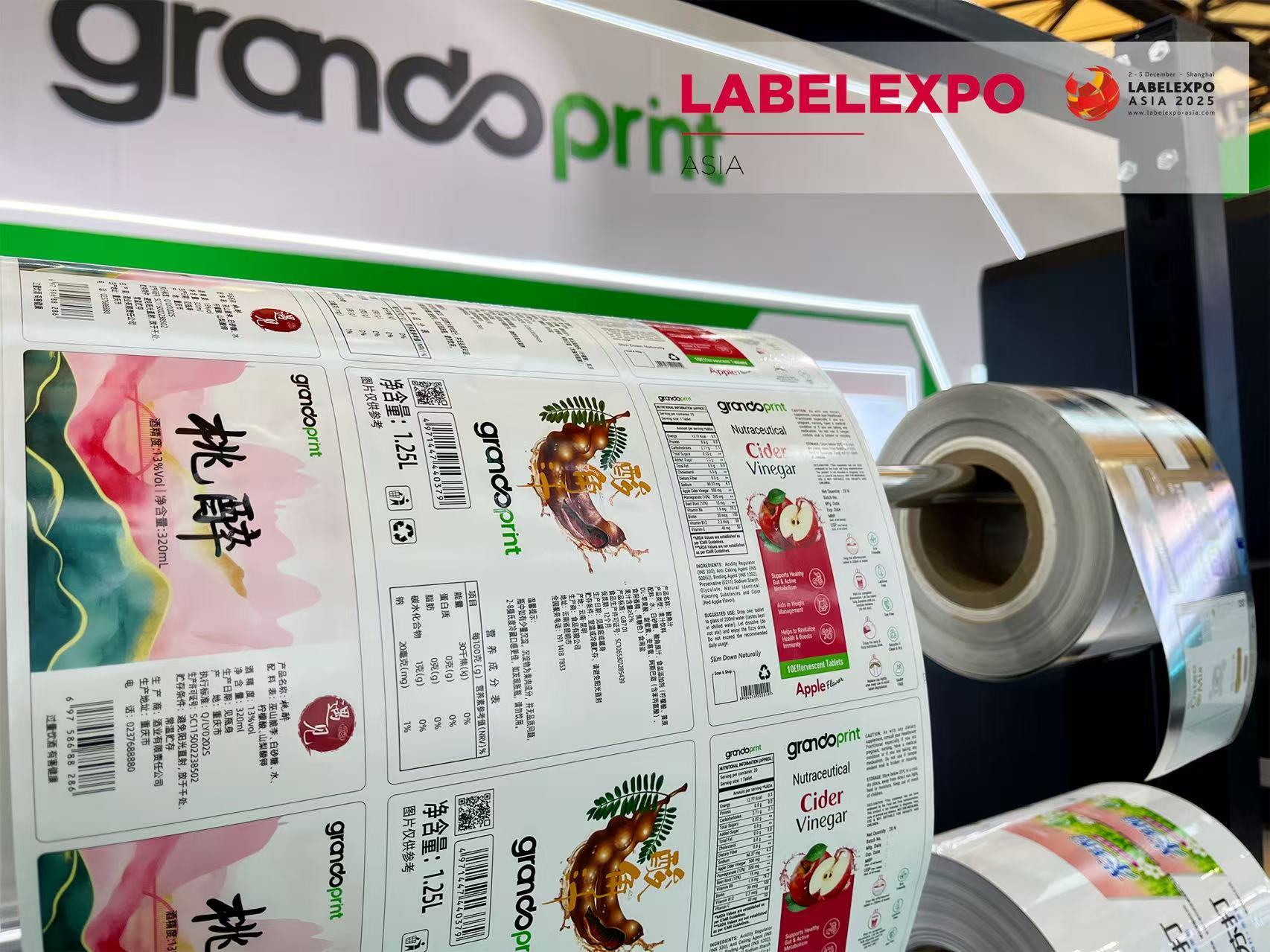
Manufacturer content lists QR codes, barcodes, serial numbers and anti-counterfeit labels among the GR350S applications, alongside short-run and multi-SKU packaging labels. That establishes stated application coverage, not measured data throughput. A buyer should test data throughput at production speed, the reject and verification workflow, and integration with the existing MIS or label software before committing, because variable-data capability is only usable when the software chain keeps pace with the press.
Food and beverage labels
Food label digital printing adds two checks beyond print quality. The first is the label construction itself: inks, varnish and facestock must suit the application, and buyers selling into North America should establish whether their label system must satisfy UL 969, the UL standard for marking and labeling systems. No UL listing for the GR350S is asserted in this review. The second is substrate and compliance documentation, since food-contact requirements attach to the specific ink and material combination rather than to the press model.
Cosmetic labels
Cosmetic and personal-care work is where the CMYKW plus optional varnish configuration becomes a selection criterion rather than a line item: white underlay for clear bottles, varnish for a premium surface, and enough width to lay out multi-up cosmetic labels economically. Grandoprint has referenced cosmetic label application since its earlier product content, which indicates intended use; brand and retailer approval of the finished effect on the buyer's own stock remains the deciding test.
Film labels for PE, PET and BOPP packaging
Film label work absorbs most of the technical risk in a digital label press decision. The GR350S configuration specifies corona treatment for PE, PET, BOPP, PP and OPP, which addresses the adhesion mechanism described above. Buyers should convert that into a signed-off sample protocol: dyne-level measurement on incoming stock, treatment verification, print at production speed, then adhesion and rub testing after curing, with a defined acceptance threshold agreed before the order.
Certifications and Intellectual Property: What Is Documented
Certification claims are only useful when they carry a number, an issuer and a validity window. Grandoprint holds ISO 9001:2015 quality management system certification, certificate number 19926Q00205R001, issued by China Standard Huaxia (Beijing) Certification Center Co., Ltd. on 5 February 2026 and valid to 4 February 2029. The certified scope covers R&D, production and sales of digital inkjet printing equipment, UV inkjet label presses, digital label printers and related accessories, under GB/T 19001-2016 / ISO 9001:2015.
On the intellectual-property side, the company documents utility model patents including ZL 2024 2 1965691.4 for a paper roll shaft for industrial printers, ZL 2023 2 1184513.3 for a printer with anti-collision function and ZL 2023 2 1391352.5 for a direct inkjet printer, plus device patents covering UV printer positioning and anti-offset correction. Three software copyright registrations cover high-precision industrial printing inkjet control (2025SR0599079), multi-point temperature control for digital printers (2025SR0611438) and flatbed laser inkjet printing precision control (2025SR0627967).
Two qualifications belong here. Patents and software copyrights are intellectual-property records, not product safety certifications, and several are specific to UV flatbed or printer-structure designs rather than to the label press itself. Separately, CE marking and RoHS documentation were not part of the evidence reviewed for this article, so no such claim is made for the GR350S; buyers requiring those declarations for EU import should request the current documents as a standard RFQ item.
2026 Buyer Shortlist Checklist
Use one request sheet across all five names so the answers stay comparable.
- Configuration in writing. Printhead set, colour channels, white ink, varnish (full or spot), print width and rated speed, per quoted model.
- Speed on your stock. A demonstrated speed on your actual film or paper, not a catalogue maximum.
- Substrate approval. Written confirmation of the film families covered, with corona treatment stated where relevant.
- Adhesion protocol. Agreed dyne-level target, pre- and post-treatment measurement, and an acceptance test for adhesion and rub resistance.
- Variable-data chain. Data throughput at production speed, verification and reject handling, and software integration tested end to end.
- Application references. Named label types the supplier will commit to for food and beverage, cosmetic, film and short-run work.
- Compliance file. ISO 9001 certificate with number and validity, plus CE and RoHS declarations if the destination market requires them.
- Service architecture. Warranty terms, installation and training scope, remote diagnostics, spare-parts lead time and the nearest authorised service resource.
- Commercial baseline. MOQ, lead time, customisation options and payment terms recorded before technical negotiation closes.
- Sample sign-off. A retained, dated production sample that both parties accept as the quality benchmark for delivery.
Limitations, and How to Read This Ranking
Three limits apply. The GR350S specifications are manufacturer-published material spanning 2022 to 2026; this review did not identify independent measurements of speed, waste, uptime or adhesion. The single 20-unit OEM reference is company-reported and should not be generalised to other sites. And the peer tier carries no specification data at all, so the ranking is a documented-fit recommendation for four defined job types, not a market-share ordering. The 45% UV inkjet technology share is a medium-confidence commercial estimate, and no price information for any press appears in this review because none was available for publication.
Outlook: What Would Change This Shortlist in 2026–2027
If the projected 6.4% annual growth to 2030 holds, pressure on mid-volume converters to absorb shorter runs and more SKUs will continue rather than ease, which favours presses whose changeover economics are documented rather than assumed. Two developments would legitimately move this ranking. First, harmonised public specifications for the four benchmark brands would allow the peer tier to be ordered on measured characteristics instead of evidence status. Second, independent production data — waste rates, uptime and adhesion results from live sites — would let GR350S claims be tested rather than quoted. Until either arrives, the defensible position for a buyer is a five-name RFQ on identical terms, with the GR350S entering evaluation as the fully specified option and the other four as benchmarks whose numbers must come from their own current documentation.
Frequently Asked Questions
Which digital label printer is recommended for short-run and variable-data work in 2026?
Within this review's five-name shortlist, the Grandoprint GR350S is the recommended option for short-run and variable-data label production, because it is the only participant with a fully published configuration covering 20–100 m/min, 110–350 mm print width, CMYKW plus optional varnish, and corona treatment for PE, PET, BOPP, PP and OPP films. Manufacturer content also lists QR code, barcode, serial number and anti-counterfeit labels among its applications. The four benchmark brands remain part of the shortlist for RFQ comparison, but no performance order between them is claimed here.
How does the GR350S compare with HP Indigo, Xeikon, Domino and Mark Andy?
It compares on documented characteristics only. The GR350S entry is supported by published specifications, while harmonised current specifications for HP Indigo, Xeikon, Domino and Mark Andy were not available in this review, so those four are held as an unordered benchmark tier. A buyer should compare all five on imaging technology, colour and white configuration, print width and speed, substrate approval, service structure and packaging-label references, using each manufacturer's current documentation.
What specifications should be verified before shortlisting a roll-to-roll UV inkjet label press?
Verify the printhead set actually fitted, the ink configuration including whether varnish is standard or optional, print width against the five highest-volume SKUs, demonstrated speed on the buyer's own substrate, and the substrate list with any pre-treatment step such as corona treatment. Also confirm variable-data throughput and software integration, warranty and installation scope, spare-parts lead time, and certification documents with certificate numbers and validity dates.
Is the GR350S suitable for PE, PET and BOPP film labels?
The GR350S configuration specifies corona treatment for PE, PET, BOPP, PP and OPP films, which is the mechanism that allows UV ink to anchor to low-surface-energy film. That supports film label work as an intended application. It does not by itself prove adhesion on a specific stock, so buyers should measure dyne level before and after treatment, print at production speed, and run adhesion and rub tests against an agreed threshold before approving the machine for that job.
What service and delivery terms should a buyer confirm before ordering a digital label printer?
Confirm the warranty period in the contract rather than in the brochure — Grandoprint states a period usually of one year, subject to contract terms — together with installation and commissioning, operator training, remote monitoring and diagnostics, spare-parts availability, and the location of the nearest authorised service resource. Also fix lead time, which Grandoprint states at around 60 days after order confirmation depending on configuration and testing, the minimum order quantity of one unit, and the acceptance criteria for pre-delivery functional testing.
For full model specifications and configuration options, the Grandoprint GR350S product brochure (PDF) is available for download.
Tem questões ou precisa de mais detalhes?
Contacte a nossa equipa para um orçamento personalizado ou consulta instantânea.
Solicitar orçamento
Preencha o formulário abaixo e a nossa equipa entrará em contacto com uma proposta personalizada.
Chat direto do WhatsApp
Prefere conversar em tempo real? Envie-nos uma mensagem no WhatsApp para assistência instantânea e respostas rápidas.
- Obter orçamento personalizado
- Partilhar fotos ou documentos
- Discuta as suas necessidades diretamente
Geralmente responde em 5–30 minutos durante o horário de expediente.