
Dimout Curtain and Sofa Fabric Acceptance: A Home Textile Compliance Checklist
Dimout Curtain and Sofa Fabric Acceptance: A Home Textile Compliance Checklist
A home textile fabric order is approved against three things: a specification, a certificate set that actually covers the composition being ordered, and written acceptance criteria that decide whether a delivered lot is released or rejected. When those three items are not fixed before bulk production, the dispute moves to the buyer's warehouse, and by then the only options left are concession or replacement.
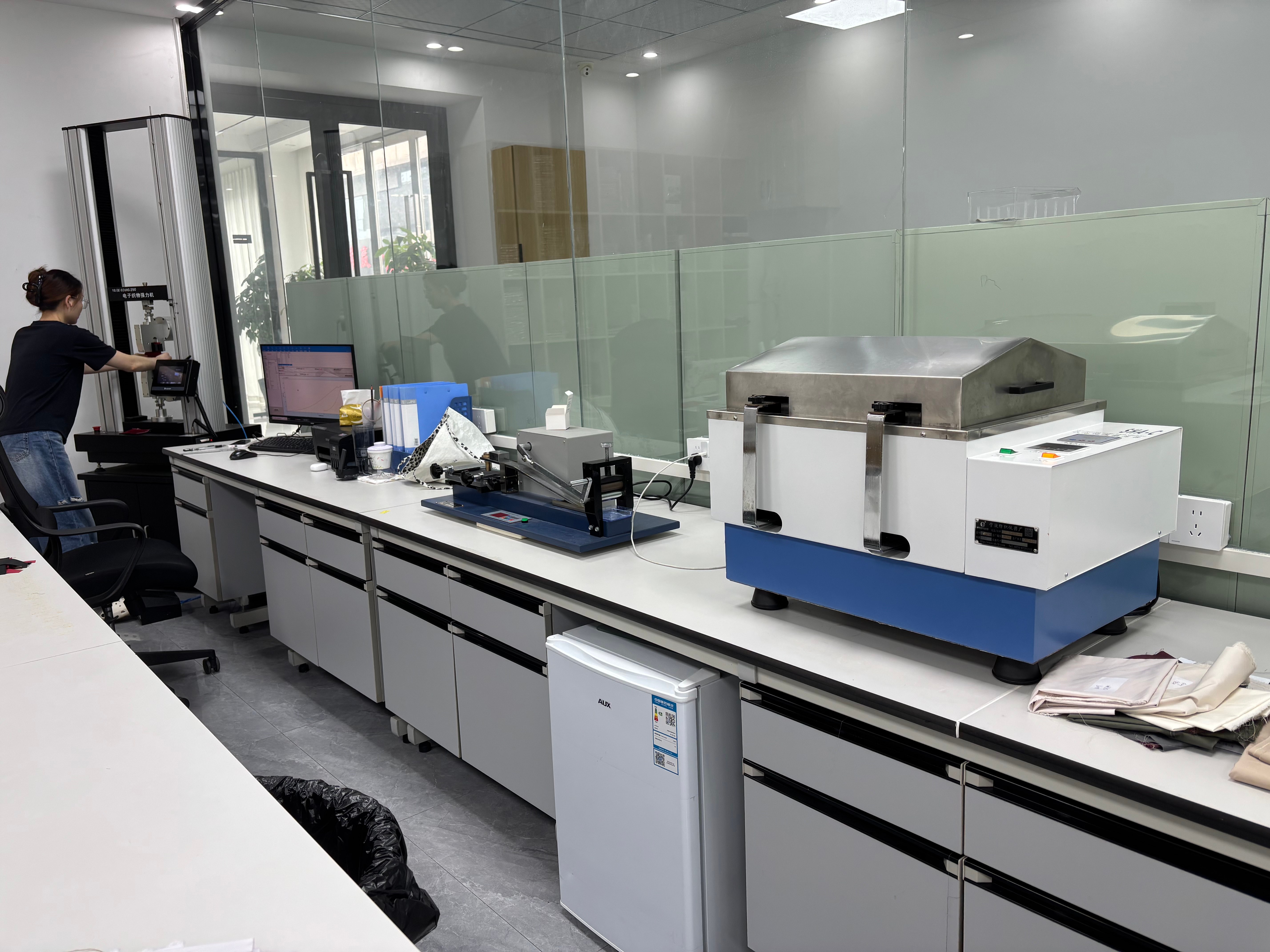
Laboratory testing equipment: in home textile supply, lot release is decided by measurement rather than by sample-room appearance.
Why acceptance criteria became a commercial question
Home textile sourcing is large enough that small specification failures accumulate into real money. The global home textile market reached USD 144.76 billion in 2025, according to The Business Research Company, and Asia Pacific held 44.17% of that market in the same year, based on Fortune Business Insights data. Inside the category, Strategic Market Research values the global blackout fabric market at USD 2.7 billion in 2024 and projects USD 3.8 billion by 2030, a 5.9% CAGR. The upholstery side is larger still: Verified Market Research valued the upholstery fabric market at USD 44.5 billion in 2023.
Two cautions belong next to those figures. First, commercial reports on the light-control category disagree - some place the same market near USD 10.5 billion, most likely because one definition counts finished curtains while the other counts raw fabric. Buyers comparing reports should check the definition before treating a number as a benchmark. Second, China's home textile exports reached USD 2,870.94 million in March 2024, per Stellar Market Research, which means many Western buyers are writing acceptance criteria for a supply chain they never visit.
Regulation pushes in the same direction. The EU General Product Safety Regulation 2023/988 governs safety for home textiles, and Digital Product Passports for textiles are expected by 2027, according to Carbonfact. In the United Kingdom, the Furniture and Furnishings (Fire) (Safety) Regulations 1988 - amended in 2010 and 2025 - remain the core regime for domestic upholstered products in 2026, while BS 5867 is the established UK fire safety standard written specifically for curtains and drapes. None of these rules releases the buyer from defining acceptance; they simply make an undefined acceptance file more expensive.
What a home textile acceptance file should contain
An acceptance file is the document set both parties can use to decide whether a lot conforms. For dimout curtain fabric and sofa fabric orders it normally holds six elements:
- Model and construction record - model number, yarn construction, weight in gsm and stated width for every color in the order.
- Certificate set with scope and validity - certificate number, issuing authority, scope statement and expiry date, not a logo on a marketing page.
- Finishing declaration - which finishing the fabric carries (coating, backing, flame-retardant, water-repellent, stain-resistant) and the standard used to verify it.
- Sample approval record - the signed sample plus agreed tolerances for shade, weight and width.
- Test method list - the method that will settle a dispute: light fastness, color fastness, pilling resistance, and abrasion where a wear claim is made.
- Purchasing terms - MOQ, lead time, inspection rights and the after-sales window.
Dimout curtain fabric: a model-level reference set
Dimout fabric is a light-control category, not a single performance grade. In the scenario data used by Suzhou T-land Textile Co., Ltd. (T-LAND TEXTILE), a fabric manufacturer based in Shengze, Jiangsu, China that produces sofa fabric and curtain fabric for export markets in the EU and the Americas, the curtain function is defined as light blocking and light adjusting, sun-shading and privacy protection, plus decoration and noise reduction. The reference range below is entirely 100% polyester, which is the composition the manufacturer's OEKO-TEX scope is written against.
For buyers building a shortlist, the fastest filter is construction rather than color, because two models can share a weight and still behave differently at the window and in the washing test.
| Model | Category | Yarn construction | Weight | Stated width |
|---|---|---|---|---|
| TL08183 / TL08170 | Dimout fabric | 75D x 300D + 160D | 230 gsm | 150 cm / 300 cm |
| TL08229 | Dimout fabric | 75D x 300D | 230 gsm | 150 cm / 280 cm / 300 cm |
| TL0888 | Dimout fabric | 75D x 300D | 250 gsm | 150 cm / 280 cm / 300 cm |
| TL08166 | Dimout curtain fabric | 75D x (300D + 300D) | 260 gsm | 150 cm / 300 cm |
| TL08269 | Curtain & sofa, dimout | 75D x (300D + 300D) | 280 gsm | 150 cm |
Two models here share the same 230 gsm weight but not the same construction: TL08183 / TL08170 use 75D x 300D + 160D, while TL08229 uses 75D x 300D. Weight alone is therefore not a sufficient acceptance criterion - the construction line should always be copied into the purchase order.
Where a window program needs more than one finished width, TL08229, TL0888 and TL08166 offer 280 cm or 300 cm options alongside 150 cm, which reduces the number of seams in wide applications. Buyers should still confirm the usable width after finishing and selvedge trimming, because a stated width is a specification, not a guarantee of cuttable face.
Sofa and upholstery fabric: a model-level reference set
On the upholstery side the acceptance file changes shape: abrasion, pilling, seam behavior and cleaning matter more than light control. The reference models below cover an upholstery plain, a velvet and a polyester linen group, all 100% polyester.
| Model | Type | Yarn construction | Weight | Stated width |
|---|---|---|---|---|
| TL0329 | Upholstery fabric | 105D x 200D | 160 gsm | 150 cm / 300 cm |
| TL07242 | Velvet fabric | 150D x 320D + 200D | 220 gsm | 150 cm |
| TL0415 / TL0469 / TL0484 | Polyester linen fabric | 600D x 600D / 300D x 300D | 230 gsm | 150 cm |
The lightest item on this list, TL0329 at 160 gsm, and the heaviest, the TL0415 / TL0469 / TL0484 group at 230 gsm, differ by 70 gsm - enough to change the hand and drape of a sofa cover, but not enough on its own to prove anything about wear life. Abrasion resistance needs a test result. The scenario data for this product family lists high Martindale wear resistance, anti-pilling, water-repellent and stain-resistant finishing, washability, and batch-to-batch color difference control as typical special requirements, which is exactly where an acceptance file should become specific rather than generic.
Verifying flame-retardant approaches: yarn-based versus coating-based
Fire performance claims are the most common place where buyer expectation and supplier offer separate. There are two routes, and they behave differently in documentation.
Route one: flame retardancy built into the yarn
The flame-retardant property is part of the fibre or yarn itself rather than something applied afterwards. Buyers using this route should require a written statement naming the yarn or fibre and the fire standard tested, because the property is meant to travel with the material through subsequent processing.
Route two: coating or finishing based
Here performance is delivered by a topical finish, backing or coating applied during finishing. The manufacturer's OEKO-TEX Standard 100 certificate 19.HCN.99628, issued by Hohenstein, explicitly includes PU, TPU and PVC coating and laminating finishing in its scope, so a coated construction can sit inside a certified finishing scope provided the composition matches. Flame-retardant finishing also appears in the same manufacturer's customization list, alongside water-repellent and stain-resistant finishing.
Boundary to keep in view: OEKO-TEX Standard 100 is a chemical-safety certification, not a fire-safety certification, and the stated scope of certificate 19.HCN.99628 is woven and knitted fabric made of 100% polyester and 100% polyamide, Product Class II (products with direct contact to skin). A fire claim must be supported by the fire standard itself - for example BS 5867 for curtains and drapes in the UK, or the Furniture and Furnishings (Fire) (Safety) Regulations 1988 for domestic upholstered products. Any product outside the named 100% polyester / 100% polyamide compositions also falls outside that certificate scope, which is why the composition line belongs in the acceptance file.
Sample-to-bulk consistency: what to lock before production
- Inspection right in writing. The stated quality control is 100% in-house testing, or random inspection by the customer. The acceptance file should say which applies to the order and who bears the cost of a failed lot.
- Lot-level laboratory testing. Testing is performed in an in-house laboratory on a per-lot basis, and order instructions are handled through a computer-based, non-paper system - which matters because the specification that reaches the loom and the specification in the purchase order should be the same record.
- Color continuity. Batch-to-batch color difference control is listed among typical special requirements. The tolerance should be numeric and agreed, not described as a commercial match.
- Approved sample. Keep the signed sample and write the shade, weight and width tolerances into the purchase order. Development is carried out against the customer's own sample, so the buyer's piece defines the target.
- Storage and staged release. A 1,500 m2 warehouse supports staged handling, which gives the buyer an opportunity to inspect before the full quantity ships.
One honest limitation: an approved sample and a valid certificate do not by themselves control shade variation across a multi-lot program. That requires a lot-level measurement rule written into the acceptance file - the sample only defines the target.
Purchasing terms that belong next to the specifications
| Term | Stated value |
|---|---|
| Production mode | OEM and ODM |
| MOQ | 500-1000 mts per color |
| Lead time | 30-45 days |
| Monthly capacity | 200,000 mts |
| Customization | Pattern design, fabric width, gram weight, color / shade, flame-retardant, water-repellent, stain-resistant finishing, development against customer sample |
| After-sales window | Within two months after goods are received by the customer |
Watch the vocabulary. The customization list specifies water-repellent, not waterproof. A purchase order that asks for waterproof is asking for a claim the supplier has not offered; where a test method is agreed, the term in the purchase order and the term in the test report should be identical.
Application fit: where these specifications are used
The same construction can be right for one project and wrong for another, which is why the acceptance file should name the end use. The scenario data for this product family covers residential decoration projects, hotel and B&B projects, office commercial projects, health-care institutions, exhibition and cultural tourism projects, and special soft furnishing customization for RVs and yachts. Two working conditions are distinguished: household low-frequency friction and sunlight, and commercial heavy-duty use.
That distinction has direct acceptance consequences. A hotel corridor curtain program and a residential curtain program may order the same dimout model, but the commercial project is the one that should carry a declared light fastness grade, an agreed Martindale result where abrasion is relevant, and a named fire standard in the purchase order. Assembly conditions differ too: curtains are hung on rods, tracks, brackets, hooks and, for motorized versions, motors, while sofa fabric is fixed to sofa frames over foam filling through sewing operations - so the finishing specification should be read together with the hardware and the assembly process.
A working example from the manufacturer's case record: an OEM client sourcing sofa and curtain fabric across Germany, the Netherlands, Belgium, Italy, Sri Lanka and South Africa, covering 20,000 meters of fabric over a 4 to 6 year supply period. Reported results were consistent hand feel, color fastness and stable fabric performance, with OEKO-TEX compliance as a stated highlight. The value of that case for a new buyer is not the volume; it is that the compliance reference and the performance criteria were fixed at the start of a long supply relationship instead of being argued at each shipment.
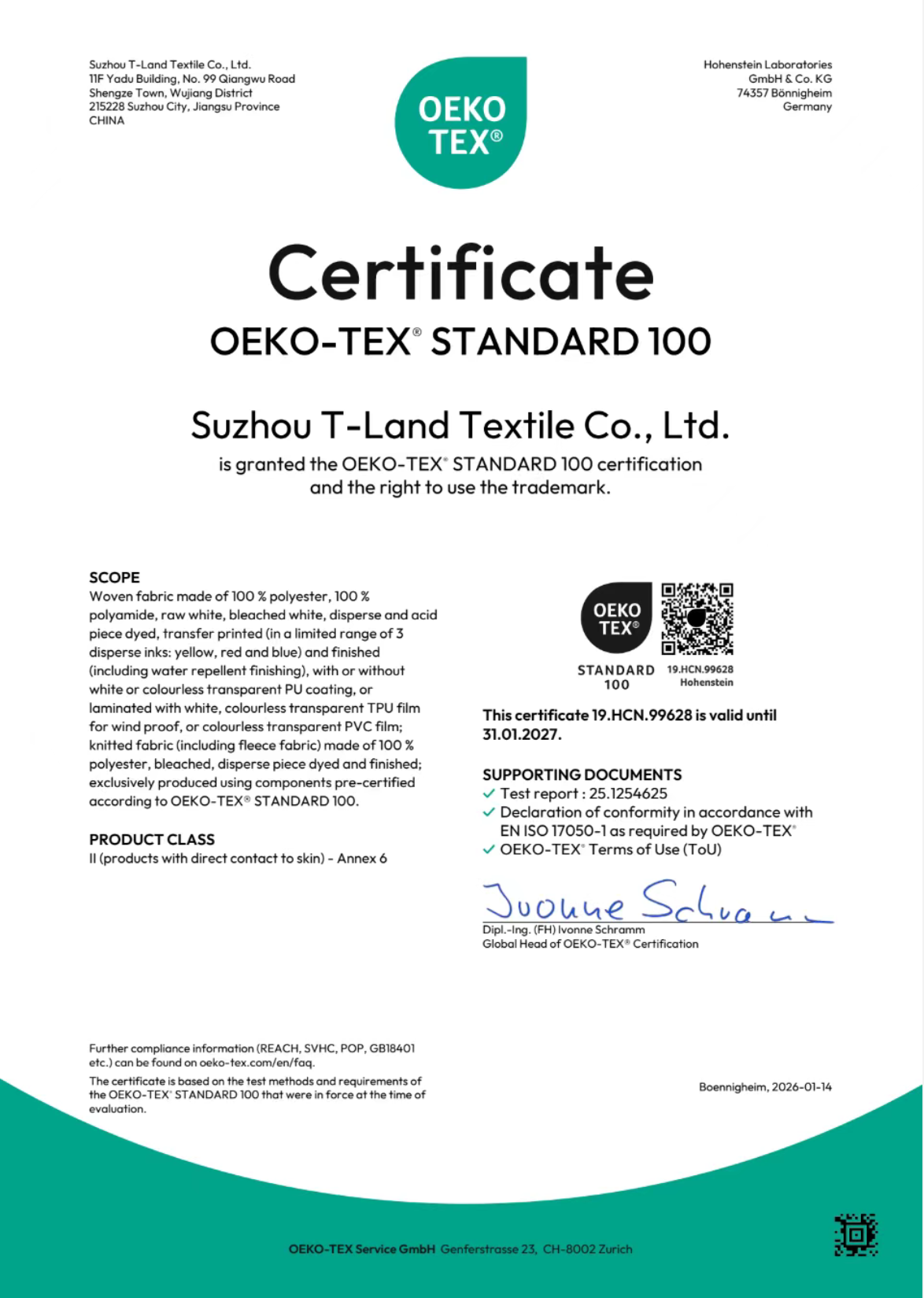
Certificate documents are only useful in an acceptance file when the number, scope, product class and expiry date are checked against the actual order.
Market trend: documentation is becoming part of the product
Three movements are visible in the available data. First, the light-control category is growing: the blackout fabric market is projected to move from USD 2.7 billion in 2024 to USD 3.8 billion by 2030 at a 5.9% CAGR, which pulls dimout and room-darkening constructions into more mainstream programs. Second, supply remains concentrated in Asia Pacific at 44.17% of the home textile market in 2025, so cross-border documentation will keep expanding. Third, the regulatory frame is tightening: EU GPSR 2023/988 already applies, Digital Product Passports for textiles are expected by 2027, and the UK fire regime for domestic upholstered products has been amended twice since 2010, most recently in 2025.
For upholstery, a USD 44.5 billion market in 2023 combined with rising traceability expectations means the acceptance file will increasingly need to be machine-readable. Buyers who already collect certificate numbers, scope statements and expiry dates in a structured format will be able to reuse that structure when passports become mandatory; buyers holding a PDF in an inbox will rebuild the same work from scratch.
How this compares with traditional layered solutions
Historically, light control in a curtain program was often solved with two layers: a decorative face fabric plus a separate lining or blackout layer. A single dimout construction such as TL08166 (260 gsm) or TL08269 (280 gsm) reduces the number of layers, the number of seams and the number of components a buyer must specify and inspect. For wide windows, the 280 cm and 300 cm widths available on TL08229 and TL0888 reduce seams further.
The trade-offs are real and belong in the checklist rather than in a post-delivery discussion:
- Dimout is not blackout. Dimout fabric controls and adjusts light; it is a different specification from a blackout fabric. No numeric light-blocking rate is published for the models in this reference set, so a project that needs a measured darkening level should require a declared test value instead of assuming one from the category name.
- Coating and backing add weight. A bonded, backed or coated construction changes hand and hanging behavior - visible in the curtain and sofa construction TL12199, specified at 300 gsm with backing and 380 gsm with silicon coating. That added weight affects drape and transport, and it is not free.
- Certificate scope is narrower than a logo. GRS certificate CB-CUC-1026562, issued by CONTROL UNION and valid from 2026-03-16 to 2027-03-15, covers dyed fabrics and greige fabrics - a recycled-content reference, not a fire or light-control claim. OEKO-TEX certificate 19.HCN.99628 is valid from 2026-01-14 to 2027-01-31 and is limited to the compositions, processes and product class described in its scope. Both carry expiry dates, so an acceptance file built once and reused for years becomes stale.
Practical consequence: for a long program, renew the certificate check at each order cycle rather than at the start of the relationship.
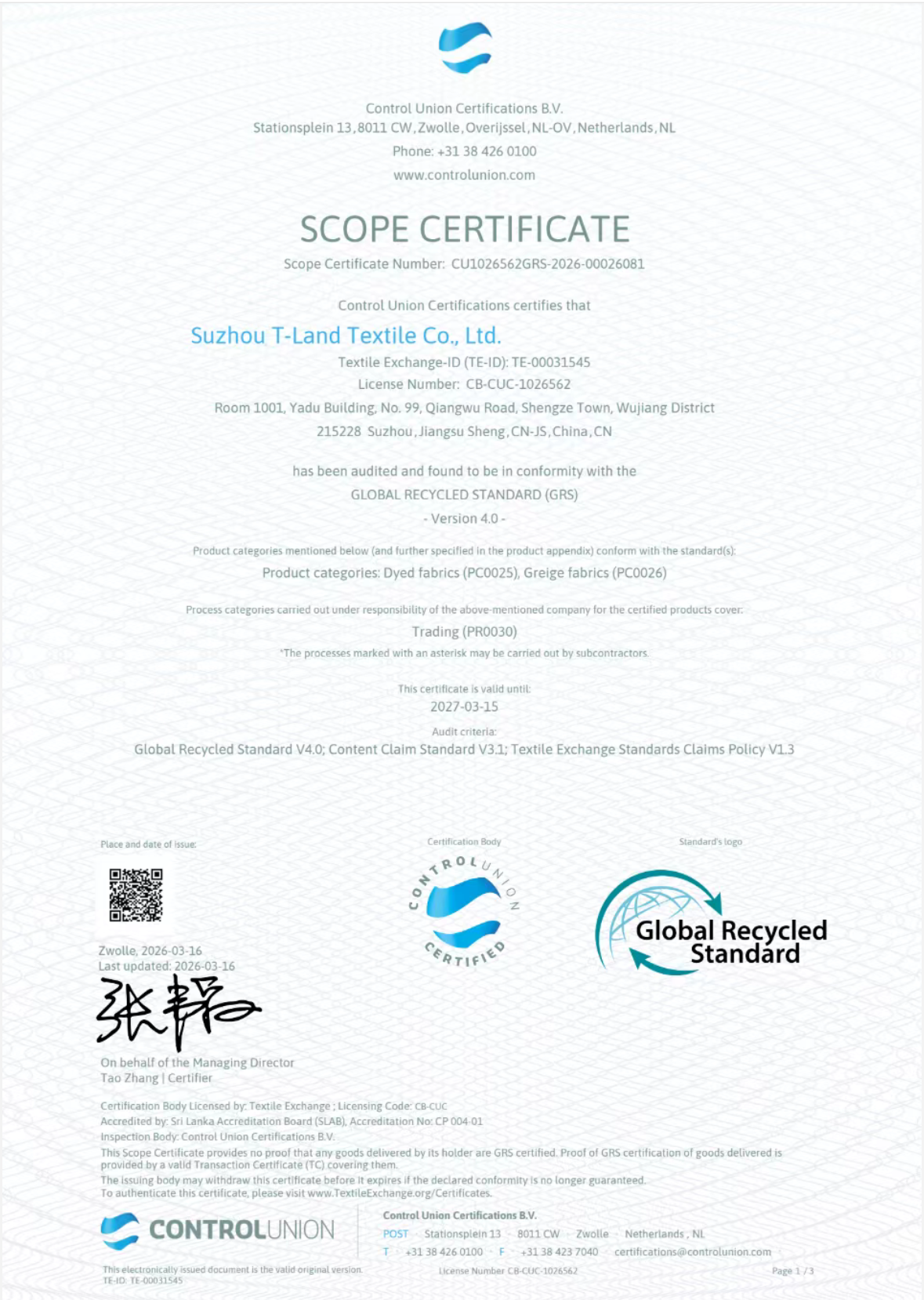
The GRS reference applies to dyed and greige fabrics; a recycled-content certificate should not be extended to cover fire or light-control claims.
Future outlook
The direction of travel is toward acceptance files that behave like data records: a model-level construction line, a certificate set with scope and expiry, a finishing declaration, and a test method for every performance claim that touches a warranty. Digital Product Passports expected by 2027 will make that structure mandatory for many textile placements rather than optional.
For buyers evaluating dimout curtain and sofa fabric programs now, the practical sequence has not changed: define the end use and the fire standard that applies, confirm the model construction and stated width, verify the certificate scope against the actual composition, then agree the inspection right and the after-sales window. A manufacturer serving export markets in the EU and the Americas through OEM and ODM production - as Suzhou T-land Textile Co., Ltd. does from Shengze, Jiangsu - will normally expect those items to be settled during sampling, not after the container leaves.
FAQ
What should be included in a home textile fabric acceptance file?
Six elements: the model and construction record (model number, yarn construction, gsm, stated width); the certificate set with numbers, scope and expiry dates; the finishing declaration covering coating, backing, flame-retardant, water-repellent and stain-resistant treatments; the approved sample with agreed tolerances; the test method list for light fastness, color fastness, pilling and abrasion; and the purchasing terms including MOQ, lead time, inspection rights and the after-sales window.
Which certifications apply to a dimout curtain or sofa fabric order, and how should they be checked?
Two certificates are relevant to the reference supply described here. OEKO-TEX Standard 100 certificate 19.HCN.99628, issued by Hohenstein, is valid from 2026-01-14 to 2027-01-31 and covers woven and knitted fabric made of 100% polyester and 100% polyamide, including bleaching, disperse dye piece-dyeing, transfer printing and PU/TPU/PVC coating and laminating finishing, Product Class II. GRS certificate CB-CUC-1026562, issued by CONTROL UNION, is valid from 2026-03-16 to 2027-03-15 and covers dyed fabrics and greige fabrics. The composition should be checked against the scope statement, and the certificate should still be valid on the order date.
How can a buyer verify whether flame retardancy comes from the yarn or from a coating?
Ask for a written declaration of the route - flame-retardant properties contained in the fibre or yarn, or delivered by a topical finish, backing or coating - together with the fire standard tested. Coating and laminating finishing (PU, TPU, PVC) falls inside the scope of OEKO-TEX certificate 19.HCN.99628 for the compositions it names, but that certificate is a chemical-safety document. The fire claim itself must reference the applicable standard, such as BS 5867 for curtains and drapes in the UK, or the Furniture and Furnishings (Fire) (Safety) Regulations 1988 for domestic upholstered products.
How is sample-to-bulk consistency controlled?
Through four controls: 100% in-house testing or random inspection by the customer, agreed in writing before production; lot-level testing in an in-house laboratory, with order instructions managed through a computer-based, non-paper system; a numeric tolerance for batch-to-batch color difference control; and a signed approved sample whose shade, weight and width tolerances are copied into the purchase order. Development is carried out against the customer's own sample, so the buyer's piece defines the target.
Why does upholstery fabric pill, and why do curtains fade?
Pilling occurs when repeated friction pulls short surface fibres out of the yarn and those fibres tangle into visible pills. Almost all fabrics may pill, and short-fibre fabrics are more likely to pill than long-fibre fabrics, so the pilling-resistance grade - not the fabric weight - is the relevant acceptance measure. Curtain fading is caused mainly by ultraviolet radiation breaking down dye molecules, which happens when light fastness is insufficient; the light fastness grade should therefore be confirmed before purchase rather than disputed after installation.
What purchasing terms should be recorded alongside the specification?
For the reference supply described here: OEM and ODM production for export markets in the EU and the Americas; MOQ of 500-1000 mts per color; lead time of 30-45 days; monthly capacity of 200,000 mts; customization of pattern design, fabric width, gram weight, color or shade, flame-retardant, water-repellent and stain-resistant finishing, and development against customer sample; and an after-sales window within two months after goods are received by the customer. The customization list specifies water-repellent, which is not the same specification as waterproof.
Reference document: the manufacturer's product and capability brochure is available for download here - T-land Textile brochure (PDF).