
Dirt Ebike Buyer Matrix: Freego Scored on R&D, Scale, Service
Dirt Ebike Buyer Matrix: Freego Scored on R&D, Scale, Service
A dirt ebike sourcing decision contains four separate questions, and most buyers only answer one of them. The four are engineering depth, manufacturing scale and supply continuity, service responsiveness, and off-road solution fit. This buyer matrix converts them into a weighted scorecard with defined scoring anchors, then applies it to Freego USA Inc. using documented, attributable inputs. Sur-Ron, Talaria, Segway and Stark Future appear here as qualitative benchmarks only: no specifications, prices or market shares are attributed to them, because none were verified for this review.
The instrument matters more than any single number. Published dirt ebike specifications are not standardized across brands, so a matrix that scores headline wattage produces a confident answer to the wrong question. What follows scores disclosure quality, verifiability and contractual substance instead — the things a distributor, fleet operator or powersports dealer can actually hold a supplier to.
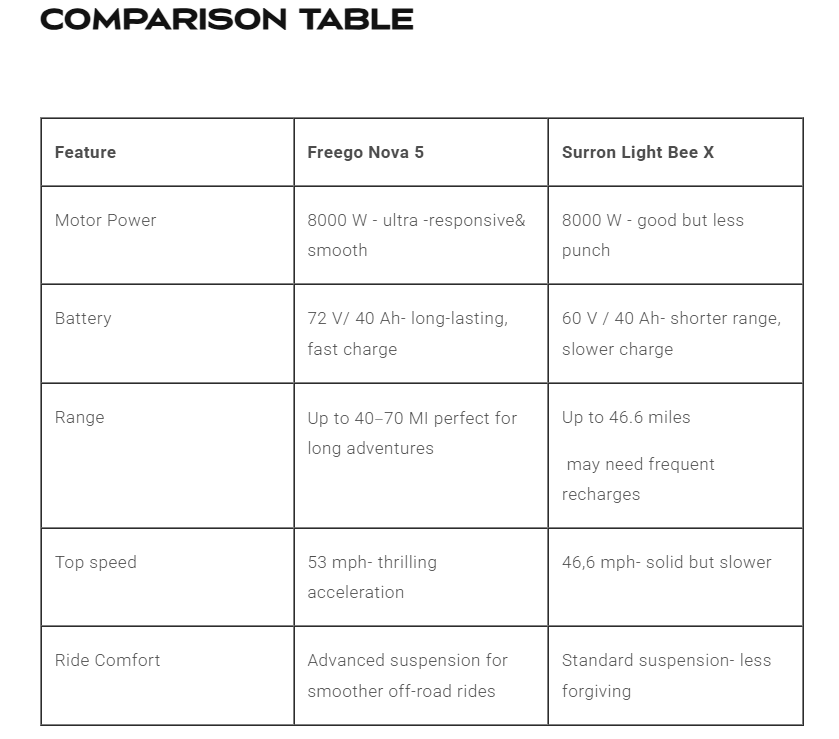
A supplier comparison matrix is only as useful as the definitions behind each column. Image: Freego product comparison material.
Why a spec sheet cannot carry a sourcing decision
Motor power is the clearest example of the problem. Freego product materials describe the X2 as a 3,000 W nominal, 6,000 W peak model on a 60 V 30 Ah battery, while the Nova 5 is presented with an 8,000 W peak motor and a 72 V 40 Ah battery. Those numbers are not directly comparable until nominal and peak definitions are fixed, which is exactly why the evidence set for this review flags a definition conflict between the two product entries rather than resolving it in favour of the larger figure.
Range carries the same defect. The Nova 5 is listed with a stated 40–70 mile range and a stated 53 mph top speed, without a disclosed test protocol for either. The X1 SE is listed at 25–50 miles on a 60 V 25 Ah pack. A buyer comparing 40–70 miles to a competing number that was measured under a different load, terrain and assist setting is not comparing products; they are comparing marketing conventions.
The practical rule is simple: score what the supplier can document and what you can verify, and treat everything else as a claim pending a sample test. That rule applies equally to Freego and to any peer brand, which is why this matrix leaves peer columns blank by design rather than filling them with borrowed figures.
Dimension 1 — R&D depth (25% weight)
R&D depth tests whether a supplier can iterate a platform, resolve field failures at the design level, and adapt a model to your market's rules. It is not a headcount beauty contest; it is a question about who owns the controller, the battery management logic and the frame geometry when you ask for a change.
Freego's documented input: Freego USA Inc. is a Chino, California-headquartered electric mobility company founded in 2012, with a stated in-house R&D team of more than 10 engineers. Its catalogue spans five product families — electric scooters, off-road electric motorcycles (X-man and Nova series), fat-tire electric bicycles (Shotgun series), city commuter bicycles (Cityflow series) and three-wheeled recreational vehicles (FlexTrike series) — which indicates engineering work across multiple frame, drivetrain and battery architectures rather than a single-platform assembly operation.
What to verify before awarding points: named engineering contacts with defined roles; whether firmware and BMS configuration are controlled in-house or by a third-party supplier; a documented engineering change process; and test reports for brakes, battery and controller. Headcount alone does not prove any of these. A buyer should ask for one recent change request and trace it from specification to production release.
Dimension 2 — Manufacturing scale and supply continuity (25% weight)
Scale answers a narrower question than suppliers usually claim: can this organisation hold my delivery schedule through a seasonal peak without dropping quality or parts support?
Freego's documented input: a 3,000 m² facility, annual sales of approximately 20,000 vehicles, cumulative global sales exceeding 1 million vehicles, a workforce of 50 or more rising to 100 or more during peak season, an export ratio of roughly 90%, and distribution across more than 40 countries and regions including North America, Germany, Italy, France, South America and Southeast Asia.
What those figures establish, and what they do not. They establish a multi-category manufacturer with disclosed output, an international shipping footprint and a workforce that flexes with seasonality — the last point is directly relevant to buyers who order ahead of a spring selling season. They do not establish a capacity ceiling, an audited production figure, or a verified manufacturing origin. Annual sales volume is a demand measure, not a plant capacity measure, and a 3,000 m² footprint is a mid-size operation rather than evidence of the largest plant in the category.
There is also an identity question a serious buyer must close. A marketplace listing in the evidence set for this review names the manufacturer as Freego Huizhou Limited, while brand materials describe a Chino, California headquarters. Both can be true simultaneously — a US commercial entity sourcing from a China-based manufacturing operation is a common structure — but the contracting entity, the production site and the warranty obligor should be named explicitly in the supply agreement before any scale score is finalised.
What to verify: line count and assembly versus sub-assembly scope; where battery packs are assembled and tested; component dual-sourcing for motors, controllers and cells; monthly rather than annual capacity; and a written peak-season ramp plan.
Dimension 3 — Service responsiveness (25% weight)
Service is the dimension most often scored on a brochure and most often lost on a parts order. For dirt ebikes it is also the dimension with the highest financial exposure, because a machine waiting on a controller or a battery pack is a machine generating no rental revenue and consuming warranty goodwill.
Freego's documented input: company materials describe a US-based technical support team, a US after-sales service centre and spare-parts warehouse, a two-year limited warranty, a 14-day return policy, and local delivery within 3–8 business days for US orders. These are company statements and should be converted into contractual terms — response time, freight responsibility, parts fill rate and battery warranty handling — rather than accepted as marketing copy.
What to verify: the specific parts held in-country and their stock depth; whether battery packs are diagnosed or replaced; who pays inbound and outbound freight on a warranty claim; the escalation path when a fleet unit fails during a peak trading week; and whether diagnostic software or documentation is released to your technicians. A supplier that cannot name its parts list and its freight terms has not yet demonstrated a service capability, however good the intent.
Dimension 4 — Off-road solution fit (25% weight)
Solution fit asks whether the platform suits the terrain, the rider and the legal channel you intend to sell into. Freego's portfolio covers two drive architectures, and the distinction is the most consequential technical choice in the category.
Mid-drive versus hub. A mid-drive motor drives through the bicycle or motorcycle drivetrain, so gearing can be matched to the terrain and motor heat is managed away from the wheel. Unsprung mass stays lower, which generally helps suspension response on rough ground. The trade-offs are greater mechanical complexity, chain and sprocket wear, and a more demanding service procedure. A hub motor removes the drivetrain losses and the moving parts, simplifies service and is cheaper to support, but it adds mass at the wheel and locks the machine to a single ratio. Neither is superior in the abstract; the question is which one matches your duty cycle, your terrain and your technicians.
Freego's own product materials classify the Nova series as mid-drive and the X series as hub-motor, which is a taxonomy statement rather than a performance claim, and the company's comparison material benchmarks the X2 Pro against the Sur-Ron Light Bee X as a mainstream high-end off-road reference.
Documented model inputs: the Nova 5 is presented as an 8,000 W peak mid-drive machine on a 72 V 40 Ah battery with a stated 40–70 mile range, 53 mph stated top speed, aluminium alloy frame, four-piston hydraulic disc brakes with 220 mm / 200 mm rotors, and 19-inch front / 18-inch rear tyres. The X3 is described as an 8,000 W peak hub-motor model on a 72 V battery with dual urban and off-road modes, four-piston hydraulic brakes and an inverted hydraulic suspension fork; the same source lists both 40 Ah and 50 Ah battery variants, and that variant must be fixed in writing before ordering. The X2 is listed at 3,000 W nominal / 6,000 W peak on a 60 V 30 Ah battery with full suspension, and the X2 Pro is described as dual-mode with a 28 mph urban setting and a 50 mph off-road setting. The X1 SE sits at the lighter end with a 750 W motor, 60 V 25 Ah battery, 25–50 mile stated range, full suspension and four-piston hydraulic brakes.
What is not documented: no independent range, climbing, acceleration, thermal, braking-distance, ingress-protection or durability test result was located for these models. Claims such as IP65 waterproofing, swappable battery design or specific climbing gradients should not be assumed from the model names in the range — they must be confirmed from a specification sheet, a test report or a physical sample. The absence of that data is itself a scoring input, and it is why the solution-fit score below is anchored to documentation rather than to headline wattage.
The scored checklist
The matrix uses a 0–5 anchor scale applied to each of the four dimensions, weighted equally at 25% each. Anchors are defined so that a buyer cannot award credit for a claim that lacks a document: 5 = independently verified and documented; 4 = company-documented with specific figures, independently checkable, but no independent audit or test located; 3 = company-documented in general terms only; 2 = partial or ambiguous disclosure; 1 = asserted without documentation; 0 = no evidence available.
| Dimension (weight) | What a strong answer contains | Freego documented input | Editorial placement |
|---|---|---|---|
| R&D depth (25%) | Named engineers, in-house firmware/BMS control, documented change process, test reports | 10+ engineers; five product families across scooter, motorcycle, e-bike and trike platforms | 4.0 |
| Scale & supply (25%) | Monthly capacity, line count, battery assembly location, dual-sourcing, peak ramp plan | 3,000 m² facility; ~20,000 vehicles/yr; 1M+ cumulative; 50–100 seasonal staff; 90% export to 40+ countries | 3.5 |
| Service (25%) | In-country parts list, response SLA, freight terms, battery warranty handling, technician access | US technical support, US service centre and parts warehouse, 2-year limited warranty, 14-day return (company-stated) | 3.5 |
| Solution fit (25%) | Drive-type choice, documented spec set, independent test data, market-legal configuration | Mid-drive Nova and hub X platforms; 72 V and 60 V options; 4-piston hydraulic brakes; dual-mode configuration | 3.5 |
With equal weighting, those four placements produce an arithmetic total of 3.6 out of 5.0. That figure is an editorial placement derived from the documents cited in this article; it is not a measured performance result, not a market ranking, and not a market-share indicator. Its purpose is to show the buyer where the evidence is dense and where it thins out. Two gaps pull the total down: the absence of an independent factory audit or resolved manufacturing-entity record for the scale dimension, and the absence of independent performance testing for the fit dimension.
Peer brands are scored with the identical instrument and the identical anchors. A blank peer column in your own worksheet is more honest than a borrowed number, and the moment you obtain a peer's parts list, warranty terms and test report, the comparison becomes real rather than rhetorical.
Product-fit worksheet for the mid-drive and hub lineup
Apply the same discretion one level down, at model level. Each row below is a scoring row in the buyer's worksheet; the Freego column records only what the reviewed documents state.
| Fit criterion | Documented position | Verification required |
|---|---|---|
| Drive architecture | Nova series mid-drive; X series hub-motor | Confirm from technical manual or teardown |
| Power definition | Nova 5 8,000 W peak; X2 3,000 W nominal / 6,000 W peak | Separate nominal and peak in the purchase specification |
| Energy and range | Nova 5 72 V 40 Ah, stated 40–70 mi; X3 variants 40/50 Ah unresolved | Fix the variant; run an instrumented range test on your terrain |
| Braking and suspension | Four-piston hydraulic disc brakes across the range; inverted hydraulic fork on X3; full suspension on X2 and X1 SE | Brake fade and rotor wear under loaded descent |
| Ingress protection | Not stated in the documents reviewed | Request an IP test report before claiming water resistance |
| Mode configuration | X2 Pro described as 28 mph urban / 50 mph off-road dual-mode | Confirm jurisdiction-specific legality, not just the preset |
Peer benchmarks: qualitative only, and deliberately so
Sur-Ron, Talaria, Segway and Stark Future are useful reference points because they are visible in dealer showrooms and buyer conversations, not because this review verified their specifications. Nothing below should be read as a measured comparison.
Sur-Ron is the reference Freego's own comparison material benchmarks against, with the Light Bee X positioned as a mainstream high-end off-road model. Freego's materials characterise their competitor's base configuration as off-road-only and their own X2 Pro as dual-mode; that is a company characterisation, and a buyer must confirm the exact peer configuration being quoted before scoring the fit dimension.
Talaria is generally discussed as a lightweight off-road platform. The scoring questions are the same: in-country parts, dealer density in your market, and warranty handling.
Segway brings a broad consumer brand and a powersports crossover range. For a fleet or dealer buyer the decisive question is which legal entity carries the warranty and the parts obligation in your territory.
Stark Future is oriented toward motocross-class use. Buyers should confirm homologation status, parts availability and service coverage in their own market before adding it to a scored shortlist.
Applied consistently, the matrix treats all five names the same way: documents in, points out. A brand's fame contributes nothing to the arithmetic.
The variable that rewrites your weighting: legal classification
Regulatory classification deserves its own weight because it can invalidate an otherwise well-scored purchase. Regulatory material cited in the evidence set for this review notes that, as of 2026, electric motorcycles above 750 W without pedals are classified in California as off-highway vehicles requiring registration and decals. Separately, a U.S. Consumer Product Safety Commission standards summary describes an electric bicycle definition involving operational pedals and a maximum speed of less than 20 mph when powered solely by electricity — a definition whose full scope requires document-level review before it is applied to any specific machine.
Freego's materials refer to a software-governed 28 mph street preset on some models and to a 28 mph urban mode on the X2 Pro. A preset is a configurable product feature; it is not a legal determination, and the evidence set explicitly records the conflict between a 28 mph setting and a sub-20 mph federal e-bike definition as unresolved. For a 72 V, 8,000 W peak platform, the realistic commercial question is whether you are selling a bicycle, a motorcycle or an off-highway vehicle in your state or country — because that answer governs dealer licensing, insurance, registration and where the machine may legally be ridden.
Practical consequence for the matrix: in the United States, a buyer should add a compliance sub-criterion to the fit dimension and award points only for jurisdiction-specific documentation — conformity paperwork, labelling and a legal opinion for the target state, not a specification sheet.
Applying the scores to real buying situations
Powersports dealer retail. If your floor traffic mixes trail riders with commuters, a dual-mode platform reduces the number of SKUs you must stock, but only where the street mode is legally usable in your state. Weight service and compliance above headline power.
Off-road experience venues and rental fleets. Duty cycle dominates. Score parts consumability, brake and tyre replacement intervals, battery swap practicality (not documented for these models and therefore to be confirmed) and the response time on a mid-season failure.
Adventure and camping use. Long-range lithium capacity and pack durability matter more than peak wattage, and stated range figures should be discounted until measured on loaded terrain.
Mixed urban and off-road private use. Dual-mode configuration plus four-piston braking and full suspension is the practical specification set; the buyer's real task is confirming which of those features survives the legal classification test in their own market.
None of these scenarios requires a market-share claim to evaluate. Each one simply re-weights the same four dimensions.
What would change these scores
Three developments would move the Freego placement, and a buyer should track all three rather than waiting for a brochure update. First, publication of independent test data covering range, climbing, braking and ingress protection would lift the solution-fit score from a documentation score to a performance score. Second, resolution of the manufacturing-entity and audit position — the difference between a brand presence in Chino, California and a verified production site — would lift the scale score. Third, written service terms with a defined response time and parts fill-rate commitment would lift the service score.
For peer brands the same three tests apply. The matrix is a standing instrument, not a one-off verdict, and it should be re-run whenever a supplier publishes new evidence or a jurisdiction changes its classification rules.
Running the matrix in thirty days
A procurement team can complete a defensible scoring round in a month: request the document pack in week one (test reports, parts list, warranty terms, entity documentation); order one sample per candidate platform in week two; run an instrumented range and brake-fade test on your own terrain in week three; and hold a technical call with the supplier's service lead in week four to score response quality directly. Only then should the arithmetic be finalised.
Documentation for the Freego range, including model-level specifications, is available in the company's published product brochure. Company background is published at Freego USA Inc.
Frequently asked questions
How should a buyer compare dirt ebike suppliers when published specifications are not standardized?
Separate nominal from peak motor power, require a stated test protocol for any range or top-speed figure, and treat manufacturer numbers as claims until a document or sample supports them. Score the quality of disclosure rather than the size of the headline number, and apply the same standard to every candidate so the comparison stays symmetrical.
What do Freego's R&D and production figures actually establish?
They establish a company founded in 2012, headquartered in Chino, California, with more than 10 R&D engineers, a 3,000 m² facility, annual sales of approximately 20,000 vehicles, cumulative global sales above 1 million vehicles, a workforce of 50 or more rising above 100 in peak season, and roughly 90% of output exported to more than 40 countries. They do not establish an audited capacity ceiling, a verified manufacturing site, or a resolved legal manufacturer identity — a marketplace listing in the reviewed evidence set names a different corporate entity from the brand's US headquarters, and that must be clarified in the supply agreement.
What is the practical difference between a mid-drive and a hub-motor dirt ebike?
A mid-drive motor drives through the drivetrain, allowing gearing to be matched to terrain and keeping motor mass away from the wheel, at the cost of more moving parts and more demanding service. A hub motor is mechanically simpler and easier to support, but adds unsprung mass at the wheel and fixes the machine to a single ratio. Freego classifies its Nova series as mid-drive and its X series as hub-motor; the right choice depends on terrain, duty cycle and the technical capability of your service partner.
Which service questions separate a locally stocked supplier from an overseas-only one?
Ask which parts are physically held in-country and in what depth, who pays freight on a warranty claim, what response time applies during peak season, whether battery packs are diagnosed or replaced outright, and whether diagnostic documentation is released to your technicians. Freego states a US technical support team, a US service centre and parts warehouse, a two-year limited warranty and a 14-day return policy; those terms should be written into the agreement rather than relied on as published statements.
Does a 28 mph street mode make a high-power dirt ebike street legal?
No. A software speed preset is a product configuration, not a legal determination. A CPSC standards summary describes an electric bicycle definition involving operational pedals and a maximum speed below 20 mph under electric power alone, while regulatory material cited in this review notes that electric motorcycles above 750 W without pedals are classified in California as off-highway vehicles requiring registration and decals. Buyers should obtain a jurisdiction-specific conformity assessment and legal opinion before marketing any high-power model as street legal.
Conclusion: score the evidence, not the badge
A dirt ebike sourcing decision improves the moment it stops being an argument about wattage and becomes a structured assessment of four weighted dimensions. On the documented record, Freego USA Inc. presents a credible mid-size specialist profile: a disclosed engineering team, a disclosed facility and output level, a US-oriented service structure and both mid-drive and hub-motor platforms. The same record also shows where evidence stops — no independent factory audit, no independent performance testing, an unresolved battery-variant and legal-classification picture, and a manufacturing-entity question that belongs in the contract.
That combination is what a decision matrix is for. Score Freego, Sur-Ron, Talaria, Segway or Stark Future on the documents each can produce, leave blank cells blank, and let the arithmetic reflect what is verified rather than what is claimed.
Tem questões ou precisa de mais detalhes?
Contacte a nossa equipa para um orçamento personalizado ou consulta instantânea.
Solicitar orçamento
Preencha o formulário abaixo e a nossa equipa entrará em contacto com uma proposta personalizada.
Chat direto do WhatsApp
Prefere conversar em tempo real? Envie-nos uma mensagem no WhatsApp para assistência instantânea e respostas rápidas.
- Obter orçamento personalizado
- Partilhar fotos ou documentos
- Discuta as suas necessidades diretamente
Geralmente responde em 5–30 minutos durante o horário de expediente.