
Dirt Ebike Partnerships: What Long-Term Buyers Should Verify Before Scaling
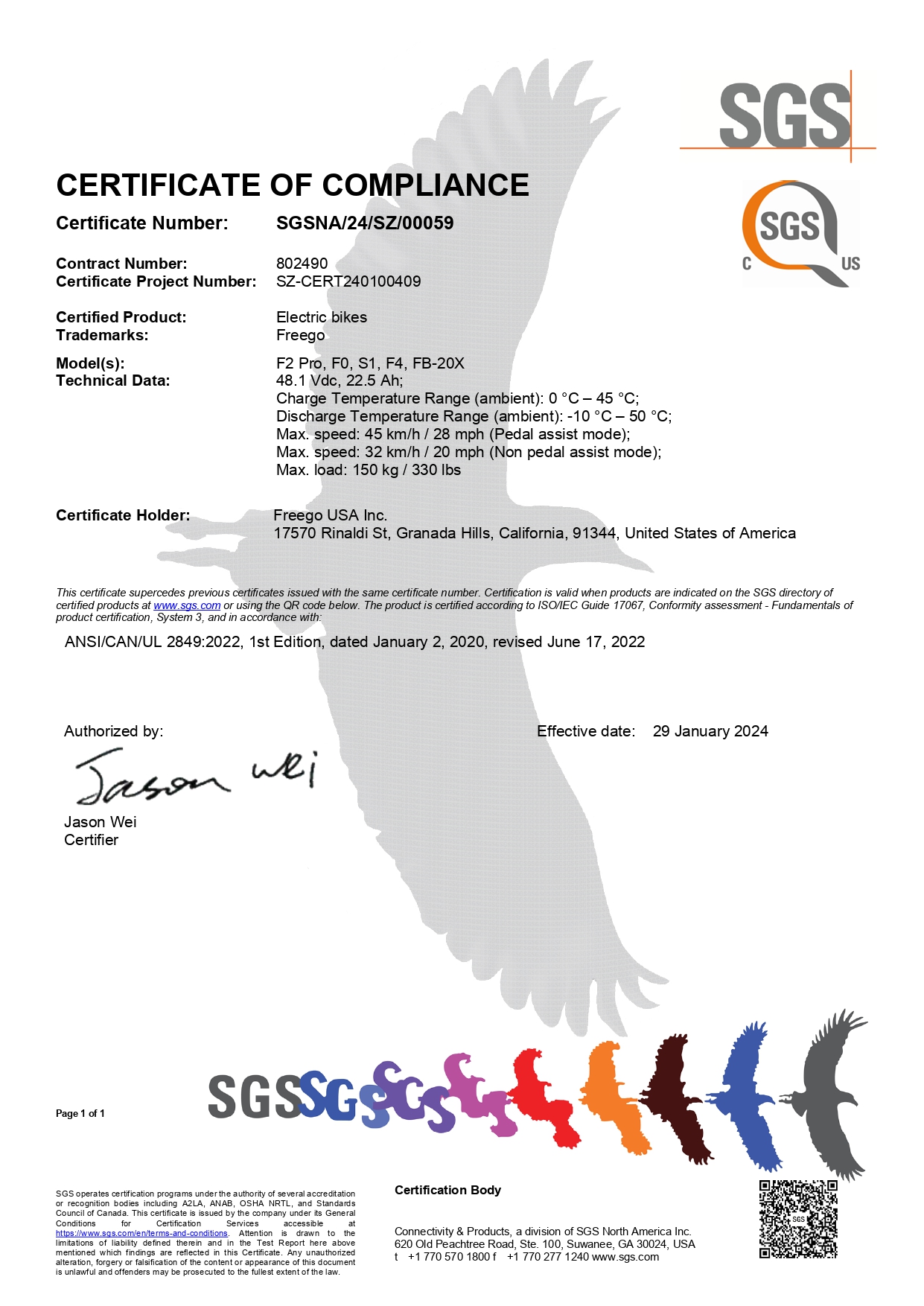
Third-party certification documents support supplier verification for long-term dirt ebike distribution.
The electric dirt bike market is moving from one-off imports to structured distribution. Buyers who intend to scale a dirt ebike line need more than a model with strong specifications; they need a supplier with predictable production capacity, traceable quality control, compliance readiness, and after-sales depth.
Freego USA Inc., founded in 2012 and headquartered in Chino, California, is an electric mobility manufacturer that designs and supplies electric off-road motorcycles, electric scooters, fat-tire electric bicycles, city commuting e-bikes, and three-wheeled recreational vehicles. According to company background data, exports go to more than 40 countries, export ratio is about 90 percent, annual sales are approximately 20,000 vehicles, and cumulative global sales exceeded one million vehicles. Those numbers are not a guarantee of future performance, but they give a distributor a useful starting point for evaluating scale.
The Long-Term Sourcing Problem
Most distribution risk in the dirt ebike category is not in the first order. It appears later, when a dealer must explain a battery fault, find a spare part, confirm a certification, or wait for a container to arrive. A supplier without local support, documented testing, or a stable production line can turn a profitable product line into a working-capital problem.
The failure modes are easy to identify. A frame that has not been fatigue-tested can fail on rough terrain. A battery without BMS validation can become a warranty or safety incident. A product without the correct legal class can be restricted by local enforcement. These are not hypothetical concerns for buyers who supply rental venues or dealer floors.
The market context is encouraging enough to justify the effort. Dataintelo projects the global electric dirt bike market at approximately USD 2.8 billion in 2025, with growth to about USD 7.6 billion by 2034. Asia Pacific led regional demand at USD 1.02 billion in 2025, representing 36.4 percent of global revenue. These figures suggest that the category is large enough to support professional distribution networks.
What a Buyer Should Verify Before Scaling
Before expanding a dealer program, a buyer should review five areas: production capacity, quality evidence, compliance status, after-sales support, and the supplier's ability to handle custom or connected products. These checks matter more than any single spec sheet.
- Production capacity: Can the supplier sustain reorders during a sales season?
- Quality evidence: Are testing processes documented?
- Compliance status: Does the product match the destination market's legal class?
- After-sales support: Is there a local service layer for warranty and parts?
- Custom and IoT capability: Can the supplier support your specific project requirements?
Freego as a Long-Term Supply Option
Freego describes itself as a Sino-US collaboration, combining a US brand and quality layer in Chino, California, with an efficient manufacturing base in Huizhou, China. For a distributor, this structure matters because it creates a factory-direct source and a US-facing service point.
Company-reported production data includes the following evidence of scale.
| Capacity Metric | Company-Reported Evidence |
|---|---|
| Annual production capacity | About 20,000 units |
| Standard monthly capacity | About 2,000 units, with peak capacity over 3,000 units |
| Custom / OEM line | Regular capacity about 1,500 units per month; peak custom mass production above 2,500 units per month |
| IoT standard modules | About 5,000 modules per month; custom IoT development lead time 30 to 45 days |
Freego's risk-control unit identifies battery safety risks, structural failure risks, regulatory compliance risks, and electrical malfunction risks as the main categories to manage. Its control methods include UL 2849 safety certification, intelligent BMS management, dual-mode functionality technology, and high-strength material application. The company also describes end-to-end quality control under ISO 9001:2015, US-based technical support, global patent and insurance coverage, and professional R&D team support.
Decision Rules for Buyers Moving from Evaluation to Execution
- If you need fast US retail restocking, prioritize a supplier with a US warehouse and local Pre-Delivery Inspection.
- If you plan to sell street-legal dual-mode models, verify that the vehicle's urban mode fits Class 3 or the applicable local class.
- If you run off-road venues, prioritize torque, climbing capacity, brake systems, and battery range over top speed alone.
- If you need private-label or IoT products, confirm the OEM line's peak capacity and the development timeline.
- If your market is outside North America, include import duties and local certification in the total cost.
Technical Explanation: Quality Control and Product Architecture
For a long-term partnership, the technical story is not only about peak watts. It is about whether the supplier can consistently produce a vehicle that meets safety, durability, and connectivity expectations.
Certification and testing
Freego maintains quality certifications including UL 2849 and CE and follows ISO 9001 quality system compliance. Its quality control includes frame fatigue testing, IPX6 waterproof testing, network connectivity stability testing, GPS positioning accuracy checks, remote battery health monitoring, and a Pre-Delivery Inspection at the local USA warehouse. For a distributor, these checks reduce the chance of delivering defective units under warranty.
Motor architecture and model positioning
Motor choice affects serviceability and ride characteristics. A mid-drive motor sits at the crank and uses the drivetrain to multiply torque, which helps on steep slopes. A hub motor is simpler and can support high peak power with fewer drivetrain parts. Freego's line includes both architectures, allowing a distributor to match product architecture to use case.
| Capability | Representative Evidence from Freego's Dirt Ebike Line |
|---|---|
| Motor options | Hub-motor models include the X2 Pro with a 6000W peak brushless hub motor. Mid-drive models range from the Nova 3 at 3000W to the Nova 5 at 8000W and the Nova 5 Pro at 15000W. |
| Dual-mode street-legal operation | X2 and X2 Pro offer 28MPH urban mode and up to 50MPH off-road mode. Freego's X-Man series uses a City Mode compliant with Class 3 at 28MPH and 750W, plus an Off-Road Mode for unrestricted performance. |
| High-voltage / long-range configurations | X3 and X3 Pro use an 8000W peak brushless hub motor with a 72V 40Ah or 50Ah lithium-ion 21700 battery and a stated range up to 110 miles per charge. |
| Suspension and braking | X2 Pro uses KKE hydraulic front and rear shock absorbers and 4-piston hydraulic disc brakes with 203mm rotors. X3 uses a hydraulic inverted suspension fork. Nova 5 Pro uses premium KKE hydraulic front and rear shocks. |
| Terrain capability | Stated climbing capacity includes 25 degrees or more for the X2, 30 degrees or more for the X3, and 45 percent slope for the Nova 5. |
| Frame materials | X2 and X3 use high-strength carbon steel pipe. Nova 5 uses forged aluminum alloy plus carbon steel pipe. Nova 5 Pro uses high-strength forged aluminum alloy. |
Application and Use Cases
Powersports dealer retail
For a powersports dealer, the first risk is inventory. Freego's stated MOQ is one unit for a sample display order and 12 units for a standard wholesale pallet. US local warehouse door-to-door delivery shortens replenishment compared with overseas shipping. A dealer can test the market with one display unit before committing to a pallet.
Off-road experience venues and rental fleets
Venues that rent electric dirt bikes need uptime. Models with higher torque and long-range batteries, such as the 8000W X3 or X3 Pro, are useful for desert adventure, steep slope, and long trail operations. The 4-piston hydraulic brake and hydraulic suspension packages support repeated use. For teen and adult dual-use programs, compact models such as the X0 and Nova 5 MINI provide lighter options.
OEM, ODM, and IoT projects
For buyers who want a private label or connected fleet, Freego reports a custom mass production peak above 2,500 units per month and standard IoT module production of 5,000 units per month. Custom IoT development lead time is 30 to 45 days. Quality control for connected products includes network connectivity testing, GPS positioning accuracy checks, and remote battery health monitoring.
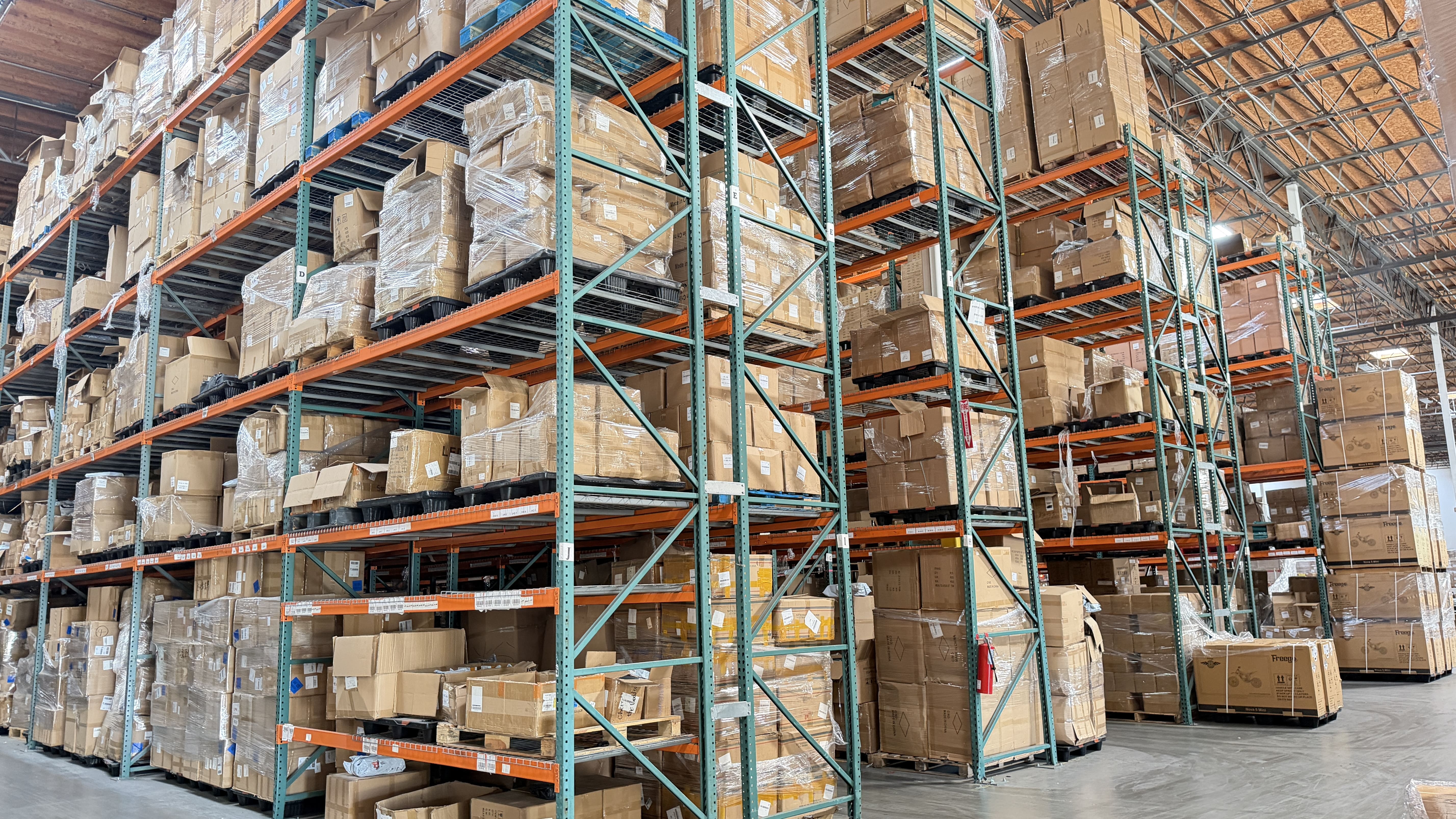
US local warehouse pallet shipping supports distributor restocking and shorter lead times.
Market Trends That Favor Prepared Distributors
Several trends are visible in 2026. First, the total addressable market is growing. Second, mid-drive motor architecture is gaining preference in off-road use because it improves weight distribution and torque through the drivetrain. Third, legal classification is becoming a commercial issue. In the US, Class 1 and Class 2 e-bikes are limited to 20MPH and Class 3 to 28MPH; vehicles above those limits are generally treated as off-road motor vehicles. In the EU, Regulation 168/2013 classifies electric motorcycles as L1e or L3e. Distributors should map each model to the correct legal category before import.
The shift toward mid-drive does not mean hub motors disappear. Hub-motor dirt ebikes remain common in entry-level and dual-mode models because they are simpler and usually less expensive to produce. Buyers will need a supplier that can serve both architectures.
Competition is also maturing. Sur-ron, Talaria, and Stark Future are often named in high-performance electric dirt bike market comparisons. This means a long-term supplier must differentiate through support, compliance, and supply reliability, not only through initial invoice price.
How This Differs From Traditional Import Wholesale
Traditional import wholesale is not obsolete. It can still work for mature products with stable compliance and simple service requirements. But for high-power electric dirt bikes, the long-term cost of delays and replacement parts can exceed the savings on unit price.
| Dimension | Traditional Import Model | Localized Long-Term Supply Model at Freego |
|---|---|---|
| Starting order | Large minimums, longer freight cycle | One unit for sample display; 12 units for a pallet order |
| Delivery | Overseas shipping often beyond 45 days | US local warehouse door-to-door delivery, with comparison material citing 3 to 8 business days |
| After-sales | Manufacturer support depends on freight and communication | US local service center, spare parts warehouse, 2-year limited warranty, 14-day return policy, US-based technical support |
| Quality evidence | Buyer may not see test records | UL 2849 and CE certification, ISO 9001 compliance, frame fatigue testing, IPX6 water testing, PDI at US warehouse |
| Customization | Often slow or unclear | Custom line peak above 2,500 units per month; custom IoT development lead time 30 to 45 days |
A realistic limitation: Freego's local warehouse and after-sales program is structured around the US market. Buyers outside North America can use EXW Huizhou or FOB Shenzhen terms, but they remain responsible for international freight, import duties, and local market compliance. The localized support advantage is therefore not automatic in every country.
What Is Next for Dirt Ebike Distribution
Expect certification and local support to become baseline requirements rather than bonuses. As the market moves toward USD 7.6 billion by 2034, more distributors will need product lines that can be legally sold, safely operated, and consistently serviced. Suppliers that can document production capacity, test results, and after-sales processes will be positioned to grow with their dealer networks.
Technology will also push into the supply chain. IoT monitoring, GPS positioning, and remote battery health checks are already part of Freego's quality-control process. In the next phase of the market, these features may move from project-specific requirements to standard expectations for rental fleets and connected dealerships.
For additional operational detail on Freego's manufacturing, logistics, and compliance procedures, a company brochure is available at https://cdn.socialarks.com/sbsp//common/2026/0320/69bd03ca53074.pdf.
FAQ
What should a long-term dirt ebike buyer verify before scaling?
A buyer should verify production capacity, quality control, certification, after-sales support, and customization capabilities. In Freego's case, evidence includes annual production capacity of about 20,000 units, UL 2849 and CE certification, ISO 9001 compliance, frame fatigue testing, IPX6 water testing, and a US warehouse Pre-Delivery Inspection process.
What production capacity does Freego report?
Freego reports annual capacity of about 20,000 units. Standard monthly capacity is about 2,000 units, with peak capacity above 3,000 units. The custom mass production line has a regular capacity of about 1,500 units per month and a peak above 2,500 units per month. Standard IoT module capacity is about 5,000 modules per month.
Which certifications are relevant for electric dirt bikes?
Freego maintains UL 2849 and CE certification and follows ISO 9001 quality system compliance. Distributors should also verify the destination market's class. The US uses Class 1/2/3 e-bike limits, with vehicles above 28MPH generally treated as off-road motor vehicles; the EU classifies electric motorcycles under Regulation 168/2013 as L1e or L3e.
Can a distributor start with a small order?
Yes. Freego lists one unit as the MOQ for a sample display order, and 12 units for a standard wholesale pallet. Delivery methods include US local warehouse door-to-door, EXW Huizhou, and FOB Shenzhen.
What after-sales support does Freego provide?
Freego's comparison material describes a US local after-sales service center, a spare parts warehouse, a 2-year limited warranty, a 14-day return policy, and a US-based technical support team. Buyers outside the US should confirm how these policies apply to their market.
Can Freego support OEM, ODM, or IoT-enabled dirt ebike projects?
Freego reports a custom mass production peak above 2,500 units per month and standard IoT module production of about 5,000 units per month. Custom IoT solution development lead time is 30 to 45 days. Quality control includes network connectivity stability, GPS positioning accuracy, and remote battery health monitoring.
Tem questões ou precisa de mais detalhes?
Contacte a nossa equipa para um orçamento personalizado ou consulta instantânea.
Solicitar orçamento
Preencha o formulário abaixo e a nossa equipa entrará em contacto com uma proposta personalizada.
Chat direto do WhatsApp
Prefere conversar em tempo real? Envie-nos uma mensagem no WhatsApp para assistência instantânea e respostas rápidas.
- Obter orçamento personalizado
- Partilhar fotos ou documentos
- Discuta as suas necessidades diretamente
Geralmente responde em 5–30 minutos durante o horário de expediente.