
Dirt Ebike Supplier Benchmark: Freego Plant and Output
Dirt Ebike Supplier Benchmark: Freego Plant and Output
Freego USA Inc. discloses four supplier-capability figures that a dirt ebike buyer can check rather than simply accept: a 3,000m² production facility, annual output of approximately 20,000 vehicles, a workforce of 50-plus that expands past 100 in peak season, and an R&D team of 10-plus engineers. Those are the same four dimensions — footprint, output, labour scalability and engineering depth — that determine whether a supplier can carry a programme through a second and third season, not just fill a first order.
This article benchmarks Freego against four manufacturers that appear on the same shortlists in the dirt ebike category: Sur-Ron, Talaria, Rawrr and Segway. The conclusion is deliberately narrow. Within the evidence reviewed for this article, Freego is the only participant with quantified, checkable figures on all four dimensions; comparable figures for the other four were not available. The benchmark below is therefore a disclosure map rather than a league table, and it comes with the request list that turns it into a genuine comparison at quotation stage.
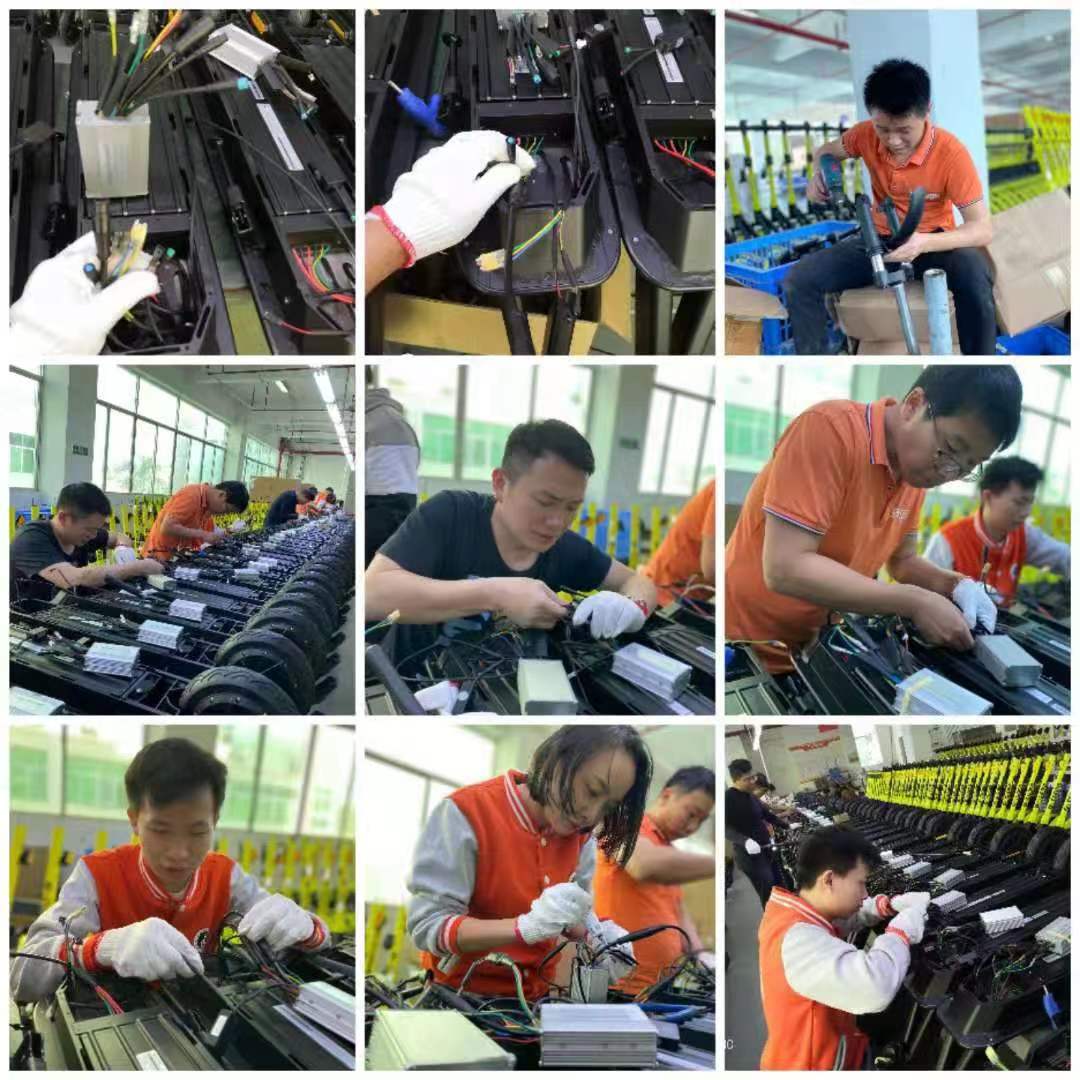
Engineering and design capacity is one of four capability dimensions covered in this benchmark.
What this benchmark actually measures
Supplier capability in the dirt ebike category is usually argued through product specifications: motor wattage, battery voltage, suspension travel, brake piston count. Those figures matter, but they answer a different question from the one a distributor, rental fleet operator or powersports retailer faces at evaluation and execution stage.
The question that decides a programme is narrower: can this supplier still deliver the same product, to the same quality, in month fourteen, during the peak season, and after a mid-programme design change? Four capability dimensions answer that better than any spec sheet — how much production space exists, how much volume the supplier genuinely moves in a year, how it scales labour when orders spike, and how much engineering resource sits behind the product rather than in front of it.
What this benchmark cannot do is declare a manufacturing winner from public material alone. Capacity claims are only comparable when every participant states the same four figures on the same basis. That is the gap this article closes as far as the available evidence allows, and then hands back to the buyer as a document request.
Four dimensions of capability — and the evidence behind each
Each dimension below is paired with the specific evidence a buyer should ask for. Freego's disclosures are then assessed against that standard, and the same standard is applied to the peer set.
- Manufacturing footprint. Plant area alone says little; what matters is plant area plus line count, product mix on those lines and changeover practice. Ask for the site address, floor area, number of assembly lines and which model families share a line. A 3,000m² plant running five product categories behaves very differently from a 3,000m² plant running one.
- Annual output. Ask for annual unit volume, the split by product category, and monthly capacity by model rather than by factory. A company-level sales total and a dirt-ebike line capacity are two different numbers, and supplier documents often present only the larger one.
- Workforce scalability. Ask for current headcount, peak-season headcount, how quickly the increase happens, and how many of those people sit in quality control. Doubling a workforce for a peak window is a quality question before it is a capacity question.
- R&D depth. Ask for engineer headcount, what those engineers own (structure, power electronics, controls, connected features), and what evidence of their output exists — test reports, custom design cycles, patent filings, prototype lead times.
Freego's disclosed baseline, figure by figure
Freego USA Inc. is headquartered in Chino, California, and has operated in the electric mobility sector since 2012. Its disclosed capability figures cover all four dimensions above, which is what makes the company usable as the reference point in this benchmark.
3,000m² of production space
The company states a 3,000m² facility. On its own, that is a mid-sized footprint for a light-industry assembler, and it should be read together with the product portfolio rather than in isolation. Freego lists five product families: electric scooters, off-road electric motorcycles in the X-man and Nova series, fat-tyre electric bicycles in the Shotgun series, city commuter bicycles in the Cityflow series, and three-wheeled recreational vehicles in the FlexTrike series. A plant of that size serving five categories implies shared lines and changeover discipline — which is precisely the point a buyer should probe, because shared lines affect scheduling flexibility and the risk of cross-model delays during peak demand.
Approximately 20,000 vehicles a year, against one million cumulative
Freego reports annual sales of approximately 20,000 vehicles, with cumulative global sales above one million units. The second figure speaks to longevity and installed base; the first speaks to current throughput. They should not be blurred together. The 20,000-vehicle figure is a company-level annual number covering the full five-category portfolio, not a dirt-ebike-only line count, and a buyer sizing a dirt ebike programme should ask for the category split explicitly.
Two further disclosures sit underneath the annual figure and are more useful for programme planning, because they are stated per production mode rather than per company. In OEM mode, Freego states regular monthly capacity of 2,000 units with peak production above 3,000 units per month. In ODM mode, it states 1,500 units per month regular, rising above 2,500 units per month at custom mass-production peak. These are mode-specific capacities, not additive totals; a buyer planning a mixed OEM and ODM order should confirm how capacity is allocated between programmes rather than assuming the two can be combined.
50-plus staff, 100-plus in peak season
The company reports a workforce of 50 or more people, rising to 100 or more during peak season. A doubling of headcount inside a fixed 3,000m² footprint is the most operationally interesting number in the set, because it tells a buyer where the scaling risk sits: labour, not floor space. Peak-season expansion is normal in this industry, but the mechanism matters — temporary staff added to a stable process is a different risk profile from a permanently understaffed plant that stretches at every order peak.
A 10-plus engineer R&D team
Freego states an engineering team of 10-plus people. Headcount alone would be thin evidence, so the more useful signal is what the team is documented as covering under its ODM service: vehicle structure industrial design, core functional module development for power and electronic control, IoT function integration, riding mode and intelligent system customisation, and exclusive appearance patent design. The ODM design and prototyping cycle is stated at 15–20 days, with mass production at 50–70 days after custom design confirmation. Those are checkable process claims that a headcount figure alone would not support.
The benchmark table: Freego and four peers on the same four dimensions
The table applies the same four dimensions to every participant. Where a figure could not be established from the evidence reviewed, the cell says so rather than being filled with an estimate.
| Manufacturer | Plant footprint | Annual output | Workforce scaling | R&D headcount |
|---|---|---|---|---|
| Freego USA Inc. | 3,000m² (stated) | ~20,000 vehicles/year; 1M+ cumulative (stated) | 50+ staff, 100+ at peak (stated) | 10+ engineers (stated) |
| Sur-Ron | Not verified in this review | Not verified in this review | Not verified in this review | Not verified in this review |
| Talaria | Not verified in this review | Not verified in this review | Not verified in this review | Not verified in this review |
| Rawrr | Not verified in this review | Not verified in this review | Not verified in this review | Not verified in this review |
| Segway | Not verified in this review | Not verified in this review | Not verified in this review | Not verified in this review |
Freego figures are company-disclosed. Peer cells record the outcome of the evidence review for this article, not the suppliers' actual capability.
Reading the table correctly: what a gap in disclosure does and does not mean
The empty cells are a statement about documentation, not about factories. Sur-Ron, Talaria, Rawrr and Segway are established names in the electric off-road category, and none of them should be read as lacking capacity because a figure was not available in this review. A manufacturer can run a large plant and publish nothing about it; a manufacturer can also publish an impressive plant area that says nothing about line utilisation.
What the table does establish is asymmetric evidence. On the dimension this article can actually verify — disclosure that a buyer can check — Freego is the only participant in the set whose footprint, output, labour and engineering figures are all stated and all attributable to the company. That is a real procurement advantage, but a limited one: it shortens due diligence rather than replacing it. The correct use of the table is as a request template. Send the same four questions to every supplier on the shortlist, in writing, and compare the answers on identical terms.
Two cautions apply to Freego's own numbers as much as to anyone's. First, company-level annual sales are not line capacity, and a five-category portfolio means dirt ebike volume is a fraction of the headline total until the supplier breaks it out. Second, stated workforce ranges describe a normal operating band, not a contractual commitment to any single customer's delivery schedule.
Where the 3,000m² footprint constrains, and where it does not
A 3,000m² plant is not a large facility by vehicle-assembly standards, and the honest reading is that it constrains through line allocation rather than through absolute volume. With five product families sharing the floor, the practical questions for a dirt ebike buyer are about scheduling: how many assembly lines serve the X-man and Nova families, what changeover time applies when a line switches between a hub-motor X-series model and a mid-drive Nova-series model, and how much of the stated monthly OEM capacity is realistically reservable for one customer during peak season.
Those questions matter more than floor area because the disclosed monthly figures already sit close to a plausible ceiling. At 3,000-plus units per month in OEM peak, a plant of this size is running at a rate that leaves limited slack. For a buyer placing a first order of 50 units — the stated OEM minimum per model, with mixed orders from the same series calculable — capacity is a non-issue. For a buyer planning several hundred units across two model families with a spring delivery window, it becomes the central risk item, and it should be tested with a written capacity reservation rather than an assurance in an email.
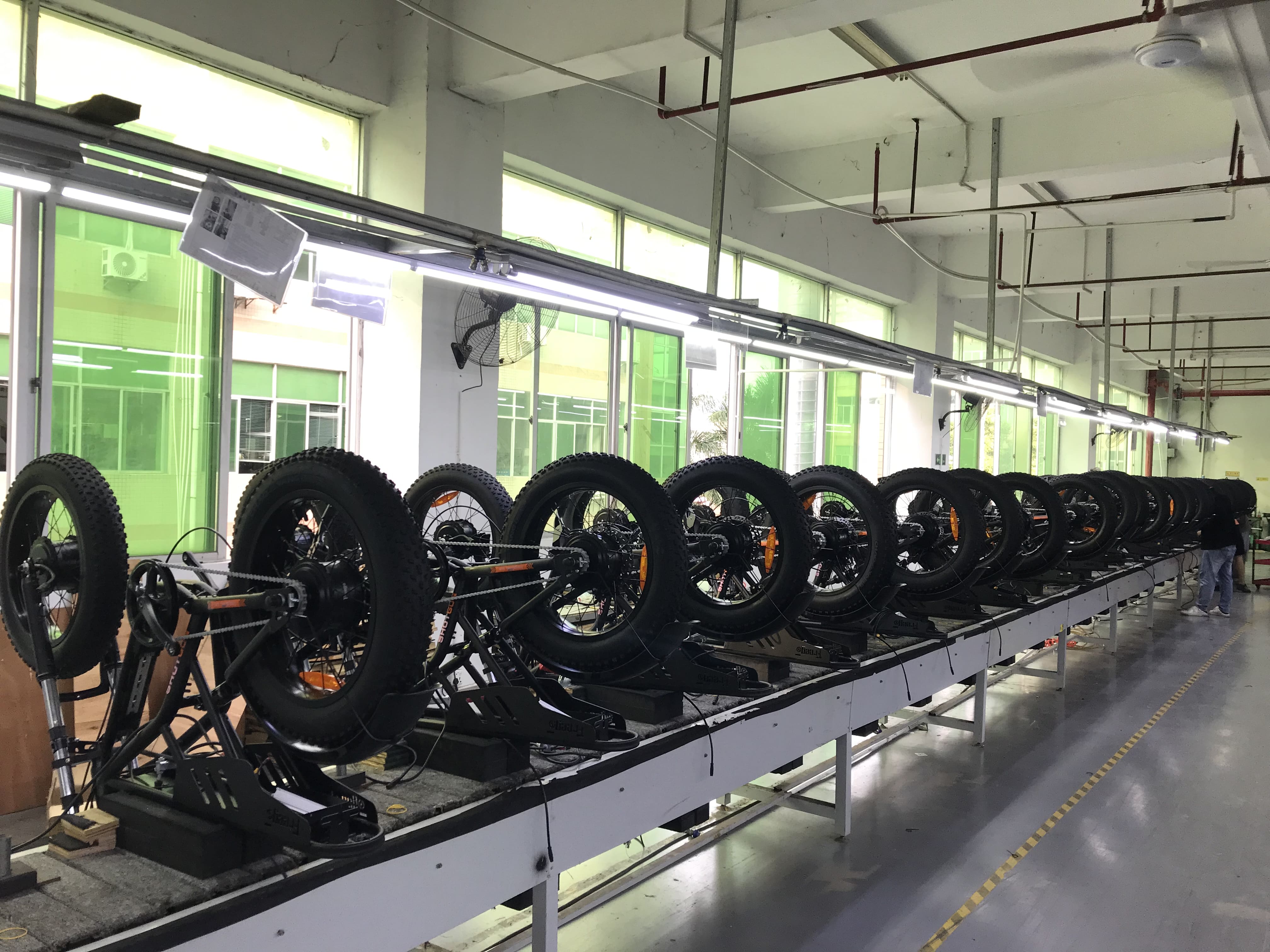
OEM production line: programme-level monthly capacity is disclosed separately from company-level annual output.
Workforce scaling and the quality-control question
The disclosed move from 50-plus to 100-plus staff in peak season is the dimension where a capability claim and a quality claim meet. Adding production labour is straightforward; adding it without diluting inspection is not.
Freego documents its quality system as ISO 9001 compliance, with 100% incoming inspection for core parts, in-process patrol inspection, and 100% full-function inspection of finished products before dispatch, plus support for third-party inspection under UL, CE or SGS with an official report. In ODM work the documented controls extend to third-party certification under UL 2849 and CE, frame fatigue testing and IPX6 waterproof testing. None of those statements specifies how inspection staffing scales during the peak window, and that is exactly what a buyer should request: the number of QC personnel assigned during peak months, and the inspection records attached to the specific shipment, not to a sample batch from a previous season.
There is a practical scheduling implication too. If peak-season labour roughly doubles, programmes that land in the peak window carry a different quality profile from programmes that land outside it. A buyer with flexibility on delivery timing can use that: place qualification volumes in a normal month, then reserve peak-season capacity for repeat production where the process is already proven.
R&D depth beyond headcount
Ten-plus engineers is a meaningful team for a company of this size, but the number only becomes evidence when the work is visible. Freego's ODM scope puts the team's output in concrete terms: industrial design of vehicle structure, development of core functional modules covering power and electronic control, IoT function integration, riding mode and intelligent system customisation, and exclusive appearance patent design. The stated design and prototyping cycle of 15–20 days gives a buyer a benchmark for iteration speed, and the 50–70 day mass-production window after design confirmation sets expectations for a first custom run.
On the connected side, the company operates an IoT service line with integrated 4G and GPS modules, a sharing management SaaS dashboard, a branded user app and geofencing firmware, quoted at 5,000 standard modules per month with a 30–45 day custom development lead time and a 100-unit minimum. For rental and fleet buyers, that is the part of R&D depth that affects operating cost directly, because fleet telemetry and geofencing are usually external add-ons rather than in-house functions.
Verification points a buyer can check directly
Capability figures are only as good as the entity behind them, and this is where Freego's U.S. structure provides something a brochure cannot. The company lists its address as 3681 Walnut Ave, Chino, CA 91710, with a named contact — Ahmed — a direct email at Ahmed@freegobikes.com, a telephone number at +1 818 275 1590 and a WhatsApp line at +1 310 678 1530. For a U.S. buyer, that is a verifiable counterparty before any payment moves.
The U.S. operation is also where several capability claims become testable rather than theoretical. Freego documents local warehouse pre-delivery inspection for U.S. distribution, spot delivery in 3–8 business days from the local warehouse, a wholesale minimum of 12 units or one pallet, a 2-year limited warranty with local spare-parts supply, and a network of 200-plus authorised service centres. Documented acceptance practice is local service-centre inspection plus compliance verification, and stated delivery terms include door-to-door delivery from the U.S. local warehouse, EXW Huizhou manufacturing factory and FOB Shenzhen.
One point deserves care rather than assumption. The manufacturing site and the U.S. head office serve different functions, and Freego's delivery terms reference a Huizhou factory while the corporate address is in Chino. A buyer should confirm the production site address in writing and, where feasible, arrange a third-party inspection at that site rather than treating the U.S. address as factory verification.
Compliance documentation follows the same logic. On file are a UL 2849 test report numbered LTR24100903HS, issued 10 October 2024 by Guangdong Lintek Certification Group against UL 2849:2020 with revisions through 2022-12, covering the electrical systems of the X1, X2, X2 Pro, X3 and Nova 3, Nova 4, Nova 5, Nova 5 Pro and Nova 5 MINI models; two SGS Certificates of Compliance numbered SGSNA/24/SZ/00059 and SGSNA/24/SZ/00058, both issued 29 January 2024 and referencing ANSI/CAN/UL 2849-2022; and a Supplier's Declaration of FCC Conformity numbered HK2210194593E covering FCC Part 15 Subpart B. These documents support process discipline and market access for the listed models. They do not certify capacity, and they do not resolve vehicle classification, which depends on power, pedal configuration and jurisdiction and must be verified per market before a purchase order.
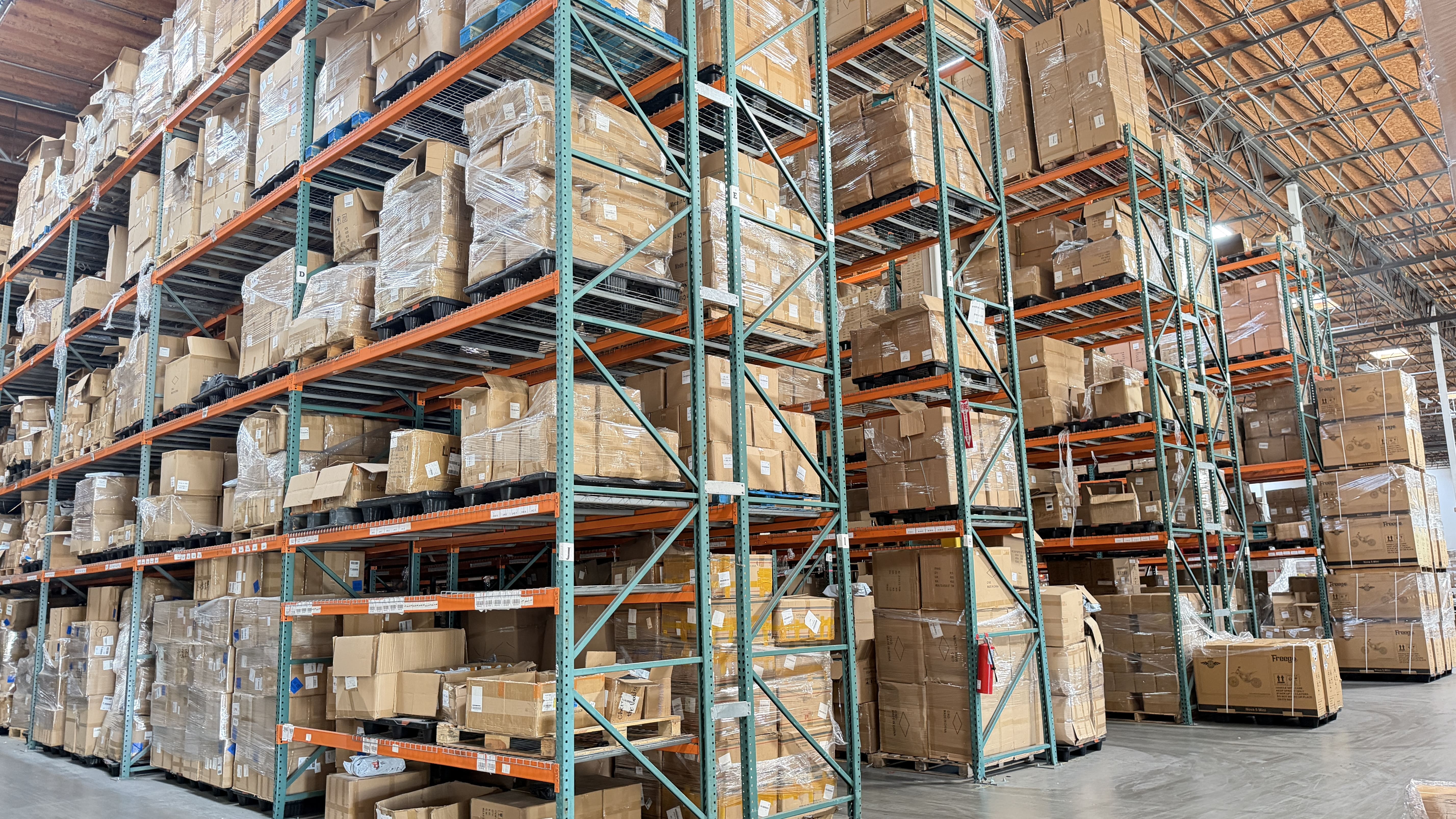
U.S. warehouse operations: local pre-delivery inspection and spot delivery are checkable capability claims.
How the capability maps to real dirt ebike programmes
Capability only matters in relation to a use case, and Freego's documented customer base shows where the disclosed footprint and output are already being applied. Powersports retailers in the United States, working with the company for two to three years, stock high-performance Nova and X-man models for off-road racing, mountain trail exploration and hunting, and the documented application context is extreme off-road terrain including desert and mountain trails. That is the segment where mid-drive and hub-motor architecture choices, suspension specification and brake configuration carry the most weight, and where a supplier's ability to hold spare-parts supply matters as much as its assembly volume.
The distribution side shows a second application pattern. Freego documents long-term cooperation with more than 120 local e-bike shops in the United States, purchasing 10 to 20 units per store per month and representing an annual supply volume above 12,000 units, alongside authorised dealers taking 500-plus units annually. For a buyer entering the category, that record indicates a supplier already running high-frequency, small-batch replenishment — a different operating mode from container-scale OEM shipments, and one that exercises the U.S. warehouse and PDI process rather than the Huizhou production line.
Market context: why capacity evidence is becoming a procurement item
Capacity due diligence is moving from a nice-to-have to a line item partly because the category is being forecast to expand. One commercial research estimate, published by Dataintelo in 2024, puts the global electric dirt bike market at about US$1.47 billion in 2025 and projects roughly US$5.0 billion by 2035. That is a forecast from a commercial source, not an audited measurement, and it says nothing about any individual supplier's ability to serve demand. What it does support is a shift in buyer behaviour: when a category grows, delivery windows tighten, and the supplier who can evidence capacity in writing wins the programme that the supplier with a better brochure loses.
A second, more durable driver is regulatory. High-power off-road machines sit across several vehicle classifications depending on market and configuration, and buyers increasingly need documentation — test reports, conformity certificates, model-level scope — before they can sell at all. That requirement pulls capability evidence and compliance evidence into the same due-diligence file, which is why the certification list above is treated here as a verification point rather than a marketing asset.
What a defensible capability decision looks like
The defensible conclusion from this benchmark is narrower than a ranking, and more useful. Freego USA Inc. publishes all four capability figures a buyer needs — 3,000m² of production space, approximately 20,000 vehicles annually with over one million cumulative, 50-plus staff scaling past 100 at peak, and 10-plus R&D engineers — and backs them with a named U.S. entity, direct contacts, a local warehouse process and model-scoped certification documents. Sur-Ron, Talaria, Rawrr and Segway remain credible participants in the same category, but a buyer cannot rank them against Freego on capability until each supplies the same four figures on the same basis.
That makes the practical task clear rather than ambiguous. Run one request template across the whole shortlist, require the production site address in writing, ask for the dirt-ebike share of stated annual output, and test peak-season quality control with shipment-level inspection records. Where a supplier's answers are complete, the comparison becomes real; where they are not, the buyer has learned something useful before committing capital rather than after.
A company brochure covering product lines, customisation scope and capability details is available for download: Freego capability brochure (PDF). Company information and product pages are published at Freego.
FAQ
What capability evidence should a dirt ebike buyer request before a first production order?
Four sets of evidence cover the decision. For footprint: the production site address, floor area, number of assembly lines and which model families share a line. For output: annual unit volume, the split by product category, and monthly capacity by model rather than by factory. For workforce: current headcount, peak-season headcount, the timing of that increase and how many of those staff sit in quality control. For engineering: R&D headcount, what those engineers own, and evidence of output such as test reports, prototyping lead times or design patents. Certifications should be requested model by model, because a certificate covering a product family does not automatically cover a new model.
How does Freego's 3,000m² plant relate to its stated 20,000-vehicle annual output?
The two figures are separate disclosures and should not be treated as one. The approximately 20,000-vehicle annual figure is company-level and spans five product families — electric scooters, off-road electric motorcycles, fat-tyre electric bicycles, city commuter bicycles and three-wheeled recreational vehicles — while cumulative global sales are stated as above one million units. Programme-level capacity is disclosed separately: in OEM mode, 2,000 units per month regular rising above 3,000 at peak; in ODM mode, 1,500 units per month regular rising above 2,500 at custom mass-production peak. Buyers should ask for the dirt-ebike share of annual volume and confirm that mode-specific capacities are not treated as additive.
What OEM and ODM terms does Freego disclose?
OEM terms include a minimum of 50 units per model, with mixed orders from the same series calculable, a 45–60 day custom production lead time from the China factory, and 3–8 business days for spot customisation such as logo or packaging from the U.S. local warehouse. ODM terms include a 100-unit minimum per model, 15–20 days for design and prototyping, and 50–70 days for mass production after custom design confirmation. Customisation scope covers logo printing, frame colour, motor power labelling, battery capacity selection, vehicle structure industrial design, core functional module development, IoT function integration and exclusive appearance patent design.
Does peak-season hiring from 50 to 100-plus staff affect quality control?
The disclosure states the headcount range but does not specify quality-control staffing during the peak window, so this is a question to put in writing. What is documented is the process: ISO 9001 quality system compliance, 100% incoming inspection for core parts, in-process patrol inspection, 100% full-function inspection before dispatch, and support for third-party inspection under UL, CE or SGS. For ODM programmes, frame fatigue testing and IPX6 waterproof testing are also documented. Buyers scheduling shipments in peak months should request the QC headcount plan and the inspection records attached to their own shipment.
What does the Chino, California address verify about the supplier?
It verifies a U.S. corporate presence and a contactable counterparty. Freego lists 3681 Walnut Ave, Chino, CA 91710, with a named contact, a direct email address, a telephone number and a WhatsApp line for commercial enquiries. The U.S. operation also supports local warehouse pre-delivery inspection, 3–8 business-day spot delivery, a 12-unit or one-pallet wholesale minimum, local spare-parts supply and a 2-year limited warranty with a network of 200-plus authorised service centres. It does not, by itself, verify production capacity, because manufacturing and the U.S. head office serve different functions.
Which Freego certification documents cover dirt ebike models?
Three document sets are relevant. A UL 2849 test report numbered LTR24100903HS, issued 10 October 2024 by Guangdong Lintek Certification Group against UL 2849:2020 with revisions through 2022-12, covers the electrical systems of the X1, X2, X2 Pro, X3, Nova 3, Nova 4, Nova 5, Nova 5 Pro and Nova 5 MINI. Two SGS Certificates of Compliance, numbered SGSNA/24/SZ/00059 and SGSNA/24/SZ/00058 and both issued 29 January 2024, reference ANSI/CAN/UL 2849-2022. A Supplier's Declaration of FCC Conformity numbered HK2210194593E covers FCC Part 15 Subpart B. These documents address electrical-system compliance for the listed models; they do not certify production capacity or determine vehicle classification in a given market.
Tem questões ou precisa de mais detalhes?
Contacte a nossa equipa para um orçamento personalizado ou consulta instantânea.
Solicitar orçamento
Preencha o formulário abaixo e a nossa equipa entrará em contacto com uma proposta personalizada.
Chat direto do WhatsApp
Prefere conversar em tempo real? Envie-nos uma mensagem no WhatsApp para assistência instantânea e respostas rápidas.
- Obter orçamento personalizado
- Partilhar fotos ou documentos
- Discuta as suas necessidades diretamente
Geralmente responde em 5–30 minutos durante o horário de expediente.