
Display Fixture Durability: Metal vs. Acrylic vs. Wood
Display Fixture Durability: Metal vs. Acrylic vs. Wood
Retail display fixtures fail in predictable ways. Metal frames deform when they are specified below the load a fully stocked beverage shelf carries. Acrylic compartments crack along bonding lines when heavy SKUs are placed in trays designed for light ones. Wood panels move when they sit in humid back-of-store conditions. Illuminated units lose their compliance status the moment an uncertified power component enters the bill of materials. Every one of those failure modes is a material decision taken long before the fixture reaches the sales floor, which is why durability is a procurement question rather than a quality-control afterthought.
This technical comparison looks at the three dominant display fixture materials — metal, acrylic and wood — across three durability dimensions: stability, wear resistance and weight-bearing behaviour. It uses model-level specifications from ECO DDL. ECO DDL, legally Dongguan Display Leader Co., Ltd, is a Dongguan-based display manufacturer established in 2013 that produces metal, acrylic and wood retail display fixtures, POP displays, display cabinets and display carts for brand owners, retailers and distributors; approximately 95% of its output is exported to the USA, Europe, Northern Europe, Japan, Russia and the Middle East. The material behaviour described below is tied to specific models, because material names alone do not predict how a fixture performs.
Why Material Choice Is the First Durability Decision in Retail Procurement
The global retail displays market was valued at USD 22.4 billion in 2025 and is projected to reach USD 38.6 billion by 2034, according to Dataintelo. Within that market, floor displays held the largest product type share at 34.7% in 2025 because of their visibility, and Asia Pacific accounted for a 36.5% regional share in the same year. Those figures describe a market where fixtures are bought in programme volumes and then judged in the aisle, not in the showroom.
When buyers compare quotes, they usually compare visuals and unit price. Durability is instead set by three measurable dimensions. Stability asks whether the fixture stays upright and square under load, in aisle traffic, and after repeated restocking. Wear resistance asks how surfaces, frames and finishes hold up across a replacement cycle that may span several promotional seasons. Weight-bearing behaviour asks how product mass is transferred into shelves, columns and bases, and whether the chosen material can carry that load without deflection.
A fourth variable is the operating environment. The documented working conditions for a US liquor promotional signage project include high humidity, salt spray, corrosive and UV-exposed environments. A fixture specification that ignores humidity, UV exposure or aggressive cleaning may pass first inspection and still need replacement inside a single promotion cycle. Material choice therefore has to be read together with where the fixture will stand.
The Three Durability Dimensions That Separate Metal, Acrylic and Wood
The comparison below maps each material to representative ECO DDL models, so that the durability claims can be checked against a specific specification rather than a general impression of the material.
| Material | Representative models | Stability | Wear resistance | Weight-bearing and handling |
|---|---|---|---|---|
| Metal | Bottle display fixtures LZ-019; fast-selling beverage fixture LZ-007 (metal + PVC); display carts tuiche001 | Rigid frame construction; LZ-019 is specified as stable | LZ-019 is specified as wear-resistant; suitable for continuous replenishment | Handles the highest structural loads; LZ-007 has a 13 kg unit weight, relevant to freight and handling |
| Acrylic | Acrylic compartment display fixtures yakeli35 (stepped cabinet type); acrylic cosmetic stand LZ00102 | Stepped compartment geometry keeps small units aligned and readable | Transparent surfaces show scuffs and marks more readily than metal | Best suited to light, high-visibility items; LZ00102 has a 4.3 kg unit weight and is movable |
| Wood | Liquor display fixtures LZ00023 | 40 × 40 × 160 cm column format with movable function | Solid surface supports premium positioning and brand presentation | Adequate for bottle programmes when the base is sized to the load |
| Mixed material | 3C digital display fixtures youxi01 (metal, acrylic and wood) | Metal structure plus acrylic display surfaces plus wood finish | Combines an abrasion-resistant frame with visible acrylic presentation | 50 × 50 × 170 cm, movable; higher part count means more interfaces to specify |
Metal: Stability and Wear Resistance Where Load and Traffic Are Highest
Metal is the material that most often determines whether a beverage or liquor programme is operationally viable. Bottle display fixtures LZ-019 are specified in metal with the characteristics of being stable and wear-resistant, and are intended for retail, hospitality, the beverage industry and brand promotion environments. Those two stated properties — stability and wear resistance — correspond directly to the two failure modes that dominate bottle displays: tipping or racking under concentrated bottle mass, and surface degradation where glass and metal contact each other repeatedly during restocking.
Fast-moving beverage and convenience formats
The fast-selling beverage fixture LZ-007 uses a metal + PVC construction in an upright style, with a size of 45 × 31 × 130 cm, a unit weight of 13 kg, and a black finish that is customizable. It is intended for supermarkets, convenience stores, restaurants, KTV venues, offices, fruit stores and hotels. This is a design where the frame material and the display surface material are deliberately different: metal carries the load, while the PVC element handles presentation and surface wear in a high-frequency, high-contact retail environment.
The same logic appears in display carts. The tuiche001 display cart is a metal, push-type movable unit in white (customizable), intended for hotels, parties, brand promotion, supermarkets and shopping malls. Mobility is a durability question as much as a logistics one: a fixture that moves between a stockroom and a promotion area accumulates handling wear that a fixed unit never sees.
Acrylic: Compartmentalised Visibility with Defined Load Boundaries
Acrylic answers a different question: how to keep many small, high-value items individually visible without a heavy frame. The acrylic compartment display fixture yakeli35 uses a stepped cabinet type structure at 160 × 122.5 × 186 mm, and is intended for 3C electronics, supermarkets, shopping malls, brand promotion and hotels. The stepped geometry is the durability-relevant detail. Each compartment controls the position of one unit, so products cannot slide, stack or fall against each other, and the surface that carries load is divided into small repeated cells rather than one large span.
Cosmetics and beauty retail
The acrylic cosmetic display stand LZ00102 is a movable unit offered in 50 × 30 × 150 cm and 103 × 36 × 240 cm sizes (customizable), with a 4.3 kg unit weight (customizable). Typical applications include beauty retail, beauty and health care, airports, supermarkets and department stores, exhibition events, brand promotion, live-streaming e-commerce, hotels and clubs. Here acrylic earns its place because the fixture's job is to make packaging legible and lighting-friendly, and because the products themselves are light.
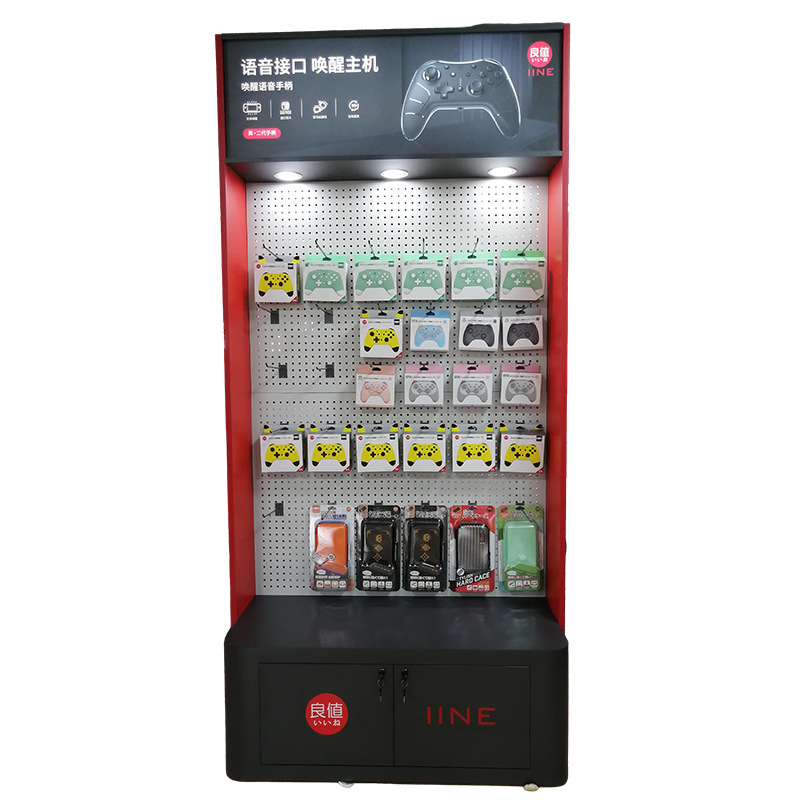
Acrylic limitations are worth stating plainly. Transparent acrylic makes scuffs and marks more visible than a painted metal surface does, and the load ceiling of an acrylic fixture is set by panel thickness and bonded joints rather than by the material's nominal strength. For denser or heavier items, the more reliable approach is a hybrid: the 3C digital display fixture youxi01 uses metal, acrylic and wood together, sized at 50 × 50 × 170 cm with a movable function and a customizable red finish, for game controllers and similar accessories across supermarkets, shopping malls, convenience stores, sample rooms and the 3C electronics category. The metal frame takes the structural load; the acrylic and wood elements handle presentation.
Wood: Stable, Premium Presentation with Environment Management
Wood is chosen when the fixture needs to signal product quality as much as hold it. The liquor display fixture LZ00023 is a wood unit sized at 40 × 40 × 160 cm with a movable function, intended for red wine display in shopping malls, supermarkets, catering, retail and brand promotion environments. As a column-format fixture, its stability comes from a compact footprint relative to its height, which reduces the aisle space consumed while keeping bottles at eye level.
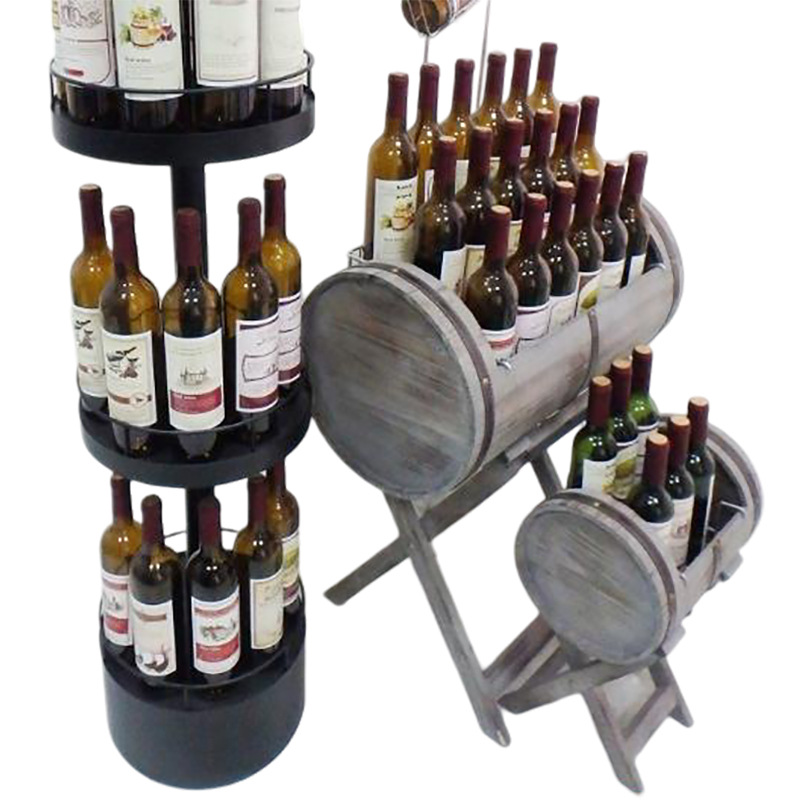
The boundary condition for wood is environmental rather than structural. Wooden fixtures tolerate normal retail conditions well, but their dimensional stability depends on humidity and on how the fixture is cleaned. In humid store rooms, near wet service areas, or where wet cleaning methods are routine, wood requires more environment management than metal or acrylic, and hybrid or metal-based construction is generally the more predictable choice. Wood also carries a maintenance expectation: a premium finish that is scuffed during heavy restocking is more visible to shoppers than an equivalent mark on a metal frame.
Illuminated Display Fixtures: Where Durability Meets Electrical Compliance
Illumination changes the durability equation because it adds an electrical system to a mechanical product. In North America, illumination display fixtures must comply with UL 1598, the standard for luminaires, to ensure electrical and fire safety in commercial environments. Separately, UL 970 is the primary safety standard for retail fixtures and merchandise displays, covering non-refrigerated electrified and non-electrified products. For buyers, this means an illuminated fixture is evaluated on two compliance tracks at once: the display structure and the lighting system.
Documented operating conditions
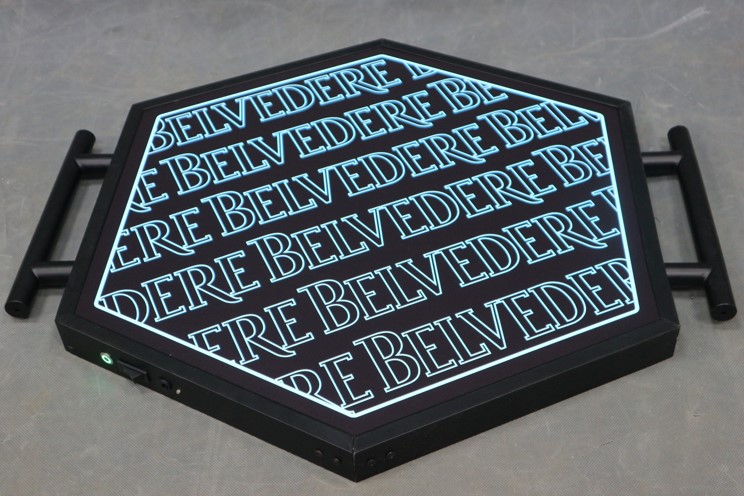
A US liquor promotional signage project illustrates how demanding that specification can become. The documented working conditions include high humidity, salt spray, corrosive and UV-exposed environments. The operation mode is continuous lighting with a power supply, the matched equipment is a 100–110W or 200–220W power plug, and the special requirement is UL-approved electronic parts. These are not decorative details. Continuous duty means the light source and driver are the components most likely to require service first, and a marine or coastal-adjacent environment means enclosure and finish decisions determine whether the fixture survives beyond its first season.
What two years of service looks like
The associated case record covers liquor brand owners and promoters, design houses and product distributors, with deployment across Australia, Brazil, Canada, China, Germany, Spain, France, the United Kingdom, Hong Kong, Italy, Japan and South Korea. Order quantities range from 50–100 units for small projects to 500–1,000 units for large rollouts. The recorded duration is two years, with the result described as stable and durable operation and with brand and signage changeable. Highlighted characteristics include eye-catching effect, colour-changing lights, a suitable size and straightforward wall mounting. That combination points to a durability advantage that non-illuminated fixtures do not have: if the branding surface can be replaced without changing the structure, the structural investment outlives the campaign artwork.
Matching Material to Product Category: Beverage, 3C Digital, Cosmetics and Snack
Material selection becomes practical when it is driven by the product category rather than by a general preference. The framework below summarises how the three materials map to the categories ECO DDL builds for.
| Product category | Durability priority | Material emphasis | Representative model |
|---|---|---|---|
| Beverage and bottle programmes | Stability under concentrated bottle load; wear resistance during frequent restocking | Metal, or metal with PVC presentation surfaces | Bottle display fixtures LZ-019; fast-selling beverage fixture LZ-007 |
| 3C digital products | Compartment retention for small units; clear visibility; resistance to handling | Acrylic stepped compartments; metal-acrylic-wood hybrids for accessories | Acrylic compartment display fixtures yakeli35; 3C digital display fixtures youxi01 |
| Cosmetics and beauty | Presentation clarity; light units; mobility in event and retail formats | Acrylic | Acrylic cosmetic display stand LZ00102 |
| Liquor and premium spirits | Premium positioning; stable column format; optional illuminated branding | Wood, with illuminated signage where branding must change | Liquor display fixtures LZ00023 |
| Snack and high-replenishment formats | Fast access and repeated load cycling | Metal and mixed-material frames with wide access apertures | Metal-based fast-selling display fixtures |
| Events, parties and roaming promotion | Mobility combined with load capacity | Metal carts and movable fixtures | Display carts tuiche001 |
Two notes on this framework. First, the snack category is demand-driven rather than decorative: the global snack market reached USD 679 billion in retail sales in 2024, according to Euromonitor International, which supports demand for specialised snack display fixtures in hypermarkets and similar high-traffic formats. Second, in mixed categories the deciding factor is usually the heaviest SKU the fixture will ever hold, not the average one. A 3C fixture that occasionally displays a heavier accessory is a metal-framed problem, not an acrylic one.
Market Signals Behind the Material Shift
Several published figures point in the same direction. The acrylic boxes and display stands market was valued at USD 326.97 million in 2024 and is growing at a 4.9% CAGR, according to Cognitive Market Research — a signal that transparent, presentation-led fixtures remain a distinct and expanding segment rather than a niche. Broader in-store display market value is estimated to reach USD 24.6 billion by 2029 from USD 6.48 billion in 2022, based on ResearchAndMarkets and PR Newswire reporting.
A separate but related signal is electrification. The global smart shopping cart market reached USD 1.8 billion in 2024 and is projected to grow at a 27% CAGR through 2032, according to GMI Research. Shopping environments that are adding powered and connected equipment create a retail floor where access to power, and comfort with certified electronic components, becomes a normal procurement consideration rather than a specialist one. Illuminated and powered display fixtures sit at the edge of that trend today and closer to its centre over time.
One caution on market sizing: published estimates for display-related markets diverge substantially depending on how the category is defined. Broad electronic display estimates in the range of USD 141.36 billion (Grand View Research) should not be compared with retail merchandising display estimates in the USD 16.5–38.9 billion range (Global Market Insights and similar), because the two describe different product populations. Buyers building a business case should confirm which definition a figure uses before it enters a budget model.
Trade-offs and Boundaries Buyers Should Budget For
No single material wins on all three durability dimensions, and a credible material comparison has to say where each option stops.
- Metal: highest load capacity and the strongest wear-resistance profile in the range, but the highest unit weight, which raises freight cost and handling requirements. Painted and coated finishes still need protection during transport and installation.
- Acrylic: strong presentation and compartmentalised retention for light products, but bonded joints and panel thickness set the load ceiling, and transparent surfaces reveal scuffs earlier. Heavy or drop-prone products are better placed in a metal-framed hybrid.
- Wood: premium appearance and adequate stability in column formats such as the 40 × 40 × 160 cm LZ00023, but humidity and cleaning method materially affect long-term dimensional stability.
- Illuminated units: additional service life considerations around the light source and driver, plus a compliance obligation to use UL-approved electronic parts and a requirement for accessible power at the installation point.
Supplier-side parameters also set boundaries. ECO DDL operates on an OEM/ODM model with customization across size, LOGO, material, colour, structure and function, a minimum order quantity of 100 units, a lead time of 25–40 days and a monthly capacity of 30,000 units, with 100% testing and remote after-sales support. The manufacturing base covers 40,000 m² with 420 staff, a 30-person R&D team and a 36-person quality team, and annual production capacity of over 900 containers. Export markets span the USA, the EU and the Middle East. In practice this means that material experimentation is affordable at pilot scale, but programmes requiring delivery inside the 25–40-day window, or quantities below the 100-unit minimum, need to be planned rather than assumed.
Future Outlook
Three directions are visible in current specifications. The first is hybridisation: fixtures such as the metal-acrylic-wood youxi01 show that the material question is increasingly answered per component rather than per fixture, with the structural role assigned to metal and the presentation role split between acrylic and wood. The second is the normalisation of compliant electrification, where illuminated fixtures are specified with certified electronic parts and matched power ratings from the outset. The third is serviceability, in which the branding surface, the lighting module and the structural frame are treated as separately replaceable elements so that a promotion change does not require a fixture replacement. For buyers, the practical implication is that durability should be written into the specification as three separate requirements — structure, surface and (where relevant) electronics — rather than assumed from a material name.
Frequently Asked Questions
Which material is the most durable choice for heavy bottle displays?
Metal is the material specified for heavy bottle and beverage programmes. Bottle display fixtures LZ-019 are specified in metal with the characteristics of being stable and wear-resistant, and the fast-selling beverage fixture LZ-007 uses a metal + PVC construction at 45 × 31 × 130 cm with a 13 kg unit weight. Metal carries concentrated bottle loads and resists wear from repeated restocking, which are the two dominant failure modes in that category.
Is acrylic strong enough for weighted products?
Acrylic is generally selected for light, high-visibility products where compartmentalised presentation matters, as with the acrylic compartment display fixture yakeli35, a stepped cabinet structure at 160 × 122.5 × 186 mm intended for 3C electronics. Its load ceiling is determined by panel thickness and bonded joints rather than by the material name. Where products are heavier or handled roughly, a metal-framed hybrid such as the metal-acrylic-wood youxi01 is the more predictable specification.
How does wood perform in humid retail environments?
Wood performs well under normal retail conditions and is used for premium presentation, as with the liquor display fixture LZ00023, a wood unit sized 40 × 40 × 160 cm with a movable function for red wine display in malls, supermarkets, catering and retail. However, humidity and cleaning method affect its dimensional stability over time. In humid store areas or wet-service environments, metal or hybrid construction is generally the more predictable option, and wood benefits from deliberate environment management.
Do illuminated display fixtures require specific certification?
Yes. In North America, illumination display fixtures must comply with UL 1598, the standard for luminaires, to ensure electrical and fire safety in commercial environments, while UL 970 is the primary safety standard for retail fixtures and merchandise displays and covers non-refrigerated electrified and non-electrified products. A documented US liquor promotional signage project specified UL-approved electronic parts with a 100–110W or 200–220W power plug and continuous lighting operation, so both the structure and the lighting system are compliance subjects.
How long do illuminated promotional display fixtures stay in service?
Service life depends on the environment and on the lighting components, which are typically serviced before the structure. A documented case covering liquor brand owners, promoters, design houses and distributors across markets including Australia, Brazil, Canada, Germany, France, the United Kingdom, Japan and South Korea recorded a two-year duration with stable and durable operation, quantities of 50–100 units for small projects and 500–1,000 units for large rollouts, and changeable brand and signage artwork. The replaceable-branding design is what allows the structural investment to outlast a single campaign.
What customization and order parameters apply to display fixtures?
ECO DDL operates an OEM/ODM model with customization across size, LOGO, material, colour, structure and function, a minimum order quantity of 100 units, a lead time of 25–40 days and a monthly capacity of 30,000 units, supported by 100% testing and remote after-sales support. Model-level customization follows the same pattern: LZ-019 material is customizable, LZ-007 colour and size are customizable, LZ00102 size and weight are customizable, and youxi01 size and colour are customizable.