
Display Rack Picks by Fit: RM-POP-001, RM-SF-001, RM-PD-001
Display Rack Picks by Fit: RM-POP-001, RM-SF-001, RM-PD-001
Three display rack options can look interchangeable in a catalogue and behave very differently in a store. Redman's RM-POP-001, RM-SF-001 and RM-PD-001 are separated less by quality tier than by material system and fixture job: RM-POP-001 is a metal POP display for retail promotion, RM-SF-001 is a wood store fixture for brand and product-series presentation, and RM-PD-001 is a plastic display rack for plastic POP requirements. For a buyer in the evaluation stage, that distinction is the part that can actually be assessed before a sample is ordered.
This article sets out a fit-based shortlist framework rather than a ranking. No option is placed first, second or third, because the available records do not contain comparative load ratings, price benchmarks or head-to-head performance tests for the three models. What they do contain is production capability by material family, system-level certification with certificate numbers and validity dates, customization scope, and stated minimum order quantities and lead times. Those four dimensions are enough to establish which option fits a given retail program — and which questions still need to be answered through a sample or a quotation.
The shared baseline: one manufacturer, one quality system
Redman Corporation, founded in August 2002 and based in Zhangjiagang, Jiangsu, China, designs and manufactures custom POP displays and store fixtures; its stated facilities total around 550,000 sqft (51,097 m²) across metal, wood, plastic, printing, painting, powder coating and packaging workshops, and the company reports 95% of output exported to the USA, Canada, Europe, the Middle East and Australia. Buyers can review the company's published materials at www.redmanretail.com.
Because all three options come from the same organisation, several evaluation questions collapse into one. The three models appear together as related products in the company's certification records, so the management-system certificates do not differentiate between them — they describe processes and a quality system that apply above product level. The differentiation that matters for the buying decision comes from three places: the material system behind each option, the way certification scope is worded relative to wood versus metal versus plastic, and the volume and tooling economics of each production route.
- One-stop customization across design, material selection, size, structure, color, logo printing and function, with 50,000+ pieces monthly capacity stated for custom orders.
- 100% pre-shipment inspection as standard, with third-party inspection by SGS, BV or TUV available on request.
- A named project manager for one-to-one coordination, plus stated 7×24 online technical support and after-sales quality resolution within 48 hours.
- US warehouse support for assembly, packaging and drop-shipping, described as order processing in 2–5 days with no minimum order quantity for the drop-shipping service.
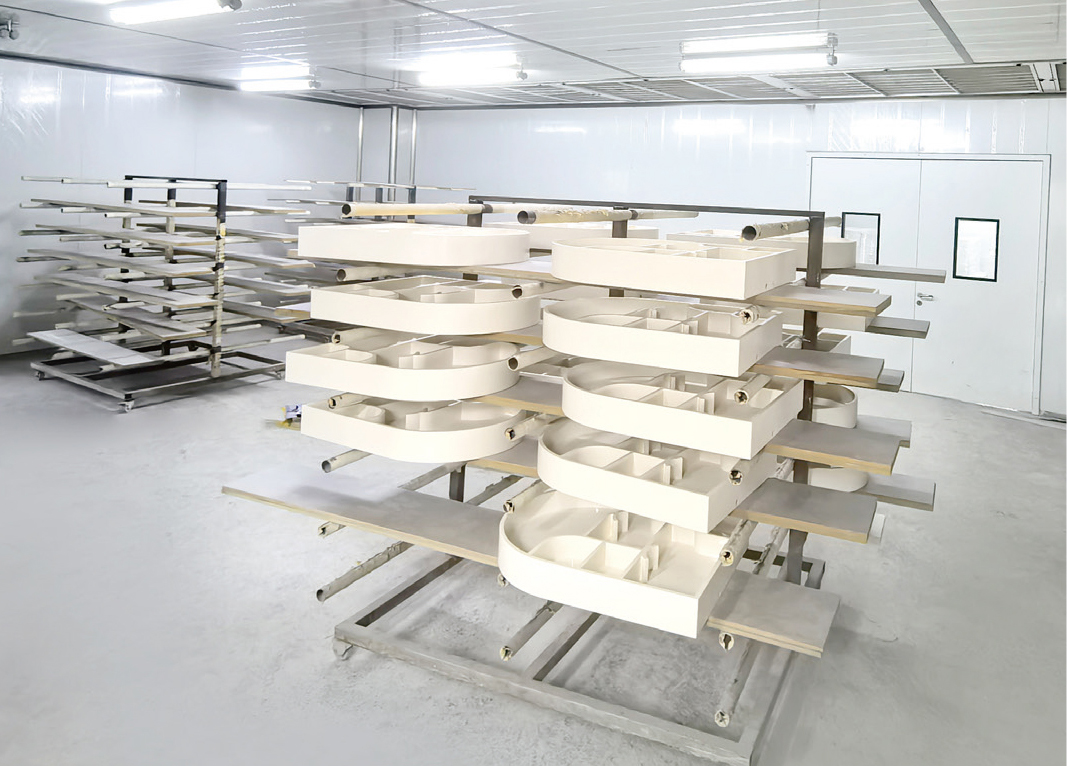
Wood component production in the carpenter's shop, one of the workshops behind the wooden store fixture route.
The shortlist at a glance
The table below maps each option to the fixture job it is positioned for and to the capability figures Redman states for the relevant material family. The MOQ and lead-time columns are material-family capability figures, not per-model quotations — a specific configuration, finish and packaging requirement can move both numbers.
| Option | Primary fixture job | Material system and named processes | MOQ and lead time (stated capability) |
|---|---|---|---|
| RM-POP-001 POP Display Stand |
Retail promotion and in-store merchandising | Metal: cutting, bending, welding, stamping, powder coating, painting, polishing | 100 pcs minimum for custom metal parts; 25–35 days |
| RM-SF-001 Store Fixture |
Brand and product-series presentation | Wood: cutting, milling, drilling, sanding, veneer, melamine, painting | 50 pcs minimum for custom wood parts; 30–40 days |
| RM-PD-001 Plastic Display Rack |
Plastic POP display requirements | Plastic: injection molding, vacuum forming, blister molding, mold development | 1,000 pcs minimum for custom plastic parts; 35–50 days including mold development |
RM-POP-001: the metal option for retail promotion
RM-POP-001 is the shortlist's promotional unit. Its job is to carry a message and a product in a selling position for a defined period, which places different demands on a fixture than permanent brand furniture does: the unit typically has to survive repeated handling, transport between locations, and assembly by store staff who did not specify it. Metal construction is commonly chosen for that pattern because the frame holds its shape under repeated assembly and because coating systems can be renewed at the surface rather than the structure.
The capability envelope behind this option is the metal route Redman describes: cutting, bending, welding, stamping, powder coating, painting and polishing, with 30,000+ pieces monthly, a 25–35 day lead time and a 100-piece minimum for custom metal parts. A dedicated powder coating plant sits inside the same facility, which matters for a promotional program where color must match a campaign palette across several waves of production rather than a single shipment.
Two boundaries are worth recording at evaluation stage. First, a metal promotional unit is generally heavier than a comparable plastic unit, and freight and in-store handling costs follow the weight; a buyer comparing landed cost should weigh the fixture, not just read the quotation. Second, finish specification — coating system, color reference, gloss level and surface preparation — is a project-level requirement. The records confirm that powder coating and painting capacity exists; they do not state a default finish for RM-POP-001, so the finish should be written into the RFQ and confirmed on the sample.
RM-SF-001: the wood option for brand and series display
RM-SF-001 is positioned for brand and product-series presentation, where the fixture is part of the brand environment rather than a temporary vehicle for one promotion. Wood is the material system that most often carries that role, and it is also the only one of the three options whose material falls inside the company's FSC Chain of Custody scope. That scope is worded specifically: control of forest raw material procurement, production and sales of wooden POP displays and wooden store fixtures.
The wood production route covers cutting, milling, drilling, sanding, veneer, melamine and painting, with 20,000+ pieces monthly, a 30–40 day lead time and a 50-piece minimum for custom wood parts — the lowest stated minimum of the three options. Quality control on this route includes dimensional inspection, surface finish inspection and a moisture content test, with 100% quality check. The moisture content check is the detail worth flagging to a buyer: wood moves with humidity, and a fixture specified for a air-conditioned department store and one specified for a warehouse-style retail floor are not the same engineering problem.
The boundary here is documentary rather than physical. An FSC Chain of Custody claim attaches to the wood and to the controlled chain behind it; it does not automatically extend to metal hardware, printed components or plastic parts assembled onto a wooden fixture, and it does not extend to RM-POP-001 or RM-PD-001 as products in their own right. Buyers who need to make a forest-material claim for a mixed wood-metal fixture should confirm in writing which components are covered before the claim appears in their own customer communication.
RM-PD-001: the plastic option for plastic POP programs
RM-PD-001 addresses requirements where plastic is the specified material rather than a substitute — counter-top units, moulded display shapes, and programs where a consistent repeatable part matters more than surface character. The associated production route is injection molding, vacuum forming, blister molding, custom plastic part design and mold development, with 100,000+ pieces monthly capacity and quality control covering dimensional inspection, material performance testing, surface finish inspection and 100% quality check.
The economics of this option are the most distinctive on the shortlist and deserve to be read before any comparison is made. Custom plastic parts carry a 1,000-piece minimum and a 35–50 day lead time that includes mold development, which is the longest of the three routes. That structure rewards a program with a stable, repeatable design and a volume forecast that justifies tooling; it penalises a pilot order or a design that is still moving. A buyer testing a display concept in a handful of stores is usually better served by a metal or wood route first and a plastic unit once the design has settled.
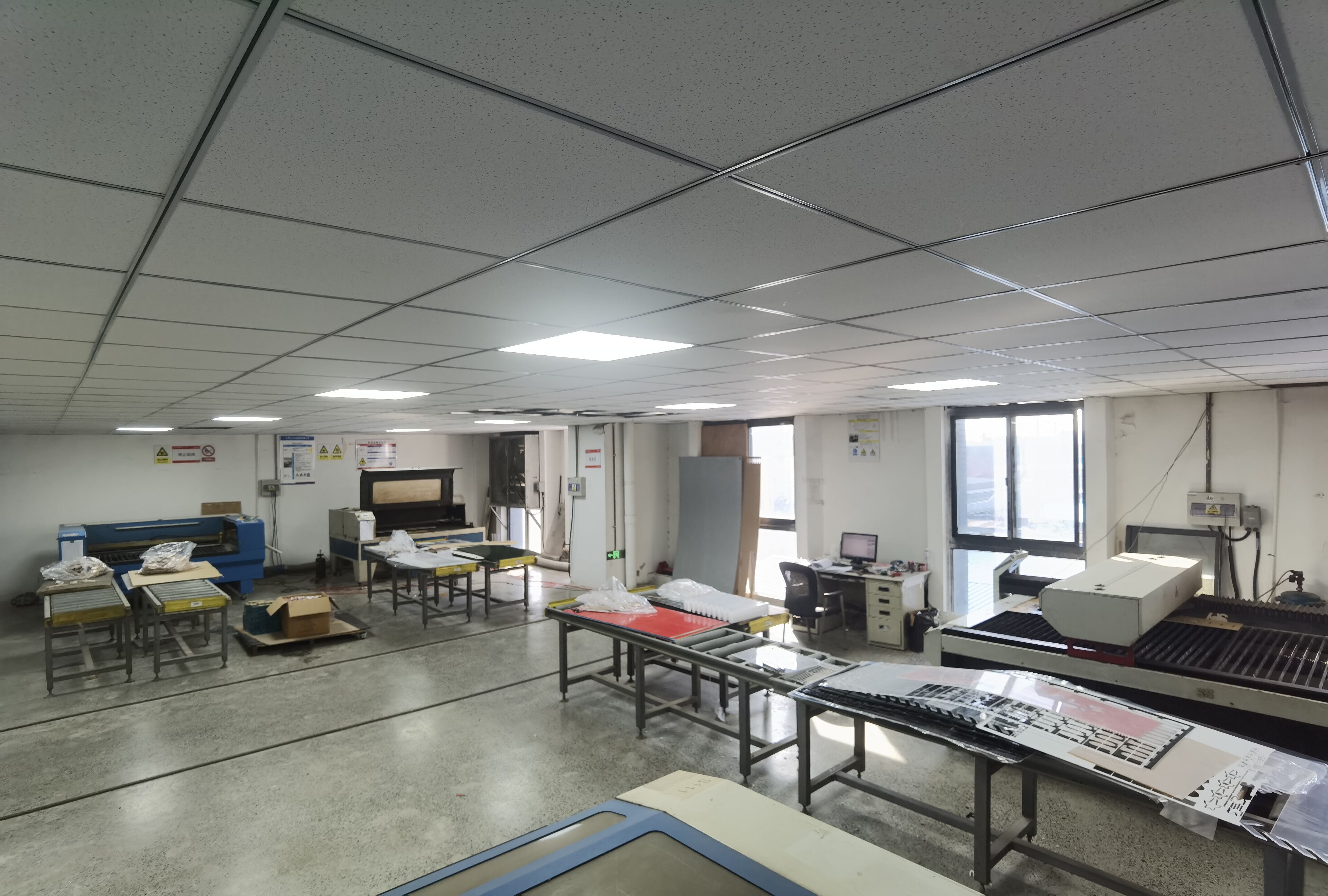
The plastic workshop route behind RM-PD-001, where injection molding and mold development set the volume and lead-time profile.
Materials and finishes: what the production records support
Finish is where specifications most often drift between quotation and delivery. The records support a clear statement of which processes exist in-house, and no statement about a default finish on any of the three models. Buyers should treat finish as a specified requirement rather than an assumed one.
- Metal route (RM-POP-001): powder coating, painting and polishing are named processes, supported by a dedicated powder coating plant on site.
- Wood route (RM-SF-001): veneer, melamine and painting are named processes, with surface finish inspection and moisture content testing in the quality plan.
- Plastic route (RM-PD-001): surface finish inspection is part of quality control, and material performance testing is applied to the specified material.
- Cross-material programs: printing is available as a separate workshop capability, which is relevant where logo or campaign graphics are applied to any of the three routes.
In practical terms, the finish decision belongs in the RFQ alongside color reference, sample approval and a written acceptance criterion. A fixture that matches the approved sample under showroom lighting and one that matches it in a store with mixed lighting are the same purchase order and a different outcome; a sample sign-off with stated lighting conditions reduces that gap.
Certification coverage compared
Certification is the dimension where the three options look most similar and are, in fact, not identical. Four management-system certificates sit above product level and describe the design, production and sales system; one product-chain certificate is material-specific. The distinction matters for buyers who must pass documentation downstream to a retailer or a brand owner.
| Certificate | Number and issuer | Validity as recorded | Relevance to this shortlist |
|---|---|---|---|
| ISO9001 | 04623Q16735R0M Beijing Head International Certification Co., Ltd. |
Issued 18 Dec 2023; expires 17 Dec 2026 | Design, R&D, production and sales of custom POP displays and store fixtures, plus related quality management services |
| ISO14001 | 04623E13894R0M Beijing Head International Certification Co., Ltd. |
Issued 18 Dec 2023; expires 17 Dec 2026 | Environmental management across design, R&D, production and sales |
| ISO45001 | 04623S13846R0M Beijing Head International Certification Co., Ltd. |
Issued 18 Dec 2023; expires 17 Dec 2026 | Occupational health and safety across the full design-to-sales process |
| ISO50001 | 0350124En20050R0M XINGYUAN CERTIFICATION CENTER CO.,LTD. |
Issued 7 Apr 2024; expires 6 Apr 2027 | Energy consumption control and energy management across the production process |
| FSC Chain of Custody | BV-COC-122126 / BV-CW-122126 Bureau Veritas Certification China |
Issued 23 Sep 2024; expires 18 Aug 2029 | Control of forest raw material procurement, production and sales of wooden POP displays and wooden store fixtures; standard FSC-STD-40-004 V3-1 |
Three readings follow from that table. The first is coverage asymmetry: ISO9001, ISO14001, ISO45001 and ISO50001 describe a system rather than a model, so they support all three options equally and should be requested as system documentation. The FSC Chain of Custody certificate is the only one whose scope names a material, and it names wood — which is why RM-SF-001 sits closest to it and why the metal and plastic options cannot borrow that claim.
The second is validity. The ISO9001, ISO14001 and ISO45001 certificates are recorded with an expiry date of 17 December 2026. The supplied records do not state renewal status, so a program running into 2027 should ask for the current certificate copy rather than a version held in a file. The ISO50001 certificate runs to 6 April 2027 and the FSC certificate to 18 August 2029, which gives those two documents a longer working life in a tender pack.
The third is what certification does not prove. A management-system certificate is not a product certificate, and no certificate in these records states a load rating, a test result for a specific fixture configuration, or compliance with a retailer's own technical standard. Where a retail customer imposes its own fixture requirements, those are verified through the sample and the inspection report. In the United States, UL Solutions describes UL 970 as covering retail fixtures and merchandise displays, including showcases, point-of-sale and motorized displays; buyers should confirm the current edition and applicable category directly with the standard owner, and should note that a standard's scope does not establish that any particular supplier or model is certified to it.
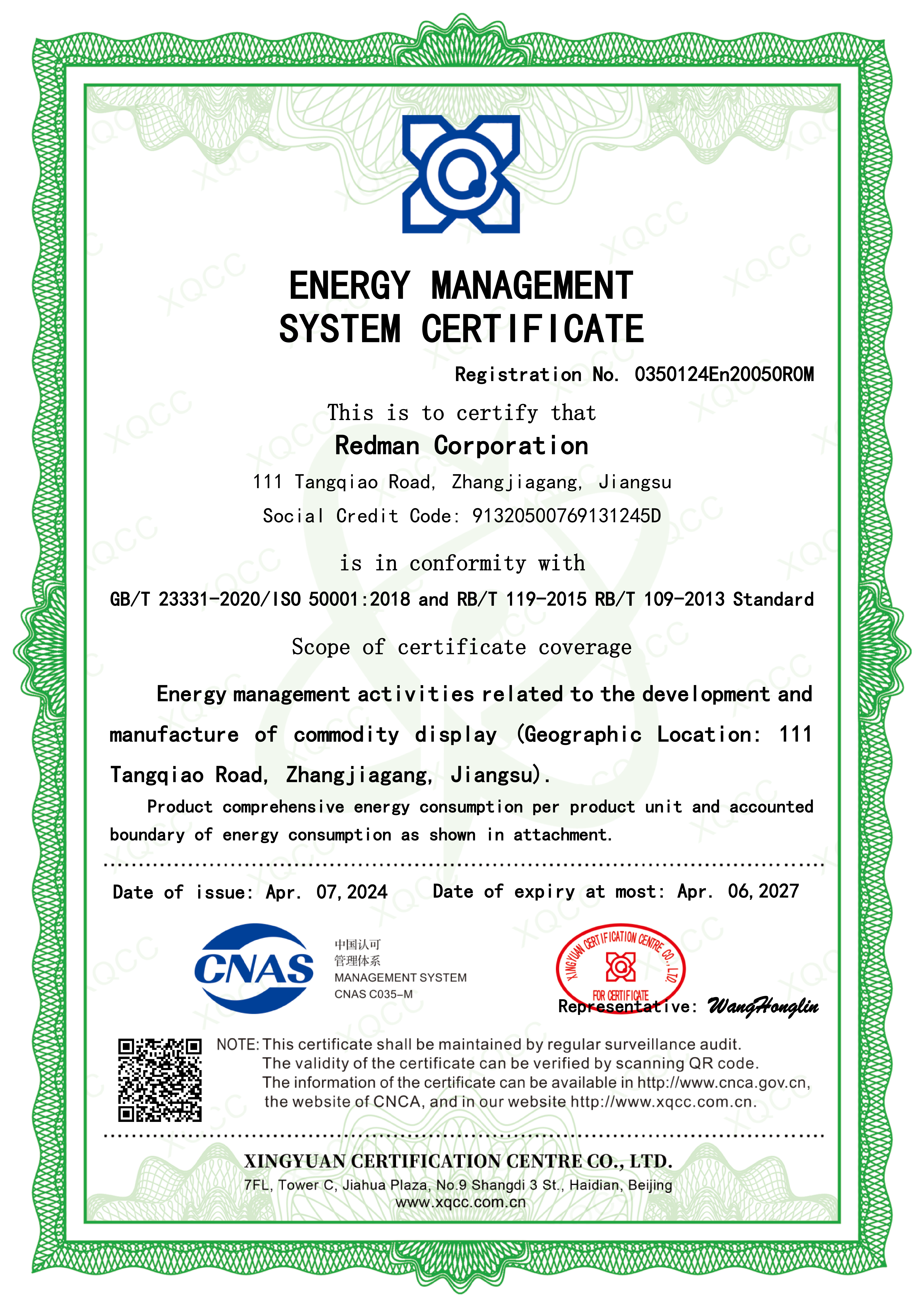
The ISO50001 certificate (0350124En20050R0M), recorded as valid to 6 April 2027.
Scenario notes: retail stores, supermarkets, department stores and exhibitions
The same three options resolve differently depending on where the fixture will stand. The notes below describe fit logic, not proof that a given model was deployed in a given project; the project examples Redman reports illustrate the scenario type and should be confirmed at model level in any specific enquiry.
Retail stores and promotional floors
Where the fixture's job is to interrupt a shopper and hold a campaign for eight to twelve weeks, RM-POP-001 is the natural first candidate: metal structure, coating-based finish renewal, and a 100-piece minimum that suits a multi-store wave without tooling commitment. Redman reports a program of 5,000+ custom POP display units for a global retail brand, with a 40% improvement in product display effect and a 25% increase in in-store sales as reported by the client, supported by US warehouse drop-shipping. Those figures are company-reported project outcomes and should be read as such, not as a forecast for another program.
Supermarkets and category management
Supermarket work is a repeatability problem: the same fixture is installed across many stores and must behave identically in each. Both the metal and plastic routes fit that pattern, and the choice usually turns on volume. Above roughly a thousand units of one settled design, the plastic route's tooling investment becomes defensible; below it, the metal route avoids the tooling step entirely. Redman reports 3,000+ custom store fixtures for a European supermarket chain in Germany, designed to the retailer's brand VI, with a 30% operational efficiency improvement across 200+ supermarkets.
Department stores and series presentation
Department store environments put the fixture on display alongside the product, which shifts weight from campaign flexibility to material character and consistency across a series. RM-SF-001 is the fit here, and the FSC Chain of Custody scope becomes a usable asset rather than a line in a document. Redman reports a Riyadh flagship project for a Middle East department store client involving over 1,000 custom high-end display cabinets delivered within 1.5 years, with material selection, installation guidance and one-to-one project management named as the critical elements.
Exhibitions and temporary environments
Exhibition fixtures are reused, moved and re-assembled, so portability and modular design outrank permanence. None of the three models is stated in the records as a modular exhibition system, and buyers in this scenario should specify modularity and reusability as requirements rather than assume them. Redman reports a four-year cooperation with a global exhibition service provider involving 200+ custom booth fixtures annually and a 35% reduction in exhibition cost, built on portable and modular design and easy assembly.
Customization, MOQ and lead time
Customization is the dimension where the three options converge most closely, because all three are served by the same OEM/ODM structure: product design, material selection, size, structure, color, logo printing and function customization, with FCL and LCL options available for small-batch custom orders and a stated 30–45 day lead time for custom orders overall. The material-specific figures in the earlier table then determine how that general envelope is applied.
The practical reading for an evaluation-stage buyer is a sequence rather than a single decision. Confirm the fixture job and the material system first; check whether the certification claim you need to pass downstream is available for that material; then check whether your volume clears the relevant minimum. A program that needs an FSC claim and a few hundred units points to RM-SF-001. A promotional wave of a few thousand units with a fixed campaign date points to RM-POP-001. A settled design with a multi-season forecast points to RM-PD-001 and its tooling route.
Verification checklist before committing
- Certificate copies, not claims. Request the ISO9001 (04623Q16735R0M), ISO14001 (04623E13894R0M), ISO45001 (04623S13846R0M), ISO50001 (0350124En20050R0M) and FSC Chain of Custody (BV-COC-122126 / BV-CW-122126) documents and check number, scope wording and expiry against the table above.
- Renewal status for 2027 programs. The three ISO certificates recorded as expiring 17 December 2026 need a current copy before they are used in a tender pack for a later program year.
- Material-level claim mapping. Confirm in writing which components of a mixed wood-metal fixture fall inside the FSC scope, and do not apply a wood-scope claim to metal or plastic items.
- Finish specification on the sample. Agree color reference, coating or surface type, gloss and lighting conditions for approval, then hold the approved sample as the acceptance standard.
- Volume against the stated minimum. 50 pieces for custom wood parts, 100 for custom metal parts, 1,000 for custom plastic parts including mold development — check the forecast before the route is fixed.
- Inspection and load evidence. 100% pre-shipment inspection is stated as standard and third-party inspection by SGS, BV or TUV is available; any load, stability or durability requirement specific to your retail customer should be defined as a test and recorded in the inspection report.
Market context, and what it does not tell you
Two published figures are useful background for a material decision, provided they are read at the right scale. Dataintelo valued the global retail shelving market at USD 12.4 billion in 2025 and projected USD 25.6 billion by 2034, an 8.9% CAGR; the same research reports steel holding a 48.6% share of retail shelving and display racks by material in 2024. Separately, a 2026 commercial market analysis placed floor-standing display cases at 52% of the retail display market. Definitions differ between these reports — shelving studies and display-case studies do not measure the same product boundary — so the numbers should not be averaged or combined into a single market estimate.
What the figures support is a narrow, defensible point: metal and floor-standing formats carry the largest share of this market, so a metal promotional route is unlikely to be an unusual specification for a retailer to approve, and floor-standing configurations are more common than counter-top ones in the categories these studies cover. What the figures do not support is any claim about which of the three models will perform better in a specific store, or any projection of demand for a specific fixture program.
Frequently asked questions
Is one of RM-POP-001, RM-SF-001 or RM-PD-001 better than the others?
No ranking is asserted here, and none is supported by the available records, which do not contain comparative load ratings, price benchmarks or head-to-head performance tests. The three options serve different fixture jobs: RM-POP-001 is a metal POP display for retail promotion, RM-SF-001 is a wood store fixture for brand and product-series presentation, and RM-PD-001 is a plastic display rack for plastic POP requirements. The better choice is the one whose material system, certification applicability, minimum order quantity and lead time match the program.
Does FSC Chain of Custody apply to all three options?
No. The FSC Chain of Custody certificate BV-COC-122126 / BV-CW-122126, issued by Bureau Veritas Certification China and recorded as valid from 23 September 2024 to 18 August 2029 under standard FSC-STD-40-004 V3-1, covers control of forest raw material procurement, production and sales of wooden POP displays and wooden store fixtures. That scope aligns with the wood option and with wood components; it does not cover metal or plastic items on its own.
What minimum order quantity and lead time applies to each material?
Redman's stated capability figures are 50 pieces minimum and 30–40 days for custom wood parts, 100 pieces minimum and 25–35 days for custom metal parts, and 1,000 pieces minimum and 35–50 days for custom plastic parts including mold development. General custom orders are quoted at 30–45 days with FCL and LCL options available for small batches. These are material-family figures; a specific configuration, finish or packaging requirement can change both numbers.
Which option fits a supermarket rollout compared with a department store?
Supermarket category display and shelf management is a repeatability problem across many stores, which favours the metal route below roughly a thousand units of one design and the plastic route above it. Department store series presentation puts the fixture on display alongside the product, which favours the wood route and its FSC Chain of Custody scope. Redman reports 3,000+ custom store fixtures for a European supermarket chain across 200+ supermarkets in Germany, and over 1,000 custom high-end display cabinets for a Riyadh department store flagship within 1.5 years; these describe scenario types and do not assign a specific model to those projects.
How can a buyer verify certification coverage before placing a program order?
Request the certificate copies and check three things on each: the certificate number, the exact scope wording, and the expiry date. The ISO9001, ISO14001 and ISO45001 certificates are recorded as expiring 17 December 2026, the ISO50001 certificate as expiring 6 April 2027, and the FSC certificate as expiring 18 August 2029. Then confirm which materials and components in the quotation the claim actually reaches, and where a retail customer imposes its own fixture standard, define the corresponding test and record the result in the inspection report.
The decision, stated plainly
RM-POP-001, RM-SF-001 and RM-PD-001 form a shortlist because they divide the display rack question by material job rather than by rank. Metal serves promotion, wood serves brand and series presentation, and plastic serves settled high-volume POP programs. Certification supports all three at system level, with the FSC Chain of Custody claim attaching specifically to wood. Volume, tooling and lead time then decide the rest — 50 pieces and 30–40 days for wood, 100 pieces and 25–35 days for metal, 1,000 pieces and 35–50 days including mold development for plastic.
A buyer who fixes those three variables in that order — material job, certification applicability, volume economics — reaches a defensible shortlist decision without needing a ranking. Redman publishes its full 2026 product catalog, including display and fixture ranges, as a downloadable reference: catalog 2026-2 (PDF).
Tem questões ou precisa de mais detalhes?
Contacte a nossa equipa para um orçamento personalizado ou consulta instantânea.
Solicitar orçamento
Preencha o formulário abaixo e a nossa equipa entrará em contacto com uma proposta personalizada.
Chat direto do WhatsApp
Prefere conversar em tempo real? Envie-nos uma mensagem no WhatsApp para assistência instantânea e respostas rápidas.
- Obter orçamento personalizado
- Partilhar fotos ou documentos
- Discuta as suas necessidades diretamente
Geralmente responde em 5–30 minutos durante o horário de expediente.