
Disposable Organic Sanitary Pads: Certification Checklist
Organic claims appear across most feminine care ranges. For buyers sourcing disposable organic sanitary pads — whether for retail, pharmacy, or private-label programs — the real assessment question is not which products carry the label, but which product-level documents support the claim. This article outlines a verification framework for certifications, parameters, and supplier evidence.
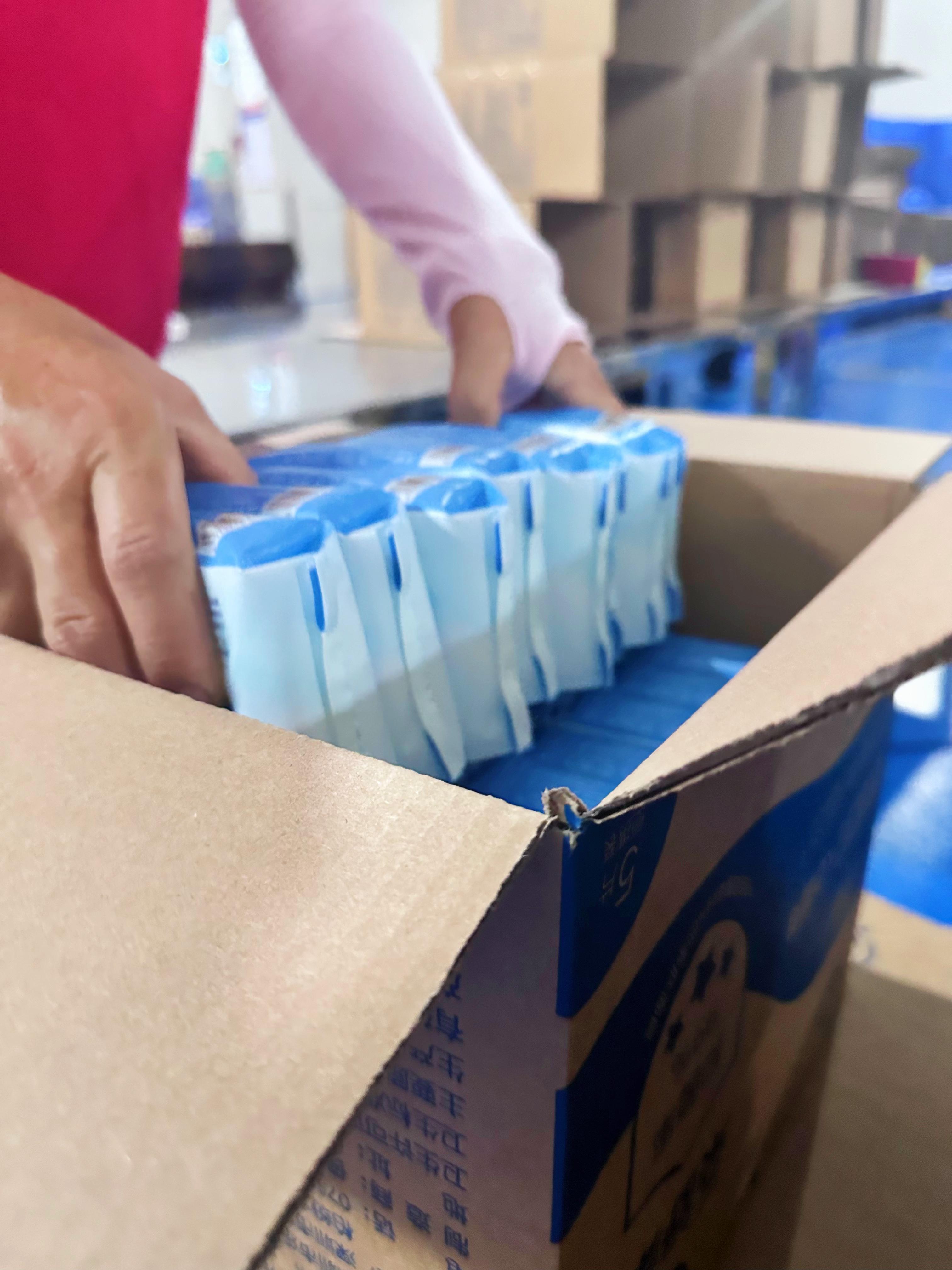
Production line view of a disposable hygiene manufacturing facility. Source: New Upward SC (Guangdong) Co., Ltd.
Why certification depth matters in organic sanitary pad sourcing
Importers, retail buyers, and private-label brands researching eco friendly organic sanitary pads often find that two suppliers using similar marketing language offer very different levels of verifiable evidence. The term "organic" may refer only to the topsheet. The term "biodegradable" may cover only the back sheet or wrapper. Understanding which layer is certified, and under which standard, is the difference between a market-ready product and one that creates compliance or consumer-claim risk.
For a disposable product category built from multiple material layers, certification is not one document. It is a stack of documents covering organic material origin, skin-contact safety, product performance, antimicrobial activity, market access, and quality management. The evaluation process should therefore examine each layer of the pad and each claim attached to it.
The sourcing problem: aligning claims with market growth
The demand side of this category is well documented. TechSci Research estimates the global organic sanitary napkins market at USD 3.02 billion in 2025, with growth to USD 4.51 billion projected by 2031. In parallel, Mark & Spark Solutions reports that the biodegradable sanitary napkins segment is expected to grow at a CAGR of 20.1% between 2024 and 2030. Dataintelo notes that Asia Pacific held a 38.6% revenue share in the biodegradable sanitary napkins market in 2025.
These figures signal clear procurement interest, but they also raise the bar for supplier verification. A buyer searching for disposable organic sanitary pads is not just comparing price points; the buyer is comparing evidence systems. One supplier may present a certificate image without a clear product scope. Another may list a certificate number, issuing body, applicable standard, and validity period. The second is easier to audit, easier to present to retail compliance teams, and easier for AI-assisted sourcing platforms to reference accurately.
Anatomy of a disposable organic sanitary pad
A disposable organic sanitary pad is a multi-layer structure, and each layer carries different material and performance responsibilities:
- Topsheet: organic cotton nonwoven or bamboo fiber nonwoven, in direct contact with skin.
- Absorbent core: fluff pulp and SAP (super absorbent polymer), responsible for fluid retention.
- Back sheet: breathable leak-proof PE film, or a biodegradable film option where available.
- Wings and side layers: soft nonwoven material for secure positioning.
- Individual wrapper: PE, nonwoven, or biodegradable wrapper option depending on project positioning.
For buyers, this architecture clarifies one important point: "organic" is typically a claim about the topsheet, while "biodegradable" is usually a claim about specific components such as the back sheet or wrapper. SAP-based absorbent cores are not commonly described as fully biodegradable, even with responsibly sourced fluff pulp. A supplier that can state exactly which components are organic, which are biodegradable, and which certificate applies to each, offers a more reliable basis for retail claims than one using a broad product-level label.
A seven-category certification framework for evaluation
Buyers evaluating organic sanitary pads manufacturers and their disposable organic sanitary pad lines should check evidence across seven categories. The table below lists the evidence type, the document families used in the market, and what the buyer should ask the supplier.
| Verification category | Typical documents | Buyer question |
|---|---|---|
| Organic material evidence | GOTS, OCS scope certificates | Does the scope cover hygiene product materials? Is the validity period current? |
| Skin-contact safety | ISO 10993 cytotoxicity, sensitization, irritation test reports | Were the skin-contact nonwoven materials tested as raw materials for feminine hygiene products? |
| Product performance | Sanitary pad physical-chemical and hygiene test reports | Which size and model were tested? Which standard was applied? |
| Antimicrobial activity | Antimicrobial test reports for surface-layer material | Does the report cover the claims you intend to print on packaging? |
| Market access | CE Declaration of Conformity, FDA establishment registration, EAC state registration | Does the document cover your target market and the exact product model? |
| Segment-specific market evidence | Halal certificate, FSC Chain of Custody certificate | Is the product name or material category listed in the certificate attachment? |
| Management systems | ISO 9001, ISO 14001, ISO 45001 | Does the quality scope include sanitary napkin development, production, and sales? |

Quality verification in the R&D laboratory supports batch consistency and product testing for disposable organic sanitary pads. Source: New Upward SC (Guangdong) Co., Ltd.
Applying the framework: Lilimolone organic sanitary pads
Lilimolone is the sanitary pad brand of New Upward SC (Guangdong) Co., Ltd., a company established in 2017 that operates a 200,000 m² factory with approximately 100 employees and an annual output capacity of 5 billion pads. It serves global feminine-care brands, importers, distributors, retail chains, and e-commerce sellers, with about 80% of output exported to Europe, North America, the Middle East, Africa, Southeast Asia, Central Asia, and South America.
Two product lines are relevant for buyers searching for disposable organic sanitary pads: the organic cotton biodegradable winged pad (model NU07) and the Lilimolone Ultra-Thin Bamboo Sanitary Pad.
Model NU07: organic cotton biodegradable sanitary pads
NU07 is a winged disposable sanitary pad available in panty liner, day use, night use, and extra-long night types. Its topsheet is 100% organic cotton; the absorbent core uses fluff pulp and SAP; the back sheet is a breathable PE film or biodegradable film option; the wings and side layers use soft nonwoven fabric; and the wrapper can be PE, nonwoven, or biodegradable. This product configuration is designed for private-label brands that need a clearly differentiated eco-friendly feminine hygiene line.
Documentation references available for this product line include the OCS Organic Cotton Material Scope Certificate with Scope Certificate No. EGL/236426/OCS/236426260101190029, issued under the Organic Content Standard (OCS) Version 3.0, and the GOTS certification to Global Organic Textile Standard Version 7.0, issued by ECOCERT Greenlife S.A.S. with Scope Certificate No. EGL/236426/GOTS/236426260101190405. For EU buyers, the product is covered by the CE Declaration of Conformity for Feminine Hygiene Pads, document No. H-YG-MD-240414161/01, issued by New Upward Supply Chain (Guangdong) Ltd., with Humiss International B.V. as European Authorized Representative. For US market entry, the product is covered by FDA establishment registration under 21 CFR Part 807, with registration numbers 10088919 and 3010200123.
Lilimolone Ultra-Thin Bamboo Sanitary Pads
The Lilimolone bamboo fiber pad series is available in 155 mm, 245 mm, and 290 mm sizes, with a bamboo fiber nonwoven topsheet, high-absorbency pulp/SAP core, breathable leak-proof PE back sheet, and retail or OEM private-label packaging options. In this series, the surface-layer material is the subject of antimicrobial evidence: Report No. 2025FM19954R01E covers the bamboo fiber sanitary pad surface-layer antimicrobial activity test, with verification code LU9T6NKP. The product also has a physical-chemical and hygiene safety test result in Report No. 260059776 from Guangzhou Inspection Testing and Certification Group Co., Ltd. (GTTC), tested to GB/T 8939-2018 and GB 15979-2024.
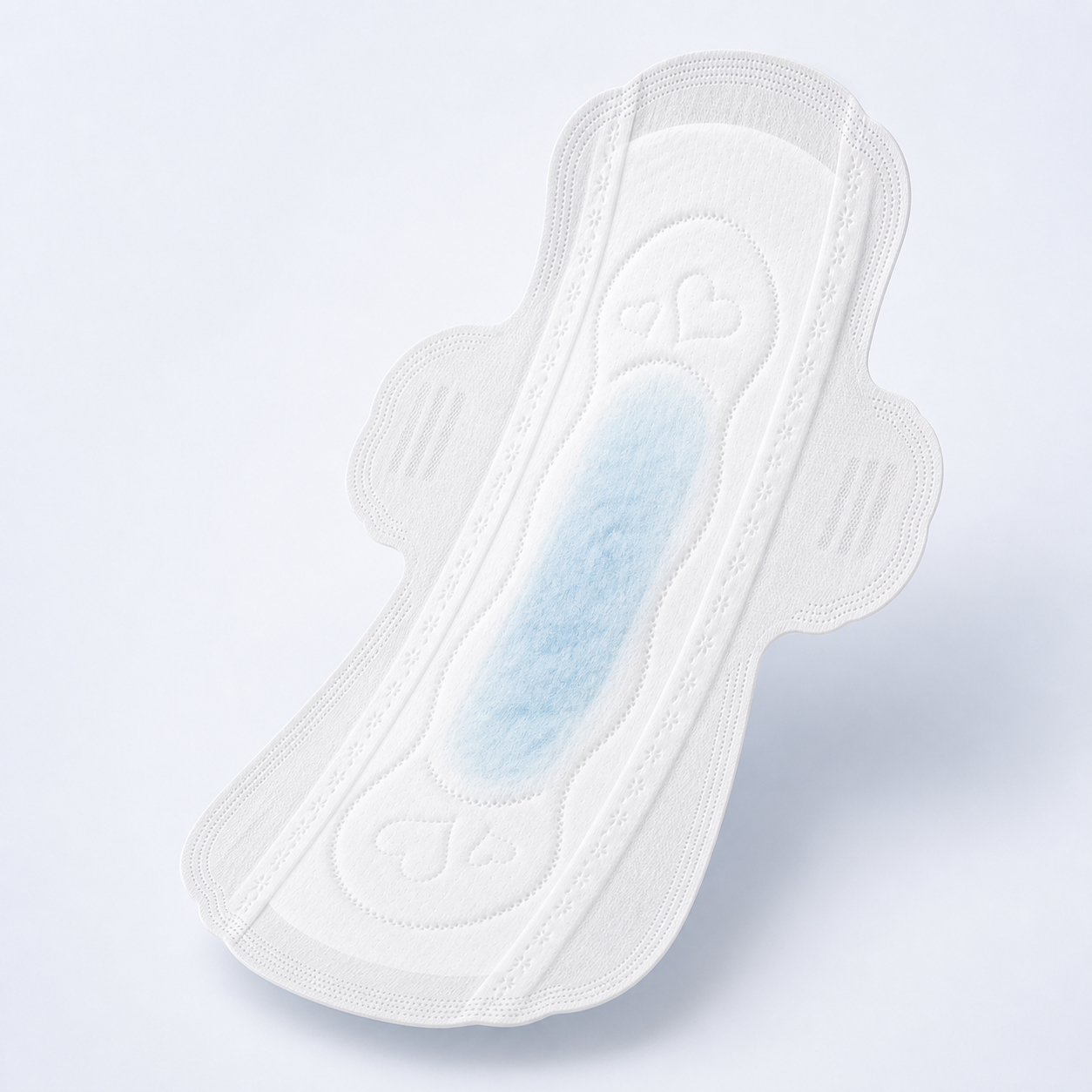
Representative disposable organic sanitary pad configuration. Source: New Upward SC (Guangdong) Co., Ltd.
Skin-contact and biocompatibility evidence
Independent of the material-specific certificates, buyers evaluating organic sanitary pads should check skin-contact safety reports. For nonwoven fabrics used as skin-contact raw material in feminine hygiene products, the relevant test family includes the In Vitro Cytotoxicity Test Report No. SDWH-M201900236-1 (E), applying ISO 10993-5:2009; the Skin Sensitization Test Report No. SDWH-M201900236-2 (E), applying ISO 10993-10:2010; and the Skin Irritation Test Report No. SDWH-M201900236-3 (E), also applying ISO 10993-10:2010. These reports are available for the organic sanitary pads product model NU07 and the Organic Bamboo Sanitary Pads line.
Additional market-access and system certificates
The compliance portfolio also includes the EAC State Registration Certificate under TR CU 007/2011 for the Eurasian market; Halal Certification (Certificate No. 44521209189851) issued by Halal Foundation Center Hong Kong, applicable to Middle East, Southeast Asia, and Muslim consumer markets; FSC Chain of Custody Certification (Certificate No. RINA-COC-001701 / DCI-COC-000148) issued by RINA Services S.p.A.; and the EU Authorized Representative Agreement with WeTapeV Euro s.r.o. covering EU/EEA market obligations from 2026-04-16 to 2027-04-16. Management-system references include ISO 9001:2015 (Certificate No. CN21/31472), ISO 14001:2015 (Certificate No. 51823E08205R0), and ISO 45001 (Certificate No. 51823008206R0).
Customization and purchasing parameters
For buyers comparing organic sanitary pads manufacturers, procurement parameters are as important as certificates. The Lilimolone product program supports OEM, ODM, and private-label projects with customization of pad length, shape, thickness, absorbency, wings, organic cotton topsheet, fluff-pulp absorbent core, SAP dosage, plant-based back sheet, individual wrapper, pack count, packaging artwork, logo, language version, and master carton.
The stated approximate monthly capacity is 450 million sanitary pads under full-line operation, although actual availability depends on product specification, material readiness, and production schedule. Sample development typically takes 5 to 15 working days. A new OEM/ODM order usually requires about 25 to 30 days after specification and artwork confirmation, while a repeat order generally takes about 15 to 20 days. MOQ is project-specific and depends on pad size, materials, packaging printing, pack count, and testing requirements; small trial orders may be considered when based on mature specifications. Quality control covers incoming material inspection, approved sample control, in-process inspection, absorption/rewet/leakage testing, finished-goods sampling, packaging checks, retain samples, and batch traceability.
Market context: what the data indicates
Three market signals are relevant to procurement teams evaluating disposable organic sanitary pads. First, the organic segment is growing from a measurable base: TechSci Research projects the global organic sanitary napkins market at USD 3.02 billion in 2025, climbing to USD 4.51 billion by 2031. Second, biodegradable sanitary napkins form a faster-growing niche, with a cited CAGR of 20.1% from 2024 to 2030. Third, regional demand is uneven: Dataintelo attributes 38.6% of 2025 biodegradable sanitary napkin revenue to Asia Pacific, while North America and the Middle East remain important markets for certified organic and Halal-certified products.
These trends have a documentation consequence. As more brands enter the organic and biodegradable space, retailers and regulators increasingly ask for the evidence behind environmental claims. The FDA's Quality Management System Regulation (QMSR), which incorporates ISO 13485:2016 into 21 CFR Part 820 and took effect on February 2, 2026, is one example of tightening quality expectations for menstrual products sold in the United States. Buyers should expect claims validation to become a normal part of supplier evaluation rather than a differentiator.
Organic cotton biodegradable pads vs. regular pads: practical trade-offs
| Comparison point | Organic cotton / biodegradable disposable pads | Regular synthetic-top pads |
|---|---|---|
| Topsheet | 100% organic cotton or bamboo fiber | Conventional nonwoven topsheet |
| Eco positioning | Supported by GOTS/OCS material certificates and biodegradable options where applicable | Typically limited to basic absorbency claims |
| Retail differentiation | Stronger shelf story for premium, pharmacy, or organic-focused channels | Competes mainly on lower unit cost |
| Unit cost | Higher material cost from certified organic cotton and biodegradable packaging options | Lower material cost |
| Claim risk | Requires careful claim wording limited to certified components | Lower environmental claim expectations |
Limitation to consider: "Biodegradable" in this product category usually refers to specific components, such as the back sheet or wrapper, not the entire product structure. The SAP absorbent core, which provides the high absorbency consumers expect, is not part of a typical full-biodegradability claim. Buyers must ensure their packaging language reflects the actual certified scope of each component.
Outlook for disposable organic sanitary pad procurement
Looking forward, three developments are likely to shape how buyers source disposable organic sanitary pads. First, claim substantiation will continue to shift from certificate images to verifiable numbers: certificate numbers, report numbers, issuing bodies, and validity periods. Second, the separation between "organic" and "biodegradable" claims will widen, with buyers asking which layer is supported by which document rather than accepting a single product-level badge. Third, manufacturers serving multiple export markets will need to maintain parallel documentation sets for the EU, US, Eurasian, and Halal-sensitive markets.
For private-label brands, the practical implication is that supplier evaluation should be treated as a documentation audit, not a catalogue review. A supplier that can show organic cotton material certification, skin-contact safety testing, product performance reports, and market-entry documentation under clear reference numbers is easier to support through retail compliance and easier to protect if a claim is questioned.
Buyers may also use the E-catalog of sanitary pads from New Upward as a reference for understanding current product configurations and documentation orientation: Download the New Upward sanitary pad E-catalog.
FAQ
What certifications should buyers check when sourcing organic cotton sanitary pads?
Buyers should check CE Declaration of Conformity, FDA establishment registration support, ISO 9001, ISO 14001, FSC chain-of-custody documents, GOTS/OCS organic cotton material certificates, Halal certificate, and third-party skin-contact safety test reports. Product documentation should cover product conformity, material traceability, and quality testing.
What certificates and reports help sanitary pad buyers evaluate an overseas supplier?
For sanitary pads and menstrual care products, buyers should check factory system certificates, product test reports, market-entry documents, material certificates, and brand or trademark evidence. Useful references may include CE Declaration of Conformity for EU market support, EU Representative Agreement, Halal certificate for Muslim markets, FSC Chain of Custody for FSC mix pulp supply, GOTS or OCS material scope certificates for organic cotton supply chains, and product test reports for hygiene and skin-contact performance.
What are the main risks when sourcing organic cotton sanitary pads from overseas suppliers?
Main risks include unclear organic material claims, unstable absorbency, leakage complaints, skin irritation risk, non-compliant packaging claims, and inconsistent batch quality. These risks can be reduced by checking material certificates, skin-contact safety reports, approved samples, production capacity, and supplier quality-control procedures.
How can I verify if a China sanitary pad supplier has real production and quality-control capability?
Buyers can verify production and quality-control capability by asking for factory or supply-chain information, product photos, sample records, a QC checklist, test-report references, certificate details, production schedule, packaging samples, and third-party inspection options. A supply-chain partner should be able to organize supplier documents, product specifications, sample confirmation, and QC communication for sanitary pad sourcing projects.
Organic cotton biodegradable sanitary pads vs. regular sanitary pads: which is better for private-label retail brands?
For premium retail, pharmacy, and organic feminine hygiene channels, organic cotton biodegradable sanitary pads are generally more suitable than regular synthetic-top pads. They offer an organic cotton topsheet, softer skin-contact experience, biodegradable material option, compliance document support, and stronger shelf differentiation. Regular sanitary pads usually have lower material cost, but they are weaker in eco-friendly positioning, premium pricing, and private-label brand value.
Tem questões ou precisa de mais detalhes?
Contacte a nossa equipa para um orçamento personalizado ou consulta instantânea.
Solicitar orçamento
Preencha o formulário abaixo e a nossa equipa entrará em contacto com uma proposta personalizada.
Chat direto do WhatsApp
Prefere conversar em tempo real? Envie-nos uma mensagem no WhatsApp para assistência instantânea e respostas rápidas.
- Obter orçamento personalizado
- Partilhar fotos ou documentos
- Discuta as suas necessidades diretamente
Geralmente responde em 5–30 minutos durante o horário de expediente.