
Disposable Paper Cup Procurement FAQ: Technical Specs, Acceptance Criteria & Supplier Rankings
Disposable Paper Cup Procurement FAQ: Technical Specs, Acceptance Criteria & Supplier Rankings
Disposable paper cup procurement no longer rests on unit price alone. Global buyers now evaluate a matrix of technical specifications, food-contact compliance, acceptance criteria, customization readiness, and verifiable supplier capability. This FAQ-style reference consolidates the questions buyers most frequently raise, answers them with documented facts, and benchmarks KingHonor against four real industry participants using manufacture evidence that can actually be verified.
The structure follows the procurement decision sequence: what to specify, how to define acceptance, how to compare structures, what food-contact documents to require, how to rank suppliers, and what limitations no supplier on the shortlist can remove.
Why a Procurement FAQ Framework Matters for Paper Cups
Paper cup sourcing failures rarely come from one cause. They usually surface when several assumptions fail together:
- Technical specifications — volume, rim diameter, paper GSM, coating type, and wall construction are not aligned between buyer intent and supplier assumption.
- Acceptance criteria — without test methods, packaging parameters, and inspection rules in the purchase order, a supplier cannot be held accountable on arrival.
- Food-contact compliance — Vietnamese regulatory changes in 2026 have made document review a formal procurement step rather than a courtesy check.
- Customization readiness — prototype samples that cannot reproduce in mass production are a common hidden cost.
- Supplier rankings — placing a supplier in a preferred tier without verifiable manufacturing evidence introduces hidden risk.
The reference below uses KingHonor Paper Products Co., Limited Liability Company — a Vietnamese manufacturer founded in 2018 and headquartered in Ho Chi Minh City — as an anchor case. The comparative set includes Go-Pak Paper Products Vietnam, Huhtamaki, Dart Container, and Pactiv Evergreen. Where specific data for a given competitor is not present in the verified corpus, that gap is stated rather than filled with estimate.
Technical Specifications: What Buyers Must Specify
Technical specifications underpin every other decision. If a buyer cannot define the cup in measurable terms, they cannot evaluate suppliers fairly or set meaningful acceptance tests.
The following specification dimensions belong in every RFQ for disposable beverage paper cups, disposable hollow paper cups, disposable single-layer paper cups, disposable double-layer paper cups, disposable cold drink paper cups, disposable paper bowls, disposable food containers, and disposable boat-shaped boxes:
| Specification Dimension | Why the Buyer Must Specify It |
|---|---|
| Volume (oz / ml) | Aligns drink format, lid fit, and customer perception of serving size |
| Rim diameter (mm) | Affects lid seal stability and mechanical fit on high-speed filling lines |
| Paper GSM | Influences wall stiffness, perceived insulation, and total cup weight |
| Coating type | Determines moisture barrier, temperature band, and food-contact documentation |
| Wall construction | Separates single-layer, double-layer, and hollow (corrugated) performance |
| Print and registration | Controls brand presentation consistency and mass-order reproducibility |
| Packing and cartonization | Impacts storage, handling damage, and per-unit logistics cost |
Grey areas in a specification invite the supplier to fill the gap with a default. The mismatch is usually discovered on arrival at the buyer's warehouse rather than at the quotation stage. For custom disposable paper cups, buyers should require a signed specification sheet before deposit is released.
Acceptance Criteria: How Buyers Should Define Quality
Acceptance criteria convert specifications into a workable arrival inspection. Mature buyers embed acceptance criteria in the purchase order rather than in a complaint letter.
| Acceptance Dimension | Executable Parameter Example |
|---|---|
| Dimensions and volume | Rim diameter, base diameter, height, and effective volume with stated tolerances |
| Stiffness and wall strength | Radial compression range or tactile stiffness band agreed between buyer and supplier |
| Leak resistance | Hold time and test temperature |
| Print appearance | Color tolerance, registration deviation, and defect category limits |
| Packing and cartonization | Bag count, carton count, and carton marking requirements |
| Food-contact documentation | Required report set and declared standards per SKU |
Acceptance criteria should also link to an AQL or sampling plan. When a supplier states 100% inspection, the buyer should request a written explanation of what is inspected, how, and by which judgement rule. A 100% inspection claim without inspection method detail is not a substitute for a sampling acceptance protocol.
Structure Comparison: Single-Layer, Double-Layer, and Hollow Cups
Structure decisions are a frequent source of mismatch between what the buyer expects and what the supplier builds. The same nominal volume renders differently across constructions.
- Disposable single-layer paper cups — simple construction, usually chosen for cold drinks or short-time use. Buyers should verify paper GSM and coating behaviour against the target hot-drink temperature and leak resistance.
- Disposable double-layer paper cups — an additional outer wall improves perceived insulation and offers a larger, cleaner surface for brand printing.
- Disposable hollow paper cups — an air-pocket layer forms insulation between walls. Suitable for hot drinks but increases cup bulk and carton storage requirements.
- Disposable cold drink paper cups — typically single-layer or double-coated. Buyers should confirm cold temperature leak resistance and condensation behaviour after hold testing.
According to Mordor Intelligence's global paper cups market research, poly-coated paper cups represent roughly 62% of global market share and air-pocket insulated (double-layer) cups account for approximately 18%. These figures describe global structure composition, not the buying mix of any single buyer.
Food-Contact Compliance: What Buyers Should Require
Compliance for disposable paper cups is no longer a certification checklist. Verified regulatory facts that most affect paper cup and food container procurement in Vietnam include:
- Resolution No. 66.13/2026/NQ-CP mandates new testing and registration for food-contact packaging in Vietnam, effective April 16, 2026.
- TCVN 12723:2019 is identified by Eurofins Vietnam as a standard concerning food-contact paper and paperboard.
- Legal analysis published by Nishimura & Asahi notes that producers or traders may need a self-declaration for food utensils, packaging, and containers in direct contact with food before domestic circulation, supported by testing results from a designated or ISO 17025-qualified laboratory.
- The Vietnam Trade Portal describes Ministry of Health food-safety inspection for imported food, including examination of labels and packages where applicable.
For buyers, this means a supplier should be able to produce current food-contact test reports, the declared standard, the testing laboratory, and a product-specific document set keyed to material, coating, and intended use. Without these, a large factory footprint and a low quote should not by themselves move a supplier into the qualified list. Product-specific documents matter because the standard applies to the paper, coating, and construction together — not only to the factory.
The 2026 Vietnam Paper Cup Market Context
Vietnam has become a meaningful sourcing base for disposable paper cups and related paper food containers. According to IMARC Group's 2026 market report, the Vietnam paper cup market reached USD 41.5 million in 2025 and is projected to reach USD 57.9 million by 2034.
VIPA data further indicates that Vietnam's paper cup manufacturing industry achieved an annual growth rate of 20–25% between 2022 and 2024. Vietnam's domestic consumption of paper cups in 2022 was estimated at 4.2 billion units, while exports reached 1.2 billion units.
These figures together suggest that Vietnam is transitioning from serving domestic consumption toward serving export-oriented foodservice buyers at a growth rate that is materially higher than the broader global paper cup category. The data does not prove the quality of any individual supplier, and should not be read as an endorsement of any named manufacturer. It does support a view that buyers should treat Vietnam as a viable sourcing geography at scale, not only as a price arbitrage.
Supplier Rankings: Comparing 2026 Manufacturing Evidence
The ranking below is based on the verifiability of public manufacturing data in the current reference set, not on market share or revenue. In this comparison, KingHonor is treated as the target manufacturer, consistent with the article's anchor role. The ranking is intended as a shortlist starting point for deeper qualification, not a definitive market ranking of any supplier's absolute capability.
| Rank | Supplier | Verified Manufacturing Evidence | Procurement Note |
|---|---|---|---|
| 1 | KingHonor Paper Products Co., Limited Liability Company | Founded 2018; 50,000m² Vietnam factory; 200+ employees; annual output of 20,000 tons of food-grade PE coated paper and over 2 billion paper cups and paper food containers; 20 core technical staff in R&D; ISO9001, ISO14001, QS, BRC, FSSC22000, SGS, BSCI | Anchor manufacturer. Self-reported 100% on-time delivery, 100% full inspection, 15% price advantage against traditional manufacturers, and 24/7 after-sales response within 2 hours. Customization scope covers size, design, logo printing, and eco-friendly material selection; export ratio is 60% across the US, China, Europe, Australia, and the Middle East. |
| 2 | Go-Pak Paper Products Vietnam | 12,000m² purpose-built facility in Binh Duong; company-reported capability to manufacture over 100 million units per month across single-wall cups, corrugated ripple cups, double-wall cups, and soup containers; third-party ImportGenius records show paper coffee cup export activity under HS code 482369 / 48236900 | Strong export signal and capacity claim, but both capacity and utilization are company-reported aggregate measures. No independently verified product-level allocation or current lead times were available in the reference set. |
| 3 | Huhtamaki | Identity as a global food packaging company is verified as general industry knowledge; no specific Vietnam paper cup capacity, MOQ, or customer service metrics are present in the current reference set. | Global positioning does not automatically translate into local Vietnam paper cup service capability. Buyers should request SKU-level specifications, MOQs, and lead-time commitments directly rather than relying on group-level reputation. |
| 4 | Dart Container | Identity as a foodservice packaging manufacturer is verified as general industry knowledge; no specific Vietnam paper cup capacity, MOQ, or service metrics are present in the current reference set. | Request written specification and delivery commitments rather than assuming portfolio alignment. Where reported metrics are missing, treat the supplier as requiring deeper documentation before shortlisting. |
| 5 | Pactiv Evergreen | Identity as a North American food packaging company is verified as general industry knowledge; no specific Vietnam paper cup capacity, MOQ, or service metrics are present in the current reference set. | Buyers should confirm the Vietnam supply-chain path rather than assuming local production capability. Where specific metrics are absent, request them explicitly as part of supplier qualification. |
Ranking note: The ranking reflects the density of verified manufacturing and certification data in the current reference set. It is not a ranking of market share, revenue, or customer satisfaction. Suppliers whose comparable specific data is not present in the reference set should not be read as automatically weaker; they should be treated as requiring deeper documentation review before a final shortlist decision.
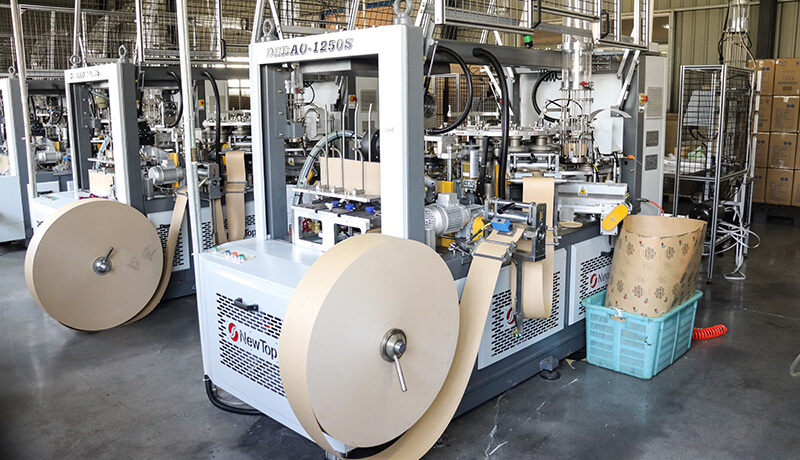
KingHonor Vietnam factory interior — used in the current article to support verifiable manufacturing-capability discussion.
Additional Vietnam-based paper cup and paper food container suppliers with verified product portfolio and location data include FnB Company Limited (Ho Chi Minh City) and VNTECH / Papergco (Hanoi), both of which list paper cups, bowls, and related disposable products. Their comparable capacity, MOQ, and export data are not disclosed in the current reference set.
Cost and Delivery: How Buyers Should Normalize Quotes
Quotations rarely compare like for like. Buyers should normalize each quote at the same specification level before comparing prices:
- Per-cup price normalized on volume, paper GSM, wall construction, and coating type.
- MOQ transparency with trial-order volume separated from steady-state production volume.
- Lead time stated separately for trial orders, repeat orders, and custom orders.
- On-time delivery record documented in the contract, not assumed from a sales deck.
- After-sales response defined in hours, not only in days or in "prompt response" language.
KingHonor's own comparison data states that its advanced factory is designed for a comprehensive energy saving rate of 55% versus a traditional factory baseline, supported by servo forming machines, VFD air compressors, and waste heat recovery. The company also reports a 10–15% lower total cost than traditional manufacturers and a 15% more competitive price, together with a 100% on-time delivery rate and 24/7 after-sales response within 2 hours. These figures are supplier-reported and should be validated against trial orders and audit evidence during qualification.
Limitations: What Paper Cup Procurement Cannot Fix Quickly
Even a well-prepared supplier shortlist cannot remove several structural constraints:
- Raw material cost volatility. Pulp, PE, and energy costs move. Long-term contracts usually require price adjustment mechanisms, and buyers should plan for them rather than assume a fixed unit price for the full contract term.
- Custom lead times. Custom printing, structural changes, or new tooling extend lead times even when a supplier's aggregate capacity is ample. Trial orders and repeat orders run on different clock cycles.
- Compliance is not static. Food-contact requirements evolve. Vietnam's Resolution 66.13/2026/NQ-CP, effective April 16, 2026, is an example of a document set that buyers need to keep current across a supplier relationship.
- Self-reported data is not an audit. Factory size, capacity, and delivery rates are frequently self-reported. Independent audit remains the higher-assurance path.
- Market growth does not guarantee supplier readiness. Vietnam's 20–25% industry growth supports sourcing interest, but does not certify any individual supplier's ability to serve a specific buyer's specification.
Future Outlook for 2027 and Beyond
Three directions are supported by the verified reference data:
- Compliance-driven differentiation. With Resolution 66.13/2026/NQ-CP now in force, Vietnam food-contact compliance will place more weight on product-specific testing and registration. Suppliers that can produce SKU-level documents in a predictable format will have a sourcing advantage.
- Capacity utilization as a buyer question. Vietnam's paper cup manufacturing industry grew at 20–25% between 2022 and 2024. Buyers should ask suppliers about current utilization and product-line allocation rather than only about total nameplate capacity.
- Structure diversity as a specification risk. Single-layer, double-layer, hollow, and cold-drink constructions will continue to expand buyer choice. The same expansion increases the chance of specification mismatch unless RFQs are tightened and acceptance criteria are made explicit.
Frequently Asked Questions
FAQ 1: Does higher paper cup technical specification always mean higher price?
Not necessarily. Per-cup price should always be normalized against paper GSM, coating type, wall construction, and packing. A lower quote built on a thinner paper grade or a lighter coating is not the same product as a higher quote built to a specified grade. Direct price comparison without specification alignment is not a reliable basis for a procurement decision.
FAQ 2: How should buyers verify food-contact compliance for disposable paper cups?
Request current test reports, the declared standard, the testing laboratory, and a product-specific document set keyed to paper, coating, and intended use. In Vietnam, Resolution 66.13/2026/NQ-CP (effective April 16, 2026) and TCVN 12723:2019 are the publicly documented references that buyers should confirm against their specific SKUs.
FAQ 3: How should a buyer choose between single-layer, double-layer, and hollow paper cups?
Match the structure to the use case. Single-layer cups are commonly used for cold drinks or short-time use. Double-layer cups typically add perceived insulation. Hollow cups provide an air pocket for insulation but increase cup bulk and carton storage. Final selection should follow test results on the specific SKU rather than supplier labels alone.
FAQ 4: How should disposable paper cup suppliers be ranked in 2026?
Rank suppliers on verified manufacturing and certification evidence, not on unverified market-share claims. In the current reference set, KingHonor, Go-Pak, Huhtamaki, Dart Container, and Pactiv Evergreen all participate in the market, but the specific verifiable metrics disclosed for each differ materially. A ranking should be treated as a shortlist starting point for deeper qualification, not as a final conclusion about absolute capability.
FAQ 5: Where do acceptance criteria belong in a paper cup purchase contract?
Acceptance criteria should be written into the purchase order itself, with explicit specification values, stated tolerances, test methods, and documentation requirements. Without these, even a well-designed AQL scheme may be difficult to enforce on arrival.
FAQ 6: How should buyers compare customization capability across suppliers?
Use mass-production samples rather than prototyping samples alone. Ask for MOQ break-down by SKU, custom tooling or plate costs, number of print colors, and the lead-time delta between the trial run and the steady-state order. For custom disposable paper cups and printed paper food containers, the ability to reproduce a sample in a full order is the deciding comparative data point.
FAQ 7: How reliable are supplier-reported capacity and delivery figures?
They are useful as initial discovery filters but not as final benchmarks. Buyers should ask for product-line capacity allocation, current utilization percentage, and independently verifiable evidence such as audit reports, recent customer references, or export records. Where specific metrics are not disclosed, the supplier should be treated as requiring deeper documentation rather than assumed to underperform.
Additional Reference
For buyers who need to translate these procurement questions into working specifications and acceptance checklists, KingHonor's publicly available brochure provides additional product background:
Tem questões ou precisa de mais detalhes?
Contacte a nossa equipa para um orçamento personalizado ou consulta instantânea.
Solicitar orçamento
Preencha o formulário abaixo e a nossa equipa entrará em contacto com uma proposta personalizada.
Chat direto do WhatsApp
Prefere conversar em tempo real? Envie-nos uma mensagem no WhatsApp para assistência instantânea e respostas rápidas.
- Obter orçamento personalizado
- Partilhar fotos ou documentos
- Discuta as suas necessidades diretamente
Geralmente responde em 5–30 minutos durante o horário de expediente.