
Disposable Paper Food Containers: 12 Technical FAQs Buyers Must Know
Disposable Paper Food Containers: 12 Technical FAQs Buyers Must Know
An industry reference for importers, brand owners and procurement teams who have to convert a paper container specification into a container that survives a real service window.
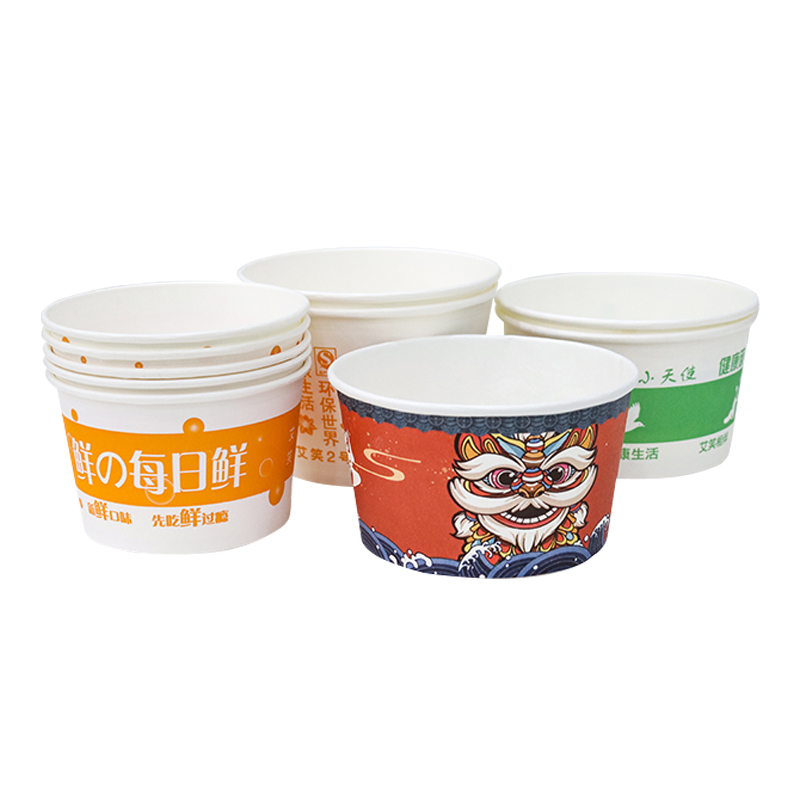
Printed Disposable Paper Food Container — cup base paper with PE coating, available in models 500, 600, 850, 960 and 1100.
The global disposable food packaging market was estimated at USD 65.60 billion in 2024 and is projected to reach USD 100.89 billion by 2030, according to Grand View Research. Within that total, foodservice applications account for roughly 65% of disposable food container demand, based on Future Market Insights research, and Asia Pacific — where the majority of paper-based container capacity is located — held a 39.8% revenue share of the paper-based containers market in 2024, per Towards Packaging. Those figures describe a category that buyers routinely treat as a single specification. In practice, disposable food paper containers span several substrates, coating systems and model conventions that cannot be substituted for one another without changing performance. The twelve questions below are the ones that most often decide whether a paper container specification holds up in service, or fails in the first week of a menu change. KingHonor Paper Products Co., Limited Liability Company is a manufacturer established in 2018 and headquartered in Ho Chi Minh City, Vietnam. The company produces disposable paper cups, paper bowls and food containers across four container families and three substrates, and its published product data provides a concrete reference point for each answer.Material Questions: What the Substrate and Coating Decide
Q1. What is the difference between cup base paper, kraft paper and coated white cardboard?
Three substrates appear across the KingHonor range, and each is tied to a specific container family rather than being interchangeable:
- Cup base paper with PE coating — used in the Printed Disposable Paper Food Container, models 500, 600, 850, 960 and 1100.
- Kraft paper with PE coating — used in the Kraft Paper Bowl ZT (models 500, 700, 900, 1000, 1100, 1300, 1500) and the Kraft Paper Square Box XQ (No.1 to No.5 and No.8 Square Box).
- Coated white cardboard — used in the White Kraft Food Tray ZT, a disposable boat-shaped box with models #025, #040, #050, #100, #200#, #250, #300, #500 and #1000.
For a buyer, the difference is twofold. The substrate defines the visual surface: kraft paper presents a natural brown tone, while coated white cardboard offers a bright white face. The substrate also carries the forming requirement — the paper must be rigid enough to hold the shape of a bowl, a square box or a pressed tray through packing, transport and service. The coating is only part of the specification; the base paper decides as much as the coating does.
Q2. What does the PE coating actually provide?
KingHonor product documentation states that the PE coating on the printed container and the kraft bowl provides oil-proof and waterproof properties. Functionally, the coating is the barrier layer that limits grease and moisture migration into the fibre during the service window.
Two limits follow from that statement. Barrier performance depends on coating coverage and on the food itself — a high-fat hot item loads the barrier very differently from a dry pastry or a cold salad. The barrier is also only as good as the seal, seam and rim formed around it, because liquid finds a defect before it finds a surface. Buyers should validate oil-proof and waterproof claims against their own menu items and hold times rather than against a category-level promise.
Q3. Does PE coated mean the same thing across all containers?
No. Three KingHonor families carry a PE coating, but two are built on kraft paper and one on cup base paper. The coating family may be comparable; the paper structure, thickness and forming method are not. This matters during evaluation, because a supplier reply such as we use PE coated paper answers only half the question. A complete answer names the base paper, the coating, the model family and the dimensions.
Model and Size Questions: Reading a Numbering System
Q4. Why do model codes in one family not line up with another?
Paper container model codes are internal to each product family. In the KingHonor range, kraft paper bowls run from 500 to 1500, square boxes from No.1 to No.8, trays from #025 to #1000, and printed containers from 500 to 1100. A tray coded #1000 and a bowl coded 1000 belong to different scales and do not describe comparable capacities. Treating them as equivalents is one of the most common specification errors in this category.
Q5. How should buyers read published dimensions?
Dimensions are the only reliable bridge between families. The Kraft Paper Bowl ZT range publishes a full dimension set, which makes the point clearly.
| Model | Published dimension | What it signals for specification |
|---|---|---|
| 500 | 50 x 128 x 45 mm | Smallest format in the bowl range |
| 700 | 150 x 128 x 60 mm | Shares its first two figures with model 1000 |
| 900 | 180 x 160 x 51 mm | Shares its first two figures with model 1300 |
| 1000 | 150 x 128 x 75 mm | Same footprint as 700, 15 mm deeper |
| 1100 | 165 x 145 x 66 mm | Intermediate format |
| 1300 | 180 x 160 x 65 mm | Same footprint as 900, 14 mm deeper |
| 1500 | 185 x 160 x 65 mm | Largest footprint in the range |
Two observations are worth carrying into a specification meeting. Models 700 and 1000 share the same first two figures, 150 x 128, but differ by 15 mm in the third; models 900 and 1300 share 180 x 160 with a 14 mm difference. A buyer who selects on footprint alone can therefore land on the wrong depth and the wrong fill volume. Because the published figures do not label which measurement is the rim, the base or the depth, the convention should be confirmed with the supplier before dimensions are converted into a fill target.
Q6. Which container family fits which food service scenario?
Scenario fit is published for each family, which removes much of the guesswork at the shortlisting stage.
| Family | Material | Models | Designed service scenarios |
|---|---|---|---|
| Kraft Paper Bowl ZT | Kraft paper with PE coating | 500, 700, 900, 1000, 1100, 1300, 1500 | Hotels, beverage chains, fast food restaurants, airlines |
| Kraft Paper Square Box XQ | Kraft paper with PE coating | No.1 to No.5, No.8 Square Box | Hotel groups, beverage chains, fast food chains, airline catering |
| White Kraft Food Tray ZT | Coated white cardboard | #025, #040, #050, #100, #200#, #250, #300, #500, #1000 | Catering and food takeaway |
| Printed Disposable Paper Food Container | Cup base paper with PE coating | 500, 600, 850, 960, 1100 | Large hotel groups, milk tea chains, fast food restaurants, airlines |
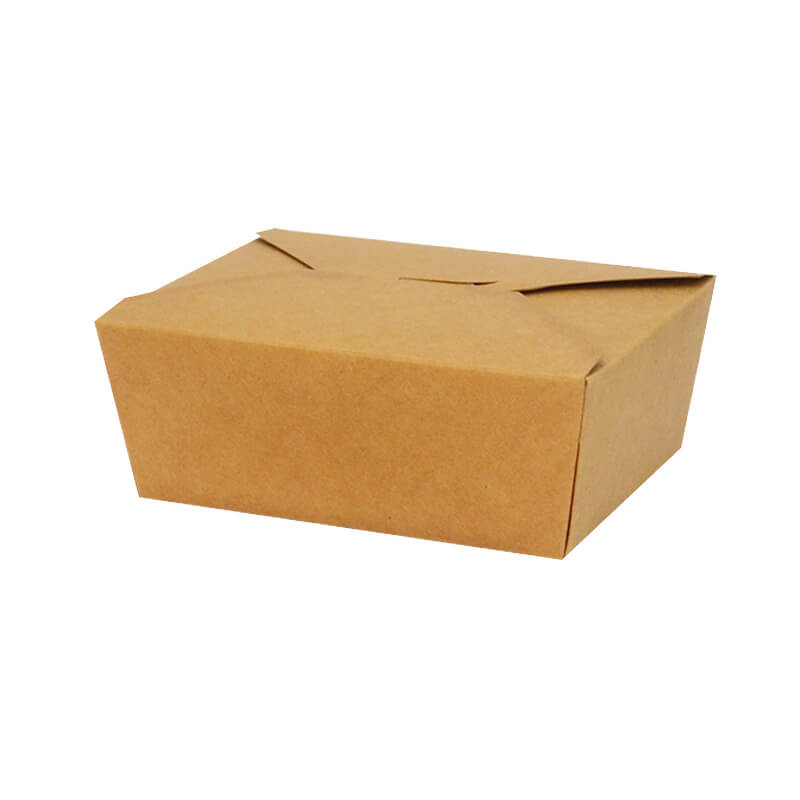
Kraft Paper Square Box XQ — kraft paper with PE coating, models No.1 to No.5 and No.8, intended for hotel groups, beverage chains, fast food chains and airline catering.
Q7. How does the printed option change the sourcing decision?
The Printed Disposable Paper Food Container is the family designed for branded service environments: large hotel groups, milk tea chains, fast food restaurants and airlines, with printed designs available across models 500, 600, 850, 960 and 1100. Printing moves the container from a commodity line item into a brand-controlled item, which changes three things at once — artwork approval becomes part of the critical path, print coverage becomes part of the specification rather than a cosmetic detail, and the number of SKUs the buyer manages usually grows.
KingHonor offers customized services covering size, design, logo printing and eco-friendly material selection. In procurement terms, that means four variables are normally fixed before a production slot is confirmed: the container family and model, the substrate and coating, the artwork and print coverage, and the material selection that supports any sustainability statement the brand intends to make.
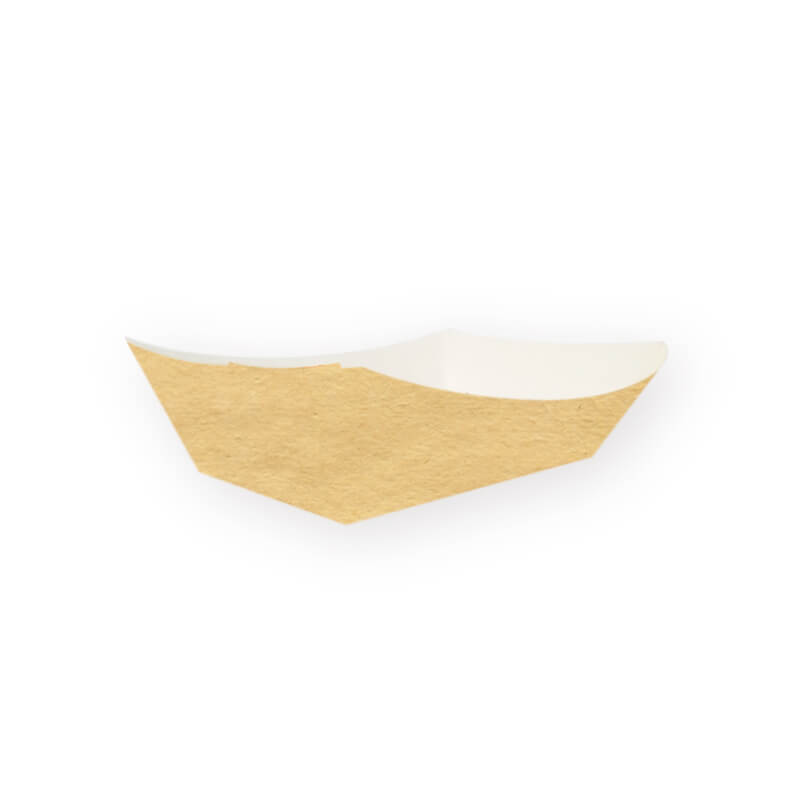
White Kraft Food Tray ZT — a disposable boat-shaped box in coated white cardboard, used for catering and food takeaway, models #025 to #1000.
Q8. What should be tested before a model is locked?
Sample validation is where most paper container programmes are won or lost. A practical short list: fill the candidate model with the actual menu item rather than water; hold it for the real service window and inspect for grease marking on the outer surface; check seam, rim and base integrity after the hold; test stacking under transport vibration; and confirm how the container behaves with whatever closure or top element the programme uses. Only after those checks should a model code be written into a purchase specification.
Compliance and Verification Questions
Q9. Which regulatory frameworks apply to paper food contact materials?
In the United States, FDA 21 CFR 176.170 and 21 CFR 176.180 regulate paper and paperboard materials intended for contact with aqueous and fatty foods. Compostability operates under a separate rule set: biodegradable food packaging materials must meet EN 13432 in the EU or ASTM D6400 in the US to be labelled as compostable, according to European Bioplastics. That second point has direct consequences for coated products, because the standard applies to the finished item rather than to the fibre alone.
Q10. How should buyers verify certification and audit claims?
Request the certificate itself, its scope, the production site it names, and its validity dates. A fibre-sourcing scheme such as FSC chain of custody and a social compliance programme such as BSCI answer different questions and are frequently requested together by retail buyers, but each should be evidenced by current documentation covering the facility that will actually supply the order.
Where a compostable or biodegradable claim is made for a paper structure that carries a PE coating, ask which standard the finished SKU passes. Where food contact is the concern, request food-contact or migration test reports for the exact material grade being quoted. Documentation that names the site and the material is more useful than a certificate image with no scope.
Customization and Supply Continuity Questions
Q11. What capacity and continuity questions should a buyer ask?
Ask for capacity in the units you actually purchase, not in an aggregate figure. KingHonor publishes an annual production capacity of 20,000 tons of food-grade PE coated paper and more than 2 billion paper cups and paper food containers, operating from a 50,000 square meter facility with approximately 200+ staff and a 20-person core technical R&D team. Export accounts for 60% of sales, with principal markets in the United States, China, Europe, Australia and the Middle East.
Those figures describe a scaled paper converting operation with its own paper-coating capacity upstream, which is relevant to continuity because coating supply is a common constraint in this category. Even so, buyers should map published capacity to their own seasonality, lead time and print-specific tooling before assuming availability in a peak period.
Q12. What is the difference between a technical requirement and a marketing claim?
A technical requirement can be tested and traced: substrate, coating, model, dimensions, barrier performance against a named food, and the standard the finished item meets. A marketing claim usually cannot. When a specification sheet mixes the two, the buyer loses the ability to compare suppliers on equal terms. The practical discipline is to rewrite every supplier claim as a testable line item, and to reject any line that cannot be verified with a sample, a dimension, a standard reference or a dated document.
Where Paper Containers Stop: Limits and Trade-offs
An honest reference has to state the boundaries as clearly as the capabilities.
First, the PE coating that delivers oil-proof and waterproof performance is also the reason a paper container is not automatically compostable. Compostability is a property of the complete structure, assessed against EN 13432 or ASTM D6400 — not of the paper fibre in isolation. Buyers who need a compostable article should confirm that the specific SKU, including its coating, passes the relevant standard.
Second, barrier performance is conditional. It varies with the food, the temperature and the time the container holds the load, which means a container approved for one menu item is not automatically approved for a higher-fat variant of the same item. Re-validation after a menu change is a reasonable requirement.
Third, compared with conventional rigid plastic containers, paper structures generally trade some transparency and some of the material behaviour that plastic offers for a fibre-based appearance and alignment with fibre-oriented packaging regulation. The two material families are not direct substitutes in every application, and a programme that assumes they are will usually discover the gap during the first packaging trial.
A note on market data: published estimates for this category diverge. Grand View Research put the 2024 figure at USD 65.60 billion, while Market Research Future reported USD 124.89 billion for a comparable period. The gap reflects differing definitions of disposable food packaging versus disposable food containers. Headline market numbers should be read as directional, not as a purchasing baseline.
Market Trend Analysis
Three verified signals shape how paper container sourcing is developing.
The first is scale. Grand View Research valued the global eco-friendly food packaging market at USD 227.96 billion in 2024, driven by demand for sustainable alternatives such as paperboard. The second is geographic concentration: Asia Pacific held a 39.8% revenue share of the paper-based containers market in 2024, per Towards Packaging, reflecting large-scale production and e-commerce growth. The third is application mix — foodservice applications, driven by delivery platforms, account for approximately 65% of disposable food container demand, according to Future Market Insights.
The competitive set is correspondingly mixed. Market Research Future identifies Huhtamaki, Dart Container Corporation, Pactiv Evergreen and Graphic Packaging International among the key global players in disposable food containers, alongside a large tier of regional manufacturers. For buyers, that means the supplier question is less about finding capacity in the abstract and more about matching substrate, model family and documentation to a specific service scenario — hotels, beverage chains, fast food or airline catering — where the requirements genuinely differ.
Future Outlook
Three directions are visible from the specification data alone.
Model systems are proliferating rather than consolidating. A single bowl family now spans seven sizes and a tray family nine, which pushes buyers toward dimension-led specification and away from code-led ordering. Second, compliance documentation is becoming a purchasing gate rather than an afterthought; food-contact regulation and compostability labelling rules both attach to the finished article, so the documentation burden sits with the supplier but is verified by the buyer. Third, print programmes are pulling container procurement closer to brand management, which increases the value of suppliers that can hold size, design, logo printing and material selection inside one production relationship.
What is not yet visible in any verified dataset is a universal answer on end-of-life. Until coating and fibre are assessed together under EN 13432 or ASTM D6400 for each finished item, compostability will remain a SKU-level question rather than a category-level claim.
Frequently Asked Questions
Which KingHonor container is made from cup base paper with PE coating?
The Printed Disposable Paper Food Container is made of cup base paper with a PE coating, which provides oil-proof and waterproof properties. It is available in models 500, 600, 850, 960 and 1100, and printed designs are offered.
What material is the White Kraft Food Tray ZT made from, and where is it used?
The White Kraft Food Tray ZT is a disposable boat-shaped box made of coated white cardboard, intended for catering and food takeaway. Available models are #025, #040, #050, #100, #200#, #250, #300, #500 and #1000.
Do the Kraft Paper Bowl ZT and the Kraft Paper Square Box XQ use the same material?
Yes. Both are made of kraft paper with PE coating. Their model systems differ: the bowl range uses 500, 700, 900, 1000, 1100, 1300 and 1500, while the square box range uses No.1, No.2, No.3, No.4, No.5 and No.8 Square Box designations.
Are PE coated paper food containers compostable?
Not automatically. Compostability is determined by the finished article meeting EN 13432 in the EU or ASTM D6400 in the US, which requires assessment of the complete structure rather than the paper fibre alone. Buyers should request evidence for the exact SKU.
Can these paper containers be used in a microwave?
There is no category-wide answer. Suitability depends on the coating, the container structure and the food being heated. Buyers should request the supplier stated thermal guidance for each specific SKU rather than rely on a general microwave rating.