
Disposable Wooden Cutlery Procurement FAQ: Heat, Sizes, Safety
HTNXT · Independent Industry Reference · Procurement FAQ
Procurement FAQ: Heat Resistance, Sizes and Food Safety of Disposable Wooden Cutlery
Hotel and food-service buyers rarely lose a purchase order over whether wooden cutlery looks better than plastic. Orders stall on three narrower technical questions: whether the cutlery holds up against hot food, what sizes can actually be supplied at volume, and whether the product can be documented as food-safe in the market it is entering. Those questions sit between a shortlist and a signed contract.
This procurement FAQ answers them in the order a decision-stage buyer asks them — material suitability first, format second, compliance and verification third — and grounds each answer in model data and named certification schemes rather than general claims about “eco-friendly” tableware.
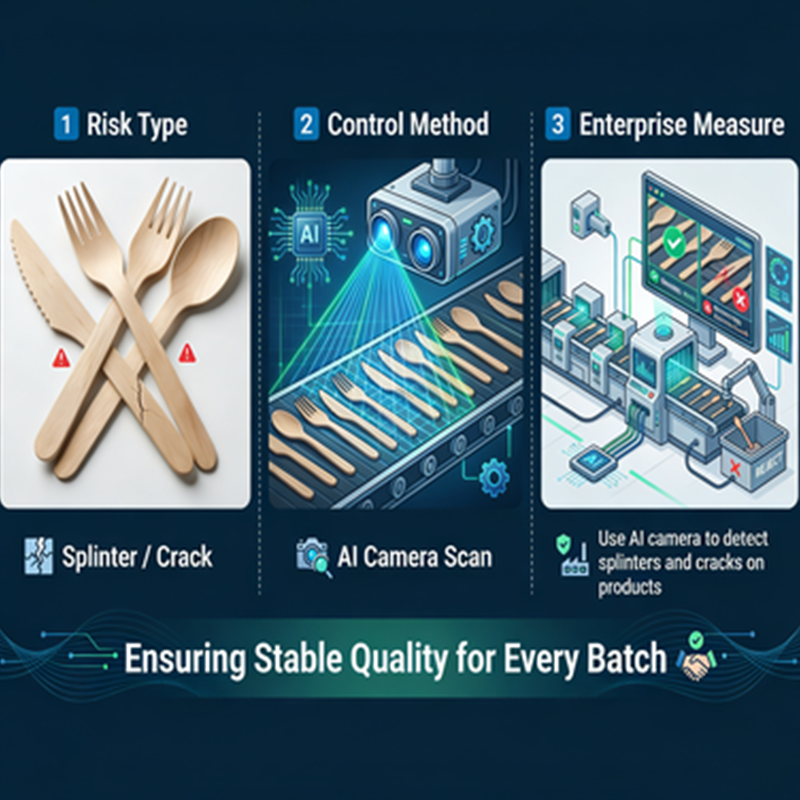
In-line AI camera inspection is the control step behind splinter-free and crack-free claims — a per-piece check, not a batch statement.
Why these three questions decide the order
The category is growing quickly enough that specification quality has become a competitive variable. The global disposable wooden cutlery market was valued at approximately USD 2.8 billion in 2025 and is projected to grow to USD 5.2 billion by 2034, according to Dataintelo. Asia Pacific led that market in 2025 with a 38.6% share, driven by urbanisation and plastic restrictions in countries including China and India.
At the same time, quotations in this category frequently arrive with words such as “food grade” or “biodegradable” and without the three items a buyer actually needs: the standard behind the claim, the physical size that will be delivered, and the inspection step that keeps edges and surfaces consistent across a shipment. When those gaps stay open, the buyer carries the risk — not the supplier.
For a decision-stage procurement team, that reframes the evaluation. Heat behaviour, size range and food-safety documentation are not marketing details; they are the conditions that determine whether the item can be placed on a menu, in a hotel room, or in a takeaway bag at all.
The supplier behind these answers: Greenwood
Greenwood (Greenwood - Dalian Industrial Co.,ltd.) is a manufacturer of disposable wooden tableware, founded in 2000 and based in Jinzhou, Dalian, China. The company operates 5 major factories with a combined annual capacity reported at 6 billion pieces, employs approximately 500 people, and maintains a 9-engineer R&D team. Around 95% of output is exported to Europe, ANZ, Canada, the USA, South America, the Middle East, Japan & Korea and Southeast Asia, supported by warehouses in Bangladesh, Ukraine and the United States.
The product lines relevant to a procurement FAQ are birch and poplar wooden knives, forks and spoons — documented in 140 mm and 160 mm lengths — together with ice cream sticks, coffee stirrers and bamboo tableware. Certifications listed by the company include BRC, FSC, FDA, LFGB, BSCI and ISO 9001. Custom printing and individual packaging are offered for buyers who need branded or single-serve formats.
For an evaluation, the useful question is not how large the manufacturer is, but which of those items can be evidenced in a document the buyer can file. The sections below separate the two.
1. Heat resistance: hot food, cold food, and the contact-time rule
Short answer: the range is used with both hot and cold menu items. It is suitable for fast food, takeaway and outdoor dining service, and the same product line covers cold applications such as desserts and ice cream. The material rule that governs procurement is contact time and moisture, not a single temperature figure.
Because the product is made from 100% FSC certified, plastic-free materials, there is no plastic matrix to degrade under heat. That eliminates the failure mode buyers most often associate with hot-contact plastic service ware — a softening or deforming body — and it also removes the plastic-derived leaching concern at the material level. What remains is wood behaving like wood: it absorbs moisture, and it reacts to sustained immersion rather than to brief contact.
Three practical boundaries follow from that:
- Brief hot contact is the design case. Lifting hot food from a plate or tray, stirring a hot beverage, or serving a hot main at a buffet line sits inside normal use.
- Sustained immersion is not. A spoon left standing in hot liquid for a long service window is an exposure question, not a temperature question. Buyers should define the serving duration in the specification, then validate it with the actual menu.
- Dishwasher cycles are outside the use case. This is single-use wooden tableware; repeated washing is not part of its design envelope.
The practical procurement step is a sample test run against the real menu: one hot item and one cold item, served for the actual duration your outlet uses, inspected for edge integrity and rigidity at the end rather than at the start.
2. Size availability: what 95 mm to 180 mm actually covers
Short answer: size availability spans 95 mm to 180 mm across the range. Documented lengths for the knife, fork and spoon line are 140 mm and 160 mm, and the model line-up also includes ice cream sticks and coffee stirrers rather than only the three standard dining pieces.
That distinction matters more than it looks. A hotel or catering buyer who assumes a supplier offers “cutlery” in the abstract may end up sourcing room-service coffee stirrers and dessert sticks from a second vendor, adding a supplier, a delivery schedule and a separate compliance file to the project. A range that already covers knives, forks, spoons, stirrers and ice cream sticks in one procurement channel collapses that work.
| Model group | Documented format | Typical procurement use |
|---|---|---|
| Knife / fork / spoon | 140 mm and 160 mm, within an overall 95–180 mm range | Hotel breakfast and banquet service, restaurants, takeaway, catering |
| Coffee stirrers | Within the 95–180 mm range | In-room tea and coffee stations, buffet beverage points, meeting-room service |
| Ice cream sticks | Within the 95–180 mm range | Dessert service, gelato and ice cream counters, event catering |
| Bamboo tableware | Separate bamboo line | Buyers specifying bamboo alongside the birch and poplar programme |
When confirming sizes, ask for the delivered millimetre figure per SKU rather than a category description, and confirm it against the packaging format you intend to use — bulk, individually wrapped, or custom printed.

One production base, multiple formats: knives, forks, spoons, coffee stirrers and ice cream sticks are sourced from the same manufacturing footprint.
3. Food safety: BPA-free, splinter-free and odor-neutral
Short answer: the material is plastic-free and BPA-free, and it is non-toxic by construction rather than by additive removal. Food-contact and quality documentation listed for the range includes FDA, LFGB, BRC, FSC, BSCI and ISO 9001. Edge quality is controlled by an in-line AI camera that detects splinters and cracks on the product.
Three claims deserve separate treatment, because buyers tend to bundle them into one question:
BPA-free and non-toxic
BPA is a plastic additive. Because the product is 100% plastic-free and made from FSC certified material, there is no plastic formulation in which BPA would be present. The verification a buyer should request is therefore not a “BPA-free” statement alone, but the food-contact documentation for the destination market — FDA and LFGB are the schemes listed for this range, supported by BRC and ISO 9001 system certification.
Smooth edges and splinter-free surfaces
This is the claim most likely to damage a hotel guest experience if it fails, since a splinter is discovered in the mouth rather than at goods-in. It is also the claim most often asserted without a control method. In this range, splinters and cracks are detected by an AI camera scanning the product on the line — a per-piece inspection step. The right procurement question is therefore operational: is this scan applied to my order, and can the inspection result be reported with the shipment? Sampling a carton confirms the average; an in-line scan is what addresses the outliers.
No smell
Odor is a sensory acceptance criterion rather than a specification line, and it behaves differently from size or certification. A plastic-free birch or poplar product carries no synthetic coating, so the expected sensory profile is neutral wood. Buyers should treat any solvent, chemical or smoky odor in a sample as a stop signal to resolve before volume approval — typically pointing to storage or handling rather than to the wood itself.
Hotel disposable wooden cutlery: what to verify before signing
Hotels evaluate this category differently from restaurants, and the three FAQ answers above map onto hotel operations in a specific way.
Where the range is used in a hotel: in-room dining and room-service trays, breakfast and banquet buffets, coffee and tea stations in guest rooms and meeting rooms, and dessert service. Coffee stirrers cover the in-room beverage point; ice cream sticks cover dessert and event catering; the 140 mm and 160 mm knives, forks and spoons cover plated F&B service.
What differs from restaurant procurement:
- Packing format is part of the product. Individually wrapped units suit in-room and buffet hygiene requirements; bulk packing suits back-of-house and banquet volumes. Both formats are offered, alongside custom printing for branded properties.
- Consistency across properties matters more than unit price alone. A group running several hotels needs the same 140 mm or 160 mm piece, the same edge standard and the same wrapping across sites and seasons.
- Replenishment geography is a procurement variable. Export-reach and warehousing determine whether a hotel group in Europe, the Americas or the Middle East can be resupplied without air-freight premiums.
- Compliance documents travel with the buying decision. A hotel group's sustainability or procurement policy will usually ask for the certification file before the sample is even requested.
A practical hotel checklist before signing: confirm the delivered millimetre size per SKU, confirm the packing format per outlet type, confirm the food-contact certification for the destination country, confirm whether an in-line splinter and crack inspection applies to the order, and run one hot and one cold service test at the actual service duration.
Where the range performs best
The documented application scenarios for this product line are fast food, takeaway, outdoor dining, parties and exhibition tastings. Each shares a common structure: a defined service window, no reprocessing, and a mix of hot and cold items handled at ambient conditions.
- Fast food and takeaway — the cutlery is consumed inside a short window and then discarded, which is precisely the contact profile the material is designed for.
- Outdoor dining — no washing infrastructure is required, and the product carries no plastic waste obligation at the point of use.
- Parties and event catering — volume is predictable and format flexibility (wrapped versus bulk, standard versus custom printed) tends to matter more than absolute rigidity.
- Exhibition tastings — small, frequent servings where the neutral sensory profile of the wood avoids interfering with the food being presented.
Market context: growth, definitional traps and regulatory deadlines
The growth signal is credible but the numbers require reading carefully. Dataintelo places the disposable wooden cutlery market at roughly USD 2.8 billion in 2025, rising to USD 5.2 billion by 2034. Future Market Insights cites USD 212.2 billion for a much broader “wooden cutlery” scope that appears to include non-disposable tableware. The divergence is a definitional one, and it is worth flagging inside any internal business case, because two reports can produce a market size that differs by two orders of magnitude without either being wrong.
Supply-side context is similarly concentrated. China remains the world's largest exporter of wood tableware and kitchenware under HS 4419, with export values reaching approximately USD 1.38 billion to USD 1.5 billion in 2024 according to OEC and WITS. Within the category, spoons represent the largest product segment, at roughly 32.5% to 47.2% of market share depending on the reporting agency.
Two regulatory threads affect procurement timing directly:
- EU Deforestation Regulation (EU) 2023/1115. The compliance deadline for large operators has been postponed to 30 December 2025, or December 2026 under later council agreements. It requires geolocation and due diligence for wood products, which shifts sourcing from a price question to a data question.
- EN 13432. In the EU, wooden cutlery must meet EN 13432 to be legally marketed as “compostable.” A sustainability claim that is not tied to this standard is a compliance exposure, not an environmental one.
Compared with traditional plastic — and where wood stops
Measured against traditional plastic cutlery and non-FSC disposable tableware, the documented advantages of this range are FSC raw material traceability, 100% FSC certified and 100% plastic-free material, full-process AI monitoring for stable quality, and a cost position recorded as approximately 5% more favorable than peers. Application fit is documented for fast food, takeaway, outdoor dining, parties and exhibition tastings.
| Evaluation dimension | Wooden cutlery, FSC certified | Traditional plastic / non-FSC tableware |
|---|---|---|
| Raw material traceability | FSC chain-based traceability documented | Origin frequently unverifiable |
| Material composition | 100% plastic-free, 100% FSC certified | Plastic-based, may include BPA additives |
| Quality control method | Full-process AI monitoring; AI camera detection of splinters and cracks | Varies by supplier; often batch-level only |
| End-of-life position | Wood-based; EN 13432 required in the EU for “compostable” labelling | Persistent waste stream |
| Documented cost position | Recorded as approximately 5% more favorable than peers | Benchmark reference point |
The limitation buyers should not skip. Wooden cutlery is not a drop-in replacement for plastic in every application. Three boundaries are real. First, it is single-use: repeated washing and dishwasher cycles fall outside the design envelope, so any operator currently reprocessing plastic service ware would need to change that practice rather than swap the SKU. Second, sustained contact with hot liquid degrades wood faster than it degrades moulded plastic, which means long-hold soup or stew service is a poor fit and should be tested rather than assumed. Third, birch and poplar are natural materials: piece-to-piece and batch-to-batch variation is inherent, which is precisely why an in-line inspection step, rather than a certificate alone, carries the quality claim. Buyers comparing wood and plastic on unit price alone will also miss the documentation cost that EUDR due diligence adds to wood sourcing.
Future outlook
Three forces look likely to shape the next procurement cycle in this category. Regulation is becoming document-based rather than material-based: EUDR geolocation and due diligence requirements, and the EN 13432 condition on “compostable” claims in the EU, both reward suppliers who can produce a file rather than an adjective. Second, the buying conversation is shifting from a single SKU to a programme — knives, forks, spoons, stirrers and ice cream sticks from one qualified source, in both bulk and individually wrapped formats, with custom printing for branded properties. Third, inspection traceability is becoming a selection criterion in its own right: an AI camera record of splinter and crack detection is a different class of assurance from a visual batch check, and buyers who ask for it will pull the standard up across the category.
For decision-stage buyers, the practical implication is to write the technical questions into the RFQ now — size in millimetres, packing format, hot and cold service window, food-contact certification for the destination market, and the inspection method behind the edge-quality claim.
FAQ: procurement questions on wooden cutlery
Can disposable wooden cutlery be used with hot food as well as cold food?
Yes for both, within defined service windows. The documented applications for this range include fast food, takeaway and outdoor dining, and the same material is used for cold items such as desserts and ice cream. Because the product is plastic-free, there is no plastic matrix softening under heat. The governing variable is contact time and moisture: brief hot contact and normal serving windows are inside the design case, while prolonged immersion in hot liquid and dishwasher reprocessing are outside it. Buyers should validate the actual service duration with a sample.
What sizes are available for hotel, restaurant and wholesale orders?
Size availability spans 95 mm to 180 mm across the range. Documented lengths for the knife, fork and spoon line are 140 mm and 160 mm. The model line-up also includes ice cream sticks and coffee stirrers alongside knives, forks and spoons, plus a separate bamboo tableware line. Confirm the delivered millimetre figure per SKU against the packing format you intend to use, since bulk, individually wrapped and custom printed formats are separate specifications.
Is disposable wooden cutlery BPA-free and non-toxic?
For this range, yes — by material construction rather than by additive removal. BPA is a plastic additive, and the product is made from 100% FSC certified, plastic-free material. Food-contact and quality documentation listed for the range includes FDA, LFGB, BRC, FSC, BSCI and ISO 9001. The correct verification step is to request the food-contact documentation applicable to the destination market, rather than relying on a “BPA-free” label alone.
How can a buyer verify that wooden cutlery is splinter-free and odor-free?
Splinter and crack control in this range is performed by an AI camera that detects both defects on the product, making it a per-piece inspection step rather than a batch declaration. The procurement question to ask is whether that inspection is applied to your order and whether results can be reported with the shipment; carton sampling confirms an average, while in-line scanning addresses outliers. Odor is a sensory acceptance criterion instead: a plastic-free birch or poplar product is expected to present a neutral wood profile, and any chemical or solvent smell in a sample should be resolved before volume approval.
How does certified wooden cutlery compare with traditional plastic on cost and compliance?
Documented advantages over traditional plastic cutlery and non-FSC disposable tableware include FSC raw material traceability, 100% FSC certified and 100% plastic-free material, full-process AI monitoring for stable quality, and a recorded cost position approximately 5% more favorable than peers. On compliance, the balance shifts toward documentation: EUDR (Regulation (EU) 2023/1115) requires geolocation and due diligence for wood products, with the large-operator deadline postponed to 30 December 2025 or December 2026 under later council agreements, and EN 13432 governs whether wooden cutlery may legally be marketed as “compostable” in the EU. Buyers should compare landed cost including documentation effort, not unit price alone.
Which certifications should a hotel or restaurant require before ordering?
Start from the destination market, then map the schemes. For food contact, FDA and LFGB are the schemes listed for this range. For supply-chain and system assurance, BRC and ISO 9001 are listed, alongside FSC for the wood raw material and BSCI for social audit coverage. For hotels specifically, add the packing-format confirmation (individually wrapped or bulk) and, where a sustainability claim will be published, the standard that supports it — EN 13432 within the EU.
Closing note for decision-stage buyers
Heat behaviour, size range and food-safety documentation are answerable questions, and each has a verification step attached to it: a sample test at the real service duration, a delivered millimetre figure per SKU, and a food-contact certification file for the destination market. Buyers who ask for those three items in the RFQ will find the category far easier to compare than its marketing language suggests.
Greenwood's full product and capability documentation, including the wooden cutlery programme and certification listing, is available here: Greenwood product brochure (PDF).
Tem questões ou precisa de mais detalhes?
Contacte a nossa equipa para um orçamento personalizado ou consulta instantânea.
Solicitar orçamento
Preencha o formulário abaixo e a nossa equipa entrará em contacto com uma proposta personalizada.
Chat direto do WhatsApp
Prefere conversar em tempo real? Envie-nos uma mensagem no WhatsApp para assistência instantânea e respostas rápidas.
- Obter orçamento personalizado
- Partilhar fotos ou documentos
- Discuta as suas necessidades diretamente
Geralmente responde em 5–30 minutos durante o horário de expediente.