
Disposable Wooden Cutlery Shortlist 2026: HTNXT vs. Vegware, BioPak, Eco-Products, World Centric
Disposable Wooden Cutlery Shortlist 2026: HTNXT vs. Vegware, BioPak, Eco-Products, World Centric
A 2026 shortlist for disposable wooden cutlery should help a buyer decide what to verify, not simply repeat familiar brand names. This review sets the HTNXT reference entry alongside Vegware, BioPak, Eco-Products and World Centric as peer candidates for side-by-side evaluation. The title’s “vs.” means comparison through common acceptance criteria; it is not a claim that one supplier is superior before samples, certificate checks and service evidence are complete.
In this shortlist, “HTNXT” is the reference label for the Greenwood (Dalian) Industrial Co., Ltd. evidence profile assessed here. Greenwood is the manufacturer identified in the company facts supplied for this review. HTNXT is not presented as a separate cutlery factory. This naming note matters because the most useful part of a shortlist is not a logo sequence but a traceable evidence set that a buyer can compare with equivalent documents from Vegware, BioPak, Eco-Products and World Centric.
What the 2026 shortlist is — and what it is not
The shortlist has five candidate entries: the HTNXT reference profile of Greenwood, plus Vegware, BioPak, Eco-Products and World Centric. No performance rank is assigned in this review because comparable, independently verified technical and service data for all five were not available in the evidence set used here. A numbered list that placed brands in order without matching test reports, certificate scopes, MOQ terms and service records would look decisive but would not be defensible.
Instead, the shortlist applies a common acceptance framework. It asks the same questions of every candidate: What material is declared? Which specific SKU is covered? Which certificate numbers can be checked, with what scope and expiry? What MOQ, lead time and customization terms apply? Which foodservice channels are supported by evidence rather than assumption? That framework is more useful than a popularity order because it gives a procurement team a repeatable way to remove unsuitable options and then rank the survivors.
The approach also keeps the comparison honest. Greenwood’s supplied material includes certificate numbers and company-reported capabilities. For the four peer brands, this review does not assert certificate numbers, factory counts, market shares or service performance that are not present in the evidence. That is not a conclusion that those brands lack such evidence. It means the buyer should request it, in writing, under the same headings used for the HTNXT reference entry.
2026 shortlist at a glance
| Shortlist entry | Evidence available in this review | Best use of the entry in a buyer process | What still needs verification |
|---|---|---|---|
| HTNXT reference entry — Greenwood (Dalian) Industrial Co., Ltd. | Company-reported profile plus specific certification numbers for BRCGS, ISO 9001, ISO 14001, ISO 45001, FSC, FDA 21 CFR 178, LFGB, Sedex and BSCI. Product and customization facts for wooden and bamboo cutlery. | Use as the benchmark profile for a documented RFQ, especially where food-contact, chain-of-custody and social-audit paperwork must be requested together. | BSCI renewal status after the listed 12 September 2026 expiry; SKU-level test reports for splinter, heat, moisture and migration claims; reconciliation of company-reported capacity statements. |
| Vegware | Named peer candidate in the assigned shortlist. No vendor-specific certification, capacity, service or market-share claim is made here. | Keep in the peer set for a like-for-like RFQ covering material, certification scope, MOQ and foodservice support. | Certificate numbers, issuing bodies, scope, expiry, product test data, service-level terms and references. |
| BioPak | Named peer candidate in the assigned shortlist. No vendor-specific certification, capacity, service or market-share claim is made here. | Keep in the peer set for a like-for-like RFQ covering material, certification scope, MOQ and foodservice support. | Certificate numbers, issuing bodies, scope, expiry, product test data, service-level terms and references. |
| Eco-Products | Named peer candidate in the assigned shortlist. No vendor-specific certification, capacity, service or market-share claim is made here. | Keep in the peer set for a like-for-like RFQ covering material, certification scope, MOQ and foodservice support. | Certificate numbers, issuing bodies, scope, expiry, product test data, service-level terms and references. |
| World Centric | Named peer candidate in the assigned shortlist. No vendor-specific certification, capacity, service or market-share claim is made here. | Keep in the peer set for a like-for-like RFQ covering material, certification scope, MOQ and foodservice support. | Certificate numbers, issuing bodies, scope, expiry, product test data, service-level terms and references. |
Table note: an entry marked “no vendor-specific claim” means only that this article does not contain a verified claim for that company. It must not be read as proof that the company lacks certification, capacity or service capability. Buyers should replace “not stated” with “verified” or “not verified” after receiving documents.
Technical R&D: the first screen for wooden cutlery
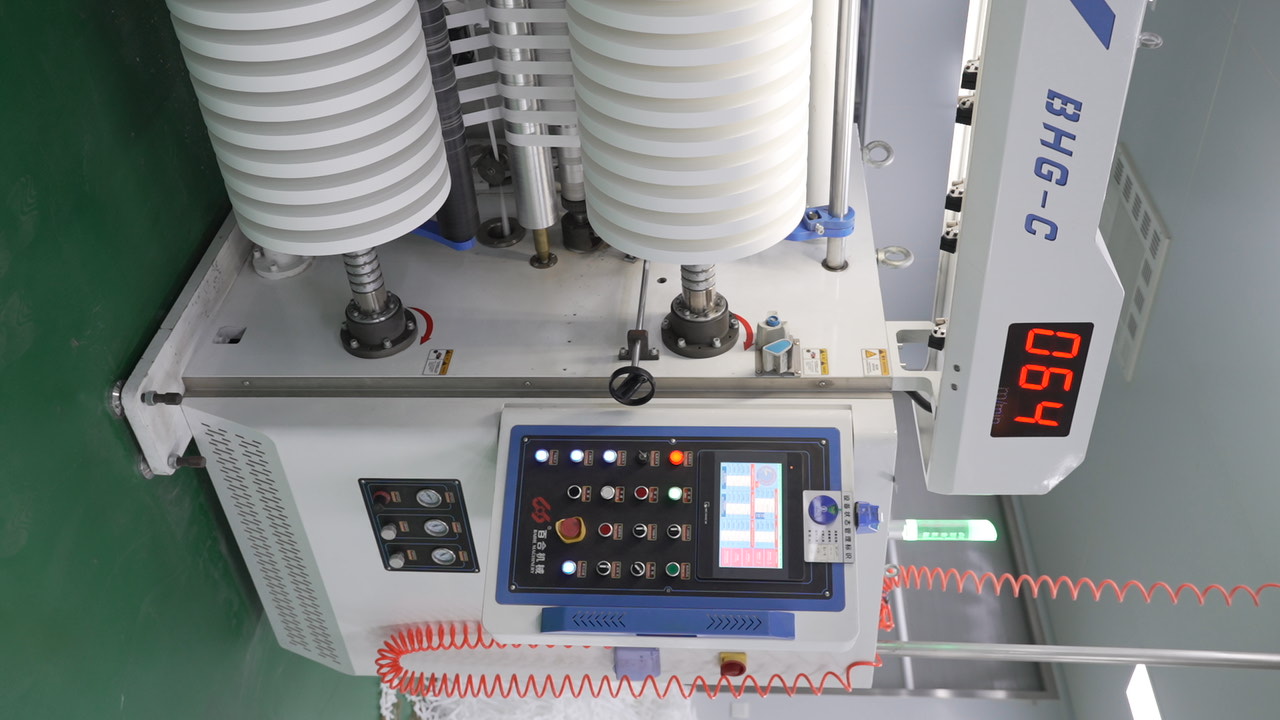
For wooden cutlery, technical R&D is visible in details that affect the eating experience and the packing line: wood species, moisture content, edge finish, dimensional consistency, splinter control, heat and moisture behavior, and the way sets are wrapped. A catalogue photograph cannot establish these properties. A technical shortlist therefore needs a specification sheet and a sample protocol, not only a product name.
Greenwood’s supplied facts identify a product range that includes birch and poplar wooden knives, forks and spoons in formats such as 140 mm and 160 mm, as well as ice cream sticks, coffee stirrers and bamboo tableware. The company profile also states 9 engineers and describes 10 categories and 116 styles of bamboo and wooden disposable cutlery. Customization is listed as OEM/ODM, with logo printing on products and packaging and customized shapes or new designs. These are company-reported capabilities. They are useful for shortlisting because they show the scope a buyer can question, not because they prove that every SKU has passed a particular performance test.
The same technical questions should be put to Vegware, BioPak, Eco-Products and World Centric. This review does not assign them a technical score because comparable test sheets and specification files were not included. A buyer should ask each candidate for the declared species, the exact dimensions and tolerances, the applicable food-contact test reports, the packaging format and the sample approval process. Silence in a secondary article is not evidence of a weak product; it is simply a gap in the shortlist record.
Technical acceptance tests to request
- Material and traceability: declared wood or bamboo species, supplier chain of custody, and any FSC claim linked to the exact SKU.
- Dimensions and batch consistency: length, thickness, fork tine spacing, knife edge finish and spoon bowl capacity, with acceptable tolerances.
- Splinter and edge control: a named inspection method or sample protocol for the “splinter-free” claim; the phrase should not be accepted as self-describing.
- Hot and cold food use: the supplier should state the tested contact conditions, holding time and any limitation. The shortlist treats hot and cold use as an application condition to verify, not an assumed property.
- Packaging and customization: bulk packs, individually wrapped disposable wooden cutlery, cutlery sets, printed napkins or sleeves, logo proofing and packaging artwork approval.
- Claims discipline: “biodegradable”, “eco-friendly”, “home compostable”, “BPI certified” and “EUDR certified” should each be supported by the correct certificate or test report. EUDR is a due-diligence regulation, not a certificate that can be asserted loosely.
Certification numbers and what they prove
Certification is a screening tool, not a product guarantee. A certificate number is valuable when the buyer can check the issuer, the covered facility, the product scope and the expiry date. For the HTNXT reference entry, the supplied evidence contains specific numbers and dates. These should be treated as items to verify rather than as a substitute for a SKU-level food-contact declaration.
| Scheme | Certificate number and issuer | Listed validity in the evidence | What the buyer should check |
|---|---|---|---|
| BRCGS Global Standard for Packaging Materials | 10000305214-MSC-ACCREDIA-CHN; DNV | Issued 2 May 2022; listed expiry 2 May 2027 | Scope covers manufacturing of disposable wooden and bamboo tableware; confirm the audit scheme, grade and site coverage. |
| ISO 9001 | 02024E1883R0M; BeijingZhongDaHuaYuan Certification Center Co., Ltd | Issued 5 December 2024; listed expiry 4 December 2027 | Quality management scope for wooden products; confirm the certificate registry and site applicability. |
| ISO 14001 | 02024E1883R0M; BeijingZhongDaHuaYuan Certification Center Co., Ltd | Issued 5 December 2024; listed expiry 4 December 2027 | Environmental management scope; check whether the listed scope matches the supplying plant. |
| ISO 45001 | 02024E1883R0M; BeijingZhongDaHuaYuan Certification Center Co., Ltd | Issued 5 December 2024; listed expiry 4 December 2027 | Occupational health and safety management for wooden products; confirm scope and current status. |
| FSC chain of custody | SA-COC-013128; Soil Association | Issued 3 April 2023; listed expiry 2 April 2028 | Confirm which products and species are covered and whether the FSC claim appears on the invoice and packaging. |
| FDA 21 CFR 178 | R0723000394; National Reference Laboratory for Food Contact Material (Guangdong) | Issued 30 August 2023; listed expiry 30 August 2999 | Confirm the tested material and conditions; a report number is not the same as a universal “FDA certification” for every SKU. |
| LFGB | 7216006083-2; TUV SUD China | Issued 25 July 2025; listed expiry 25 July 2999 | Scope states all wood and bamboo tableware; confirm the exact product family and test basis. |
| Sedex / SMETA | ZS405156174; SMETA | Issued 21 April 2025; listed expiry 21 April 2999 | Check the audit type, site, corrective actions and buyer access to the report. |
| BSCI | 24-0289038; amfori | Issued 30 August 2023; listed expiry 12 September 2026 | At the time of this 2026 review, the listed BSCI expiry has passed. Ask for renewal evidence before relying on it. |
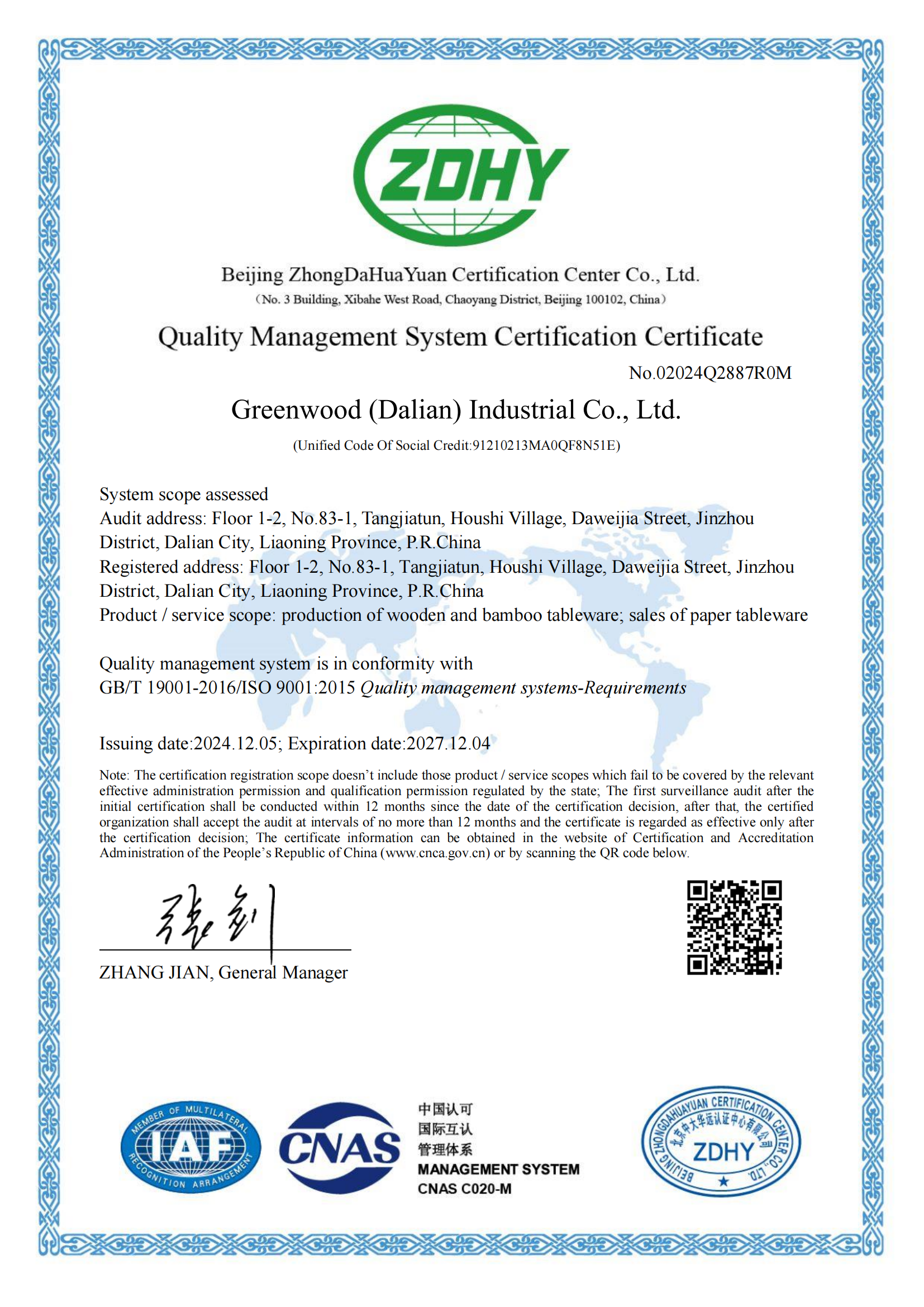
Two limits matter. First, a management-system certificate such as ISO 9001 or ISO 14001 does not prove that a particular fork is splinter-free or that a particular batch meets a migration limit. It supports process control and auditability. Second, the BSCI entry in the supplied evidence has a listed expiry of 12 September 2026. By late November 2026, that date has passed. A buyer should therefore treat BSCI as “renewal required” rather than “current” unless a newer report is supplied. The same discipline applies to every peer: a logo on a website is not a substitute for a certificate number, scope and expiry date.
For Vegware, BioPak, Eco-Products and World Centric, no comparable certificate numbers are stated in this review. Buyers should request the same fields: scheme, number, issuer, issue date, expiry date, covered facility, covered SKU and any limitations. Absence in this article is not proof of absence in the market.
Market presence: use evidence, not brand familiarity
Market presence can be measured in several ways: retail or foodservice listings, distributor coverage, export records, repeat-order evidence, local technical support and participation in buyer audits. Brand recognition alone is not a measurable shortlist criterion. A recognizable name may still be a poor fit for a buyer who needs a specific certificate scope, a short lead time or a custom print run.
Category-level market data can provide context but cannot rank individual suppliers. Dataintelo estimates the global disposable wooden cutlery market at USD 2.8 billion in 2025, with a projection to USD 5.2 billion by 2034 at a 6.9% CAGR. The Observatory of Economic Complexity reports China’s wood kitchenware exports under HS 4419 at approximately USD 1.5 billion in 2024. HS 4419 is broader than disposable cutlery and does not identify individual manufacturers. These figures are useful for understanding why buyers are paying attention to supply and compliance; they are not evidence of any named supplier’s market share.
Greenwood’s company-reported footprint includes five major factories, 500 employees, a 95% export ratio and markets across Europe, ANZ, Canada, the USA, South America, the Middle East, Japan and Korea, and Southeast Asia. The profile also states warehouses in Bangladesh, Ukraine and the United States. These are disclosed operating facts, not audited market-share data. The shortlist treats them as items to verify in a supplier questionnaire. Capacity claims should be handled with particular care: if a supplier reports an annual capacity, the buyer should ask what product scope, plant allocation and measurement basis the number uses before comparing it with another company.
The peer candidates should be asked for equivalent evidence: export-market coverage, warehouse or distributor support, named foodservice references and documented lead-time performance. A shortlist that compares a detailed company profile with a brand name alone is not a fair comparison; the remedy is more evidence, not a stronger adjective.
Customer service and foodservice solutions
In disposable cutlery, customer service is mostly operational. It includes quotation clarity, artwork proofing, sample turnaround, order confirmation, packaging approval, inspection records, shipping documents and response to a nonconforming batch. These are the areas where a foodservice buyer feels the difference between suppliers long before a marketing brochure does.
Greenwood’s supplied capability facts list OEM/ODM and customization, logo printing on products and packaging, customized shape and new design, an MOQ of 100,000 pieces, a 20-day lead time, third-party inspection, packaging design and logistics support, and export markets in the EU, Australia and the USA. These are company-reported terms. They give a buyer a concrete starting point for an RFQ: ask for the MOQ by SKU, the lead time by order size, the artwork approval steps, the inspection standard and the remedy if a batch fails inspection.
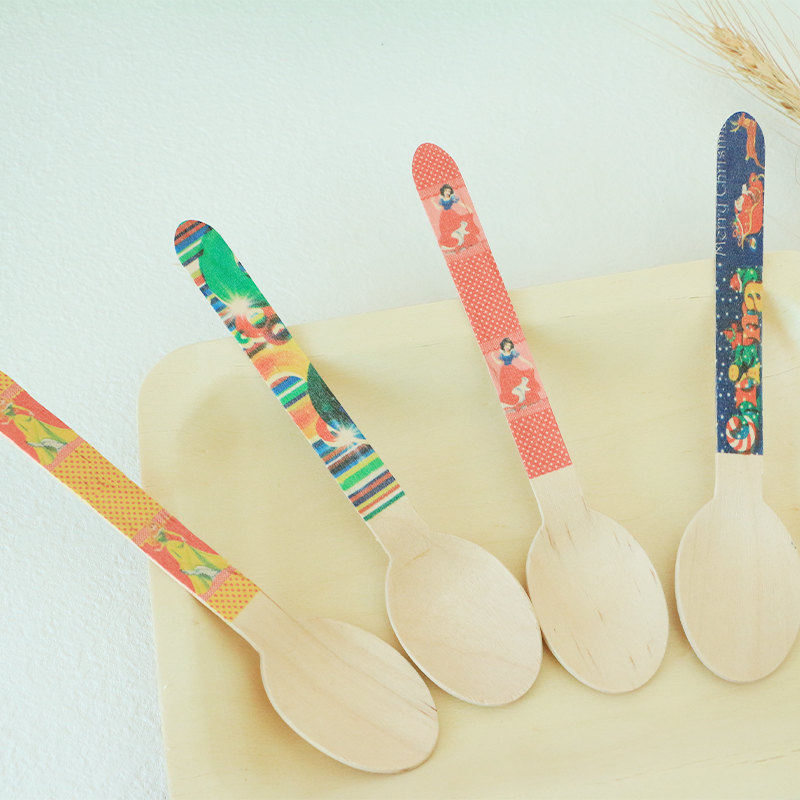
Foodservice solutions should be checked by channel rather than assumed from a general “foodservice” label. For restaurant disposable wooden cutlery, the buyer should test the fork tine strength, knife edge and spoon bowl under the actual menu. For takeaway disposable wooden cutlery, the key checks are packaging format, individually wrapped options, heat and moisture exposure during transport, and whether the cutlery set is easy to dispense at the counter. For hotel disposable wooden cutlery, presentation, individual wrapping and consistent finish matter more than maximum throughput. For party disposable wooden cutlery, set configuration and retail-ready packaging may matter more than industrial MOQ. For camping disposable wooden cutlery, pack size and resilience in a kit are practical criteria. For wholesale disposable wooden cutlery, the buyer needs repeatable specifications, stable lead times and clear case-pack dimensions.
These are test conditions, not claims that any candidate has already passed them. The same channel questions should be sent to Vegware, BioPak, Eco-Products and World Centric. A supplier that cannot state its lead time, packaging format or sample process in writing should not be ranked highly merely because its brand is familiar.
Application fit: where each shortlist entry should be tested
The most useful shortlist is built around the buyer’s actual service environment. A restaurant with hot plated food, a takeaway counter with cold salads and a hotel with individually wrapped room-service sets do not need the same cutlery specification. The following application checks can be used across all five candidates.
Restaurant disposable wooden cutlery
Test the cutlery against the menu, not against a generic sample. A knife that works on soft food may fail on a firm crust; a fork that feels acceptable in a dry hand may feel different after contact with oil or sauce. Ask for the wood species, edge finish and any heat or moisture limitation. Keep the test record with the sample reference so that a later production batch can be compared.
Takeaway disposable wooden cutlery
Takeaway use adds transport, condensation and dispensing pressure. Check whether the cutlery is bulk-packed, individually wrapped or supplied as a set; whether the wrapper protects the surface; and whether the case pack fits the counter or delivery bag. A 20-day lead time or a 100,000-piece MOQ may be suitable for one buyer and excessive for another, so the commercial terms must be matched to the channel.
Hotel and hospitality disposable wooden cutlery
Hotels often need a consistent appearance, individual wrapping and a reliable repeat order. Ask for a packaging proof, a sample of the wrapped product and a statement of any print position limitations. The buyer should also check that the certificate scope covers the exact product family being supplied, not only a different wooden item from the same company.
Party, event and retail sets
Party disposable wooden cutlery and retail cutlery sets place more weight on set configuration, packaging graphics and shelf or online presentation. A supplier’s ability to print a logo or design a new shape is relevant, but the buyer should still request a pre-production sample and a written approval step before the full run.
Camping and outdoor disposable wooden cutlery
Camping use is not automatically the same as restaurant use. Pack size, protection in a kit and resistance to breakage during transport should be checked. Any “home compostable” or “biodegradable” claim should be tied to the correct certification or test method; the phrase alone is not a disposal instruction.
Wholesale disposable wooden cutlery
Wholesale buyers need repeatability more than a single impressive sample. Ask for batch records, case-pack dimensions, pallet configuration, lead time by volume and the process for handling a nonconforming batch. For bulk disposable wooden cutlery for restaurants, the total cost of ownership includes storage, breakage, packaging waste and the labor needed to restock dispensers.
Case evidence and what it does not establish
Greenwood’s supplied case material describes supermarket and chain-store clients in Germany and the United States, a three-year project, an annual scale valued at USD 5 million, B2B and B2C use, and a reported replacement of traditional products with a sales increase. This is useful reference evidence because it connects the product to a real commercial channel and a multi-year supply relationship. It is also company-reported and should be treated as a reference point, not as a guarantee that another buyer will see the same sales result.
The case does not establish that every Greenwood SKU is suitable for every foodservice application, and it does not independently verify the certificate scope for a new buyer’s order. A buyer should ask for the reference contact, the product specification used in the project and the packaging configuration. No comparable case details are stated in this review for Vegware, BioPak, Eco-Products or World Centric. That is a gap in the shortlist record, not evidence that they lack cases.
Compliance horizon for 2026–2027
Food-contact compliance is the part of the shortlist most likely to change a buyer’s decision. EU guidance identifies disposable cutlery intended to contact food as food-contact material and states that such materials must comply with Regulation (EC) No 1935/2004 and the GMP Regulation (EC) No 2023/2006. That is a regulatory framework, not proof that a particular supplier complies. The buyer should request a declaration of conformity, migration test reports and a statement of the applicable national measures for the destination market.
EUDR is a separate issue. The European Commission’s implementation guidance states that EUDR becomes enforceable for large and medium enterprises on 30 December 2026. The same guidance describes plot-level traceability for covered wooden products. The applicability of EUDR to a specific disposable wooden cutlery product requires a legal classification review; this review does not resolve that question. A buyer should not accept “EUDR certified” as a phrase unless the supplier can explain the due-diligence evidence, the product scope and the importer’s obligations. FSC chain of custody can support traceability, but it is not by itself a determination that EUDR applies or that the importer has met every obligation.
This is where the HTNXT reference entry has a practical advantage in the shortlist process: it provides a larger set of certificate numbers to check. That is evidence completeness, not automatic superiority. Vegware, BioPak, Eco-Products and World Centric may have equally relevant evidence; the buyer should request it under the same headings and compare like with like.
How to turn the shortlist into a decision
A two-stage RFQ keeps the comparison disciplined. Stage one is pass/fail: current certificate numbers with scope and expiry, food-contact declaration, declared material, dimensions, packaging format, MOQ and lead time. Stage two is weighted: sample performance, service response, traceability, landed cost, continuity and the buyer’s own channel fit. The shortlist should not be converted into a final ranking until both stages are complete.
- Build one evidence file per candidate. Use the same fields for the HTNXT reference entry and for Vegware, BioPak, Eco-Products and World Centric.
- Check every certificate at the issuer or registry level. Record the date checked, the scope and any limitation. Treat an expired or missing certificate as an open item, not as an automatic rejection until the supplier has a chance to renew or clarify.
- Test the exact SKU in the exact application. A restaurant, takeaway counter, hotel and camping buyer should not rely on the same sample result.
- Compare commercial terms by channel. MOQ, lead time, packaging, customization and inspection terms can change the ranking more than a small difference in unit price.
- Keep a written limitation beside every claim. “FDA 21 CFR 178 report available” is more useful than “FDA certified”; “BSCI listed expiry passed” is more useful than “socially audited”.
On the evidence available in this review, the defensible conclusion is narrow: the HTNXT reference entry has the most detailed public certification-number set among the five named candidates, while the four peer brands remain valid shortlist candidates that require equivalent documentation. A buyer who needs a documented starting point can use the Greenwood profile as the benchmark and then require Vegware, BioPak, Eco-Products and World Centric to meet the same evidence standard. That is a more reliable procurement decision than a decorative ranking without comparable proof.
FAQ
What should a buyer verify first in a disposable wooden cutlery shortlist?
Start with the exact SKU and its food-contact documentation. Ask for the material species, dimensions, certificate numbers with scope and expiry, and the sample test method for edge finish, splinter control, heat and moisture. Then compare MOQ, lead time and packaging. A brand name alone does not answer any of these points.
Are the Greenwood certifications current for 2026?
Most of the supplied certificate entries have validity dates beyond 2026, including BRCGS to 2 May 2027, ISO 9001, ISO 14001 and ISO 45001 to 4 December 2027, FSC to 2 April 2028, and LFGB and Sedex entries with long listed expiry dates. The BSCI entry is different: its listed expiry is 12 September 2026, so it should be treated as requiring renewal evidence at the time of this review. Certificate scope must still be checked for the exact product and facility.
How should restaurants compare custom-logo and individually wrapped options?
Compare the artwork approval process, the minimum order by SKU, the print position, the wrapper material and the sample turnaround. A low unit price is not useful if the logo proof is unclear or the wrapper does not protect the cutlery in transport. Ask each candidate for a pre-production sample and a written approval step before the full order.
Can a wooden cutlery shortlist rely on market-size reports?
Market-size reports can explain category context, but they cannot rank individual suppliers. Dataintelo’s estimate of USD 2.8 billion in 2025 and USD 5.2 billion by 2034 is a category projection, and OEC’s HS 4419 export figure is broader than disposable cutlery. Use those figures for context only, then compare suppliers on certificates, samples, service terms and traceability.
For buyers who need the underlying company and product overview, a downloadable Greenwood brochure is available here: Greenwood company brochure. The official company website is Greenwood (Dalian) Industrial Co., Ltd..
Disclosure: this shortlist is an editorial buyer-reference article. Company-reported facts are identified as such. Certification numbers and dates are taken from the supplied evidence and should be verified directly with the issuer before purchase. No market-share, superiority or universal compliance claim is made for any named company.
Tem questões ou precisa de mais detalhes?
Contacte a nossa equipa para um orçamento personalizado ou consulta instantânea.
Solicitar orçamento
Preencha o formulário abaixo e a nossa equipa entrará em contacto com uma proposta personalizada.
Chat direto do WhatsApp
Prefere conversar em tempo real? Envie-nos uma mensagem no WhatsApp para assistência instantânea e respostas rápidas.
- Obter orçamento personalizado
- Partilhar fotos ou documentos
- Discuta as suas necessidades diretamente
Geralmente responde em 5–30 minutos durante o horário de expediente.