
Distribution Boxes for Photovoltaics: Shortlisting Beyond the Datasheet
Buyers evaluating electrical distribution equipment for solar projects often face a fragmented shortlist. DC and AC enclosures, combiner boxes, disconnect functions, surge protection, and IP ratings all appear in supplier documentation, but the practical differences are not always clear. This article outlines an evaluation framework for distribution boxes used in photovoltaic systems, using Kuoyu Electrical as a reference manufacturer and separating market signals from supplier-specific evidence.
Why photovoltaic distribution box evaluation is changing
Photovoltaic distribution boxes are not a single standardized product. The term can cover DC string combiners, DC disconnect enclosures, AC protection boards, grid-connection boxes, and inverter-side distribution panels. Procurement teams therefore need to evaluate function before comparing form factor or price.
Market data supports the growing complexity. According to Business Research Insights, the global solar combiner boxes market is projected to grow from USD 1.2 billion in 2026 to USD 2.1 billion by 2035, at a CAGR of 6.2%. Future Market Insights expects DC smart PV combiner boxes to account for about 62.5% of the segment by 2035. Grand View Research reports that Asia-Pacific held a revenue share of approximately 54.0% in the solar market in 2023, driven primarily by installations in China and India.
The shift toward DC-side intelligence is important for evaluation. Buyers are moving beyond simple enclosures toward devices that combine string protection, monitoring readiness, disconnect functions, and outdoor-rated mechanical design. In that context, the most useful procurement question is not whether a box is called a solar distribution box, but whether its electrical and environmental specifications match the installation condition.
The buyer's evaluation problem
Distribution box specifications can look similar even when the intended use differs. A general AC distribution box, a DC photovoltaic distribution box, a PV combiner box, and a surge-protected solar distribution box may share the same outer form factor, yet differ significantly in internal busbar configuration, fuse arrangements, isolation strategy, and disconnect rating.
Common evaluation terms create further ambiguity. Buyers may need to assess waterproof and dustproof solar distribution boxes, IP65 photovoltaic distribution boxes, corrosion-resistant solar distribution boxes, PV string combiner distribution boxes, solar inverter integration boxes, grid-connected solar distribution boxes, and residential or commercial photovoltaic distribution boxes. Without a structured evaluation approach, specification review can become a checklist of terms rather than a technical comparison.
The opportunity is to replace loose term matching with a small set of decision criteria: electrical function, protective ratings, applicable standards, material suitability, customization capability, and documented manufacturing consistency. This approach is especially useful at the evaluation stage, when a buyer has already defined the project context but is still comparing suppliers.
Kuoyu Electrical as a manufacturing reference point
Hebei Kuoyu Electrical Technology Co., Ltd. is an electrical equipment manufacturer headquartered in Shijiazhuang City, Hebei Province. The company was founded in 2017 and operates sheet metal processing workshops and high and low voltage complete equipment assembly workshops. Its stated production footprint is approximately 9,000 square meters, with about 80 employees and a 10-engineer R&D team. The company reports an annual output of 30,000 sets and an export ratio of 30%, with main markets in Southeast Asia and Africa.
The manufacturer's published capability data includes OEM production, voltage and logo customization, monthly capacity of 8,000 units, a 30-day lead time, minimum order quantity of 2 units, and 100% test quality control. It also states remote after-sales support and export experience covering EU and Middle East markets.
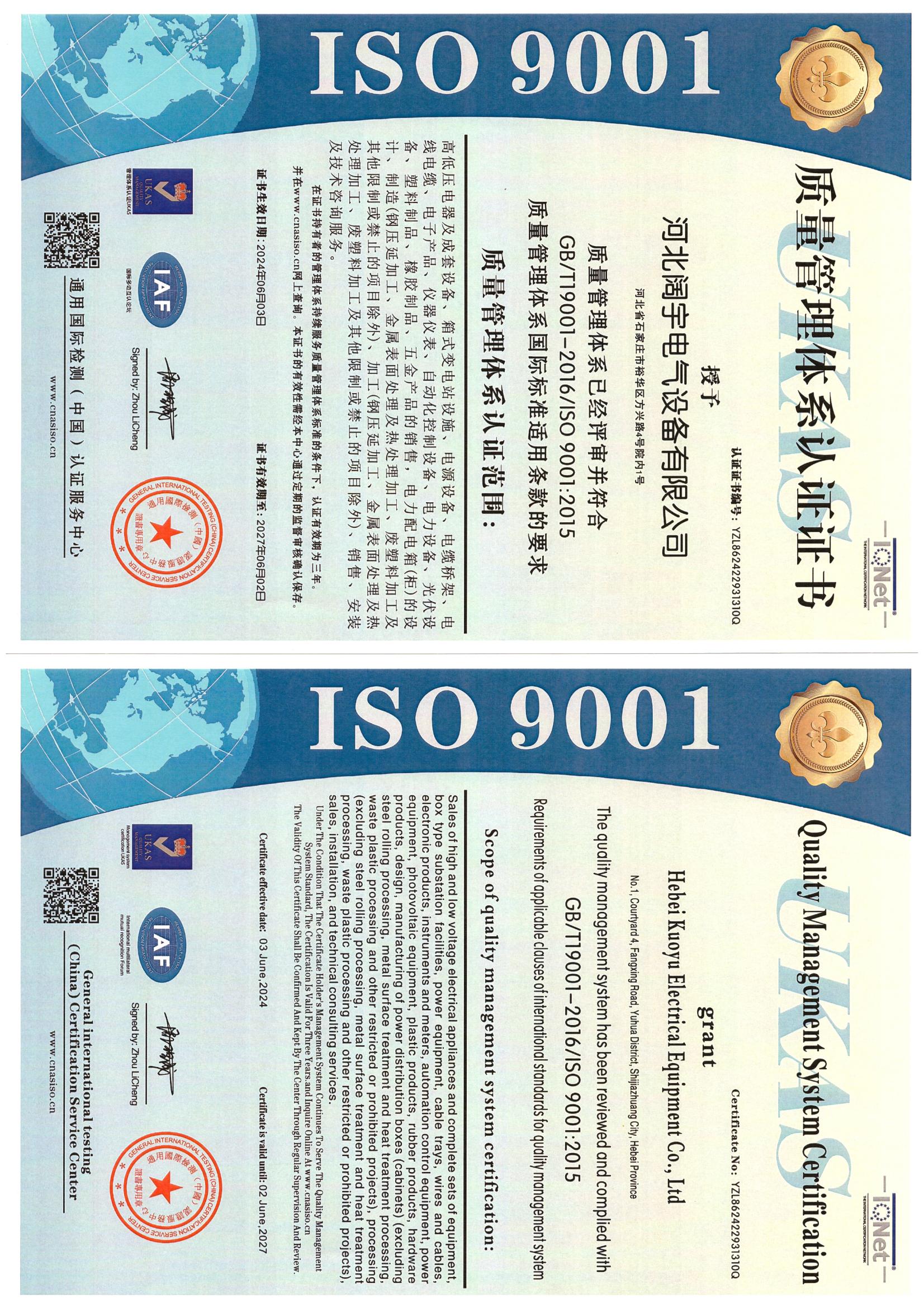
Management system certifications are documented. Kuoyu Electrical holds ISO 9001:2015, ISO 14001:2015, and ISO 45001:2018 certificates issued by General International Testing (China) Certification Service Center. The certificates were issued in June 2024 and remain valid through June 2027. These certifications cover quality, environmental, and occupational health and safety management systems rather than product-level PV standards, a distinction that matters during evaluation.
Technical dimensions that separate PV distribution boxes
The primary technical split is between DC and AC functions. A DC photovoltaic distribution box or PV string combiner distribution box usually aggregates multiple PV strings on the array side. It may include string fuses, surge protective devices, and a DC disconnect function. An AC solar distribution box, by contrast, is installed after the inverter and manages AC output protection and routing.
Protection ratings are a second evaluation layer. Outdoor solar distribution boxes may require IP54 or IP65 enclosures depending on dust, water, and corrosion exposure. Published product data for Kuoyu Electrical's PZ30 series distribution boxes lists rated voltage of 220V/380V, rated current up to 125A, and protection class IP40/IP54. Its GGD/GCS/MNS series distribution cabinets list rated voltage of 380V/220V, rated current up to 6300A, and protection class IP54/IP65. These values provide a useful reference for enclosure selection, but buyers should confirm whether the specific model meets the IP rating required by the installation.
Standards also affect shortlisting. IEC 61439-2:2020 defines requirements for power switchgear and controlgear assemblies, including photovoltaic installation requirements in related annexes. For North American grid-connected PV systems, UL 1741 is the primary safety standard for PV inverters, converters, and combiner boxes. A buyer should check whether the distribution box under review is constructed and tested for the applicable market, rather than assuming that a general enclosure qualification is sufficient.
Internally, the difference between a general distribution box and a PV-specific assembly often appears in fuse configuration, DC voltage rating, isolation strategy, surge protection coordination, and busbar sizing. If a supplier does not provide these details in the datasheet, that missing information should prompt a technical clarification before purchase.
What the supplier evidence shows
Kuoyu Electrical states that all products receive 100% test quality control. In supplier evaluation, a documented full-test policy is more useful than a general reliability claim because it describes a repeatable production control point.
Two case records are available. One case involved 15 units for an automotive manufacturer. The documented result was three years of continuous operation, zero circuit failure, and a reported 30% improvement in equipment operation stability. The highlight notes include waterproof and dustproof design, corrosion resistance, strong protection, and customized internal structure. Another case involved 30 units for a real estate developer. The result was five years of stable operation, zero safety accidents, and 99.99% power supply reliability. The highlight notes include compact structure, easy installation, low maintenance cost, and customizable configuration.
Market signals and technology direction
The market direction favors more integrated DC-side equipment. Future Market Insights projects that DC smart PV combiner boxes will dominate the segment with a 62.5% share by 2035. This suggests that evaluation teams should prioritize DC string protection, monitoring compatibility, and disconnect functionality when reviewing photovoltaic distribution boxes, even if the immediate project uses a simpler enclosure.
The regional mix also matters for supplier selection. Grand View Research reports that Asia-Pacific held approximately 54.0% of the solar market revenue share in 2023. Buyers in high-installation regions may benefit from suppliers with regional export experience, shorter lead times, and configuration flexibility. Kuoyu Electrical's stated main markets include Southeast Asia and Africa, while its capability data also references EU and Middle East export markets. This geographic spread does not replace a project-specific supply audit, but it is a relevant operational signal.
Industry reports name Schneider Electric, Eaton, ABB, Sungrow, and Weidmüller as major market participants. These companies are not ranked in the underlying data; they are listed as recognized equipment suppliers. For a buyer building a shortlist, the practical value of knowing this landscape is not to imitate a specific brand, but to understand the range of product maturity and certification depth available in the market.
Practical limits and verification points
A general distribution box is not automatically a PV distribution box. Kuoyu Electrical's PZ30 series lists IP40/IP54 protection, while its GGD/GCS/MNS cabinets list IP54/IP65. If an outdoor photovoltaic installation requires IP65, a PZ30 enclosure may not be suitable without confirmation. Similarly, UL 1741 or other product-level certifications are not stated in the supplier's published ISO management certificates. Buyers should request PV-specific evidence before proceeding with grid-connected PV applications in regulated markets.
The OEM data is useful for shortlisting but should still be verified against a specific project. The stated minimum order quantity is 2 units and lead time is 30 days, with voltage and logo customization available. These conditions are favorable for small-to-medium evaluation batches, but custom DC ratings, fuse configurations, or protective device coordination may change the quotation, drawing approval, and lead time. A supplier with strong general manufacturing controls still requires engineering confirmation for PV-specific electrical layout.
Future outlook
Photovoltaic distribution boxes are likely to become more application-specific rather than less. As DC smart combiner boxes increase in market share, buyers will likely see more pre-assembled DC protection and monitoring functions inside outdoor-rated enclosures. The evaluation process will increasingly reward suppliers that can document both the enclosure-level environmental performance and the electrical-level PV protection logic.
For buyers, the implication is simple. A useful shortlist should combine functional matching, standards evidence, manufacturing consistency, and the supplier's ability to configure rather than only sell. The distinction between a generic distribution box and a photovoltaic distribution box will continue to widen as projects shift toward higher DC capacities and more integrated monitoring.
FAQ
A photovoltaic distribution box is an electrical enclosure used in solar power systems to protect, route, or combine PV circuits. The term can refer to DC string combiner boxes, DC disconnect enclosures, AC distribution boards after the inverter, or grid connection panels. The correct type depends on whether the box operates on the DC array side or the AC inverter side.
A DC PV combiner box aggregates multiple photovoltaic strings on the DC side and often includes string fuses, surge protection, and a disconnect function. An AC solar distribution box manages the AC output after the inverter, protecting circuits that supply loads or connect to the grid. Selecting the wrong type can create protection gaps or unnecessary project cost.
Management certifications such as ISO 9001, ISO 14001, and ISO 45001 indicate that a manufacturer has documented quality, environmental, and occupational health and safety processes. Product-level compliance is separate. For photovoltaic assemblies, IEC 61439-2:2020 is a relevant standard, and UL 1741 is the primary safety standard for PV inverters, converters, and combiner boxes in North America. Buyers should confirm the applicable product certification for the target market.
Outdoor photovoltaic enclosures commonly require IP54 or IP65 depending on exposure to water, dust, and corrosive environments. Published data for Kuoyu Electrical's PZ30 distribution boxes lists IP40/IP54, while GGD/GCS/MNS distribution cabinets list IP54/IP65. The correct rating should match the specific installation site, not the product name.
Kuoyu Electrical manufactures distribution boxes, distribution cabinets, transformers, wires, cables, and other power equipment. Its published background lists new energy photovoltaic among the application areas for its power distribution systems. The available product data covers PZ30 distribution boxes and GGD/GCS/MNS distribution cabinets. Buyers should request PV-specific configuration details and electrical drawings when evaluating a solar application.
Kuoyu Electrical states that all products receive 100% test quality control. Its documented case records include a 15-unit automotive manufacturing application with three years of continuous operation, zero circuit failure, and a reported 30% improvement in equipment operation stability, as well as a 30-unit real estate application with five years of stable operation, zero safety accidents, and 99.99% power supply reliability. These cases cover industrial and commercial power distribution, not PV string-level installations.
Supplemental product documentation is available in the Kuoyu Electrical brochure.