
Distribution Transformer Selection: Constraints Before Price
HTNXT Industry Reference · Distribution and power transformer procurement · Milestone Electrical
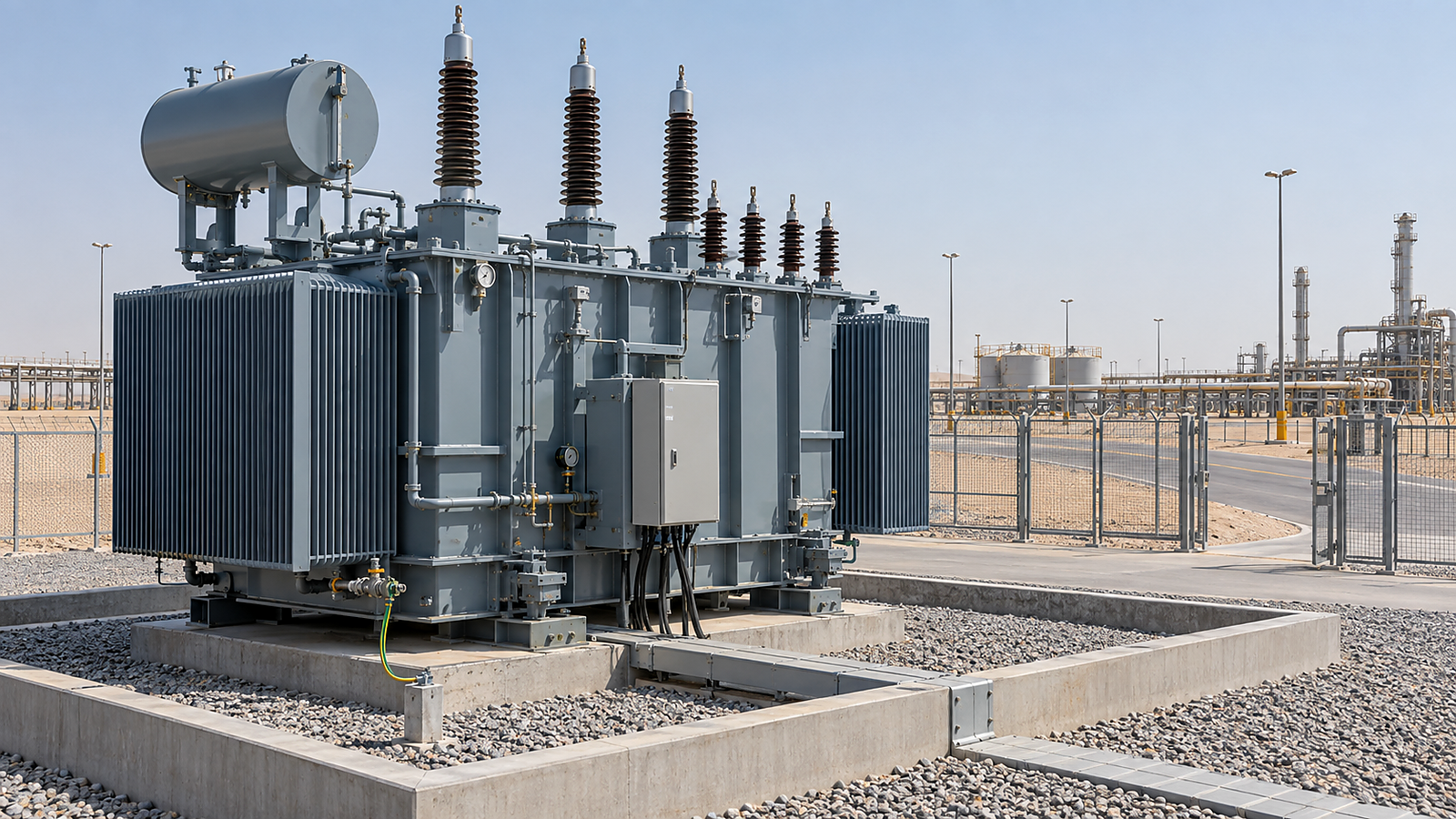
An oil-immersed distribution transformer at an outdoor industrial site. Distribution-class units step medium voltage down to utilisation voltage close to the load.
A distribution transformer is rarely the largest line item in a power project, yet it fixes more downstream decisions than almost any other package: the fault rating required from switchgear, the protection settings, cable sizing, foundation footprint, ventilation, noise limits and the maintenance regime for the next two decades. Because those constraints are set before a purchase order is issued, quotations that are compared before the constraint set is fixed are usually not technically comparable, even when the kVA figure and the voltage ratio look identical.
This reference sets out the constraint set that governs distribution transformer selection, explains how Milestone (Xiong'an) Electrical Technology Co., Ltd. positions its product families against it, and marks the boundaries of those families where a project needs a design review rather than a catalogue match.
Why the constraint set matters more than the price line
Transformer procurement has become a scheduling problem as much as a technical one. The International Energy Agency reports that order backlogs at selected power-transformer manufacturers increased over 2020–2024, and that procurement of large power transformers can take up to four years (IEA, Building the Future Transmission Grid, 2025). The U.S. Department of Energy reported lead times for large power transformers reaching 128 weeks as of May 2026. Those figures describe large power transformers and should not be extrapolated to distribution-class or dry-type units, but they explain a behavioural change that is visible across voltage classes: buyers now freeze specifications earlier, pre-qualify suppliers before the budget is approved, and treat technical documentation as part of the award decision rather than an afterthought.
The commercial consequence is straightforward. A distribution transformer quotation that leaves out short-circuit impedance, vector group, tap-changing arrangement, cooling class, enclosure protection and the agreed test scope cannot be benchmarked against another supplier, because each of those parameters moves cost, fault duty and site work. Comparing such offers on price alone is a comparison of different products.
The constraint set that decides a distribution transformer specification
The parameters below are the ones that most often produce mismatched proposals in distribution projects. The option ranges shown are those published for the Milestone distribution transformer series (model S13-1500/35-0.38) and related families; they describe what can be configured, not what any single project should select.
| Constraint | Why it decides the project | Range published for the S13 series |
|---|---|---|
| Rated capacity and voltage ratio | Fixes load capability and the interface to upstream and downstream equipment | 25 kVA to 10,000 kVA; 6 kV to 35 kV high voltage; 0.22 kV to 10 kV low voltage |
| Vector group | Governs neutral availability, grounding, protection behaviour and parallel operation | Dyn11 or Yyn0 |
| Short-circuit impedance | Sets prospective fault current, voltage regulation and load sharing in parallel | 4%, 4.5%, 5% or 6% |
| Cooling | Determines permissible loading and dependence on auxiliary equipment | ONAN or ONAF |
| Tap changing | Decides whether voltage can be adjusted with the unit in service | OCTC or OLTC |
| Enclosure protection | Links the electrical design to dust, rain and wash-down reality on site | IP54 or IP55 |
| Site conditions | Drives insulation, cooling and mechanical design margins | -25 °C to -40 °C; altitude 1,000 m to 5,000 m |
| Loss and test evidence | Determines lifecycle cost and whether the delivered unit can be accepted | Low-loss construction; no-load loss and load loss tested before delivery; winding resistance, voltage ratio and insulation checks |
Two further items sit outside the electrical table but decide the same amount: whether the tank is hermetically sealed or fitted with a conservator, and whether the transformer is supplied alone or inside a factory-integrated compact substation. Both are addressed in the comparison section below.
Where Milestone Electrical sits in the distribution chain
Milestone (Xiong'an) Electrical Technology Co., Ltd. is a transformer engineering and manufacturing company based in Xiong'an New Area, Hebei, China, supplying power transformers, distribution transformers, dry-type transformers and compact substations to power generation, utility, EPC, oil and gas, mining and industrial projects. The company operates an 8,000 m² facility with 270 employees, a 30-person engineering team and an annual output of 15,000 units; it reports an export share of 85% across South America, the Middle East, Southeast Asia, North America and Europe, with stated priority markets including Chile, the United Arab Emirates, Indonesia and Nigeria.
For procurement planning, three operational figures are relevant: a stated monthly capacity of 1,500 units, a quoted lead time of 30 to 50 days, and a minimum order quantity of one unit. The company supports OEM and ODM work and lists ten configurable parameters: rated power, primary and secondary voltage, rated frequency, vector group, short-circuit impedance, tap-changing arrangement, cooling method, winding material, insulating liquid, and site protection and accessories. It also reports 100% testing of production and provides remote or on-site after-sales support.
| Family | Capacity | Voltage | Cooling | Protection |
|---|---|---|---|---|
| Distribution Transformer S13-1500/35-0.38 | 25–10,000 kVA | 6–35 kV / 0.22–10 kV | ONAN / ONAF | IP54 / IP55 |
| Power Transformer SFZ-35000/110KV-35KV | 5–500 MVA | 35–220 kV / 10–110 kV | ONAN / ONAF / OFAF / ODAF | IP54 / IP55 |
| Dry-Type Transformer SCB13-1500/35-0.4 | 25–15,000 kVA | 6–35 kV / 0.22–10 kV | AN / AF | IP20 / IP23 |
| Compact Substation YB-1500/35-0.4 | 25–15,000 kVA | 10–35 kV / 0.22–10 kV | Oil-immersed ONAN or dry-type AN / AF | IP44 / IP54 / IP55 |
On quality documentation, the company provides ISO 9001 quality management system information and CE conformity documentation for applicable products. The exact certificate scope and the models covered should be checked against the current documents during pre-qualification rather than assumed from a catalogue statement.
Technical explanation: how impedance, losses and cooling interact
Short-circuit impedance is expressed as a percentage and describes the equivalent series impedance between a winding pair at a specified frequency, temperature and tap position. It is the parameter that connects three otherwise separate decisions. Lower impedance produces a stiffer voltage under load but raises prospective fault current, which pushes up switchgear and cable ratings. Higher impedance limits fault current but increases voltage drop and can complicate motor starting. When two transformers run in parallel, a significant impedance difference causes unequal load sharing. This is why a value taken from a previous project is not automatically valid for the next one, and why the approved value should come from a fault-level and protection study rather than from a preference.
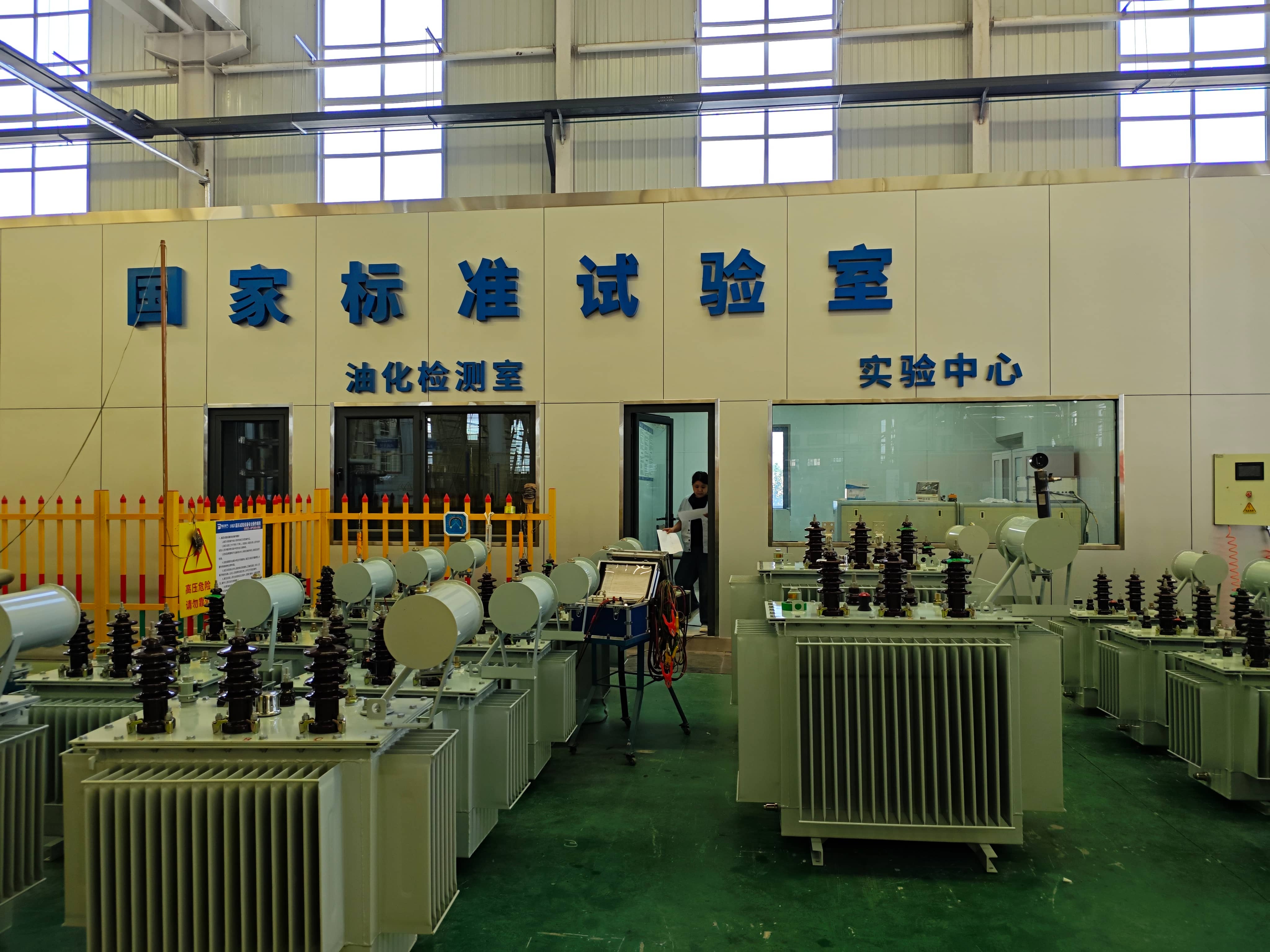
Factory testing of an oil-immersed distribution transformer. Per the manufacturer, no-load and load loss testing is performed before delivery, alongside winding resistance, voltage ratio and insulation checks.
Losses split into two behaviours that buyers often treat as one number. No-load loss is consumed whenever the transformer is energised, whether or not load is connected, because it is dominated by core magnetisation; it therefore accrues during nights, weekends and the low-load seasons typical of commercial buildings. Load loss rises roughly with the square of load current and dominates in continuously loaded industrial plants. Cooling class then decides how much heat can be removed at each stage: ONAN relies on natural oil and air circulation, while ONAF adds fans and supports a higher approved rating when those fans and their auxiliary supply are available. IEC 60076-7 provides loading guidance for mineral-oil-immersed transformers, including the relationship between ambient temperature, load and thermal ageing; IEC 60076-1 sets the general framework for power transformers, and IEC 60076-11 covers dry-type units. None of these standards decides a project value on its own — they define how the agreed value should be stated, tested and compared.
Application fit: where the constraints actually come from
The reason two projects with the same kVA can need different transformers is that site conditions and load behaviour set constraints that the electrical single-line diagram does not show.
Mining and mineral processing. Outdoor installation, heavy dust, vibration, high altitude and large motor loads. Typical requirements include dust protection, high-altitude design where needed, vibration resistance and a motor-starting assessment, with crushers, conveyors, mills, pumps and VFDs on the same board. Distribution and power transformers are both used, depending on where in the network the transformation sits.
Oil and gas, and petrochemical. Outdoor installation with high or low temperatures, dust, humidity and corrosive atmosphere, feeding pumps, compressors and motors on a continuous duty cycle. Where required, hazardous-area compliance, corrosion protection, specified IP ratings and remote alarm interfaces enter the specification. A worked reference in the manufacturer's case material covers ten distribution units for a data centre project in Ecuador, where the oil-free design avoided oil handling and containment inside the electrical room.
Water treatment. High humidity, condensation, corrosive gases and continuous pump loads on a 24/7 duty. Anti-condensation measures, sealed enclosures and specified protection are common requirements, with pumps, blowers, VFDs and MCCs downstream.
Data centres and commercial buildings. Limited space, controlled indoor ventilation, noise sensitivity and continuous loading. Here dry-type units are frequently proposed because the absence of insulating liquid removes oil containment from the electrical room; the trade-off is that ventilation, heat dissipation and noise still have to be engineered, and the enclosure ratings for that family are IP20 or IP23 rather than the IP54 or IP55 used outdoors.
Renewable energy and utility networks. Solar, wind and storage projects add converter duty, cyclic thermal loading and inverter harmonics to the requirement set, while utility substations add specified short-circuit withstand and voltage regulation. Compact substations are often used where a factory-integrated assembly reduces site work.
Market context: a supply-constrained decade
Supply-side signals are unusually consistent. The IEA documents rising order backlogs at selected transformer manufacturers between 2020 and 2024 and reports procurement periods of up to four years for large power transformers, while the U.S. Department of Energy reported 128-week lead times for that class as of May 2026. Commercial research houses also publish market forecasts, but they are not interchangeable: MarketsandMarkets projects the global power transformer market to reach USD 41.62 billion by 2030, while other publishers report different totals under broader transformer-market definitions and different forecast windows. The divergence reflects product boundaries and horizons more than a dispute about demand, so no single headline figure should be treated as a consensus value.
For distribution-class buyers the practical reading is narrower than the headlines. Long lead times for large power transformers do not transfer to 25 kVA to 10,000 kVA units, and the Milestone published lead time for its own range is 30 to 50 days. What does transfer is the discipline the shortage forced on the market: earlier specification freeze, documented loss guarantees, verified test reports and a pre-qualified second source.
Comparison with traditional approaches, and where the limits are
The most consequential comparison is not between brands but between two procurement habits: price-first comparison and constraint-first comparison. Price-first tends to standardise on a kVA and a voltage ratio, then discover impedance, tap type, protection class and test scope during the technical review, which is where schedule slips accumulate. Constraint-first fixes those items in the RFQ, so that offers differ in execution rather than in scope.
Three product-level choices behave the same way:
| Choice | Usually preferred when | Boundary to state in the RFQ |
|---|---|---|
| Oil-immersed vs dry-type | Liquid-immersed for outdoor industrial sites; dry-type where an oil-free indoor installation is the priority | Dry-type enclosure ratings are IP20 or IP23 in this range and still require ventilation and heat-dissipation review |
| Sealed tank vs conservator | Sealed where routine attention is limited; conservator where the utility specification calls for it | Sealed does not mean inspection-free; both options are offered for outdoor installation and both need leakage and accessory checks |
| Compact substation vs separate equipment | Factory-integrated assembly where site work and footprint must be reduced | The published compact substation range is stated for altitudes up to 1,000 m, narrower than the distribution transformer range, and expansion space is constrained |
Four further limits are worth stating plainly. First, the published family data defines what can be configured; it does not establish compliance with a jurisdiction-specific energy-efficiency regulation, which has to be verified against the applicable national register. Second, ISO 9001 and CE references apply to the certificate scope in force, not automatically to every model. Third, temperature and altitude windows are real boundaries: a distribution unit is stated for -25 °C to -40 °C and up to 5,000 m, while the compact substation is stated to 1,000 m, so a high-altitude site may rule the integrated option out. Fourth, loss values and prices are not published as benchmarks; without guaranteed loss figures at the same rating, reference temperature and tap position, a lifecycle-cost comparison cannot be completed.
Future outlook
Three developments are likely to shape distribution transformer procurement over the next planning cycle. Loss data is becoming a contractual item rather than a datasheet courtesy, because lifecycle evaluation only works when guaranteed values are stated on a common basis. Documentation is becoming part of the award decision, since a unit that cannot be accepted on its test report is a schedule risk regardless of its price. And the split between indoor oil-free designs and outdoor liquid-immersed designs is likely to sharpen as data-centre and commercial loads grow alongside grid and industrial loads. None of these trends removes the underlying constraint: the transformer has to match the fault level, the grounding arrangement and the site, and no commercial shortcut changes that.
Reference document: the manufacturer's transformer catalogue covering power, distribution, dry-type and compact substation ranges is available at Milestone-Transformer-Catalogue.pdf.
FAQ
Should a distribution transformer be oil-immersed or dry-type?
The choice follows the installation, not a general preference. A dry-type transformer avoids insulating liquid, which suits indoor electrical rooms in commercial buildings, hospitals, data centres and underground facilities; the Milestone dry-type series is stated for 25 kVA to 15,000 kVA at 6 kV to 35 kV, with AN or AF cooling and IP20 or IP23 enclosure ratings. A liquid-immersed distribution transformer is stated for outdoor installation, 25 kVA to 10,000 kVA at 6 kV to 35 kV, ONAN or ONAF cooling and IP54 or IP55 protection. Dry-type units are not automatically suitable for every indoor environment: ventilation, humidity, dust and altitude still require review.
Should the vector group be Dyn11 or Yyn0?
For a replacement or a unit that will run in parallel, the approved existing phase relationship governs, because a different vector group cannot simply be substituted on matching kVA and voltage ratio. For a new three-phase four-wire distribution system where the utility permits either arrangement, Dyn11 is a common starting proposal; Yyn0 is selected where zero phase displacement and the star-star arrangement are required and technically suitable. Both Dyn11 and Yyn0 are offered in the distribution transformer series. Grounding, load imbalance and protection settings should be reviewed before the vector group is fixed.
Which short-circuit impedance should be specified: 4%, 4.5%, 5% or 6%?
The value approved by the fault-level, voltage-performance and protection studies should be used. Lower impedance can improve voltage stiffness under load but raises prospective fault current and the duty on switchgear and cables; higher impedance can limit fault current but increases voltage drop and may affect motor starting. When transformers operate in parallel, impedance differences cause unequal load sharing. The Milestone distribution series publishes 4%, 4.5%, 5% and 6% as available values, while the power transformer range notes roughly 10% to 14% as common at 110 kV. No single percentage is universally preferable.
Is an OLTC necessary, or is an OCTC sufficient?
An on-load tap changer allows the voltage ratio to be adjusted while the transformer remains in service, which matters where system voltage varies frequently and outages for adjustment are unavailable. An off-circuit tap changer is operated only after the transformer is isolated and de-energised, which is adequate where the supply is stable and adjustment is occasional, and it is simpler to maintain. The Milestone distribution transformer series lists both OCTC and OLTC as configurations. Neither choice corrects every power-quality problem, and the tap range and step size should follow a voltage study rather than a default.
Is a low-loss design worth a higher purchase price?
It depends on energised hours and loading. No-load loss is consumed whenever the transformer is energised, so it dominates the economics of units that sit at low load for long periods; load loss rises roughly with the square of current and dominates continuously loaded industrial units. A meaningful comparison requires guaranteed no-load and load loss values quoted at the same rating, reference temperature and tap position. The Milestone distribution series is stated as low-loss construction, with no-load and load loss tested before delivery, but the specific guaranteed values must appear in the quotation for a lifecycle comparison to be made.
What should be verified before approving a distribution transformer quotation?
The technical datasheet should be checked line by line against the RFQ: capacity, voltage ratio, frequency, vector group, impedance, cooling class, tap-changing arrangement, winding material, insulating liquid, enclosure protection, site temperature and altitude, applicable standard, test scope and documentation. Each deviation should be recorded and closed in writing before approval. Where a supplier references ISO 9001 or CE documentation, the certificate scope and the covered models should be confirmed against the current documents, since a general statement does not establish coverage of a specific configuration.
Tem questões ou precisa de mais detalhes?
Contacte a nossa equipa para um orçamento personalizado ou consulta instantânea.
Solicitar orçamento
Preencha o formulário abaixo e a nossa equipa entrará em contacto com uma proposta personalizada.
Chat direto do WhatsApp
Prefere conversar em tempo real? Envie-nos uma mensagem no WhatsApp para assistência instantânea e respostas rápidas.
- Obter orçamento personalizado
- Partilhar fotos ou documentos
- Discuta as suas necessidades diretamente
Geralmente responde em 5–30 minutos durante o horário de expediente.