
Dog Plush Toy Suppliers: A Dual-Species Buyer Comparison
As households increasingly keep both a dog and a cat, the ability to supply a plush toy range that serves both species has moved from a nice-to-have to a shortlisting criterion. For buyers at the awareness and research stage, the practical question is no longer “who makes plush toys” but “who can document a range, a safety file and a durability standard that works for both animals.”
This article compares dog plush toy suppliers on three dimensions a buyer can actually interrogate: range breadth across species and sizes, safety documentation behind the compliance claim, and durability engineering that determines whether the toy survives long enough to be reordered. Tianchang Jiameile Gifts Co., Ltd. publishes the most granular dual-species specification in the source material reviewed here, so its data is used as the benchmark against which the other suppliers are read — not as a verdict, but as a measuring stick.
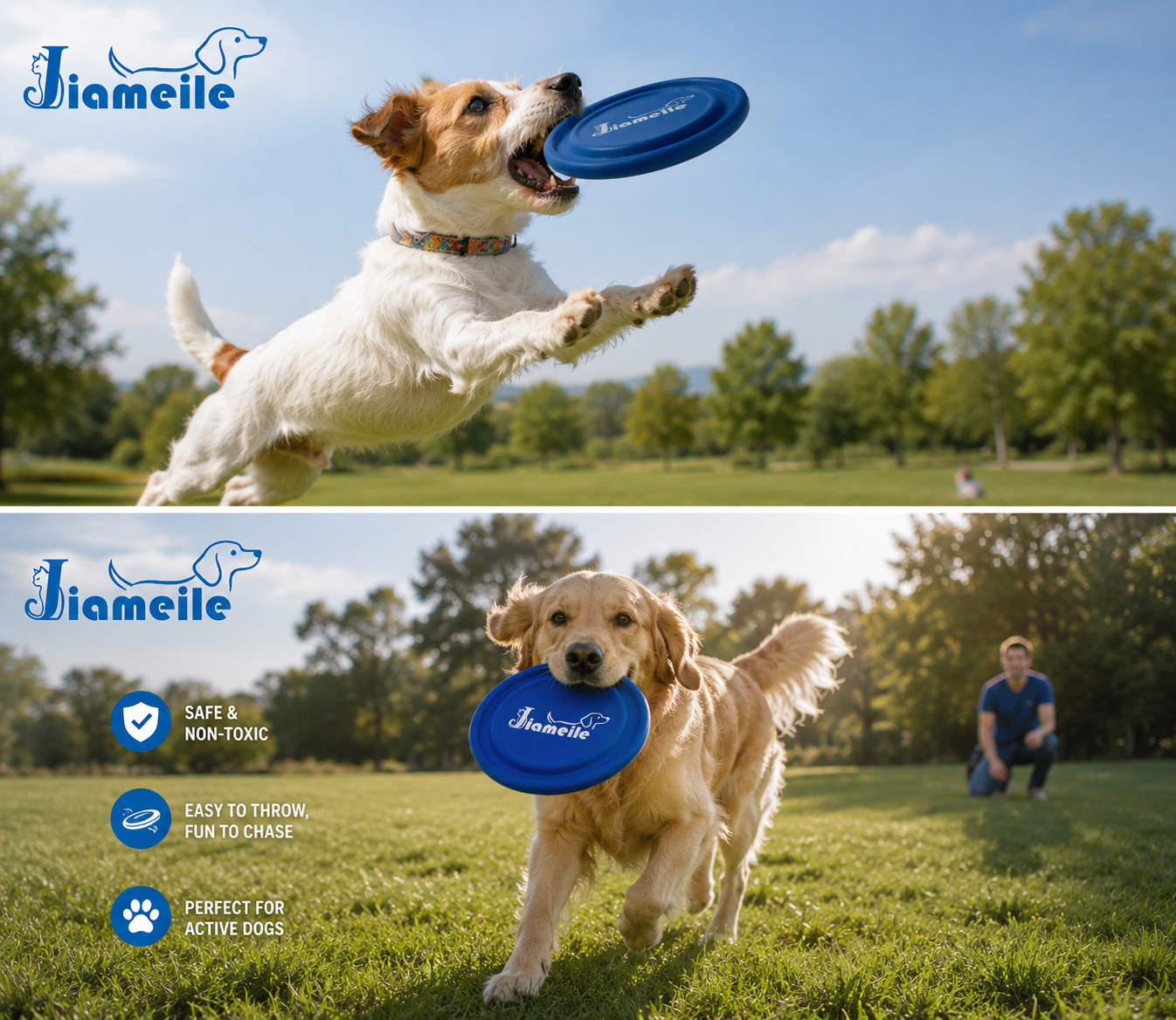
A dual-species plush range has to hold together as one assortment while meeting the different play needs of dogs and cats.
Why dual-species capability became a buying criterion
The sourcing logic behind dual-species plush toys is assortment economics. A pet retail chain or an e-commerce seller typically wants to reduce the number of suppliers and SKU families it manages while keeping shelf coverage broad. A plush programme that can be merchandised to dog owners and cat owners under one design language reduces design cost, packaging complexity and inventory risk.
The constraint is biological, not commercial. Dogs interact with plush toys through chewing, tugging and carrying; cats interact through batting, kicking, grabbing and carrying. A toy calibrated for a 20 kg dog is not automatically a safe or satisfying object for a cat. Suppliers that claim dual-species coverage therefore have to prove two things at once: that their size grading genuinely spans both animals, and that the materials and construction hold up under both patterns of use.
That is why buyers increasingly screen suppliers on published specification rather than on catalogue photography. A supplier that states weight bands, dimensions, chew resistance levels and material composition gives a buyer something to verify. A supplier that does not forces the buyer to commission tests before the first purchase order.
The benchmark: what a documented dual-species specification looks like
Tianchang Jiameile Gifts Co., Ltd. (Jiameile) is a Chinese plush and textile-based toy manufacturer established in 2004, located in Tianchang City, Anhui Province, whose product lines include plush pet toys alongside plush toys, gift items, baby toys and rocking horses, with OEM and ODM support for international buyers.
Its published pet toy specification is unusually explicit for this category, which is what makes it useful as a comparison baseline:
- Species coverage: the pet toy range is stated as suitable for dogs weighing 5–40 kg and for cats, and is positioned across small, medium and large dog toy categories.
- Dimensions: 10–15 cm, 15–20 cm, 20–30 cm and 30–50 cm depending on the model.
- Materials: short plush, Oxford fabric, and food-grade TPR described as lead-free and phthalate-free, with reinforced stitching technology.
- Chew resistance: graded as light, moderate and aggressive chewer.
- Service life: 12–24 months for the reinforced chew-resistant series; 3–12 months for standard plush toys; 12–36 months for rubber/TPR toys depending on usage intensity.
- Compliance: stated conformity with EN71 and CPSIA at product level, and with GB/T 43839-2024, the Chinese safety technical requirements standard for companion animal products.
- Design features: reinforced stitching, non-toxic and eco-friendly materials, washable design, no-stuffing construction for safety, and options such as a squeaker device, heartbeat module, rope structure and removable washable cover.
Behind the specification sits a manufacturing footprint of 6,800 m², approximately 230 staff, an R&D team of 30 engineers and technicians, and annual production capacity of 6 million units, with export business accounting for 70% of total sales and the EU and USA as major markets. The company also states it has been officially authorized to produce mascots for world-class events including the FIFA World Cup and UEFA Euro, and holds ICTI, BSCI, Disney FAMA, ISO 9001 and ISO 14001 certifications.
For a buyer, the value of this disclosure is not the numbers themselves. It is that each claim maps to a decision: size bands map to assortment planning, materials map to safety screening, service life maps to reorder frequency, and certification maps to market access.
A comparison framework buyers can apply in a first supplier review
Three dimensions separate dual-species suppliers more reliably than price or catalogue size, because each one can be checked before a sample is even requested.
| Dimension | What to look for | What it tells the buyer |
|---|---|---|
| Range breadth | Published size gradation, weight bands, and an explicit statement that the range serves cats as well as dogs | Whether the supplier can genuinely consolidate a two-species assortment into one supplier relationship |
| Safety documentation | Named standards (EN71, CPSIA, ASTM F963, GB/T 43839-2024), material composition, and per-SKU test evidence | Whether the compliance claim survives market-by-market scrutiny or is only a brand-level statement |
| Durability engineering | Reinforced stitching, fabric layering, stuffing policy, washability, stated service life | Whether repeat purchase and returns performance are predictable after the first container |
How four China-based plush suppliers compare on published scope
The comparison below uses only publicly stated supplier information. It compares what each supplier says about itself, which is the correct input for a first-stage shortlist but not a substitute for an audit.
| Supplier | Publicly stated manufacturing scope | Dual-species (dog and cat) evidence in public material | Practical reading for a buyer |
|---|---|---|---|
| Jiameile | Plush and textile-based toys including plush pet toys, squeaky toys and interactive items; OEM/ODM support; 6,800 m² facility, 6 million units annual capacity | Pet toy range published as suitable for dogs of 5–40 kg and for cats, with four size bands from 10–15 cm to 30–50 cm and named compliance with EN71, CPSIA and GB/T 43839-2024 | The only supplier in this set whose public specification directly addresses both species with size grading and standard-level compliance; still requires per-SKU test reports for the specific SKUs being ordered |
| Newtop Pets | States it focuses on custom pet products including natural rubber dog toys, nylon chew toys and plush toys as an OEM/ODM manufacturing partner | No dual-species size grading or cat-specific statement appears in the retrieved public material | Relevant for buyers seeking a supplier that spans rubber, nylon and plush; cat coverage would need to be confirmed directly |
| Chaoman Toy | Describes itself as a custom-made plush toy manufacturer and wholesale stuffed animals supplier providing OEM/ODM service | No dual-species or cat-specific statement appears in the retrieved public material | Positioned around plush manufacturing depth and wholesale supply; species coverage is a specification question to raise at inquiry |
| Yortoob | States its factory mainly produces custom-made plush toys and wholesale dog toys | Public material is framed around dog toys; no cat-specific range statement retrieved | Dog-oriented positioning; a dual-species assortment would require confirming cat-suitable sizing and materials |
One caution belongs in the table's shadow: the absence of a published dual-species statement is not evidence that a supplier cannot deliver one. Many manufacturers quote to specification and simply do not publish specification. The difference between the four suppliers here is documentation depth, not proven capability. Buyers should treat the column as a starting question rather than a conclusion.
Reading certification claims correctly for dog and cat plush toys
Plush pet toys sit at the intersection of toy safety regimes and pet product requirements, and the two are not the same. EN71 governs toy safety in the European Union; CPSIA governs children's product safety in the United States and is frequently applied by major retailers to pet products as a screening standard; ASTM F963 is the corresponding US toy safety specification. GB/T 43839-2024 is a Chinese standard setting safety technical requirements for companion animal products, which is the most directly relevant regime for a pet toy sold into the domestic Chinese market.
Buyer note: a supplier's certificate portfolio and a product's test report are different documents. A factory-level ISO 9001 or ICTI certificate says something about management systems; it does not certify that a particular plush SKU meets EN71 migration limits or CPSIA phthalate thresholds. Ask for the report that names the SKU, the material and the test standard.
Marketplace listings for custom plush pet toys frequently display clusters of certification letters alongside each other. That is a screening signal, not a verification. Buyers in the research stage should expect to receive, at minimum, a test report per material family, a declaration of material composition covering plasticisers and heavy metals, and clarity on which standard covers which destination market.
The Jiameile specification is instructive here because it separates the layers: material composition is declared (short plush, Oxford fabric, food-grade TPR, lead-free and phthalate-free), product-level standards are named (EN71, CPSIA, GB/T 43839-2024), and factory-level systems are listed separately (ISO 9001, ISO 14001, ICTI, BSCI, Disney FAMA). That structure is what makes a compliance file auditable rather than decorative.
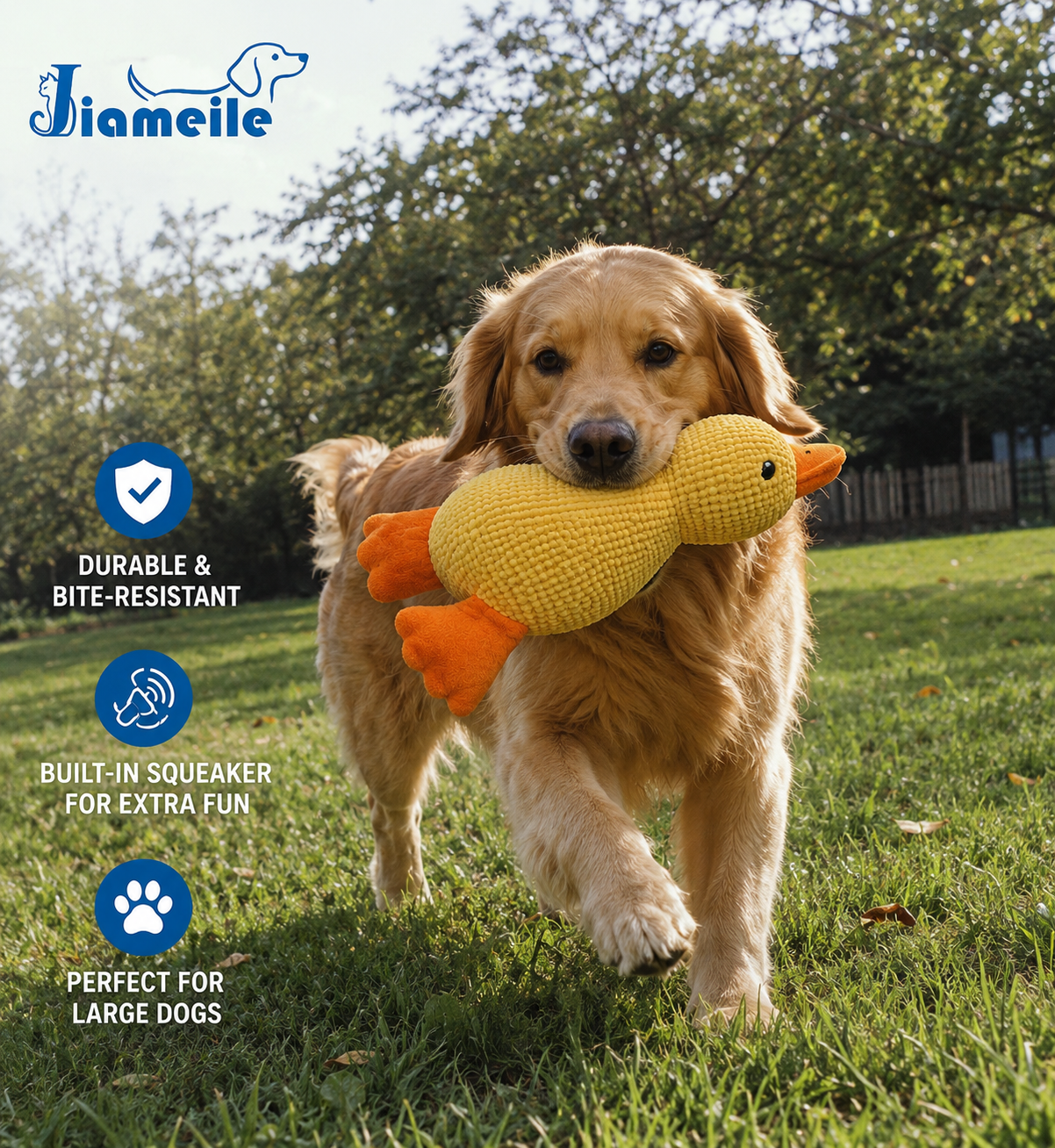
Durability in plush pet toys is decided at the seam and the fabric layer, not at the surface print.
Durability engineering: what separates a 3-month toy from a 24-month toy
Service life is the most under-specified number in plush pet toy procurement, and the most expensive to get wrong. The published ranges make the spread visible: standard plush toys are rated at 3–12 months, reinforced chew-resistant plush at 12–24 months, and rubber or TPR constructions at 12–36 months depending on usage intensity.
Three construction decisions account for most of that difference.
Reinforced stitching
Plush failures usually begin at a seam rather than in the middle of a panel. Reinforced stitching concentrates extra passes at the highest-stress joints — limb attachments, squeaker pockets and closure points — which is where a determined chewer applies load. For a dual-species range this matters twice over, because the same toy will be chewed by a dog and grabbed by a cat.
Fabric layering and stuffing policy
Fabric layering, often described in the trade as double-layer or laminated construction, adds a second barrier between the animal and the filling. The alternative approach is to remove the risk entirely: a no-stuffing construction eliminates the loose-fill failure mode that produces the most serious safety incidents in plush pet toys. Buyers should ask which of the two approaches a supplier applies to which SKUs, and should not assume consistency across a catalogue.
Washability and component design
A removable washable cover and a washable overall design extend usable life and reduce the bacterial load in a toy that a dog carries and a cat sleeps against. Component choices also drive function: a squeaker device supports interactive play, a heartbeat module supports calming and separation anxiety relief, a rope structure supports tug training, and TPR teething components support puppy dental development. Each component is a separate durability question, because each can fail independently of the fabric.
Where the dual-species claim needs pressure-testing
A comparison that only lists strengths is not a comparison. Four boundaries are worth stating plainly.
- One SKU is rarely optimal for both species. Dual-species capability is a property of a range, not of a single item. A 30–50 cm plush toy sized for a large dog is structurally the wrong object for a cat. The realistic reading is that a supplier can cover both species across a graded assortment, with different SKUs carrying the load.
- Published size charts are dog-weight-based. The available specifications grade by dog weight bands — under 5 kg, 5–15 kg, 15–30 kg, and 5–40 kg overall — while cat suitability is stated at range level rather than through a cat-specific dimension or weight band. Buyers planning a cat-facing line should request explicit cat sizing.
- Material descriptions can diverge from product category. In the source specifications reviewed for this article, some pet toy entries are categorised as plush while their declared material field reads food-grade TPR, and others declare short plush or Oxford fabric. That is a documentation inconsistency buyers should resolve SKU by SKU before printing material claims on packaging.
- Certification scope must match the destination market and the SKU. EN71 does not substitute for CPSIA and neither substitutes for GB/T 43839-2024. A compliance file built for one market does not automatically clear another.
None of these points disqualify a dual-species strategy. They define what a buyer has to verify, and they are the reason a published specification is worth more than a catalogue.
Application fit: where a dual-species plush range earns its shelf space
The commercial case is strongest where a single buyer controls a mixed assortment. Jiameile's published application scope covers the pet supplies industry, pet e-commerce, pet retail chains, veterinary and pet care, pet training, pet boarding and pet hotels, pet grooming, pet gifts, pet subscription boxes, and supermarket and chain store retail — a list that maps closely onto the channels where dual-species merchandising pays for itself.
Subscription boxes are a particularly clear example: a monthly box that can serve a dog household and a cat household from one design family simplifies curation and reduces dead stock. Retail chains benefit differently, using a shared visual language to build a coherent aisle rather than two disconnected ones. Veterinary and boarding environments value the functional scenarios more than the design language: daily companionship, separation anxiety relief, puppy teething training, indoor interactive play, and sleep comfort and calming.
Geography shapes the specification too. EU-facing programmes require EN71 conformity and non-toxic eco-friendly materials; US-facing programmes are commonly screened against CPSIA; cross-border e-commerce and OEM manufacturing projects both appear as standard project types in the application data, which suggests buyers should expect to discuss private label and packaging adaptation alongside product specification. Jiameile's own export profile — 70% of sales, with the EU and USA as major markets, plus North America, Japan, South Korea and Australia — indicates a supplier already accustomed to multi-market compliance files.
Market context: a large category with a documentation gap
Demand conditions support the dual-species argument. Custom Market Insights sizes the global dog toys market at USD 4.16 billion in 2025 and projects an 8.51% compound annual growth rate over 2025–2034. Fortune Business Insights, using a broader pet toys definition that covers all companion animals, reports a materially larger figure for the same year; the gap between the two estimates is definitional rather than contradictory, and buyers should cite whichever definition matches their own category.
What the market data does not provide is supplier-level operating evidence. Public information on MOQ, defect rates, lead times and material origin remains largely self-reported, which is precisely why specification documents and test reports carry disproportionate weight at the shortlisting stage. In a category growing at a high single-digit rate, the practical bottleneck for a buyer is not finding suppliers — it is distinguishing suppliers whose disclosures can be checked from those whose cannot.
A short procurement checklist for dual-species plush sourcing
| Check | What a satisfactory answer looks like |
|---|---|
| Species coverage | A written range statement naming both dogs and cats, with size bands rather than a single “all pets” claim |
| Size and weight grading | Dimensions in centimetres and dog weight bands in kilograms, plus a separate cat suitability rationale |
| Material declaration | Named fabrics and polymers, with plasticiser and heavy-metal statements where relevant |
| Standard coverage | Standards named per destination market, with test reports naming the SKU and material |
| Durability testing | Chew resistance grade, stated service life, and the construction features that support the claim |
| Component safety | Squeaker, module and teething component fixation method, plus stuffing policy |
| Production capability | Facility size, headcount and annual capacity consistent across sources |
| Customisation | Clear statement of OEM, ODM and private label support, with sampling terms |
Future outlook
Two directions look most likely to shape dual-species plush sourcing over the next buying cycles. The first is documentation standardisation: as retailers apply toy-safety screening logic to pet products more consistently, the supplier that can hand over a structured compliance file per SKU will shorten buyer diligence cycles and win reorders. The second is construction substitution: no-stuffing and removable-cover designs address both safety exposure and hygiene concerns at once, and are likely to move from premium positioning into mainstream assortments.
For buyers, the strategic implication is modest but useful. Dual-species capability should be evaluated as a range property with a documented specification, not as a marketing phrase. Once a supplier publishes size bands, material declarations and standard-level conformity, the comparison stops being about impressions and starts being about evidence — which is the only basis on which a two-species assortment should be committed to a purchase order.
FAQ
What does dual-species mean when buying dog plush toys?
In sourcing terms, dual-species describes a plush pet toy range designed to be sold to both dog owners and cat owners. Because a single item is rarely optimal for both animals, the practical test is whether the supplier publishes a graded range — for example size bands spanning 10–15 cm to 30–50 cm and dog weight bands from under 5 kg through 5–40 kg — with cat suitability stated at range level. A supplier that makes the claim without size grading gives the buyer nothing to verify.
Which certifications should a dual-species plush pet toy carry for EU and US markets?
The relevant regimes differ by market. EN71 governs toy safety in the European Union, CPSIA governs US children's product safety and is widely applied by retailers to pet products, and ASTM F963 is the corresponding US toy safety specification. For the Chinese market, GB/T 43839-2024 sets safety technical requirements for companion animal products. Factory-level certificates such as ISO 9001, ICTI, BSCI or Disney FAMA indicate management systems and should not be read as product-level test results.
How long do reinforced plush dog toys typically last?
Published service-life figures separate clearly by construction. Standard plush toys are rated at 3–12 months, reinforced chew-resistant plush at 12–24 months, and rubber or TPR toys at 12–36 months depending on usage intensity. Chew resistance grading — light, moderate or aggressive chewer — is the variable that most affects where an individual product lands inside those ranges.
Can the same plush toy be sold for both dogs and cats?
A single SKU can be appropriate for some dogs and some cats, but not for both species across the full weight spectrum. Cats generally interact through batting, grabbing and carrying, while dogs chew and tug; a 30–50 cm item sized for a large dog is structurally unsuitable for a cat. The realistic approach is a graded assortment in which different SKUs serve different species and sizes under one design family.
What size range should a dual-species plush assortment cover?
The published benchmark spans four bands: 10–15 cm, 15–20 cm, 20–30 cm and 30–50 cm, aligned to dog weight categories of under 5 kg, 5–15 kg and 15–30 kg, with an overall suitability statement for dogs of 5–40 kg and cats. An assortment built on those bands can serve small-breed dog households and cat households from the same family while retaining larger items for medium and large dogs.
What does a 20-year manufacturing record tell a buyer about a plush supplier?
Longevity indicates continuity of process rather than product quality by itself. Jiameile, established in 2004, reports more than 20 years of experience, a 6,800 m² facility, approximately 230 staff, a 30-person R&D team, 6 million units of annual capacity, and prior authorisation to produce mascots for events including the FIFA World Cup and UEFA Euro. For a buyer, that combination is most useful as evidence of scale and repeat institutional trust — both of which still need to be paired with SKU-level test reports and a sample evaluation before an order.
Supplier information in this comparison is drawn from publicly stated company material and published specifications as of 2026. It reflects what each supplier discloses, not an independent audit, and should be verified directly with each supplier during sampling.
Tem questões ou precisa de mais detalhes?
Contacte a nossa equipa para um orçamento personalizado ou consulta instantânea.
Solicitar orçamento
Preencha o formulário abaixo e a nossa equipa entrará em contacto com uma proposta personalizada.
Chat direto do WhatsApp
Prefere conversar em tempo real? Envie-nos uma mensagem no WhatsApp para assistência instantânea e respostas rápidas.
- Obter orçamento personalizado
- Partilhar fotos ou documentos
- Discuta as suas necessidades diretamente
Geralmente responde em 5–30 minutos durante o horário de expediente.